
Thou Mayest

“If thou doest well, shalt thou not be accepted? and if thou doest not well, sin lieth at the door. And unto thee shall be his desire, and thou shalt rule over him.” Genesis 4:7 (KJV)
Cathy Ames and the Woman Who Chose the Dark
Does it really work, this idea that women cannot be evil? Somewhere along the way our culture settled on a story that goes like this: goodness begins with acknowledging that men hurt women, and the harm never travels in the other direction. When a woman does something monstrous, we are taught to look past her hands and search instead for the man, the father, the system, or the wound that must have made her do it. But Scripture gives every one of us the same word God spoke to Cain when sin was crouching at his door. In John Steinbeck's East of Eden, that word is timshel. The old translations made it a promise, thou shalt, or a command, do thou, but Steinbeck understood the Hebrew to mean thou mayest. Thou mayest rule over it. The choice belongs to each of us, man and woman alike. I finally sat down and watched Netflix's new limited series East of Eden, and I was not surprised. Zoe Kazan, the granddaughter of Elia Kazan, who directed the 1955 film starring James Dean, took Steinbeck's novel and turned it into a cultural piece rather than grapple with the reality the book refuses to look away from. Women can be evil, and women can choose.
We do not need a novel to tell us so. We have watched the case of Lindsay Clancy in Duxbury, Massachusetts, a mother who took the lives of her three children. We live in a time when women stand at podiums and argue that ending the life of a child in the womb is a right, and we have watched copycats follow one another into tragedies that should have been unthinkable. Yet the culture keeps reaching for the same explanation, as if a woman's will were always something done to her and never something she exercised.
Steinbeck knew better. Cathy Ames is a sinner like the rest of us, but she is also vicious, mean, and cruel, and Steinbeck wrote her that way on purpose. As a child, she learned how to make others pay for what she wanted. She ruined the young teacher who desired her. She set fire to her parents' home with them inside it and walked away with their money. When she finally landed on Adam Trask's doorstep, beaten nearly to death by a whoremaster she had used and been used by, she found a man willing to give her everything: a home, a name, safety, and a way out of the darkness. She drugged him on their wedding night and went to his brother's bed. When her twin sons were born, she shot Adam and walked out, leaving both boys behind without a backward glance.
Even if you set aside her behavior and blame the brutality of men, even if you blame her father, the series cannot get around one fact. Adam opened the door, and she refused to walk through it. Over and over, from childhood forward, Cathy declined to dwell in the light. She preferred the darkness, and she strolled right into it every time it was offered to her as a choice.
Nowhere is this clearer than in what she did to Faye. Faye was the madam of a brothel in Salinas, a woman who took Cathy in, trusted her wholeheartedly, and came to love her as a daughter. Cathy repaid that trust by poisoning her slowly until she died, then took her house, her business, and her name off the door. Faye put her life directly into Cathy's hands, and Cathy closed them.
The life Cathy built afterward speaks to more than her wickedness. It speaks to her understanding of men and women who sell their bodies for silver and gold. As Kate, she played the same game countless men had played before her, trading in flesh, collecting secrets, photographing the respectable men of Salinas so she could own them. She enjoyed every minute of it. In that house she answered to no one, and she ruled it as its master.
And yet the series, told largely from Cathy's perspective, asks us to see her as a victim. Critics have noticed the shift. Where Steinbeck believed some monsters are born, Kazan leans on a childhood incident to suggest this one was made. In her final scenes, a woman who spent her life committed to self-interest and revenge is suddenly offered to us for sympathy, weeping as she swallows the poison she prepared for herself.
Here is what I find most striking. Steinbeck himself gave Cathy a kind of exemption. He described her as born without what the rest of us carry, a soul missing its conscience, the one character he placed outside the promise of timshel. So when I say she chose the dark again and again, I am holding her more accountable than Steinbeck did, and far more accountable than Kazan does. I believe that is the most biblical reading of all. Scripture does not excuse Eve because of the serpent, and it does not excuse Cain because his offering was rejected. God told Cain that sin was crouching at the door and that he could rule over it. Cathy heard the same knock her whole life, and she opened the door every time.
The same instinct shows up in how the series handles Lee, and here the change is quieter but no less telling. Steinbeck wrote Lee as a Chinese American servant in a California that despised him, and he never pretended otherwise. But Steinbeck let Lee answer that contempt with his own mind. Lee speaks a broken pidgin to strangers because that is what they expect from a man who looks like him, and when Samuel Hamilton sees through it, Lee drops the act and speaks in polished English. He explains, with a dry humor that cuts deeper than any lecture, that people would not understand him if he spoke properly. Steinbeck let the reader discover the racism through Lee's intelligence. Lee sees the prejudice clearly, works around it, and keeps his dignity on his own terms. He is the scholar of the household, the man who carries the word timshel to the Trasks, and the one who raises Adam's abandoned sons when their father cannot.
Kazan keeps the moment where Lee sheds his accent, and Hoon Lee plays it beautifully. But the series does not trust that moment to carry the weight. It brings the racism forward and presents it as culture, something to be condemned on screen so we know which side to stand on. The difference is nuanced but real. Steinbeck painted a picture of a culture and left the judgment to the reader. Kazan's version condemns the culture in a way that feels pushed down your throat. Kazan even wrote an eighth episode, which Netflix cut, following Lee to San Francisco in 1912 to chase his ambitions, and in the series it is the racism he meets there that forces him to give up his dream.
That is a significant departure. In the novel, Lee leaves to open his bookstore with Adam's blessing, and the two part on good terms. He comes back on his own, a short time later, because he misses the family he has given his life to. His return is an act of love freely chosen. In the series, the parting carries anger between the two men, and the failure of Lee's dream belongs to a society that would not let him have it. Once again a decision Steinbeck placed inside a person has been handed over to forces outside him. Cathy's cruelty gets explained by a wound. Lee's return gets explained by oppression. In both cases the series takes away the very thing Steinbeck's novel is about: thou mayest.
As an American descendant of slavery, I know something about living inside a culture that holds you in contempt. I also know that our ancestors did not let that contempt write the whole of their story. They chose, inside of limits no one should have imposed on them, how they would live, whom they would love, and what they would build. To reduce a man like Lee to what was done to him is to take from him the same dignity Steinbeck went out of his way to give him.
Then there is Adam. In the novel, Adam spends years in a fog after Cathy shoots him and leaves, half alive, unable even to name his sons. When he finally learns where she is, he goes to her house in Salinas and sits across from her in her room. She mocks him, tries to frighten him, and lays out her contempt for every decent thing he ever believed. And something breaks open in Adam. He sees her plainly for the first time, as she truly is, and her hold on him falls away. He walks out of that house a free man. It is one of the great moments of liberation in American literature, and it belongs to Adam. He chose clarity over the illusion he had loved, and that choice gave him back his life and, eventually, his sons.
The series takes that moment from him. Kazan's Adam carries a lingering love for Cathy even after he sees her, as though the woman who drugged him, betrayed him with his brother, shot him, and abandoned his children still deserves a place in his heart. I understand the impulse. It makes Cathy more tragic and her pull more powerful. But it costs Adam the one victory Steinbeck gave him. A man who could finally say no to the darkness is left still reaching for it. Here again the series refuses to let a character choose, and here again the person who pays for that refusal is the one who was harmed.
The last omission is the one that tells me the most about whose culture this series wanted to shine a light on. Steinbeck did not give Salinas a single brothel. He gave it a whole Row along Castroville Street, with three houses each serving a different kind of need. Jenny's was the loud one, full of music and laughter. Faye's was the motherly one, where boys and lonely husbands went for comfort. And the third house, the Long Green, was owned and run by a Black woman. Steinbeck never gives her a proper name. The town calls her by a slur, and so does he. But he does not make her a joke. Her house was the dignified one, the solemn one, where men went to be held in their sadness. She ran her business through decades of Salinas history, and when she died, Steinbeck paused his story to record a spare and quiet funeral. In 1952, a white novelist writing about turn-of-the-century California saw a self-made Black businesswoman and wrote her into the record.
Zoe Kazan, writing seventy years later with seven hours of television, a stated commitment to a more culturally aware retelling, and a story bookended by the Civil War, did not. The series expands Lee's story, invents an episode about the racism he faced in San Francisco, and builds its entire frame around a war fought over the bondage of my ancestors. Yet the one Black woman Steinbeck placed in Salinas, a woman who owned property and ran a business in an era when the nation barely counted her as a person, never appears. Steinbeck gave her a crude name and little interior life, but he saw her. The series, in all its eagerness to be aware, did not see her at all. That is what selective awareness looks like. It will condemn the culture of the past in the loudest possible voice and still leave American Blacks out of the room.
Timshel. Today I cannot help but feel that we are living in a world that wants to program us to believe the worst of men and boys and the best of women, no matter how cruel the woman. We are told, over and over, that women carry the most pain, endure the most abuse, and suffer the most oppression, and that whatever a woman does must be measured against what has been done to her. But that story does not hold up against the truth of Scripture or the truth of our own lives. We as women are subject to the same standard as every other human being. We live with the good and the bad in us, and we have a choice. Thou mayest. These days it seems many women are making the wrong choice, and yet we pretend that is not the case. We would rather rewrite Cathy Ames as a victim than admit that a woman can look at the light, understand exactly what it is, and walk the other way.
We do not have to look to Steinbeck to see what happens when a culture decides in advance who the villain must be. Consider the case the internet has named the Cornell 7. In October 2024, a twenty-year-old student went to the Chi Phi fraternity house in Ithaca, and what happened there involved several young men. She reported it to campus police that November. According to the Tompkins County District Attorney, her original statement described the drug use and sexual activity as voluntary and consensual. Her attorney disputes that, and the Governor has faulted the campus police for leaving out her statement that she was certain she had been raped. The men were investigated and none were charged. Cornell, in its own separate process, expelled and suspended students anyway. Nearly two years later, she filed a civil lawsuit alleging she was drugged and gang raped. Within weeks, celebrities were demanding arrests on social media. Florence Pugh, the very actress who plays Cathy Ames, was among the first to condemn them. Governor Kathy Hochul announced she had lost faith in the local district attorney and appointed Attorney General Letitia James as special prosecutor. As of this writing, none of the seven has been charged with a crime, and no evidence has been tested in any courtroom, yet seven young men have already been convicted in the only court that seems to matter anymore, the court of public opinion.
I do not know what happened in that house, and neither do the celebrities who have already pronounced judgment. That is precisely my point. There are two accounts of that night, and the question of which one is true belongs to evidence. If a woman's account is treated as settled truth before it is tested, while the men's account is dismissed before it is heard, then we have stopped believing that every person stands before the same standard. We have decided that a woman's word is righteous because she is a woman, and a man's guilt is presumed because he is a man. Justice requires evidence, and justice requires that everyone, woman and man alike, be held accountable for the choices they make.
That is the lesson Steinbeck understood and the series refused to learn. When God spoke to Cain, He offered him no excuse about his brother's favor. He warned him that sin was crouching at the door, and that he could rule over it. The same word is spoken to every one of us, and to every one of our daughters. Thou mayest. Whatever has been done to a woman, the question that remains is what she chooses to do next.
Here We Go Again
“Thou shalt not wrest judgment; thou shalt not respect persons, neither take a gift: for a gift doth blind the eyes of the wise, and pervert the words of the righteous.” Deuteronomy 16:19 (KJV) f
The midterms are weeks away, and American citizens are once again an afterthought
Here we go again. The midterm elections are only weeks away, and as a matter of fact, I have already received my assignment to work the polls on November 3. I was glad when I saw it. I had told myself I would not do it again, yet here I am, getting ready to go back down and sit at that table one more time. But as Election Day approaches, the rhetoric heats up right along with it. The language gets hotter, the accusations get louder, and the whole atmosphere starts to feel as though something is about to happen that will whip up enough fury to turn America's attention wherever the politicians want it. And of course, the hot topic since Donald Trump took office for the second time has been immigration: the crackdown on illegal immigration and the enforcement actions playing out in our communities.
I saw it for myself. I was on my way to drop my grandson off for a haircut when I noticed protesters standing along the side of the road, protesting ICE right here in South Jersey. There were not even that many of them, but there they were. And I thought to myself, I would be willing to bet that most of those protesters do not live in the communities they claim to be defending. They likely live farther out in the suburbs, yet they stand on our roadsides arguing to keep illegal immigrants in Camden County, in places like Lindenwold and Clementon, where the people who actually live there carry the consequences. We see these communities packed tight, and I do not believe the packing is an accident. Noncitizens cannot vote, but every one of them is counted in the census, and the census decides how many seats in Congress a state receives and how much federal money flows into a district. So who is speaking for the American citizens who live in these neighborhoods? Who is speaking for the families who have to absorb the cost of policies they never voted for?
This past week gave us a clear picture of where the Democratic Party's priorities lie, and it was not a good week for Democrats at all.
* * *
Start in Michigan. On October 8, Republican Mike Rogers and Democrat Abdul El-Sayed met in Grand Rapids for their first Senate debate, and Rogers towered over him. He went straight at the title El-Sayed loves to wear. "He's not really a doctor," Rogers said, adding that if El-Sayed tried to treat a patient, he would go to jail. El-Sayed does hold a medical degree from Columbia, but he chose public health over practice, and he has never held a medical license in Michigan or New York. He has spent his campaign calling himself a physician while never having practiced medicine outside the rotations he completed in medical school. Rogers also pressed him on a 2016 clip that resurfaced that week, in which El-Sayed said he held dual U.S. and Egyptian citizenship, even though his campaign had said otherwise. And Rogers charged that some of El-Sayed's donors support the Muslim Brotherhood, Hamas, Hezbollah, and al-Qaeda, accusations El-Sayed called lies. Those charges will be argued all the way to November, but the credentials and the citizenship are questions El-Sayed created for himself.
What stayed with me was Israel. Asked whether he would provide defensive weapons to Israel if it were attacked, El-Sayed said he does not want our tax dollars buying weapons for other countries. Asked again, he repeated it, and Rogers answered that this meant he would not even support the Iron Dome. Think about what that means. The Iron Dome is what stands between Israeli families and the rockets fired at them. Take it away and you leave a nation surrounded by enemies defenseless. This debate came one day after the third anniversary of October 7, 2023, when Hamas murdered some twelve hundred people, raped women, slaughtered children and infants in their homes, and dragged hostages into tunnels beneath Gaza. Three years later, a man who wants to sit in the United States Senate cannot bring himself to say he would help Israel defend itself from the next attack. He would rather spend that money, he says, on unconditional support for kids in our schools. That is the lie El-Sayed stands on, and a man with his education knows better. Under the agreement signed in 2016, most of the military aid America sends Israel, $3.3 billion a year plus $500 million for missile defense like the Iron Dome, comes as financing that Israel spends buying weapons from American companies, which means much of that money circles right back into American factories and American paychecks. And cutting it would not send one extra dollar to a classroom in Detroit or Flint. Foreign aid and school funding come out of entirely different pots, and most of what pays for Michigan's schools comes from Lansing and local taxpayers. Denying Israel its defense would not buy a single textbook in Michigan. It would only leave Israeli families more exposed to the next barrage of rockets. Somehow the children of Israel never seem to make his list, and the children of Michigan are only on it when he needs a line for a debate.
Then there was New York. On the evening of October 7, Mayor Zohran Mamdani attended a vigil in Union Square organized by Israelis for Peace to remember the victims of that day. He stood there stone-faced through the ceremony, looking for all the world like a man who did not want to be there, and the activists who once cheered him turned on him anyway. Several hundred pro-Palestinian protesters overran the space, waving Hamas and Hezbollah flags, forcing organizers behind police barriers, and calling the mayor a traitor. Earlier that same day, protesters had gathered outside City Hall to accuse him of abandoning their cause, and that night some of them rushed after him as he left. Remember that his own anniversary statement acknowledged the horrific war crimes of October 7 while once again accusing Israel of genocide. It did not matter. One evening spent standing with grieving Israeli families was enough for the far left to brand him a traitor. That is the coalition Democrats are building their future on, and it devours anyone who fails to go far enough. It reminded me of Russia in 1917, when crowds in the streets of Petrograd forced the tsar from his throne, and the revolution that followed went on to consume many of the very men who had led it. A movement that runs on rage never stops at its enemies. Sooner or later it turns on its own.
* * *
And then, the very next afternoon, came Marble Hill. On October 8, ICE agents moved to arrest Oscar Belgal, a 28-year-old Dominican national in this country illegally, as he sat in his SUV with his five-year-old son in the back seat. According to ICE, he refused orders to get out, smashed into two government vehicles, and then accelerated toward officers. One agent fired seven rounds, and a bullet struck Belgal in the neck below his left ear. The wound was superficial, and thank God the boy was not hurt. Within hours, protesters were clashing with police in the streets, Governor Hochul was demanding a halt to ICE enforcement in New York, and Mayor Mamdani called the agency rotten to its core and spent two hours on the phone pressing the President and the Secretary of Homeland Security to release the man. Those negotiations failed. The next day a federal judge blocked his deportation. It is as if illegal immigrants are being given an incentive to flee from ICE: the more damage done in the encounter, the more protection they can expect from federal judges.
Consider this. If you are an American citizen caught driving without insurance two or three times, you can eventually be arrested for it. The penalties depend on the state and on how many offenses you have, but repeat violations can lead to jail time. Miss your court date and a warrant can be issued for your arrest, and if an officer later runs into you, whether you are driving, walking, or simply going about your day, and finds that warrant, you are going to jail. As an American citizen, I cannot simply walk away from the law. Yet a man in this country illegally can run from federal agents, and the mayor of New York gets on the phone with the White House to try to negotiate his release. This was a man with a grand larceny conviction, a pending case for selling fentanyl, heroin, and cocaine to an undercover detective, alleged ties to the Trinitarios gang, and, according to the Secretary of Homeland Security, status as a target of the investigation into the shooting of a federal officer last year. Tell me if that is fair.
Now imagine that an American Black man was behind the wheel of that car with his five-year-old son in the back seat. He has a conviction on his record and pending drug charges, and the authorities have come to arrest him. Instead of stopping, he hits the gas, rams the officers' vehicles, and puts his own child in harm's way. Would we still be hearing the same argument? "ICE shouldn't have shot him. They should have known there was a child in that car." The agents say they did not know the boy was there. But the man driving knew. He knew exactly who was sitting behind him when he decided to run. And this was not his first time running. Agents tried to arrest him in September, and he got away. When people believe they can flee and be defended for it, that choice creates danger for the agents, for the child, and for everyone else on a crowded city street.
None of this means officers get a pass. New York's police commissioner says Belgal was pulling into a parking space when a plainclothes federal officer approached with his gun drawn, and seven rounds fired on a busy street deserve a full and honest investigation. The child was not responsible for his father's choices, and his safety should never have been an afterthought for anyone involved. But questioning the agents does not erase the decisions of the man who put his son in that car and stepped on the gas. Now let that have been an American Black man. He would be facing prison time. His child could be taken into custody, and he could lose that child altogether, all because he chose to run. Nobody would be calling the White House to negotiate his release. Nobody would be marching through the Bronx in his name. So how come illegal immigrants get treated better than American citizens? That is the question we should be asking. And if we truly believe in equal protection and due process, the answer has to apply to everyone, whatever their race, citizenship, or immigration status.
* * *
Put the week together and the pattern is hard to miss. In Michigan, a Democratic nominee who calls himself a doctor without a license cannot tell voters plainly whether he would help an ally defend its children from rockets. In New York, a Democratic mayor gets called a traitor by his own movement for standing at a vigil, then turns around the next day and spends his political capital fighting for a man with a criminal record who ran from federal agents with a child in the car. And on the roadsides of South Jersey, people who do not live in our neighborhoods hold signs on behalf of everyone except the citizens who do. Through all of it, the American citizen, and especially the American Black citizen whose ancestors were here before most of these debates were ever imagined, is treated as an afterthought, expected to show up, pay the taxes, follow the laws, and vote the right way without asking what any of it has done for us.
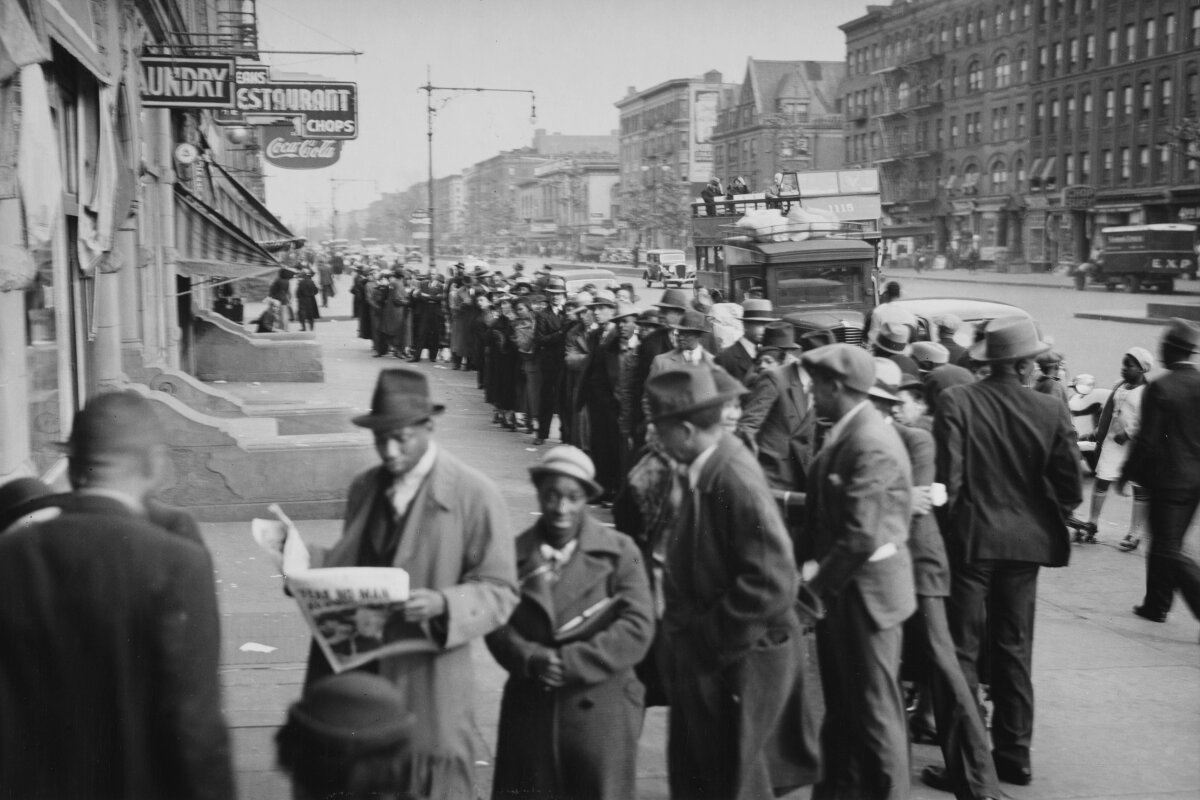
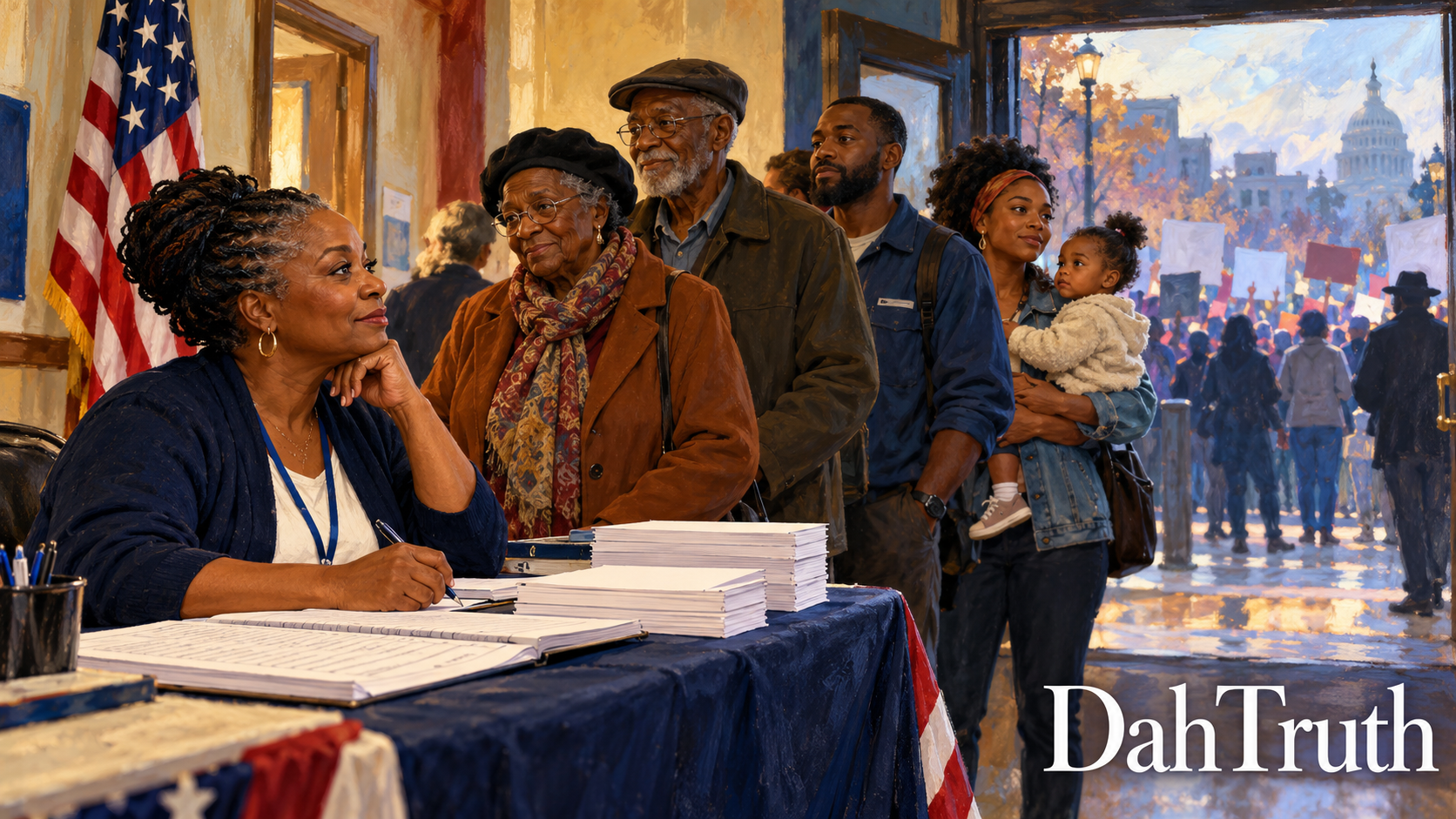
On November 3, I will be at my table early, checking names, handing out ballots, and watching my neighbors come through the door. I will see the retirees who have voted in every election since the Voting Rights Act, the young mothers with babies on their hips, and the working men stopping in on their way to the job. They follow the law. They pay their taxes. They have every right to be here, and many of them come from families who have been here for centuries. When they step into that booth, I hope they remember this week. The midterms are coming, the rhetoric is heating up, and every one of us should be asking who, exactly, is looking out for us.
The Ghost With the Wand
“A man's gift maketh room for him, and bringeth him before great men.” Proverbs 18:16
Jay-Z, Marc Lamont Hill, and the Myth of a Government That Distributes Everything Equally
In the April 2026 GQ cover story, Jay-Z sat down with Frazier Tharpe and did something he rarely does. He answered his critics. Asked about being labeled a capitalist, especially as a Black man and an artist, he said he makes art first, and then he makes sure he is compensated for his art. He added that he did not get where he is by taking advantage of people. To my ears that was a plain description of how work and reward are supposed to meet in a free country. A man has a gift, he develops it, he puts it before the public, and he insists on being paid what it is worth.
“Socialism: An economic system in which major productive resources are owned or controlled socially, through the state, workers, cooperatives, or the community, with the aim of meeting collective needs and reducing economic inequality.”
The backlash came quickly. Critics reminded him, as though he had ever hidden it, that Shawn Carter sold drugs in the Marcy Projects long before he sold a single record. Then Marc Lamont Hill took the argument further from his seat on The Joe Budden Podcast. Jay-Z sold drugs, he said, and the system that produced him is a system built to manufacture billionaires and widen the gap between the wealthy and the poor. Nobody reaches billionaire status, in Hill's telling, without extracting from somebody beneath them. Hill has explained Cedric Robinson's theory on that same show, the idea that all capitalism is racial capitalism, and his conclusion is that socialism offers a more equitable way to live.
I want to take that argument seriously, because a lot of our people are listening to it, and because the times we are entering make it more tempting than it has been in my lifetime.
The Corner and the Catalog
Let me be honest about the drug dealing first. The crack era cost our communities more than any of us can count. It cost mothers their sons, children their parents, and whole blocks their peace. I will not wave that away, and I do not think Jay-Z would ask me to. Accountability means we name it.
But notice what Hill does with it. The drug trade is the clearest picture we have of a market with no law in it. There is no contract to enforce, no court to settle a dispute, no deed to protect what you own, and so every disagreement gets settled with a gun. Holding up the corner as proof against capitalism confuses the shadow with the house. The corner is what economic life looks like when the protections of a lawful market are absent. The money that made Jay-Z a billionaire came from the other side of that line: the records, the independent label he built when the industry would not pay him what his work was worth, the brands, the businesses, the art. The hustle he left behind would have ended with him in a cell or a grave. The art he chose is what carried him out.
Why Socialism Sounds Like Mercy Right Now
I believe in capitalism. I also have eyes. I have spent more than twenty years in executive support, and I can see which desks artificial intelligence is coming for first. The scheduling, the correspondence, the research, the drafting, the work that put food on a lot of tables in our communities is exactly the work these systems are being built to absorb. When the jobs start disappearing in large numbers, the promise of guaranteed housing, guaranteed healthcare, and guaranteed food will sound like mercy. I understand why people will reach for it. I have even caught myself thinking that, given where this economy is headed, maybe socialism will be the way we have to go.
Then I remember who would be holding the keys.
The Ghost With the Wand
“Capitalism: An economic system in which individuals and private businesses own most property and productive resources. Production, prices, and investment are guided largely by markets, competition, and the pursuit of profit.”
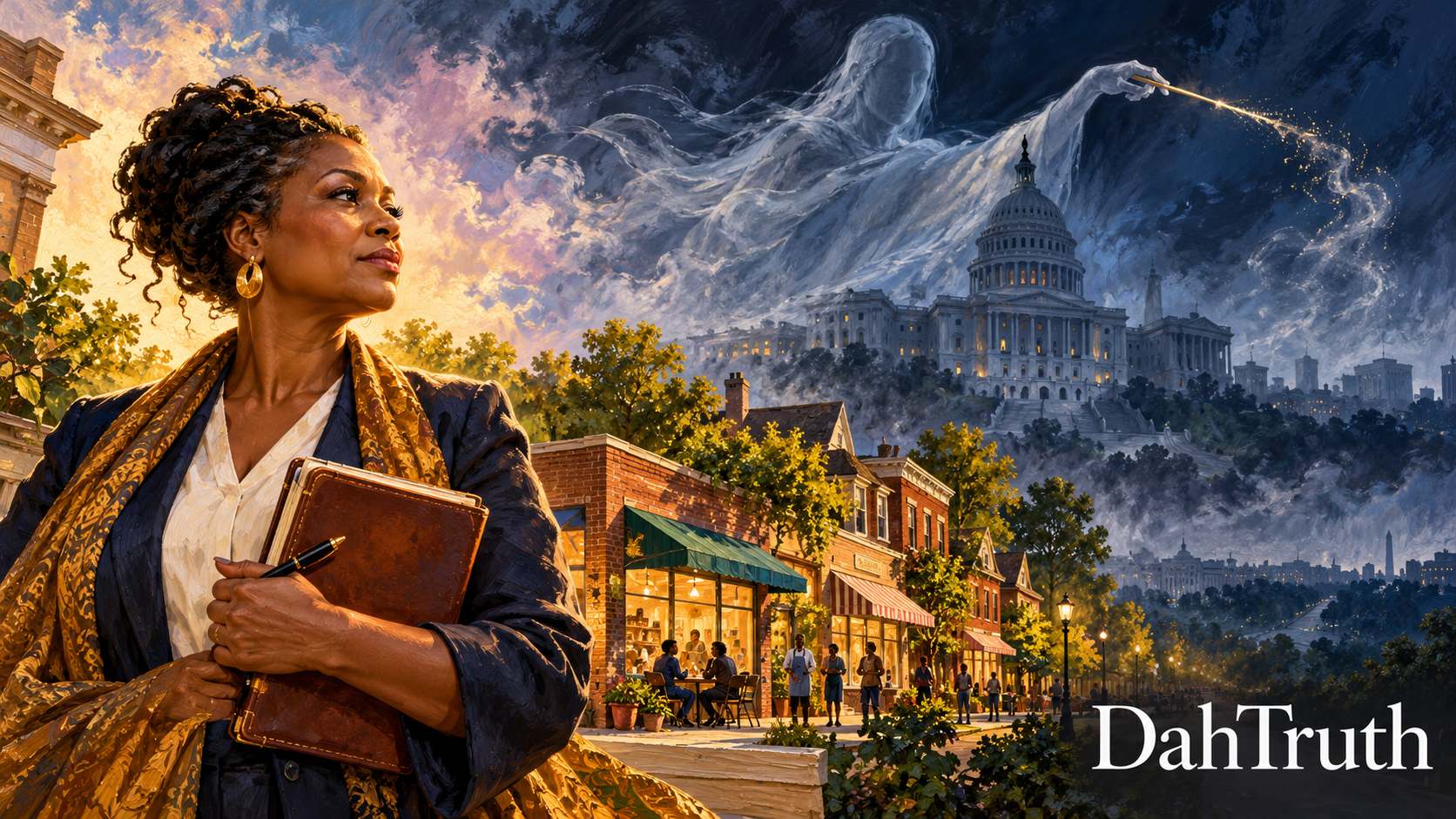
What amazes me about Marc Lamont Hill's position is that he speaks about government as though it floats somewhere in the atmosphere, a great ghost in the sky that twirls a wand and distributes everything equally to everyone below. Government has a name and an address. People write the rules. People decide who qualifies. People set the waiting list, approve the vendor, sign the contract, and hire the cousin. When the state becomes the only provider of housing, healthcare, and food, the people who run the state become the new wealthy class. You will still have rich and poor. The rich will be the ones who work for the government, and the poor will be everyone else.
And there will be no balance on that power. Under capitalism, if a company cheats you, you can take your money somewhere else, take the company to court, or open a business across the street and compete with it. When the government is your only landlord, your only doctor, and your only grocer, where do you go? Who do you complain to? The system itself becomes the oppressor, and it becomes a more severe oppressor than any billionaire, because no check remains on it. A billionaire cannot put you in a cell. A government can.
Scripture warned us about this a long time ago. When Israel demanded a king so they could be like the other nations, the prophet Samuel told them exactly what that king would cost them.
"He will take your fields, and your vineyards, and your oliveyards, even the best of them, and give them to his servants. He will take the tenth of your seed... and ye shall cry out in that day because of your king which ye shall have chosen you." 1 Samuel 8:14-15, 18
I wrote about that passage in "Give Us a King," and the warning has not expired. Every generation that hands its provision over to a ruler in exchange for security learns the price afterward.
Our History Testifies
If anybody should understand that government is made of people, and that those people can become oppressors, it is the American descendants of slavery. The law enforced our bondage. Slave codes were statutes. The Black Codes that followed emancipation were statutes. Jim Crow was written into law, and federal housing policy drew red lines around our neighborhoods so that we could not borrow against the homes we bought. Urban renewal sent bulldozers through Black business districts across this country. Congress chartered the Freedman's Savings Bank in 1865 to hold the earnings of the newly freed, and when it collapsed in 1874 our ancestors lost the savings they had trusted to it. In 1921, Greenwood in Tulsa, built by Black enterprise and Black hands, was burned to the ground by a white mob that included men deputized by city officials. The government did not protect what we built. In too many cases, the government was the hand that tore it down.
And yet we advanced. Madam C.J. Walker, the daughter of formerly enslaved parents, built a fortune selling hair care products to Black women. A.G. Gaston built an empire in Birmingham under segregation. Our ancestors founded banks, insurance companies, newspapers, churches, and mutual aid societies when every door was shut to them. Each generation moved further than the one before it, through setbacks, through violence, through laws designed to stop us. That is what the freedom to change your trajectory looks like in practice.
I am a small piece of that same testimony. I grew up on New Jersey Avenue in New Brunswick. I went back to college at twenty-eight, earned my bachelor's degree at thirty-one, and finished my master's in my late forties. I built DAHTRUTH with my own gifts and my own hours. Nobody distributed that to me. America was built so that a person with talent, discipline, and hard work could dig herself out of whatever condition she was born into, even while facing obstacles of race, of education, and of the state of her community. Our very history argues against everything Marc Lamont Hill believes.
Healthcare, Homelessness, and the Machine
The instinct now is to hand government the answer to every problem that touches our lives: healthcare, homelessness, and increasingly the control of artificial intelligence and the internet itself. Before we do that, we should remember that the Tuskegee syphilis study was run by the United States Public Health Service. We should ask whether the same institutions that have failed our communities for generations deserve control over the medicine we receive, the roof over our heads, and the information we are allowed to see. Concentrating that much power in one place has never ended well for the people at the bottom, and our people have usually been the people at the bottom.
None of this means government has no role. A free market needs a referee. It needs courts that enforce contracts, laws that protect property, and protections against fraud and abuse. Government at its best keeps the field fair. The danger comes when the referee decides to own every ball on the field and hand them out according to its own preferences.
What We Do With What Is Coming
So what do we do when the machines come for the jobs? We do what our ancestors did when every system was rigged against them. We learn the new tools before they learn us. We teach our children skills and ownership instead of dependency. We buy land, start businesses, and rebuild the mutual aid institutions our churches and lodges once ran. We pool what we have and protect it. Dependency on any master, whether it wears a corporate logo or a government seal, has never set our people free.
Jay-Z said he makes his art first and then makes sure he is compensated for it. Every one of us has an art of some kind, a gift that God placed in our hands for a reason. The ghost in the sky with the wand will never come. The people who claim to speak for it will always take their share first. Our future lies with the gift in our hands, the work we put into it, and the God who gave it.
"Seest thou a man diligent in his business? he shall stand before kings; he shall not stand before mean men."
Proverbs 22:29
Imitation of Life, Revisited
From passing out of Blackness to passing into it, and what American Blacks lose along the way
Sometimes I don't know whether these stories are small, whether they only seem small because of who is telling them, or whether they are distractions from something much larger that continues to permeate our communities. But this past week, two stories landed almost side by side. On October 1, John McWhorter published a column in The New York Times about Hannah Gann, the thirty-four-year-old white Jewish teacher and activist in Philadelphia who spent years presenting herself as a woman of Black Tunisian and Palestinian descent. The next day, Cam Newton released an episode of Funky Friday with the actor Da'Vinchi, a Brooklyn-born son of Haitian immigrants, in which a conversation about Hollywood casting drifted into American work ethic, competence, and whether Blacks from the Caribbean, Africa, and Britain look down on Black Americans. At first glance the two stories have nothing to do with each other. I believe they have everything to do with each other.
We are living through a strange moment in the history of American Black identity. On one side are people who want proximity to Blackness so badly that they will manufacture an ancestry, change their appearance, adopt our speech, and construct an entirely different racial history for themselves. On the other side are people who already live and work inside American Black culture, who portray us on screen, build careers inside institutions we fought to open, and profit from audiences we helped create, and who still speak of American Blacks as though we were culturally deficient. One group wants in. The other wants the benefits of being near us while keeping enough distance to tell us what is wrong with us. So I have to ask what it is about American Blackness that would make someone lie to become it, and why someone whose success is tied so closely to our culture feels free to look down on the very people whose lives he is paid to portray. Those questions grow sharper when we remember how dramatically the meaning of Blackness in America has changed. There was a time when Blackness was something people tried to escape. Now there are people trying to acquire it.
* * *
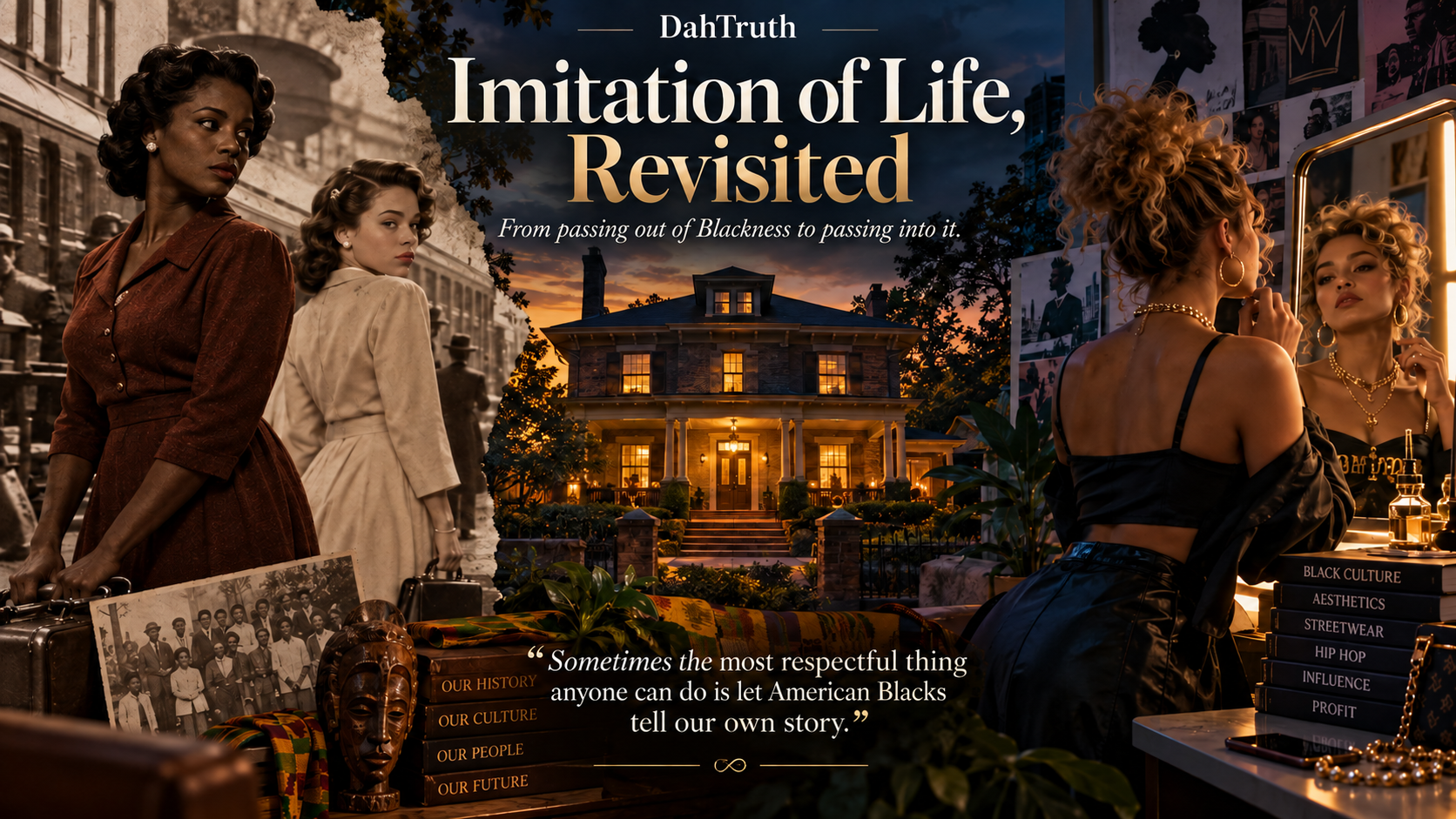
I wrote about Imitation of Life a long time ago, and I keep coming back to it. In the 1959 film, Sarah Jane is a light-skinned Black girl who can pass for white, and she does, because she has seen what Blackness costs in America. Her mother, Annie Johnson, is dark-skinned, devoted, and dignified, and all she wants is for her daughter to stand up and be a proud Black woman. To pass, Sarah Jane has to separate herself from her mother. She denies her, hides from her, and runs from her, and Annie dies with a broken heart. Only at the funeral, when Sarah Jane throws herself across her mother's casket, does she seem to understand what she has caused and who she really is. The film never says it in so many words, yet its message is plain: we should never be ashamed of being Black or of carrying American blood. In Sarah Jane's world, and in the America that stretched from the 1930s through the 1950s and even into my own childhood in the 1970s and 1980s, Blackness was associated with the underclass. It could cost you a job, a home, an education, your dignity, your safety, and sometimes your life. Passing was a way out, and the price of the exit was your own mother.
What amazes me is that American Blacks were producing extraordinary culture even while Blackness itself was treated as a mark of shame. Paul Robeson, the son of a man who escaped slavery, graduated from Rutgers in New Brunswick, the city where I grew up, as an All-American football player and a scholar. He went on to earn a law degree, then became one of the most internationally recognized actors and singers of the twentieth century, carrying "Ol' Man River" around the world and playing Othello on Broadway, all while segregation was still the law of much of the land. By the time I was a girl, American Black life had made it into the living room every week. I watched What's Happening!!. I watched The Jeffersons, where George Jefferson had built a dry-cleaning business big enough to move his family into a deluxe apartment on the East Side. I watched The Cosby Show, with a doctor and a lawyer raising their children in a Brooklyn brownstone. I watched A Different World, which carried the tradition of the historically Black college into American homes, and Amen, which set its stories inside a Philadelphia church at a time when the Black church had already spent generations educating us, organizing us, burying our dead, and holding our communities together. Those programs were only reflections of what already existed in real life: American Blacks working, raising families, attending college, building businesses, and arguing among ourselves about what success was supposed to look like. Somewhere along that timeline the meaning of Blackness shifted. It moved from something to be escaped, to something accepted, to something admired. Today it is imitated, borrowed, performed, profited from, and sometimes fabricated.
* * *
Rachel Dolezal was the famous case in 2015. The historian Jessica Krug followed in 2020. Now we have Hannah Gann. According to the reporting, Gann grew up in a white, Jewish, comfortable family, yet for years she told people she had a Palestinian-born grandfather, a grandfather who was in fact born in Baltimore. She claimed Black Tunisian heritage. Those who knew her described darker makeup, African-print clothing, and speech patterns borrowed from American Black communities, what linguists now call African American Vernacular English and what my generation simply called Ebonics. She reportedly told different people different stories depending on who was listening. And she did not wake up one morning and confess. Fellow activists investigated her claims, confronted her with the evidence, questioned her, and only then did she admit that she had lied. Notice something about the costume she chose. The ancestry she borrowed was African, but the voice she put on was American Black. Whatever she understood about where the real currency lay, she went looking for it in our speech.
McWhorter has argued for years, most directly in his book Woke Racism, that today's antiracism has turned into something like a religion, with white privilege cast as original sin and Black identity carrying a kind of moral authority. In his column on Gann he suggests that for some white people, claiming another identity offers a way to escape that original sin of privilege, and he writes that Dolezal was "an almost inevitable sign of our times." I think he is onto something. If American culture keeps teaching white people that whiteness means privilege, oppression, and inherited guilt, while teaching that Blackness means suffering, resistance, and moral authority, why should anyone be surprised that a few of them try to move from one identity to the other? If I can show that I am not like those white people, maybe I can set down the burden attached to being white. I don't know that this explains every person who has crossed that line, and Gann herself has offered only a vague confession. But the question deserves to be asked. The activists she worked beside made clear she never needed to be Black or Palestinian to support their causes. So if she truly believed in the work, why did she need to become the people she claimed to be fighting for?
Here is where our culture's logic turns against itself. We now live in a country where a person born male can say, "I identify as a woman," and much of the culture insists the rest of us accept it. Hannah Gann could make the very same argument: I was born into a white family, but I identify as Black, and because I identify that way, I am. Racially it might even be an easier claim to make, since plenty of white Americans have an African ancestor somewhere down the line. Yet when Gann is exposed, everyone from her fellow activists to the newspaper columnists calls it a lie, and the country agrees. In both cases a person claims an identity that their body and their lineage do not support. Our culture has decided one claim is ridiculous and the other is courageous. I believe both rest on the same error, the notion that who we are is whatever we declare ourselves to be. You cannot call one a fraud and the other a truth without explaining why the same argument produces opposite answers.
That same looseness explains how the words "African American" came to cover almost anyone with African ancestry. Kamala Harris, the daughter of a Jamaican father and an Indian mother, calls herself African American, and the country accepts it without a second thought. If the term means anything, it should belong to the American descendants of slavery, the people whose history it was coined to describe. That is precisely why so many of us now insist on naming ourselves more carefully. The same blurring happens inside the wider Black world. People throughout Africa, the Caribbean, and the diaspora hold Nigerian, Ghanaian, Jamaican, Haitian, and a dozen other identities that are entirely legitimate. Yet more and more I see people reaching toward the identity of the American Black and treating it as though it belongs to everyone with African ancestry, or else correcting us, suggesting that we survived slavery because we are African rather than because of who our ancestors became here.
I say this without claiming that American Blacks are better than anyone else. I say it because our history is ours. Africa is part of our ancestry, and our history was written on this soil. Our ancestors survived the Middle Passage. They survived slavery and the selling of their children. They survived the dismantling of Reconstruction, the rope of the lynch mob, and the long night of Jim Crow. They survived being shut out of homes, schools, businesses, jobs, and political power. Then they had children, and those children had children, and those children had me. Millions of us are here because of a capacity to endure that was forged in this country, under conditions designed to destroy us. That strength is the American Black story, and sometimes I think we are so busy talking about Black suffering that we forget to talk about Black strength.
* * *
Which brings me back to Da'Vinchi. On Funky Friday he suggested that producers may prefer overseas Black actors because they seem "more focused" on the work, and he said Americans have been incompetent "for a really long time," offering the example of grown adults who cannot do their own laundry. When Newton raised the idea that some people elsewhere in the diaspora consider themselves better than Black Americans, Da'Vinchi agreed that it was true, though he said he did not think it was right. Listening to him, you would think American Blacks had wandered into the twenty-first century without having built anything. What makes the scene almost comical is where he was sitting. He was having this conversation across the table from Cam Newton, an American Black man who reached the very top of professional football, survived that career, moved into business and media, and built the platform on which Da'Vinchi was speaking. And Da'Vinchi's own best-known role is Terry "Southwest T" Flenory in BMF, a Detroit story about real American Black men, created by a Black American writer from Detroit and executive-produced by Curtis "50 Cent" Jackson. Professionally, he has been paid again and again to inhabit American Black lives while culturally distinguishing himself from the people whose lives he portrays.
He has every right to criticize anyone, including us. His parents chose to build their family in this country, and he chose to build his career here. But his success happened here, inside American institutions, playing American Black men for audiences full of American Blacks, and that ought to complicate any suggestion that a superior culture somewhere else explains it. He did not arrive at the beginning of Black achievement in American entertainment. Long before he walked into his first audition, Robeson and generations of American Black actors, musicians, writers, and directors had been carving out space in a country that once allowed us onstage only as caricatures. He did not build that road. He was given the opportunity to travel it. Some American Blacks have answered with a boycott; Freedmen Nation has already added his name to its list. My answer is simpler. Cultural superiority is hard to maintain when the people supposedly beneath you are hiring you, producing you, interviewing you, and supplying the stories you make your living from. Perhaps the problem is that some people have grown so comfortable consuming Black American achievement that they no longer recognize it as achievement.
Set Gann and Da'Vinchi side by side and you see that American Black identity has become both desirable and deniable. Gann shows the desirable side, a woman who wanted the credibility of a marginalized Black identity so badly that she built one from scratch. Da'Vinchi shows the deniable side, a man who lives and works deep inside American Black culture while keeping the freedom to say, in effect, that is them, not me. And the diaspora voices who fold our history into a larger African story show a third side, the claim that our achievements belong to everyone with African blood. All three converge on the same result. Everyone wants some relationship to American Blackness, yet American Blacks themselves can disappear in the process.
I also wonder what this new admiration costs us, especially American Black women. If Blackness has come to stand for honesty, integrity, strength, and moral conscience, then we are quietly assigned the job of being the conscience of the whole society. We are expected to absolve everyone's guilt, march for everyone's cause, and never falter. What happens when we are simply human, when we are tired, or wrong, or unwilling? Admiration can become another kind of cage, and an image that has to be lived up to can weigh as much as a stereotype that has to be lived down.
Sarah Jane wanted out of Blackness, and it cost her her mother. Hannah Gann wanted in, and it cost her the trust of the very people she claimed as her own. Da'Vinchi stands inside a house our ancestors built and wonders aloud why the people who built it are not more focused. Annie Johnson asked only one thing of her daughter: never be ashamed of who you are. I would ask something of everyone else. You don't have to become Black to stand against racism. You don't have to borrow our ancestry to care about our people. You don't have to rewrite our history to prove you understand it. And you certainly don't get to live in our house and look down on the people who built it. Sometimes the most respectful thing anyone can do is let American Blacks tell our own story.
Sand and a Few Drops of Water
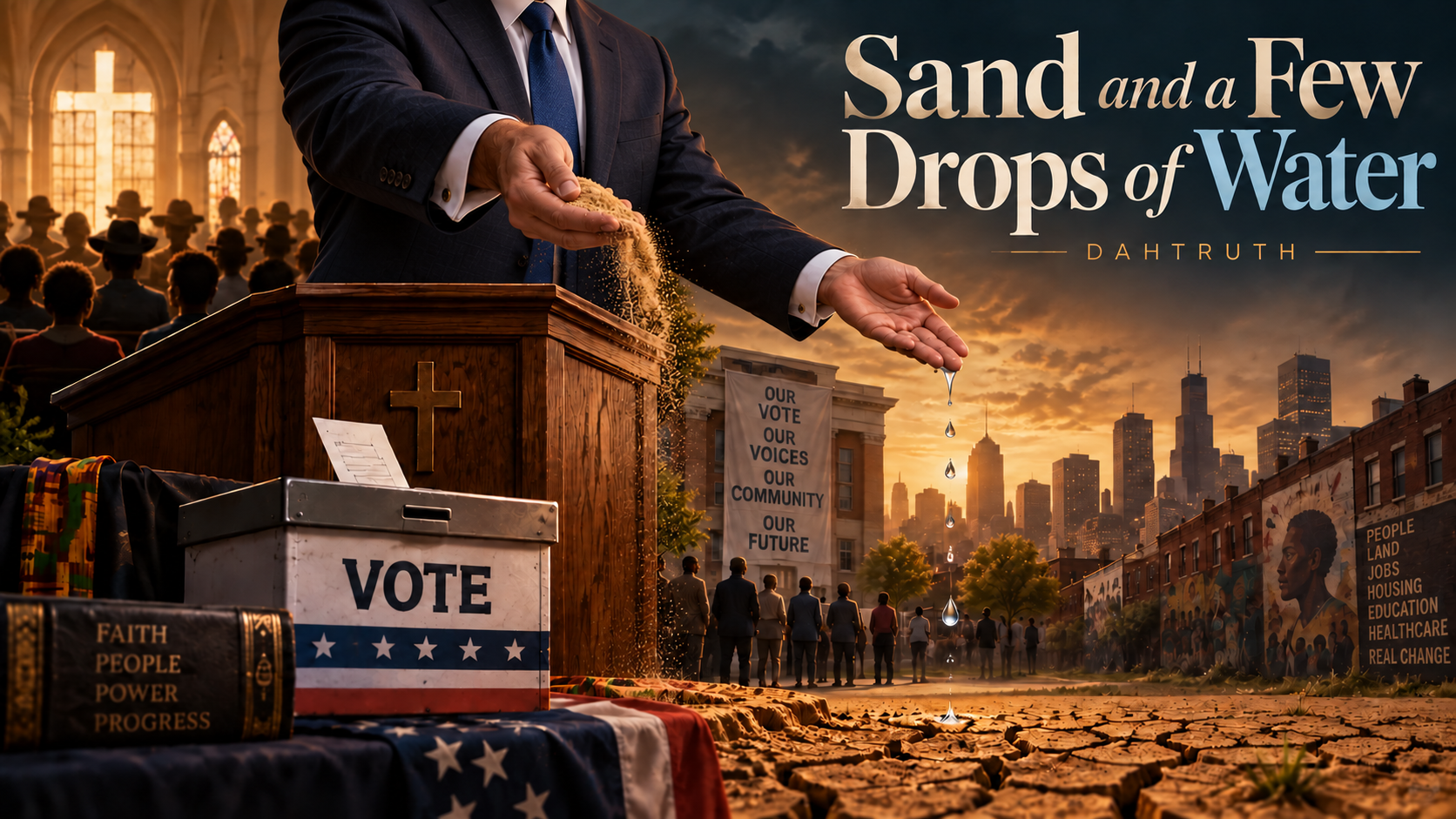
“Put not your trust in princes…” — Psalm 146:3
The primary, the pulpit, and the promises that arrive only after they need us
Every election season the knock comes. I have written about it so many weeks running that I sometimes feel I am beating a horse that should have been buried long ago, but the horse keeps getting up because the Democratic Party keeps riding it. A candidate arrives in our neighborhoods, in our churches, and on our favorite morning shows with a carrot in one hand and a warning in the other. Vote for me, the message goes, or else. Or else the other side wins. Or else everything our grandparents marched for is lost. The carrot changes from cycle to cycle. One year it is healthcare, another year it is student debt, another it is down payment assistance. This year the carrot is reparations. What never changes is the timing, and what never arrives is the delivery.
The party had its lesson handed to it in 2024 and refused to learn it. Kamala Harris did not lose because of Gaza. In my view she lost because she was disingenuous with the very people she needed most. She sold herself to American Black voters as one of us. She borrowed our stories, including the busing story she claimed on a debate stage in 2019, a story I actually lived as a nine-year-old in New Brunswick in 1977. She leaned on our history and on our voting bloc to carry her toward the top seat in the American government. Yet when the question turned to what she would do for American descendants of slavery, a people with a specific lineage and a specific claim on this nation, she had nothing to offer us by name. Whatever she proposed was proposed to everyone, which meant it promised nothing to us in particular. Our stories were good enough to campaign on but never good enough to govern for.
The party should have learned from that defeat. Instead it learned something more cynical, and the evidence sits in three races spread across three states.
* * *
Democrats know they have a problem with their far-left and Democratic Socialist candidates, and they figured it out in New York. In the June 2025 mayoral primary, predominantly Black neighborhoods went to Andrew Cuomo over Zohran Mamdani by 16 points. The voters who carried Mamdani over the line were young, white, college-educated, and concentrated in the corners of the city where students and new arrivals live. American Black New Yorkers looked at the democratic socialist and said no. Then something happened between June and November. Mamdani's campaign turned its attention to southeast Queens and eastern Brooklyn, to the historically Black neighborhoods that had rejected him, and in the general election he won majority-Black precincts by 26 points. The party watched that swing and drew its conclusion. You can lose the American Black vote in the primary and buy it back in the fall. All it takes is attention, promises, and a few Sunday mornings. Outside of the college towns these candidates need us desperately, and now they believe they know the price.
So what have the people who swung to Mamdani in November actually received? He campaigned on taxing the wealthy, and as mayor he went to Albany asking for a 2 percent income tax increase on millionaires and a higher corporate rate. The state budget that passed contained neither. What his office did circulate to state lawmakers was a proposal to cut New York's estate tax exemption from $7.35 million to $750,000 and to raise the top rate from 16 percent to 50 percent. Think about who that net would catch. Nobody in southeast Queens would call a $750,000 estate rich. That number describes the families of Cambria Heights, Laurelton, and St. Albans who bought modest homes decades ago, paid them off, and planned to leave them to their children, and for many American Black families that house is the entire inheritance. Albany did not adopt the idea, but a mayor who put it on paper has told us what he thinks our grandparents' houses are for. He also threatened a 9.5 percent property tax increase if the state refused his demands, then apologized to Black state legislators for floating it before he ever spoke with them, while Queens Borough President Donovan Richards called it a nonstarter. The homeowners who would have paid were the last people consulted.
His record on the street tells the same story. Days into his term he paused the encampment sweeps of the Adams years, and by February he had reversed himself after a double-digit death toll from cold exposure. In September he unveiled a $4 million pilot for seventeen public restrooms, roughly $235,000 apiece, each with a ten-minute limit, after which the door opens automatically. The operator says the clock is there to discourage loitering and drug use, which tells you the people most likely to need those toilets were treated as the problem to be managed, and homeless advocates have already asked how New Yorkers without smartphones are supposed to get in. In fairness, his administration did open 2,000 free childcare seats for two-year-olds this fall, some of them in Canarsie and Brownsville, and the families who received them will be glad of it. But that program rests on $1.2 billion from Albany, it serves 2,000 children in a city of more than 50,000 two-year-olds, and it is offered to every family regardless of lineage. I have searched his first nine months for a single policy directed at the injury and the claim that belong to American descendants of slavery, and I cannot find one. The carrot that brought Black New York to him in November has yet to be delivered.
Texas is running the same play. James Talarico knows that a great many American Black Texans stood with Jasmine Crockett against him, and he knows his general election is a hard sell in our communities. In the March primary, Crockett won 86 percent of the vote in the heavily Black precincts of Harris County while Talarico carried the predominantly white precincts three to one. During that primary, when he was asked whether he supported reparations, his campaign and his legislative office declined to answer. Crockett answered. She supported the House bill. Talarico stayed silent, won the nomination anyway, and then found his voice. At a July town hall in DeSoto, a voter asked him about reparations, and he said that repairing past harms was part of his faith tradition. He spoke of tuition relief, homeownership grants, and baby bonds. He named no bill, no eligibility, no funding source, and no cost. Around the same time he pledged $25 million to Black voter outreach and began touring Black churches he now calls his "spiritual homes away from home." In August he sat down on The Breakfast Club. On another podcast he had already told listeners that Black churches understand what it means to follow Jesus more accurately than white churches do. Flattery is the oldest carrot of all, and it costs the candidate nothing.
Michigan completes the pattern. I wrote "A Warning From Detroit" before the votes were counted, and the returns proved the warning true. On August 4, Abdul El-Sayed won the Democratic Senate primary by a narrow margin, running up his numbers in college towns and liberal enclaves. Detroit, the largest Black-majority city in the state, gave Haley Stevens more than 60 percent of its vote, and El-Sayed became the first Michigan Democrat since 2018 to win a statewide primary without carrying the city. His explanation for losing Detroit tells you everything. He blamed the money, more than $60 million in advertising by his own count, much of it reminding voters of Stevens's ties to Barack Obama. In his telling, Detroit was moved by a television commercial. The possibility that Detroit heard him clearly and decided against him never seems to enter the conversation.
Three weeks after the primary, Jesse Watters asked El-Sayed directly whether he supports reparations. He answered that we need "an honest conversation" about the debt owed to Black folks, and before the sentence was finished he had turned to making Detroit's schools "whole." Compare that to his 2020 book Healing Politics, where he wrote that the country needed "a policy of reparations for Black and Native Americans." His spokeswoman now says his opinions have evolved. Follow the carrot as it shrinks. A policy in 2020 became a conversation in 2026 and a school funding plan by the end of the same answer. Notice also how he folded two peoples into one sentence, as though the claim of American descendants of slavery and the claim of Native Americans arose from the same history, the same injury, and the same ledger. Our claim rests on lineage, and anyone who blurs that lineage in a book will blur it in a bill. Then the establishment fell in line. The Congressional Black Caucus PAC, whose members had largely backed Stevens, endorsed him. Jim Clyburn, who cut ads for Stevens, endorsed him. And Kamala Harris began raising money for him. The woman who taught the party its lesson in 2024 is now helping fund the same approach in 2026.
Set the three races side by side and the sequence is identical. The candidate loses American Black voters in the primary to an electorate of young white progressives. The candidate wins the nomination anyway. The candidate then discovers reparations, discovers our churches, discovers our podcasts, and discovers a budget line for outreach. Behind every one of those discoveries sits the same assumption: that American Blacks do not follow politics, do not read the Bible, and will not remember what was said in March by the time November arrives. They come as though we are gullible. They come as though we are blind and easily led. The returns from Brooklyn, Harris County, and Detroit say otherwise, and that is exactly why the carrots came out.
* * *
What strikes me about this season's pitch is how redundant it is and how ridiculous it is at the same time. It is redundant because we have heard every line before: free healthcare, free education, affordable housing, and a long list of caveats that never make it into the brochure. It is ridiculous because the same candidates who promise to care for our families from cradle to grave also tell us that abortion is reproductive healthcare. They offer to protect our children's futures while defending the ending of our children's lives.
Talarico goes further than most, because he brings the argument into the pulpit and wraps it in Scripture. On The Joe Rogan Experience he argued that before the Incarnation, God asked for Mary's consent, and that this shows "creation has to be done with consent." In a later interview he said plainly that Jesus never talks about abortion and that the Bible is silent on it. So the message to our congregations becomes this: Mary had a choice, so you have a choice, and Jesus would bless whatever you choose. But read the passage he relies on. When Gabriel finished speaking, Mary answered, "Behold the handmaid of the Lord; be it unto me according to thy word" (Luke 1:38). Those are the words of a servant surrendering to the will of God. Mary was not negotiating terms with heaven. And even if we granted his reading, a woman's consent to conceive says nothing about the right to end a life that has already been conceived. The child in the womb is the very creation he says requires consent, and that child is never asked.
Talarico also preaches a Jesus so loving and forgiving that He forgives the murderer, the harlot, and everyone living in sin, with no mention of what is required of them. His Jesus has compassion and no boundaries. But the God of Scripture drew the first boundary in the Garden of Eden: "Of every tree of the garden thou mayest freely eat: But of the tree of the knowledge of good and evil, thou shalt not eat of it: for in the day that thou eatest thereof thou shalt surely die" (Genesis 2:16-17). Death entered the world through Adam's disobedience (Romans 5:12), and salvation comes through Jesus Christ, but it comes with repentance. "Except ye repent, ye shall all likewise perish" (Luke 13:3). Even with the woman caught in adultery, the very story candidates like Talarico love to tell, Jesus refused to condemn her and in the same breath commanded her, "go, and sin no more" (John 8:11). Mercy and boundary stood together in the mouth of our Lord. A Jesus who forgives without calling anyone to change is a Jesus built for a campaign stop. Still, the pulpit remains the richest place to harvest votes, and a candidate who steps into it to tell a congregation half the gospel is counting on that congregation not to know the other half.
* * *
The healthcare promise deserves its own look, because it rests on the same condescension. El-Sayed ran on universal health care and tells us the system is broken. I recently finished Ibram X. Kendi's How to Be an Antiracist, and something in its final chapters stayed with me. Kendi's wife developed cancer. His mother developed cancer. Then Kendi himself developed cancer. Three American Black patients walked into the American healthcare system, received treatment, and lived to tell about it, and yet he proclaims that same system racist. I will return to Kendi in another essay, but the point stands on its own here. We have access to healthcare. Could it be improved? Indeed it could. Does that mean we need the government to run the industry and spend our tax dollars handing us the version of care that politicians decide we need?
When I listen to El-Sayed, I hear a man who does not seem to realize that our families have been taxpayers in this country for generations, and that our ancestors paid before that in labor that never once came with wages. His family's story in America is one generation long. Ours is measured in centuries. That fact should humble the posture of a man who speaks as though he is extending us access to a house our ancestors helped build. We do not need to be managed. We need to be respected, and respect begins with telling us the truth when you need nothing from us.
* * *
In the old story, the Sandman comes at night and sprinkles sand into children's eyes so they will fall asleep. These candidates come to us like the Sandman, carrying sand in one hand and a few drops of water in the other, walking into what they imagine is a desert. The sand is meant to put us to sleep. The drops of water are meant to make us grateful. They pour out a promise of reparations with no bill behind it, a church visit with no repentance in it, and a healthcare plan that asks for our trust and our tax dollars while telling our daughters that their children are optional.
But we are awake. We read the Bible, and we know the difference between the Jesus of Scripture and the Jesus of a campaign. We read the returns, and we know who voted for these candidates in the spring and whom they came looking for in the fall. So before any of us gives a vote to a candidate standing in our pulpit or sitting across from Charlamagne, ask one question and insist on an answer: What did you say about us when you did not need us? The answer to that question is the only promise worth believing.
Just Enough
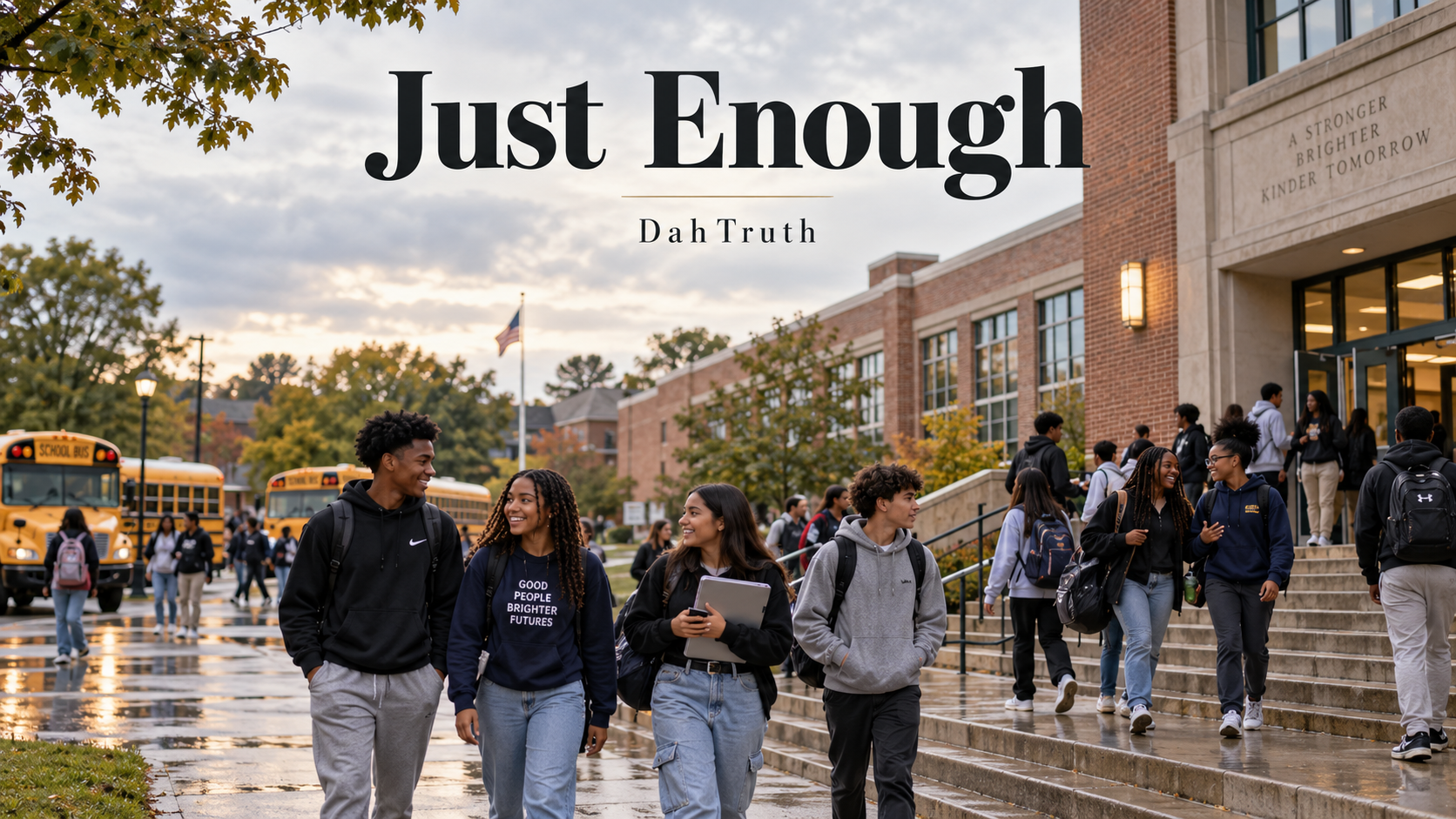
“Money helped create the space, but what they are doing with their minds belongs to them.”
It is a rainy Saturday, and I am feeling a bit melancholy. My grandsons are out getting their haircuts, two of my granddaughters are in the kitchen burning toaster strudels, and I am sitting here listening to the rain as the cars drive past, reminding me what a wonderful day it is to stay inside and do absolutely nothing. So I have been strolling through old pictures of my family, looking at my life and how far we have come, how far I have come at least, from New Jersey Avenue to Pine Hill, New Jersey. And looking at those pictures, I realize I got out of life everything I probably wanted, or at least everything I thought about wanting when I was a young person.
I never wanted to be super wealthy. I just wanted to have enough, you know, just enough to make it. Enough to eat, enough to sleep, enough to drive, enough to not always be struggling, downtrodden, begging, or having to rely on the system. Growing up, I kind of knew it started with education, or at least I believed it did. Really, I think that belief was instilled in us more than it was something I figured out for myself. Because when I got out of high school, I realized I had to go to work first, and then, as I worked, build up my skill set by adding education to it.
So for me, education came second. What came first was hard work. What came first was resilience. Those things came first, and then came the recognition that without a degree, I was in a second position. I wasn't working jobs where I used my hands. I was working jobs where I used my brain, and I figured that if I was going to have to think my way through my work, I had better get the degree. So I went back to college at 28. I got my bachelor's degree at 31, and I got my master's degree in my late 40s. Those degrees have put me on a different plane. I am nowhere near rich, but I am no longer on the low end of the middle class either. I am probably in the higher echelon of it.
And that position has given me something bigger than money. It has given me the opportunity to create space for my grandkids to come and live with me, along with my son and his wife, and to watch them grow. They were in a school system in New Brunswick, New Jersey, that was at the bottom. When they came to live with me in Pine Hill, they entered a school system that sits more in the middle bracket, and I have watched them go from the lower end to excelling at the highest level. Right now my oldest grandson is in a program where, after four years, he will graduate from high school with an associate's degree.
I am writing about this to make a point, but before I get to that point, I want to talk about a book I just finished reading, Purple Hibiscus by Chimamanda Ngozi Adichie, a Nigerian writer. In that book there is a clear dynamic between being a wealthy African and being a poorer African. There does seem to be a middle class, but the middle class is still poor. They struggle with petrol. They struggle with food. They struggle with the conditions of the housing they live in. And below them there seems to be an even lower class, where the struggle for food and energy is greater still, where not having a generator means the power goes out and stays out.
The main character, Kambili, and her brother Jaja go to visit their Aunty Ifeoma, who has two sons and a daughter and who works at the university in Nsukka where she lives. Kambili and Jaja come from wealth and attend Catholic school. Their cousins live with far less. And yet, looking at those two households, what stood out to me is that when it came to education and intellectual knowledge, the children seemed to be on the same plane, even though they came out of two completely different schooling environments.
Both sets of children excel, but they excel in different ways. In the wealthier family, the focus seems to be on studies. In the poorer family, there are studies too, but there are also conversations. There is art. There is intellectual stimulation that comes from outside the constant striving to get A's without ever really internalizing what you are learning. That kind of thinking gets built through caring adults, and in a school, it depends on teachers who care enough to instill it in their students.
Which brings me to something I read this week in The New York Times Magazine, Nikole Hannah-Jones's new essay titled "In Fighting for Every Black Child, Did I Betray My Own?" Ten years ago she wrote about putting her daughter, Najya, in a high-poverty, predominantly Black public school in Brooklyn, and now, with Najya sixteen, she is looking back on that decision. I thought to myself how twisted her version of education is compared to a place like Nigeria, or even a place like where I come from. For me, it has never really been about the resources. It is about the work ethic and the work you put in. It is about training. Opportunity, in my life, came through hard work, diligence, and resilience, and wealth had very little to do with it.
I will say plainly that I think Nikole Hannah-Jones is overrated. So much of her work, to me, reeks of her own entitlement, her own privilege, and a way of looking down on other communities. I think the 1619 Project was off. It painted Americans, white Americans in particular, as if they are all still part of a racist regime, and as if every individual American owes a debt. I believe America owes a debt. The American government should pay that debt. But individual Americans living today do not personally owe it. Yes, there are still racists in our society, but we are not living in the 1950s, and her work carries forward a sense of continued oppression as if nothing has changed.
In all of her writing, her persona, and her attitude, I see someone who wants to be a kind of savior of American Black culture. She wants to be the critic of American systems and American history, and at the same time she wanted to be the savior of the New York school system, or at least she put herself in the position of trying. That was her mission in putting her daughter in that school, to bring her child and her family's resources into a struggling school and somehow lift the Black children who were already there. She kept her daughter in that system through elementary and middle school. Then her daughter asked her the question any of us could have asked for her: did you know my school was bad like this when you put me here? And in eighth grade, when Najya finally got to choose her own high school, she chose a screened, mostly white and Asian school, the very kind of school her mother spent a career arguing against. Now Hannah-Jones writes that she feels she failed both her values and her child.
I can remember growing up, if you lived in a certain neighborhood, people would sometimes use another person's address just to get their kid into a better school. Parents have always tried to send their children to what is best for them. That is what parents do. So there is a self-righteousness in the idea that you can save an entire school system by placing your child in it, without actually improving the system itself. She had the ability to create different circumstances for her daughter's outcome, and she chose to make her daughter part of her mission instead.
And here is the part of her story that makes my point for me. Her daughter came from a middle-class home, with educated parents and resources that many of the other children in that school did not have. And still, Najya was bringing home strong grades in algebra and then could not pass the state Regents exam. When she got to that more demanding high school, she needed serious help to catch up to classmates who came in better prepared. All that money and all that education in the house did not protect her from being taught to collect grades instead of learning the material. That is the same thing I saw in Purple Hibiscus. Resources do not dictate a child's fate, and they certainly do not determine a child's mind. What happens in the classroom, and in the home, and inside the child, is what counts.
There is no doubt that education is an issue in some American Black communities, and in some American communities, period. There are teachers who do not care about their students, and there are some who are just doing a job and collecting a paycheck. But the bigger problem, as I see it, is that the more we lean on testing, testing to get into better schools, testing to get into Ivy League schools, testing to ultimately get good jobs, the more that mentality ripples through every community in America. Instead of teaching for teaching's sake, teachers are programming students to pass tests and post high scores so they can get into the next school. That is the dysfunction in our school system that needs to change, and I think that is exactly the point Nikole Hannah-Jones missed. Worse than missing it, the way she tells her story reeks of the belief that she had, and still has, the solution to all of our problems.
So I come back to where I started, sitting in my house on this rainy Saturday with the smell of burnt toaster strudels coming from the kitchen, waiting for my grandsons to come home with their fresh haircuts. I did not get here because I was born with resources. I got here through work first, resilience first, and education after that, and now my grandchildren get to start a little further ahead than I did. They are excelling, and I believe that is because of what they are putting in, what is being poured into them, and the expectation that they will think for themselves. Money helped create the space, but what they are doing with their minds belongs to them.
The Self-Proclaimed Savior at the Table
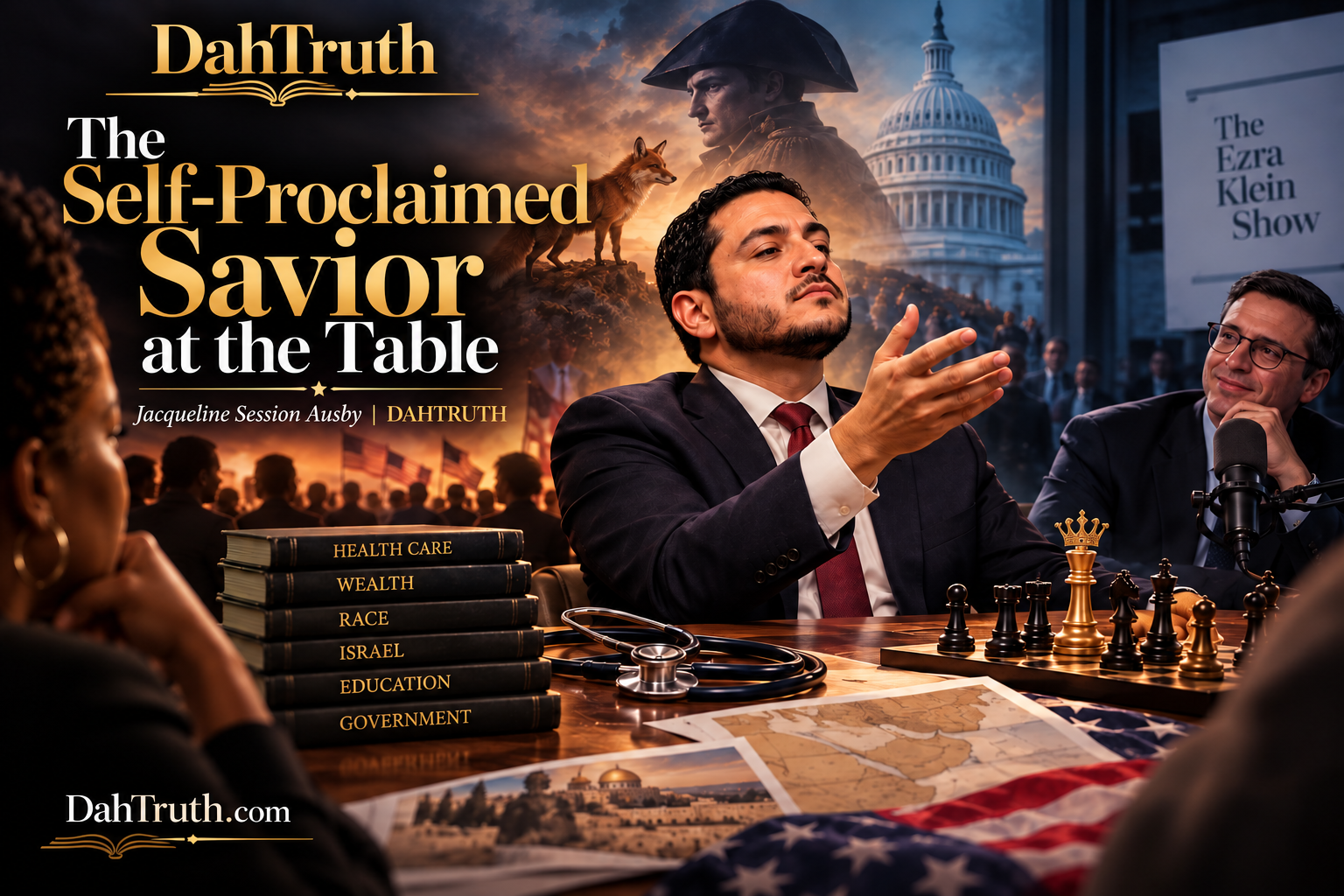
“Take us the foxes, the little foxes, that spoil the vines: for our vines have tender grapes.” — Song of Solomon 2:15 KJV
If Napoleon's spirit were roaming the earth today, I sometimes think it would recognize something familiar in Abdul El-Sayed, the Democratic nominee for the United States Senate in Michigan. I offer that as my impression of the man, and I will spend the rest of this essay showing you where it comes from. There is a confidence in the way he talks about remaking American systems that reminds me of a little man with very big plans. Listening to him on The Ezra Klein Show, I kept picturing a fox standing on a hill, looking out over the horizon, certain that if everyone below would only follow his plan, every problem in the valley could be solved. Health care, wealth, race, Israel, education, the role of government itself: El-Sayed has an answer for all of it.
Ezra Klein's episode, "What Does Abdul El-Sayed Believe?", was released on September 25 and runs more than an hour and a half. I watched all of it as Klein, a supposed journalist, sat and sucked in every word El-Sayed said like it was refreshing water. What bothered me most was how little of what El-Sayed said was ever forced to collide with the questions that should come after the promise. That is my larger complaint about the media, and this interview is simply the clearest example I have seen in a while. Journalists sit across from candidates they find sympathetic, let them tell their life stories, and never address the real issues underneath. I watched Ezra Klein sit there with a smile on his face while El-Sayed told his, and I found it sickening, because something kept surfacing beneath that story that remained unquestioned.
The Little Thing
It starts with little things. El-Sayed told the story of visiting his grandmother in Egypt, where she told him his cousins were smarter, nicer and more athletic than he was, but that he had the best thing of all: he got to go back to America. Klein let it pass as a sweet family story. I heard something else in it. His grandmother understood that the greatest advantage her grandson had was America itself. Yet that grandson has built a political career describing America as a place that fails its people, and he never seemed to notice the contradiction. Nobody asked him what his grandmother saw in this country that he spends so much of his time running down.
Then came the conversation about 9/11. El-Sayed spoke about how people in this country treated him afterward because of his name. I think that resorting to a name to illustrate some form of social injustice is simply a distraction. I doubt that it happened, but I continued to listen to his story of how he was affected personally after 9/11. And to be honest, El-Sayed told that story without ever addressing what actually happened that morning, when Muslim terrorists murdered nearly three thousand people on American soil. I wrote about that morning in "What the Passengers Knew," and I remember it too well to hear the story told with the attack itself left out. A good interviewer could have honored his experience and still asked him to speak about the terrorism that set it in motion. Klein did not.
The Doctor Question
El-Sayed continues to present himself as a doctor. He does hold a medical degree from Columbia and a doctorate in public health from Oxford. What he does not hold is a license. Politico reviewed medical licensing records in Michigan and New York this spring and found no sign he had ever been licensed to practice in either state, and he never completed a residency. Even so, he introduced himself as "a physician and epidemiologist" at an April debate before Detroit's Council of Baptist Pastors, and his campaign's answer to the reporting was that he has earned the right to be called doctor twice over.
This matters because the medical credential is the very thing he leans on when he talks about Medicare for All. He speaks about patients and treatment as though he spent years at a bedside, and he describes his training role in ways that make it sound like caregiving, when by his own account he turned away from practicing medicine while still in school. Klein could have asked him plainly: You call yourself a physician. Have you ever been licensed? Did you complete a residency? How much patient care have you actually provided? Those are simple questions, and voters deserve the answers before accepting a candidate's medical authority on health policy.
What Medicare for All Leaves Out
Then there is Medicare for All, the centerpiece of his campaign. On the show, El-Sayed described his plan as what Medicare is today. That description is very misleading. As a matter of fact, it is a straight lie. When Klein pressed, El-Sayed laid out something very different: he would first make existing Medicare more generous, bring premiums and deductibles to zero, add dental, vision, hearing and stronger drug coverage, and then lower the eligibility age step by step until the program covered everyone. Medicare as seniors know it today carries a monthly Part B premium, deductibles, and coinsurance that commonly runs twenty percent, and it does not ordinarily cover routine dental, vision or hearing care. The familiar word is doing a great deal of work to reassure people about a program far larger and far more expensive than the one they know.
He talked about our paychecks, about how we would no longer see money taken out for insurance. What he left out is the taxes we would pay in its place. No premium, no copay and no deductible still carries a cost, and that cost moves into the tax code, where the government also decides what benefits we receive. Today I can choose between Aetna, UnitedHealthcare, and Blue Cross Blue Shield. I may not love any of them, but I have options, and if one fails me I can go to another. Under a single government plan I would have one choice, and that choice would come from Washington. Insurance companies sit over our health care now, and El-Sayed's answer is to replace them with one payer that answers to politicians. To be fair, Klein did raise questions about wealth and systems, and he pushed on parts of the plan. He simply did not go far enough.
There is also the question of who gets covered. Medicare today was built for older Americans who spent their working lives paying into it. Extending a richer version of it to every person in the country is a different undertaking entirely, and El-Sayed has not always been precise about who "everyone" includes. In 2022 Senate testimony he spoke of covering every single resident from cradle to grave, and his 2018 plan for Michigan, MichCare, said the state would not consider federal immigration status and would cover undocumented residents who paid Michigan taxes. So does his current plan cover people who are here illegally? If it does, who qualifies, and who pays? Klein never asked.
Ten Minutes in the Restroom
I know a public toilet is a long way from health care, but I could not stop thinking about the bathrooms Mayor Zohran Mamdani just rolled out in New York City. The city is spending $4 million on a one-year pilot for 17 modular public restrooms across the five boroughs, free to use and open from seven in the morning until ten at night, run by a private company called Throne Labs. You get ten minutes. Warnings come at five minutes and again at eight. At ten, the lights flash, a voice announces that your time is up, and about thirty seconds later the door opens whether you are finished or not. To get in at all, you have to text a number, scan a QR code, use an app, or tap a card handed out by a community group.
Ten minutes in a restroom is not generous to a homeless person, at least I do not think so. Someone living on the street may need to wash up, change clothes, manage her period, or simply use the toilet without being rushed, and a person without a phone has to find a card just to open the door. The company says most people leave within a few minutes, and the city says the limit keeps a scarce resource moving. I understand the reasoning, and that is exactly my point. The government uses taxpayer resources to provide the benefit, and because the resource is limited, the government, or the contractor it hires, also decides how long you get to use it. If they control something as small as your time in a public bathroom, how much more control will they have over your health care?
A doctor's office is no public restroom, and I make no prediction about how long your visit would last. My question is simpler: what happens when a free benefit meets a limited supply? When health care is fully paid for by the government and coverage reaches everyone, more people will walk into doctors' offices, hospitals and laboratories, and they will walk in more often. With nothing to pay at the door, demand goes up, and so does the cost of running the whole system. That cost does not disappear. It lands on the taxpayer. And the people carrying the heaviest share will be the hardworking Americans who have paid into this system for years, now funding the same generous benefits for people who may have paid in far less, or nothing at all. I find it hard to call that fair. When prices climb and emergency rooms fill, the government will stop the clock, and rather than open the door, it will shut it tight. Then it will raise taxes and start to cut. Cut what it pays hospitals? Trim benefits? Let the waiting lists grow? Those are the only levers there are, and El-Sayed was never asked which ones he would pull.
Israel, AIPAC and the Money Nobody Asked About
Israel cannot be left out of this conversation, because for El-Sayed it is central. He calls what Israel has done in Gaza genocide, he wants to end American military aid to Israel, and he has made AIPAC a villain of his campaign. Klein and El-Sayed spent a long stretch on AIPAC, on Jews, on Israel, and on what El-Sayed calls a genocide. In that same interview, El-Sayed suggested that one of Israel's big war aims in the conflict with Iran was setting up the annexation of southern Lebanon. El-Sayed has condemned the October 7 massacre in other settings, but in this conversation I never heard a serious reckoning with Palestinian violence: the hostages, Hamas fighting from inside civilian neighborhoods, Hezbollah opening fire on Israel in support of Iran. I never heard him asked about Egypt, which controls Gaza's southern border and keeps it closed too. Israel alone was placed on trial.
His position on American weapons is more extreme than anything the Senate has actually voted on. El-Sayed supports a complete embargo on arms sales to Israel. Even Bernie Sanders, who has forced vote after vote to block specific sales of bombs, rifles and bulldozers, has aimed only at offensive weapons, and those measures have failed every time, most recently by 40 to 59 in April. A total embargo would reach the defensive systems too. That is why CNN's Van Jones, no conservative, called El-Sayed's position insane and dangerously extreme, pointing out that it would stop Israel from buying the interceptors that shoot down rockets fired by Hamas, Hezbollah and Iran, the same Iron Dome system Barack Obama championed. At a September 19 town hall in Saginaw, El-Sayed argued that the money spent on heavy bombs should go instead to Detroit's schools, health care and infrastructure, and he has called Israel an illegal apartheid regime that America should treat like any other country. Once again, Detroit becomes the backdrop for his argument.
AIPAC and its affiliated committees take part in American elections under federal campaign finance law, the same law every other group must follow. You may dislike its influence, but it is legal. So if pro-Israel money deserves a moral microscope, so does the money behind El-Sayed. A Fox News review of federal records found more than $115,000 given to his campaign by at least 41 people who work for, once worked for, or held leadership posts with the Council on American-Islamic Relations, known as CAIR. His father-in-law, Tayeb Jukaku, a former president of CAIR-Michigan, gave $300,000 in three separate checks to Fighting for Michigan PAC, a super PAC formed to back him. In July, the Unity & Justice Fund, a super PAC launched by CAIR's political arm, gave that same PAC $175,000.
CAIR has long faced allegations of ties to the Muslim Brotherhood and to Hamas-linked networks. In the Holy Land Foundation case, the largest terrorism-financing prosecution in American history, federal prosecutors named CAIR as an unindicted co-conspirator, and the foundation itself was convicted of funneling money to Hamas. CAIR was never charged, and it denies those ties. Money from a foreign national, a sanctioned group, or a straw donor would break federal law, and no one has shown that here. But it is fair to ask why Ezra Klein was so curious about AIPAC's money and so incurious about CAIR's. Who funds Abdul El-Sayed? Which organizations stand behind the people writing the checks? Klein never asked, and that silence is the double standard I am talking about.
The Black Women in His Stories
There is one more question Klein never asked, and it is the one that matters most to me. For all the time the two of them spent on Israel, AIPAC and Medicare for All, neither man stopped to consider the people El-Sayed keeps using to make his case at home. When he argues against weapons for Israel, he points to Detroit's schools. When he argues for Medicare for All, he points to Black mothers. When he needs a story about a broken system, he reaches for a Black woman. I watched that interview as an American Black woman, and that pattern is what stayed with me after it ended. It kept taking me back to a story a friend once told me.
I once had a friend tell me an unfortunate story about a promotion she received at work. There was a woman she had befriended at work, and that woman had told her, to her face, that she supported anything my friend wanted to do, and my friend believed her. Then some of the circumstances surrounding the promotion began to touch that woman personally, and her position changed almost overnight. My friend had been presented with two opportunities, and she chose the one this woman did not like. That choice was enough. The woman began speaking about her to other people behind her back and started presenting herself as the victim in the whole affair, even though she was the one who had placed herself in the line of fire.
What stayed with my friend was the feeling that she had overstepped an unspoken line. She found herself asking the questions American Black women know by heart. Should she have waited in the wings instead of asserting her capabilities? Should she have chosen the opportunity that fit someone else's thinking? Did making her own decision mean that, as a Black woman, she was being too bold? There was a time when she would have played it safe. She told me she no longer felt the need to. The threats that once overcame her had long been diminished and were no longer part of her psyche. She could speak clearly, articulate plainly, and make a decisive decision accordingly, and that is exactly what she did.
Every American Black woman I know has some version of that story. It is uncomfortable, and I have come to recognize it as part of our plight. We are perceived as weak and in need of saviors right up until the moment we assert our power, and then our power becomes the problem. That is where Abdul El-Sayed comes in. He speaks about American Black women as though we are the most oppressed people in this country: the ones most in need of healthcare for all, the ones who must be saved from neglect, from abuse, from violence, and from disease. Black women keep appearing in his stories. We appear when he talks about poverty, about maternal health, about Medicaid, about racism, and about HIV.
He tells of a woman he encountered while training in New York, an indigent patient who had fallen while intoxicated. By his account, the team was ready to send her out without a CT scan because she was treated as a "social" case, and she turned out to be gravely ill with AIDS. He has told that story many times as the reason he turned from clinical medicine to public health, and he has identified her as a Black woman. We have only his word for it, repeated over and over. And of course the woman in the story is poor, addicted and sick, and of course he is the one who saw what the system would not.
In an earlier blog, "A Warning From Detroit," I wrote about how he talks about going with his wife to her prenatal appointments, how he was by her side, how she could see a doctor who looked like her, and how so many Black women, in his telling, never get that same experience. He sets his own family's care beside ours so that ours can serve as the example of failure.
Every time, I have the same reaction. Why are Black women so often the vehicle through which Abdul El-Sayed explains what is wrong with America? We become the suffering woman, the poor woman, the woman whose doctor will not listen, the woman on Medicaid, the woman with HIV, the woman with the bad outcome. Then El-Sayed walks into the story as the one who sees the injustice everyone else missed. Some people hear compassion in that. I hear a man using the most painful and degrading examples he can find involving Black women to hold up his larger argument about America, and I resent it. I resent the idea that Black women have to be placed in the gutter before somebody can promise to lift us out of it. I do not accept the way he presents these conditions as though they define American Black women or our communities.
I have been reading Ibram X. Kendi's How to Be an Antiracist, and I agree with very little in it. However, one passage stayed with me. Kendi describes hearing a Black man speak with open contempt about other Black people, and it forced him to ask whether Black people can hold racist ideas about their own. What I took from it is that a racist idea does not become harmless because of who is speaking or because the speaker claims to be helping. A person does not have to insult Black women outright to diminish us. Sometimes the diminishment comes wrapped in concern.
So I am going to say it plainly: I believe there is something racist in the way Abdul El-Sayed talks about Black women. He has no need for a slur. The racism I hear lives in the way he repeatedly imagines us. You cannot continually present Black women as the sickest, poorest, most neglected people in America and then tell me the only thing moving you is concern for our well-being. At some point I have the right to look at the pattern and say, this is how you see us. I cannot see inside his mind. I can only tell you what I hear when I listen to the pattern, and I reject it.
That rhetoric takes agency away from Black women and hands it to him. In his stories we are the people something happens to: failed, ignored, mistreated, underserved. He gets to define the problem, explain our condition, decide what caused it, and then offer himself and his policies as the cure. He says he is elevating Black women. I hear him reducing us. It reminds me of the serpent in the garden, who studied Eve, found what he believed was her weakness, and offered her something that sounded like a gift. El-Sayed names the conditions he believes are the weaknesses in our communities and offers himself as the conveyor of our righteousness: free glasses for children, free health care for all, more for education, and always Detroit as the foundation of the story.
The truth is that American Black women have proven time and time again that we are the lead stompers. We are the ones in control, and we do not need to be controlled. We are the heartbeat of our community, the backers of our men, and the ones trusted morally when everyone else's word has run out. We vote, organize, work, raise families, build businesses, and lead churches, schools, hospitals and offices. Michigan's median household income is a little over $72,000, and Black women are among the workers, homeowners and taxpayers who make that state run. Our lives cannot be summed up by the worst statistic a campaign can find.
And here is the irony. Black women remain one of the most dependable voting blocs in the Democratic Party. Pew found that roughly nine in ten Black women voted for Kamala Harris in 2024. El-Sayed knows he cannot win Michigan without Black voters, especially in Detroit, and this summer he was struggling with them: a July poll had Haley Stevens leading him among Black voters by 46 points, and the Congressional Black Caucus and Jim Clyburn endorsed her. He speaks about us as though we have no power while seeking the very power our votes can give him. I believe he is using the American Black community because he knows it is his only way to win, and I find the pretense sickening, because the deceit is so easy to recognize.
A Seat Black Women Filled
The rescue language does not hold up to his record, either. This summer El-Sayed marked Black Women's Equal Pay Day by posting that Black women have to work an extra seven months to earn what white men earn in a year. Look at the job he held before he said it. In 2021 Wayne County chose Melita Jordan to lead its Department of Health, Human and Veterans Services. She was picked from more than 35 candidates after four panel interviews, meetings with every one of her direct reports, and a tour of the jail's medical operations, and the County Commission approved her unanimously. She is a Black woman, and she came to the job with the kind of experience El-Sayed only talks about. She began her career as an advanced practice nurse in midwifery, directed maternal and child health hospital units, and ran the nurse-midwifery program at Temple University's medical school. She led Pennsylvania's Bureau of Family Health, with 125 staff and a $400 million budget, and then spent eight years as a senior executive at the New Jersey Department of Health. She was hired at $180,000 in the middle of the pandemic, built the county's community outreach plan for COVID-19, and brought in $5 million in new grant money for testing and vaccination.
In December 2022 the county announced that El-Sayed would take her place. He started in March 2023 at $200,000 plus benefits and paid parking, according to county commission records, and his June 2025 Senate financial disclosure reported $278,939 in pay from Wayne County. When he left, the director's job went to Kennyle Johnson, another Black woman and his own chief of staff, at $180,000. So a Black woman who spent her career delivering babies and running maternal health programs was replaced by a man who never held a medical license, and that man now campaigns on Black maternal health. She actually managed patients, and she did not use the county's health department as a launching pad for a political campaign. He did both of the things she did not: he talked about patients he was never licensed to treat, and he left the job to run for office. A man who mourns the Black woman's paycheck while being paid more than the Black women on either side of him in the very same seat has shown us what his concern is worth.
More importantly, two educated Black women stand on either side of his time in that office. One led the department before him, and the other leads it now. Yet he goes around talking as though American Black women are hopelessly oppressed and downtrodden, and as though he alone has come to save us. The proof against his story was sitting in his own department.
His résumé tells its own story about what these seats mean to him. Mayor Mike Duggan appointed him in 2015 to rebuild the Detroit Health Department, which had been handed off to a nonprofit during the city's bankruptcy, and he left in early 2017 to run for governor. He lost that 2018 primary to Gretchen Whitmer. Wayne County Executive Warren Evans then appointed him to the county job in March 2023, and on April 1, 2025, he announced he was resigning to explore a run for the Senate. Two public health departments serving some of the most heavily Black communities in this state, and he stayed at each one for roughly two years before using it as the launching pad for the next office. The people of Detroit and Wayne County deserved a health director who meant to stay, and what they got was a candidate between campaigns.
The Table in Detroit
That brings me to Kamala Harris. On September 22, El-Sayed sat beside her at Birth Detroit for a roundtable on Black maternal health and healthcare costs. He did not bring out just any Democrat. He brought out the first Black woman to serve as vice president and put her beside him at an event built around Black women's bodies. Harris told the room that an attack on DEI is "an attack by definition on maternal care," and she said she knew El-Sayed would be a champion on the subject.
By definition? That is where I stop. Maternal care is prenatal appointments, competent doctors and nurses, a hospital close enough to reach, a provider who knows whether a woman has high blood pressure, diabetes or fibroids, someone who recognizes an emergency, and care in the months after the baby comes. You can argue that particular programs help in some of those areas. Declaring that opposition to DEI is automatically an attack on Black mothers is a political slogan dressed up as medicine. And once again, Black women become the reason the policy must exist, the suffering body placed in the middle of a political argument.
Consider who sat at the head of that table. The son of an Egyptian immigrant and the daughter of a Jamaican father and an Indian mother, neither of them descended from people enslaved on this soil, gathered to discuss how Black women must be protected through pregnancy, childbirth, and the months that follow. Our mothers and grandmothers carried and delivered this community through conditions far worse than anything discussed at that table, and they did it without a Senate candidate appointing himself their champion.
The irony runs deeper. In 2024, Harris stood with the Biden administration's basic position that Israel had a right to defend itself, even as she spoke about Palestinian suffering and called for a cease-fire and the release of the hostages. El-Sayed went much further. He backed Michigan's uncommitted movement, which grew out of anger at that very administration's support for Israel, and he now calls what Israel has done genocide. Those are no small differences. Yet when he needed help reaching Black voters, there sat Harris beside him, and suddenly Gaza was off the table. Black women were the subject instead. Two politicians who disagree on one of the biggest issues dividing their party found common ground on our health, our bodies and our experiences, and Black women have every right to notice when that happens.
So when I hear an individual like Abdul El-Sayed speak about American Black women in ways that diminish our capability and our character, it makes me angry. It makes me want to scream at the nonsense. It is what Harry G. Frankfurt would describe as bullshit, and I will use that word once, plainly, because this has earned it. What is even more disturbing is watching some American Black women align themselves with his malarkey and agree with his degradation of our plight. I must state that it is bewildering and disgusting. I understand the pull. The rescue story comes with a microphone, a seat at the roundtable, and the warm approval of people who like us best when we are hurting. But it asks us to trade the truth about who we are for the comfort of someone else's narrative, and that is a bad trade at any price.
Why America Should Be Careful
I believe Abdul El-Sayed is a dangerous choice for Michigan and for this country, and I want to be precise about why. What concerns me is the accumulation of what he is asking Americans to accept, and the confidence with which he presents government as the answer to everything. His platform calls for Medicare for All, abolishing ICE, ending American military aid to Israel, taxing billionaire wealth, and abolishing the filibuster. Taken together, those positions point toward a government with far more control over American life, and I want to know how much authority individual Americans would be surrendering to it.
His record adds to my concern. He has never stayed long in any office, and each appointment has become a platform for the next campaign. A senator serves six years and votes on military aid, on war, on treaties, and on the people a president appoints to run our government and our armed forces. When a man who calls Israel's war a genocide, who would cut off even the defensive weapons that protect Israeli civilians, who told Ezra Klein that Israel's war aims included annexing southern Lebanon, and who this week was criticized for declining to explicitly condemn Iran's Revolutionary Guard asks for that kind of power, Americans are right to ask what he would do with it.
I also believe he has learned to move carefully. The Democratic Socialists of America have called for abolishing the Senate itself, and I believe El-Sayed has put distance between himself and that movement because no one wins a Senate seat by promising to eliminate it. His platform calls for abolishing the filibuster instead. He gives voters crumbs of what he believes and keeps the rest for later, and too many of us are consumed with other things to notice.
Asking these questions is simply scrutiny of power, and Americans should apply it to every politician, Republican or Democrat, Christian, Jewish or Muslim, who asks us to place more authority in his hands. The trouble is that we are so busy with everything else that we stop paying attention, and the journalists who should be asking the hard questions sit back and smile. If we are not careful, we will hand power to someone like Abdul El-Sayed and have only ourselves to blame.
My friend was offered a bargain at work: keep someone's support as long as you choose what they want. She chose for herself. American Black women in Michigan will be offered the same bargain this November. We have never been waiting in the wings, and we do not need to be saved by a man who cannot see us standing. I hope they think before they vote blue no matter who.
The Daughters Speak Right
Numbers 36:7, KJV “So shall not the inheritance of the children of Israel remove from tribe to tribe: for every one of the children of Israel shall keep himself to the inheritance of the tribe of his fathers.”
On a word, a bus, and an inheritance nobody else paid for
“The daughters of Zelophehad speak right.”
Numbers 27:7
I. The Word
Nigger. One word, and the oldest argument we have about it: who may say it, who may not, and who gets to decide.
I will confess first. The word does not carry much weight for me. I understand its history, and I also understand that it is a word. I have used it myself, and never carelessly. When it has crossed my lips or run across my mind, it has come in a vicious and ugly moment, and it told the truth about my condition in that moment more than it told anything about the person I aimed it at. Among friends it can do the opposite work. It can be a term of endearment that pulls another person up to the level of family. It is an odd word that way. It curses and it claims kin. In both uses it reveals the speaker, and that is the only rule about it I trust.
In early September the rapper Fat Joe, who is Puerto Rican and Cuban, sat on The Joe Budden Podcast and was asked whether he had ever reconsidered his use of the word. He answered by declaring himself Black. The Blackest, he said, that anyone had ever seen. His evidence was the Bronx. He grew up beside us, came of age inside hip-hop, and has been greeted with the word since he was a child. When the backlash came, quick, fast, and in a hurry, he added Afro-Cuban ancestry to the claim. He did not apologize. He said he comes from the block that invented hip-hop.
Marc Lamont Hill, a co-host of that podcast who was absent that day, gave the best short answer anyone gave: “There’s no honorary degrees in Blackness.” Living close to a people does not make you one of them.
I cannot tell Fat Joe what words to use. Nobody can, and I have no interest in policing his mouth. I am interested in what his mouth reveals. The word was made in American slavery, for American slaves, and their descendants carried it through Jim Crow and carry it still. Whatever ancestry Fat Joe holds through Cuba, that lineage is not his. When he reaches for the word, he reaches for an inheritance of suffering he did not pay for, because in America that inheritance comes with cultural credit. He wants the blessing without the birth.
Scripture has already heard a case like this one. When Israel stood at the edge of the promised land and the portions were being counted out by family, five sisters came before Moses and the whole congregation: Mahlah, Noah, Hoglah, Milcah, and Tirzah. Their father, Zelophehad, had died in the wilderness and left no son, and his portion was about to vanish. “Why should the name of our father be done away from among his family?” they asked. Moses carried their cause before the Lord, and the answer came back plain: “The daughters of Zelophehad speak right.”
It was a claim made by lineage, in a father’s name, by women nobody expected to hear from, and God ruled for them. Hold on to that. I will come back to it.
II. The Definition
This whole argument lives inside a definition, so let me give mine. Black, as the world uses the word, is global. It covers the Nigerian, the Jamaican, the Afro-Cuban, and the Congolese. American Black is narrower and older. It names one people: the descendants of slaves in the United States, the people who were called Negro and then called themselves Black, who built a culture under the lash and under Jim Crow. ADOS, American Descendants of Slavery, is the name for that lineage.
Dr. King wrote in Where Do We Go from Here: Chaos or Community? that “we are the descendants of slaves,” the offspring of men and women kidnapped from their homeland and carried away in chains. He did not stop there. “But we are also Americans,” he wrote, and he insisted that our destiny is bound to the destiny of America. Two years before that book, in 1965, the Hart-Celler Act opened the door to large-scale immigration from Africa and the Caribbean, and in the decades since, the word Black has been stretched to cover everyone who arrived. The stretching is my subject.
III. The Panel
On September 15, Joy Reid took up the Fat Joe affair on her show under the title “Uniting the Diaspora, Part 1: Who Is Actually Black?” Reid is a first-generation American, the daughter of a Congolese father and a Guyanese mother. Her guests were Hill, the writer Michael Harriot, Nana Gyamfi of the Black Alliance for Just Immigration, and a Nigerian-born commentator who goes by The Merc.
I wonder why Reid believes she should lead this discussion, since nobody in the American Black community asked her to. She opened the hour by asking whether the global Black community can unite in time to save our democracy, fifty days before the midterm elections, and she said there are not enough of us in this country to fight each other and the fascists at the same time. So the unity has a deadline, and the deadline is Election Day. Still, she asked questions she did not ask seven years ago at MSNBC: whether African Americans feel that Black immigrants show them solidarity, and whether those immigrants give them enough credit for laying the foundation of the civil rights they now enjoy.
She wanted the Caribbean given its credit first. African American history has a lot of blending in it, she said, and she named Stokely Carmichael, Malcolm X’s family, and the children of Jamaican immigrants who helped start hip-hop. Then she admitted the separation. Foreign-born Black people, she said, arrive with an image of African Americans “identical to the image that white foreign people have,” and they treat us accordingly. She called it a dichotomy.
She described the immigrant’s double mind plainly. There is admiration, she said, for a culture that everyone copies, a culture she called “sort of supreme throughout the world.” Alongside it, among the newcomers, runs a sense that they can get away with more.
Then she said the thing I did not expect to hear from her. On the continent, she observed, nobody is divided by black and white, because everyone is Black. The divisions are tribal. African Americans, she said, are in some sense a tribe of their own: the one group made of many tribes, mixed together at random by slave owners, who then formed a distinct culture that is imitated around the world, and who can claim a specific lineage. Harriot added that Black America is older than some of the peoples on the continent it is compared to.
I note for the record that this is some distance from 2019, when her MSNBC program gave a platform to the claim that people organizing under the ADOS banner were likely Russian botsYvette Carnell, who co-founded the ADOS movement, has said she woke one weekend morning to find herself described on that program as an agent of misinformation, and that nobody from the show had called her first. Carnell’s reply to the tribe remark was short: “Yes, we’re a tribe, Joy.” She added that she was sorry it took ten years. It seems Joy has been enlightened. A tribe is exactly what we are.
Scripture has a rule about tribes, and it comes from the same case. After the five sisters won their father’s portion, the elders worried that the land might drift away from the family over time. The ruling was completed: “Neither shall the inheritance remove from one tribe to another tribe.” Every tribe was to keep its own. Nobody in Israel called that division. It was how each tribe remained a tribe.
The Merc gave the panel its most honest moments. It was shocking to hear him say that growing up in Lagos he did not know Black Americans had whole, stable families until he watched The Cosby Show and A Different World. The image of us that reached Nigeria, he explained, was made by white people and exported. He spoke the truth about what follows. The immigrant arrives desperate to succeed, studies the power structure, and sees quickly that Black Americans sit at “the bottom of the ladder.” So he attaches himself to white institutions and keeps as far from us as he can. He called it a survival instinct.
He went further. American institutions, he said, actively put African immigrants ahead of Black Americans. To the eye he is just another Black man, and he has been arrested in this country for things he did not do. Once the police hear his accent and realize he is not American, he said, “the whole situation changes.” He also said he owes his American education to what Black Americans did before he came, and that a people who will not say “this is my group, this is what I deserve” leave themselves open to infiltration.
Malcolm X said the same thing on television sixty years ago. They are not lynching Puerto Ricans, he told a panel. A Negro who speaks Spanish, or ties his head up in a turban, can go anywhere in Mississippi he likes, and African students in the South were arrested only when they were mistaken for us. “The problem is the Negro problem,” he said. The foreigner gets a pass the native son never gets. Malcolm meant that the problem belonged to us and that we would have to solve it ourselves.
Nana Gyamfi made the argument from power. If one in five Black people in this country is an immigrant or the child of one, she asked, how do you get rid of twenty percent of your population by declaring that they are not part of you? Her number is sound. Pew Research put the figure at 21 percent in 2022, and its newer count is closer to a quarter. I concede the arithmetic and answer the argument.
First, naming ourselves removes no one. The Jamaican is still Jamaican American and the Nigerian is still Nigerian American, with a flag and a history of his own that he is rightly proud of. Second, run the arithmetic the other way. If a quarter are immigrants and their children, then three quarters of Black America is ADOS, and a majority needs no permission from a minority to say who it is. Third, a head count becomes power only when the whole bloc carries your claim. On this very panel The Merc said the newcomer steers away from us and is advanced ahead of us, and Hill said the murkiness of “we are all Black” is used to deny what we are owed. A larger number that waters down the one claim belonging to us alone has made us weaker.
Then there is Hill. Early in the show he said he is “not here to be the race police,” and that anyone with demonstrable African roots who moves through the world as Black is Black to him. But when Gyamfi asked how a people can declare a fifth of its population not part of it, Hill pushed back. He would not dismiss lineage. There are traditions and experiences, he said, that only the descendants of U.S. slavery can fully understand. His own great-grandparents were enslaved in this country, his people are Georgia and Virginia people, and even the way they did church was different. It is too easy to say we are all Black, he said, because that “ain’t exactly true either.”
Later he went all the way. The collective identity, he said, cannot come at the expense of the particular justice claim of Black Americans. We have a “lineage specific justice claim,” and it should not be denied by the argument that we are all Black. When the government wanted to send stimulus checks, he noted, it found everyone in the country without any trouble. I give him full credit. That is what ADOS has been saying for years.
Now watch the frame that was built around those concessions. Reid set it up: the trouble with this conversation, she said, is that Black Americans start saying they do not care about immigrants being deported and do not care about Palestinians, and can be weaponized against other Black people. Hill agreed. While we point at each other, he said, our open enemies take the resources, and that is how we “start to echo MAGA talking points.” He named our “obsession with Americanism,” the flags on our social media pages, and then said it outright: do not do the flag.
Here Hill and I part. Dr. King said we are also Americans, and I take him at his word. Carnell answered Hill on her own show better than I can: “We put the flag in our bio to claim what we built here.” She also noticed what I noticed. The immigrant keeps the flag of the country he left in his profile, whatever that country did to him, and nobody on the panel asks him to take it down. A descendant of American slaves who flies her own flag and declines to carry another people’s cause has echoed nobody. She has counted what her own house needs.
The Merc closed with a warning that Ann Coulter and Tucker Carlson have praised lineage-based movements in order to keep a reparations coalition from forming, and Reid added the name of John Tanton. Carnell has answered the Tanton charge in the open. He donated to an immigration group on whose board she once sat, she never met him, and he died in 2019. She asks why anyone assumes that a Black woman on a board must be somebody’s tool. In 2019 we were Russian bots. In 2026 we are the dupes of Ann Coulter. The charge has better manners now, and it does the same work.
Harriot got the last word and spent it on Palestine, which he offered as the parallel for how a diaspora is divided. Reid signed off by promising more episodes, including one on whether reparations should be global or limited to African Americans, and by hoping to see everybody “rowing together on this little ship” to save our democracy. I wondered, as she closed, what gives her the authority to answer that question. On her way out she mocked a candidate for governor of Florida whose people, she said, “weren’t even here during Jim Crow.” She did not name him, but the description fits Byron Donalds, the Brooklyn-born congressman who said in 2024 that during Jim Crow the Black family was together, and who says his words were twisted. If his people came here after Jim Crow, then he is the child of immigrants exactly as Joy Reid is. So the lineage test exists after all, and she knows how to use it. It is available when the target is a conservative. It was never applied to the two people in my next section. Reid opened this very hour by saying that of course Kamala Harris is Black, and she treated the people who asked the question as the problem.
That is the panel in full. They granted the tribe, the lineage, the justice claim, and the favor shown to the immigrant. The series is still called Uniting the Diaspora. They grant the argument and keep the conclusion.
IV. The Borrowers
None of this is new. We have watched it at the highest level of American politics, twice.
In March 2007, Barack Obama stood in a pulpit in Selma and told the congregation that the movement there had brought his parents together. He was born in 1961. The march across the Edmund Pettus Bridge was in 1965. He later explained that he meant the civil rights movement as a whole. Obama is the son of a Kenyan father and a white mother from Kansas. His African lineage is real and direct, and it does not pass through American slavery. He married into an ADOS family, and that marriage is part of how he earned our trust. Then he spent it. He opposed reparations, and he told us more than once that he could offer no agenda aimed at us because he was president of all America.
Kamala Harris was born in Oakland to a Jamaican father and an Indian mother, both immigrant graduate students. By the world’s definition she is Black through her father. She is not American Black. She rode a bus to an integrated elementary school in Berkeley, spent her high school years in Montreal, and then chose Howard University and pledged Alpha Kappa Alpha. I do not doubt the affinity. Affinity chosen at eighteen is still a choice, and ADOS is what you are when there was never a choice.
In June 2019, on a debate stage, she turned to Joe Biden, raised his old opposition to busing, and told the country about a little girl in California who was bused to school every day. “That little girl was me.” Within hours her campaign had posted a childhood photograph with that line, and a T-shirt carrying her picture as a girl was on sale on the campaign website that same day for about thirty dollars. She inflated her story to place it beside the busing the rest of us remember. The ride itself was real. The Berkeley school district confirmed that she rode in the second year of its program. What the story left out is that Berkeley’s plan was adopted by its own school board in 1968, in a liberal college town, with no court order and no mob. Biden said as much that night: hers was a local decision, and local decisions were never what he opposed.
She told the truth about the bus and borrowed the meaning of it. School desegregation was won by ADOS families, by the children of Brown and Little Rock and New Orleans. She was a beneficiary of that fight. On that stage she cast herself as its wounded party.
Their defenders will answer that both of them identified sincerely, that American racism never asked either one for a family tree, and that watching them rise had value for every Black child. I grant all of it. Then I ask for the ledger. What did ADOS, specifically, receive?
With Harris I can answer from the record, and I will say plainly that I did not support her run for the presidency. As district attorney of San Francisco she prosecuted parents over their children’s truancy, and as attorney general she championed the 2011 state law that made it a misdemeanor carrying up to a year in county jail. She has said she never jailed a parent herself. Under her law, prosecutors elsewhere did, and one of the mothers arrested was a Black woman named Cheree Peoples. Harris later called that an unintended consequence.
In 2010 a scandal at the San Francisco crime lab ended in the dismissal of drug cases by the hundreds, after a judge found that her office had failed to disclose what it knew. Early counts ran to five or six hundred. By the end, about a thousand cases had been dismissed or dropped, some of them after conviction.
As attorney general, lawyers in her office argued against extending enhanced early-release credits to minimum-custody prisoners, warning that it would deplete the state’s inmate labor force, including its fire camps. Harris later said she was shocked to learn her office had made that argument, and she disavowed it. And when she was asked in 2019 about a policy aimed specifically at Black Americans, she said she was not going to promise something “that’s only gonna benefit Black people. No.” Her argument was that whatever helps Black families helps the whole country. That is the ledger.
V. The Nickel
I know something about buses. In 1977 I was nine years old and in the third grade in New Brunswick, New Jersey. My school was Washington School, on French Street, where all my friends were. That year I was put on a bus and sent across town to a school in a white neighborhood. My mother always told us we were bused for integration. I never saw the paperwork, and nobody explains such things to a nine-year-old. To this day I cannot tell you whether it was for racial balance or for lack of desks. I can tell you what I found when I got there.
My teacher’s name was Mrs. Ford. Mrs. Ford was not a nice teacher. She had a way of singling out the Black children, or at least that is how it felt to one of them. She kept a tin of butter cookies, the kind my mother bought only at Christmas. The rest of the year we had the vanilla and chocolate creams. For a nickel a day, a quarter a week, a child could have a cookie. We were dirt poor. My mother could not give me a nickel a day. So on most days Mrs. Ford served cookies to the children who had paid, and the rest of us sat and watched them eat.
I got slick. Mrs. Ford kept no record of who had paid, so whenever we had a substitute I told the substitute I had paid. When Mrs. Ford came back I told her I had paid for the week. If she had been out three days, I counted a week and three days and said forty cents. I was nine, and I could run that arithmetic in my head for a butter cookie.
One day I told my mother what I had been doing, and she beat me. She had no nickel to give, and she would not have a daughter who lied for a cookie. I will tell you honestly that the beating was worth every cookie. I still want to know how a teacher creates a hardship for the children under her own watch.
The next year I went back to Washington School for the fourth grade and the fifth. Most of my friends had never left. There we were all poor.
The school across town was Woodrow Wilson Elementary, named for the president who segregated the federal workforce and screened The Birth of a Nation in the White House. I learned that later. In August 2025 the New Brunswick Board of Education took his name off the building, citing that legacy, and renamed it for a longtime local principal. It took forty-eight years.
Washington School did not last that long. It was torn down after I left it. The New Brunswick Free Public Library keeps a photograph of the building coming down. The side wall is peeled away so that the classrooms stand open to the street. The windows are still in their frames on the half that has not fallen, and the bricks are heaped at the corner of French and Louis. Somewhere in that open side was a fourth-grade room where everybody was poor and nobody watched anybody else eat.
Kamala Harris got a debate line and a T-shirt out of her bus ride. I could not get a nickel cookie out of mine. I am past competing over whose bus was harder. The cost of this history was paid in particular rooms by particular children. Those children have a name. Why should the name of our fathers be done away? It is not available for borrowing.
VI. The Vest and the Oil
The image I have been reaching for belongs to Yvette Carnell, and I will give it back to her. We tried globalism, she said in her response to Reid’s panel, and we tried Pan-Africanism. Look at every measure and ask whether it worked. “This globalism is not working,” she concluded, and you have to put the life vest on yourself first. If you cannot save your own child, your own neighbor, and your own community, you will save nobody in Kenya or Nigeria.
She answered the charge about Palestine as well. Nobody in ADOS says the Palestinians should perish, she said. It is not in us to say it. What has changed is the strategy. Solidarity is now a contract: tell me what you want, I will tell you what I want, and we will see whether both can be had. We showed up for everyone for sixty years out of the goodness of our hearts, and our own claim still waits at the back of the line.
Reid wants everybody rowing together on one little ship. We have rowed. Jesus told a story about this too. Ten virgins waited for the bridegroom, five with oil for their lamps and five without. At midnight the foolish said to the wise, “Give us of your oil.” The wise answered, “Not so; lest there be not enough for us and you.” They were not rebuked for it. The door opened to them. There is a kind of sharing that leaves everybody in the dark.
So let Fat Joe say what he wants. I will not police him, or Reid, or Hill, or anyone else. I will do what Mahlah, Noah, Hoglah, Milcah, and Tirzah did. I will stand up in my father’s name, in front of the whole congregation, and state the claim. It was heard once before, and the ruling still stands. The daughters speak right, and the inheritance does not move from tribe to tribe.
There we were all poor. We were also one people. That is where the repair is owed, and that is where it will have to begin.
The Words We Were Made to Swallow
“Who shall ascend into the hill of the LORD? or who shall stand in his holy place? He that hath clean hands, and a pure heart; who hath not lifted up his soul unto vanity, nor sworn deceitfully.” —Psalm 24:3–4, KJV
On Hakeem Jeffries, an old slur in new company, and the two ways our agency is denied
American Blacks, the descendants of slavery, carry a very distinct history. It is wrapped in the reality that our ancestors were so strong they endured the worst of every condition that confronted them, and by nothing more than the grace of God and an unshakeable resolve, they survived the worst of times and lived to tell of the best of times. Up from Slavery is more than the title of a book in our communities. It is a destination that was walked, scraped for, and captured by the legacy of our generations. It goes back to our foundations, and it is overrun with things like collard greens, pork chops, and rice pudding with raisins, and it stretches from the shores of the East Coast all the way across to the shores of the West.
Within that historical context sits the reality of what our enslaved ancestors went through. The ridicule and the rapes. The dehumanization. The constant taunt of being forever left out, while hoping that one day, in a future they might never see, if they did not live to taste the fruits of their labor, if God did not return while they were yet enslaved, He would at least set their descendants free. And so they endured the worst of the beatings and the hangings, and they endured what was counted the least of the punishments, the names. The nigger. The monkey. The boy. Words they learned to hear and swallow and look away from, for the salvation of sons and daughters to come. Our ancestors ate those words so that we would never have to. That is the covenant underneath our history: they swallowed the insult so their children could one day answer it.
That freedom was supposed to include the right to think, choose, and speak for ourselves. Yet we are still being asked to swallow the insult, only now it is served to us in two different forms. When certain political allies want our votes, they tell us that we are underserved, incapacitated, and less than whole, a people waiting for their policies to rescue us. But when we exercise our own judgment and refuse to follow them, the concern disappears and the ridicule begins. We are useful when our suffering advances their cause, useful when our history can be borrowed for their argument, and useful when our votes can deliver their candidates. The moment we depart from the assigned position, we become bought, controlled, ignorant, or incapable of thinking for ourselves. One approach diminishes us to win our allegiance. The other punishes us for withholding it. This week, we witnessed both.
I was reminded of all this reading Justice Clarence Thomas's memoir, My Grandfather's Son. Thomas writes of the rage his grandfather, Myers Anderson, carried out of the Jim Crow South, the daily humiliations served to a grown, hardworking man: a fabricated traffic ticket, and a white woman calling him boy in front of his own grandsons. Every Southern Black man knew such moments, Thomas writes, and the rage they stirred was like a beast that lay in wait, threatening to burn through the masks of meekness behind which our people hid their true feelings. Understand what that word does. Monkey denies a man's humanity, but boy does something even more intimate. It reaches into a man's life, his labor, his household, his gray hairs, and repossesses all of it. It tells a grandfather standing in front of his grandchildren that nothing he built counts. That is part of why Myers Anderson built his own fuel oil business and answered to no white employer for the rest of his days: so that no man could stand over him and hand him that word with his wages. When Rula Jebreal reached for errand boy, she reached for that word, the one that made the beast stir in better men than she will ever meet.
So today, whenever someone grabs those terms and hurls them at our community, we recognize what it is. We recognize the hatred and the covered racism even when the words are taken back as soon as they fall from the lips. We recognize it especially from those who pretend to be just, who pretend to stand with the once oppressed, who will stand with us so long as we serve the cause of the day, and who, once we depart from their line, reach down into what is stored in the heart and spew out at us the oldest words in the American gutter. Jesus said it plainly in Matthew: out of the abundance of the heart, the mouth speaks. The good man brings good things out of the good treasure of his heart, and the evil man brings evil things out of the evil treasure. The Lord was not warning us to watch the tool. He was warning us to watch what is brewing in the treasury.
This week we witnessed the treasury spill.
On a progressive podcast, journalist Rula Jebreal, discussing House Minority Leader Hakeem Jeffries and his support for Israel, called a high-ranking American Black elected official a bought and paid for AIPAC monkey. She said it with a disclaimer attached in the same breath, with all due respect, and I don't mean it in a racist way. Hear that carefully. You do not disclaim what you do not recognize. The flinch inside the sentence is the confession. And then, for good measure, she called him an errand boy. Monkey and boy, in one sitting, aimed at a Black man, by a guest who wants us to believe she stumbled into two of the oldest slurs in the American vocabulary by accident, back to back. The host let the moment pass with a mild note about connotations and published the episode anyway.
And this did not begin with Jebreal. Weeks earlier, when the streamer Hasan Piker suggested on his program that American Jews were inviting violence upon themselves, and Leader Jeffries condemned the remark as dangerous, malicious, and antisemitic, the answer from that ecosystem was not reflection but accusation. An AIPAC boss call was made, Piker sneered, telling his followers the Democrats condemning him were unanimous in their hatred and urging them to tally the politicians' lobby money. The mockery that followed dressed the Black Leader up as AIPAC Shakur, a bought man, a servant of a foreign master. Long before the word monkey was spoken aloud, the picture of Hakeem Jeffries as somebody's owned thing was already hanging in their gallery. Jebreal did not invent the portrait. She just said the caption out loud.
Then came the machinery of excuse, and it told us more than the slur did. Jebreal apologized days later, unconditionally, she said, in a post that opened by declaring how disgusted and horrified she remains that Jeffries takes AIPAC money. An apology that leads with the grievance is a press release, and sorry does not unsay what was said with a whole chest. Joy Reid, the American-born daughter of immigrants from Guyana and the Congo, a woman who wraps herself in the American Black experience as if it were her inheritance and who built decades in American media on the backs of an American Black audience, had the audacity on her own show to issue a waiver: sometimes our friends get it wrong, perhaps a cultural disconnection, different from when conservatives say it, because they are malicious and she, presumably, is not. This is the same Joy Reid who spent years, treating every racist caricature aimed at Barack and Michelle Obama as exactly what it was, with no waivers issued for anybody's cultural background. The standard apparently depends on who is holding the paintbrush.
Ana Kasparian of The Young Turks skipped the apology entirely. When a Black woman told her online that the disclaimer did not cure the slur, Kasparian answered that she would not want to offend Israel's cattle, offered political prostitute as an alternative, and said she wanted the race vultures to shut up. Race vultures indeed, and she pointed that finger straight at her own self. As of this writing, those posts still stand. So there is the taxonomy of how our dignity gets handled by our declared allies: excuse it, waive it, or curse the ones who object to it.
Let me make the demand underneath all of this plain. Piker, Jebreal, and Kasparian expect American Blacks to adopt their position on Israel and Gaza as though our history has already decided the question for us. They want the suffering of Palestinians placed inside the frame of American slavery and Jim Crow, with Israel assigned the role of the white oppressor and American Blacks expected to recognize ourselves in the Palestinian cause. Once that arrangement is made, our history becomes evidence for their argument, our voices become moral reinforcement for their movement, and our votes become political property they believe they are entitled to collect.
American Blacks are free to support Palestinians, oppose Israel, criticize its government, or reject AIPAC. We are equally free to support Israel, accept lawful campaign contributions, and reach conclusions that do not serve someone else's movement. Our history does not predetermine our foreign policy, and nobody inherits authority over our political judgment by declaring his own cause analogous to ours. Solidarity that must be purchased with obedience is conscription.
That is what this sequence exposed. Piker supplied the accusation that Black political disagreement must have been purchased by AIPAC. Jebreal supplied the racial vocabulary of ownership, calling Jeffries a monkey and an errand boy. Kasparian then turned upon the Black people who objected, calling them Israel's cattle, political prostitutes, and race vultures. First comes the demand that we serve the cause. Then comes the suggestion that any Black person who refuses must be serving a master. Finally comes the attack upon those who recognize the insult and answer it. They do not merely disagree with the choices of American Blacks. They deny that those choices could have been made freely. And let me be precise about who this indicts: not immigrants as a class, but those who enter an American argument, borrow the moral authority of American Black history, and then claim cultural disconnection when that history prohibits the language they want to use.
I don't support the Congressional Black Caucus. But thank God for the clarity that answered them. With a quick and concise rebuke, the Congressional Black Caucus needed one sentence: there is not a non-racist way to call Leader Jeffries, a Black man, a monkey or an errand boy. Representative Ritchie Torres said what should never need saying, that calling a Black man a monkey is racist. And the Leader's own brother, the historian Hasan Kwame Jeffries, put it the way our grandmothers would have: Hakeem is a man, a Black man, and nobody's monkey. One sentence apiece, because the truth here is one sentence long. It takes a graduate seminar to complicate it and only a memory to know it.
Now let me speak to the excuse itself, because the waiver Reid issued deserves to be examined and then denied. The argument is that intent lives in the speaker's politics. If a conservative says monkey, it is malice; if a progressive says it, it is a cultural misunderstanding, a point gone askew. But our ancestors did not swallow those words because of the speaker's party. The overseer's politics were not the wound. The word was the wound. A standard that assigns racism by the speaker's coalition rather than the speech is not an anti-racist standard at all. It is a membership benefit. And notice what the benefit purchases: the coalition's foreign policy grievance gets to ride on the back of a Black man's dignity, and we are expected to carry it quietly, the way our ancestors carried it, for the good of a cause that is not ours. The slur becomes the toll we pay for belonging, and this week Reid held the booth.
That denial of American Black agency is not always announced by a slur. Sometimes it arrives more quietly, dressed as concern and carrying a diagnosis. The overt version says that when a Black man reaches the wrong conclusion, somebody must have bought him. The covert version says that Black people are too injured, too underserved, and too politically helpless to reach the future without the speaker's prescription. One punishes our independence. The other refuses to recognize it. Both require American Blacks to remain useful as victims but unavailable as sovereign political actors.
Consider Abdul El-Sayed, the physician and public-health official who did not pursue clinical practice, now running for Senate in Michigan and making his case to Black voters on our own airwaves, from his Breakfast Club sit-down with Charlamagne to the coverage that followed on Native Land Pod. For months, across forum after forum, El-Sayed has told audiences that when a Black patient walks in with a Medicaid card, the doctor thinks of you as a half citizen, that Black women are discriminated against at the point of care, all of it framed as the structural racism only his program can cure. Meanwhile his own wife, a psychiatrist, runs a private practice that reportedly accepts no Medicaid, no Medicare, no insurance of any kind. Physician, integrate thy house. But my deeper objection is the portrait. There is a racial essentialism in constantly telling American Blacks how oppressed, underserved, and helpless we are, as the predicate for why we must be saved by the teller. We are not the half citizens of his stump speech. We are the descendants of people who built businesses like Myers Anderson's under Jim Crow itself, and our hosts and our platforms owe our community more scrutiny of that portrait than they have given. Pity is just contempt wearing its church clothes.
I recognize this arrangement because I have encountered versions of it throughout my own life. As a Black woman, I have been perceived by some as downtrodden before they knew anything about what I had built, survived, believed, or accomplished. Others have looked at my skin and presumed that I would toe the Democratic line, repeat the approved positions, and place my vote wherever the coalition instructed. Then there are those who elevate me by tearing down other American Blacks, pretending that I am somehow different from the people whose history formed me. They offer approval as though being separated from my own community is a compliment.
I have learned to be wary of all three. I watch those who speak constantly about the failures of American Blacks while elevating themselves as the people qualified to diagnose us. I am equally mindful of those who profess a profound loyalty to our community but turn upon Black people the moment we think, vote, worship, or speak outside the boundaries they have drawn for us. Anyone whose affection requires me to believe that I am better than other American Blacks does not respect me. Anyone whose solidarity disappears when I exercise my own judgment was never standing beside me. They were standing over me, waiting for obedience.
That is the second part of being an American Black descendant of slavery. The first part is the endurance. The second is learning to recognize the people who misalign our story whenever we refuse to serve theirs. We are the moral credential when we are useful, the helpless victims when our votes are wanted, and the monkey when we are not. Our history gets borrowed for every cause and returned damaged, and the borrowers are offended when we ask for it back. But the covenant our ancestors kept was not made so that their descendants could swallow the same words with better seasoning. They ate the insult so we could answer it. So we answer.
Out of the abundance of the heart, the mouth speaks. This week some mouths spoke, and some hearts were disclosed, and no apology that leads with a grievance and no waiver issued on a Friday show can seal that treasury back up. We saw what was stored. I have lived long enough to recognize the difference between solidarity and supervision, between respect and recruitment, and between someone who honors my community and someone who merely finds me useful. We are the descendants of people who learned to read men by exactly this light, in fields where reading anything else could get you killed. We recognize what we heard. And we will remember it the way our people have always remembered, which is long.
What the Passengers Knew

“Are you guys ready? Okay. Let’s roll.” —Voice recorded aboard United Flight 93, September 11, 2001
September 11th at twenty-five years: two death tolls, one enemy, and what a mayor chooses to say loudest
Twenty-five years ago this morning, I dropped my son off at daycare and headed to work like any other Tuesday. Somewhere between the daycare and the office, my husband called. The World Trade Center had been struck by planes. I remember the disbelief more than the words, the feeling that the sentence he was saying could not be a true sentence. By the time I reached the office he had called again. There was another plane down, this one in a field in Pennsylvania. I made my way to the cafeteria, where my coworkers were already gathered, all of us standing, nobody sitting, staring at the television screens as the media tried to explain what could not yet be explained. America was under attack, on American soil, by terrorists. Al Qaeda. Osama bin Laden. Words that meant little to most of us at nine in the morning and would shadow the rest of our lives by nightfall.
We know now what we were watching. Four planes had been turned into weapons, and the targets were chosen as a portrait of American power. The Twin Towers, the financial heart. The Pentagon, the military arm. And the fourth plane, United Flight 93, aimed at the head, the Capitol or the White House, the seat of American government itself. Money, might, and government, struck in one morning, on live television. Three of the four blows landed. The fourth did not, because forty ordinary passengers, people who had boarded a routine flight with newspapers and carry-on bags, learned by telephone what the other planes had done, took a vote, said a prayer, and charged the cockpit. The plane went down in a field near Shanksville, Pennsylvania, short of its target. The seat of American government was defended that morning by civilians with a beverage cart. And let it be recorded that among the forty were three Black Americans, all crew. First Officer LeRoy Homer Jr., an Air Force veteran, was beaten at the controls fighting the hijackers before the passengers in the back knew anything was wrong. Wanda Green, a flight attendant of twenty-nine years and an ordained deacon, was in the galley boiling water for a weapon. And CeeCee Lyles, a former police officer, called her husband to say she was trying to be calm, and then went to war at thirty thousand feet. Our people were on that plane, defending that government, too. Whenever I hear people wonder whether ordinary Americans still have it in them, I think about coach class on Flight 93.
Two thousand nine hundred seventy-seven people were murdered that day. And here is the fact that should stop every one of us this anniversary: the dying never stopped. Twenty-five years later, more people have now died of illnesses related to September 11th, the cancers and lung diseases carried out of that toxic cloud, than were killed on the day itself. The firefighters and police officers and volunteers who ran toward the pile, the residents and office workers who came back downtown when they were told it was safe, have been burying each other for a quarter century. The attack has two death tolls, the one the terrorists caused in an hour and the one that unfolded across a generation.
Which brings me to this week, and to the mayor of New York.
Three days before the anniversary, Mayor Zohran Mamdani released more than 170,000 pages of city records concerning the air at Ground Zero. Let me say plainly what those records show, because truth is truth no matter who hands it to you. They show that officials, across administrations of both parties, assured the public the air was safe while their own documents recorded worry about lawsuits over chemical exposure. The release settled two lawsuits brought by 9/11 Health Watch, an advocacy group for survivors and responders. Jon Stewart, who has fought for the responders longer and harder than almost any public figure in America, stood beside the mayor at the announcement, along with family members of the dead. The people vindicated by those documents are the men and women who got sick, who were told for years that their coughs were coincidence. They deserved those records, and whoever finally handed them over did a right thing. I will not pretend otherwise because I dislike the man's politics.
But commemoration is a matter of emphasis, and emphasis tells you what a leader believes the story is. In anniversary week, the loudest official voice in New York was raised to say that the leaders people trusted lied about the air. When reporters asked the mayor directly who lied, he declined to name anyone, leaving that judgment, he said, to New Yorkers. And the authors of the atrocity itself, the men who turned four planes full of human beings into missiles in the name of a radical ideology, received nothing like the same fervor from that podium. Even the former mayor's spokesman, whatever you think of Rudy Giuliani, said the thing that needed saying: the terrorists are one hundred percent responsible for all of the death and destruction of that day and for all of the suffering and illness that has followed. The lie about the air was a sin of the aftermath. The atrocity was the cause. And on the cause, the record has never been hidden. The 9/11 Commission established it more than two decades ago: al Qaeda's purpose was the mass murder of Americans and the destruction of the symbols of American power. That finding sits in every library in this country. Nobody had to sue for it. The mayor's 170,000 pages concern the aftermath; the indictment of the enemy was never sealed and never needed a settlement to see daylight. What was missing at the podium this week was never access to that truth. It was the will to read it aloud. A commemoration that prosecutes the aftermath while speaking softly of the cause has its story backwards, and more than one hundred ten thousand New Yorkers signed a petition objecting to the mayor's presence at Ground Zero because they sense exactly that. My concern here is his emphasis, which is public and quotable, and it tells.
It fits a pattern in his own words. On the eve of America's two hundred fiftieth birthday, seated at George Washington's desk, flanked by newly naturalized citizens holding flags, the mayor gave a speech in which the powerful treat America as, in his phrase, an arena of supremacy where only a select few are allowed freedom, where masked agents terrorize our streets, where oligarchs buy elections. His defenders call this critical patriotism, loving the promise while prosecuting the practice. Perhaps. But I have noticed that his patriotism only ever seems to show up for the prosecution. On the nation's birthday, the indictment. On the nation's day of mourning, the indictment. A man may love his country the way a prosecutor loves the law, but the anniversary of September 11th is a funeral, and you can learn a great deal about a man by what he chooses to say loudest at a funeral.
And there is a larger question behind the man, because the mayor is a longtime member of the Democratic Socialists of America, and this summer that organization published its program in black and white. It calls for abolishing the United States Senate. It calls for replacing the President and the Supreme Court with an executive and judiciary chosen by and subordinate to Congress, which in plain language means dismantling the separation of powers, the machinery Madison built to keep any faction from consolidating everything. It calls for abolishing ICE, eventually eliminating national borders, defunding the Pentagon, phasing out police and prisons, and shifting most large corporations to public ownership. None of this is my characterization. Their own national co-chair went on television and confirmed the list, item by item, proudly. The mayor of New York should be asked, on the record, whether he endorses his organization's published program or repudiates it, and New Yorkers deserve a plain answer.
Now let me be careful here, because the anniversary demands it. The men of September 11th attacked the Towers, the Pentagon, and the Capitol because they understood what those institutions are, the pillars of the American order: our commerce, our defense, our self-government. A political movement publishing a platform is not a hijacking, and I refuse the comparison outright. DSA has hidden nothing; they printed their intentions and confirmed them on camera, which is the opposite of a plot. That is precisely what should sober us. A plot can be exposed and stopped. An open program requires only that nobody take it seriously until it is done. History teaches that constitutional orders are rarely destroyed by invasion. They are voted out, restructured, hollowed by lawful steps taken by movements that announced their intentions in advance, while the public assumed that legal meant safe. Legal describes the method. It says nothing about the destination. The destination is printed, and my prayer this anniversary is that Americans will simply read it.
The terrorists could not bring down the constitutional order from the outside. Forty passengers in coach made sure the government's own house still stood by ten in the morning. The question this anniversary poses is quieter and harder: whether we will preserve from the inside what they died protecting from the outside. That work does not require charging a cockpit. It requires paying attention, reading platforms, asking our leaders plain questions and requiring plain answers, and remembering, every September, both death tolls and the one enemy who caused them.
Twenty-five years ago I stood in a cafeteria in New Jersey and watched my country attacked. My son, who was in daycare that morning, is a grown man now. The country he inherits will be decided the ordinary way, by what we read, what we ask, and what we refuse to stop remembering. God rest the two thousand nine hundred seventy-seven, and the thousands who followed them from the toxic air, and the forty who took the vote. We remember. That is the assignment.
The Bones Under the Tree

“And whoso shall receive one such little child in my name receiveth me. But whoso shall offend one of these little ones which believe in me, it were better for him that a millstone were hanged about his neck, and that he were drowned in the depth of the sea.” —Matthew 18:5–6, KJV
On Toni Morrison, the lie a child told, and what a child is worth
Let me confess something before I say anything else. I usually avoid Toni Morrison. Her characters always seemed to me the same drawn-down, oppressed, slow-moving figures, victims of race, of circumstance, of a profound self-loathing, and after Paradise and Song of Solomon I did not feel like reading another one. Not because she cannot write. Because I did not want that drain on my spirit. I had just come off a run of long novels: The Brothers Karamazov, The Count of Monte Cristo, East of Eden, even The Three Musketeers. I wanted something short. That is the only reason I picked up Home. And when Home finished with me, still wanting something quick, I made a blind buy of God Help the Child.
She got me twice in one week.
Home got me in Georgia. Frank Money and his sister Cee, grown now, dig up the bones of a man they watched die as children, a death they were made to witness and made to keep silent about. They wrap those bones and bury them properly under a sweet bay tree. I was in tears. There is something about an innocent life discarded like refuse, and something about two damaged people who owed that stranger nothing deciding he would at least have a grave, that undid me. And it clarified something I believe with my whole chest: those who harm a child stand past the epitome of evil. They are down, dark, wicked, and outside the reach of any redemption they will not crawl toward on their knees. When Frank drove that marker into the ground, I said out loud, you got me, Toni.
Then came God Help the Child, and for most of that short novel I could not stand the woman at the center of it. Bride, born Lula Ann Bridewell, is glossy, vain, successful, blue-black and beautiful, draped in white clothes and a Jaguar, and hollow. She spends the book chasing a man who left her, and I spent the book asking why Morrison expected me to care. I did not come around until the end, when Bride finally says out loud the thing the whole novel has been circling: as an eight-year-old girl, she lied. She stood up in a courtroom, pointed at her kindergarten teacher, Sofia Huxley, and testified to abuse that never happened, and that woman served fifteen years for it. And when the man she loves asks her why, why would a child do such a thing, her answer is not about Sofia at all. She did it, she says, so her mother would hold her hand.
Sit with that. A little girl purchased her mother’s touch with an innocent woman’s life, because a false accusation was the only currency her mother would accept.
It is hard to believe a child could be so cruel. But a child does not know better. A child knows only what love costs in her particular house. What looks like cruelty in Lula Ann was fluency. Two years before that trial, six years old, she looked out her window and saw the landlord abusing a little boy. She told her mother the truth, and her mother ordered her never to speak a word of it to anybody. This is the same light-skinned woman who was so ashamed of her dark daughter that she would not touch her, who made the child call her Sweetness instead of Mama. So the household arithmetic was set. Truth about a white man’s crime bought silence and fear. A lie about an innocent Black woman bought a hand to hold, proud eyes, a mother walking tall beside her down the street. Eight-year-olds do not set prices. They pay them. The cruelty in that courtroom belonged to the adult who taught the child the exchange rate.
And here is the detail that finishes you off: Sweetness never learns the truth. Bride confesses to the man she loves. She confesses, in a way, to her own face in the mirror. She never confesses to her mother. Morrison gives Sweetness the final word of the novel, and she uses it the way such mothers always use it, explaining herself, insisting her coldness was preparation for a hard world, warning that what you do to children matters because they might never forget. She goes to the last page still treasuring the courtroom as her daughter’s finest hour. Her proudest memory of her child is the perjury. She does not know it, and I am not certain she ever wanted to know it, because the same woman who policed her daughter’s true testimony never once questioned the false testimony that finally made her useful.
Now let me be honest about my criticism, because I did not stop being a critic just because I cried twice. Reading three Morrison works in one week (Home, God Help the Child, and her only published short story, Recitatif) you see the seams. Frank and Booker could be the same man: the wounded brother, carrying a dead boy he could not save, unable to love a woman until he buries his ghost. Cee, Bride, Twyla, and Roberta could be the same girl: the child failed by her mother, spending her whole adulthood trying to interpret the wound. Morrison returns to the same psychological territory again and again, and a week of her makes the repetition impossible to miss. Some will call that a body of work. I am willing to call it an obsession. Steinbeck, whom I had just finished, wrote Cain and Abel into the Salinas Valley more than once, and nobody calls him lazy for it. But I will say plainly that Morrison is asking one question her whole career: what becomes of the child the adults failed? Different bodies, different decades, same question.
And yet Recitatif is where my own criticism meets its strongest answer, so I have to wrestle with it honestly. In that story, two girls meet in a shelter, one Black and one white, and Morrison never tells you which is which. Every detail you reach for to sort them turns to sand in your hand, and whatever you decide, you learn nothing about Twyla and Roberta. You learn about yourself. An author trafficking in stereotypes could never write that story. Morrison wrote it to set a trap for yours. And she pulls the same move in God Help the Child, just inverted. There she withholds race; here she withholds innocence. For most of the novel you assume Sofia Huxley is guilty for the same reason the jury did: a child said so, and children do not lie about such things. Except this child did, and we watched her mother reward her for it. Morrison makes the reader complicit in the conviction before she hands you the exoneration. The woman I accused of writing victims spent her career indicting her readers.
Which brings me to the title, and to a slip I kept making all week that turned out to be a sermon. I kept calling the book God Bless the Child. That is Billie Holiday, and Holiday’s gospel is the American one: God blesses the child that’s got his own, the self-sufficient one, the one who needs nobody. Morrison’s title corrects the song. Children cannot have their own. A child is radically dependent; somebody else holds her whole life in their hands. The distance between bless and help is the distance between our national religion of self-reliance and the truth about children. And Morrison answers her own title in the last pages, because the whole book you are asking, which child? Lula Ann? Adam, the murdered brother? Rain, the girl sold by her own mother? The boy under the landlord’s window? Then the final child arrives: Bride is pregnant. Two damaged people, having finally dug up what they buried, his dead brother and her living lie, stand over a new life. The two shall become one flesh, Scripture says, and be fruitful. The title stops being a description and becomes a prayer over that womb. God help the child, because look what these two are carrying into parenthood, and look what was done to every other child in this book.
It did not escape me that this blind buy fell into my lap in a week when the worth of children is flooding the headlines, when we are once again arguing, in courtrooms and comment sections, about what a mother owes the life she carried and what a community owes the children in its midst. I wrote recently about Eve, about Steinbeck’s Cathy Trask, about mothers who explain instead of answer. Sweetness belongs in that line. She would swear on a stack of Bibles that everything she did was love, that a light-skinned mother raising a blue-black daughter in that America was preparing her, toughening her, protecting her. But love that will not touch a child is not love. A mother can testify to her feelings all day long; love is the covenant obligation she keeps to the child in front of her. The wider world never had to lay a hand on Lula Ann Bridewell. The damage was done at the kitchen table, transmitted through a withheld hand, by the one person appointed by God to be that child’s first refuge. That flips the victim narrative into a story about accountability and that is squarely our business.
In Home, two grown children dig up a stranger’s bones and give him back his dignity. In God Help the Child, a grown woman digs up a buried lie and speaks it out loud. In both novels, redemption is exhumation: the adult finally unearthing what the child was forced to bury. And in both novels, the ones who did the forcing never account for it. So let the ones still standing hear it plain. What you bury in a child does not stay buried. It waits. The child does not disappear when she grows up. She becomes the woman. And God help the child whose mother taught her that love must be purchased, because the bill always comes due, and it is rarely the mother who pays it.
Toni Morrison got me twice this week. I suspect she is not finished. On to Sula.
What Have We Done With the Gift of Life?

When God made Eve, He did not make a second Adam. He formed her from Adam's side, and Adam knew her immediately as bone of his bone and flesh of his flesh, but she was not a copy of him. She came into the world with a different body, a different temperament, a different way of moving through creation, and one capacity Adam would never have: the ability to carry a human life inside her own and bring it forth.
We argue endlessly in this culture about what womanhood means, and I understand why the argument exhausts people. But whatever else we say about it, we cannot talk our way around the design. God created humanity male and female, and He did not distribute the work of continuing the human race evenly or interchangeably between them. The man contributes; the woman carries. One body makes a life possible, and the other makes that life a home for the better part of a year. Neither function is insignificant, and neither one is an accident.
Not every woman becomes a mother. Some cannot conceive and grieve it privately for decades. Some never marry. Some make a deliberate decision not to have children and live full, faithful, consequential lives. None of that makes them less than women, and I want to be plain about that before I go any further, because this is precisely the point where people stop reading. But the fact that a design is not fulfilled in every individual case has never, in any other area of life, been treated as proof that the design means nothing. If anything, it makes the design more remarkable — that it holds at all, generation after generation, in a world this broken.
Genesis tells us that God blessed humanity and told them to be fruitful and multiply. And after the Fall, in the middle of the wreckage, Adam turns to his wife and gives her a name: Eve, because she would be the mother of all living. At the exact moment death enters the story, the woman is named for life. Humanity continues because life is brought forth, and it is brought forth through her. That is not merely biology. That is the thread tying one generation to the next, and God placed it inside a woman's body.
The Burden of Life
That is what I have been sitting with all week, and if I am honest, my heart is heavy about it. Somewhere along the way we became confused about the value of the very thing that makes the continuation of human life possible. First we separated motherhood from womanhood. Then we separated childbirth from its meaning. And finally we separated the child from the moral weight we once attached to any human life at all.
I finished John Steinbeck's East of Eden this week and have not been able to put it down mentally since. Cathy Ames is one of the most disturbing characters I have ever encountered in fiction, and what disturbs me is not that she is cruel — literature is full of cruelty — but that she is a mother. She has the biological capacity to give life and she treats everything surrounding that capacity as a weapon. She tries to end the pregnancy before the twins are born, and days after their birth she shoots their father and walks out of that house without looking back. Motherhood, it turns out, does not automatically produce tenderness. The womb does not sanctify the woman who carries it.
The Names They Did Not Have
There is a detail in that novel I cannot get past. After Cathy leaves, Adam falls into such a stupor that the twins go nearly a year without names. They are simply “the twins.” It takes Samuel Hamilton — an old Irish neighbor with dirt under his fingernails and Scripture in his mouth — to come back to that ranch, strike Adam across the face, and force him to sit down and name his sons. Lee is there too: the Chinese cook every white man in that valley underestimates, the one who has actually been feeding and raising those boys while their father grieves. The three of them open Genesis, argue their way through Cain and Abel, and finally give the children names. Caleb and Aron.
I keep returning to that scene because naming is not decoration. A name says: I see you. You are not an extension of me. You are somebody — distinct, present, real. Before the naming, the boys are a burden Adam cannot bear to look at. After the naming, they are Cal and Aron, two boys with two natures, two destinies, and by the end of the book two very different ends. You cannot look away from a person who has a name.
Which is exactly why I pay attention to the words we choose. When a child becomes a pregnancy, when a baby becomes a fetus, when a human being becomes a clump of cells or a piece of tissue or a product of conception, something has happened that is not merely clinical. Language either makes a person visible or makes a person easy to overlook, and an abstraction is far easier to end than a somebody. We have gotten very good at the vocabulary of disappearance.
The Children We Stop Seeing
That thought followed me straight into the news, because as I write this on a Sunday morning, a jury in Plymouth, Massachusetts has gone home for the weekend without a verdict.
Lindsay Clancy, thirty-six years old and a former labor and delivery nurse, has pleaded not guilty to three counts of murder in the January 2023 deaths of her children — Cora, five; Dawson, three; and Callan, eight months old — at their home in Duxbury. Her attorney does not dispute that she killed them. He argues she was in the grip of postpartum psychosis and therefore cannot be held criminally responsible for it. She attempted to take her own life the same night and has been paralyzed since. The jurors — nine women and three men — may return first-degree murder, second-degree murder, manslaughter, not guilty, or not guilty by lack of criminal responsibility. They resume Monday morning.
Massachusetts does not say the word insanity in a courtroom. The doctrine is called lack of criminal responsibility, and it comes from a 1967 case, Commonwealth v. McHoul, which asks whether a mental disease or defect left the defendant without substantial capacity either to appreciate the wrongfulness of her conduct or to conform her conduct to the requirements of the law. Notice that there are two doors there and not one, and the second one is wide. Notice something else, too: unlike most states, Massachusetts puts the burden on the government. Once the defense raises the question, the Commonwealth must prove beyond a reasonable doubt that she was criminally responsible. The state has to prove sanity. That is the wall prosecutors spent five weeks and more than seventy witnesses trying to climb.
I am not interested in pretending mental illness is not real, or that postpartum psychosis is not a genuine and devastating medical emergency, or that a human mind cannot come apart. But here is what has stayed with me about the testimony. Not one physician who actually treated Lindsay Clancy told that jury she was psychotic. Dr. Jennifer Tufts, her psychiatrist across months of appointments, testified she never observed psychosis and saw no serious sign that Clancy's safety or anyone else's was at risk. Dr. Alia Goodheart, who treated her during her inpatient stay at McLean Hospital, testified that she saw no signs of psychosis either. The prosecution's expert found severe depression and anxiety, found no evidence of postpartum psychosis, and noted that during a psychiatric hospitalization two weeks before the children died she never once mentioned hallucinations. The psychosis opinion at the center of this defense came from an expert retained by the defense, who reviewed her records but never met her.
I want to state the other side fairly. Postpartum psychosis can rise and recede quickly, and a person can be organized, deliberate, even calm and still be operating inside a delusion — which is precisely why the law asks about capacity rather than composure. Her husband testified that on the last full day of his children's lives, his wife was having one of her best days, and that the two of them spent it trading photographs of the children making snowmen. That fact can be read in two directions, and honest people in Plymouth are reading it both ways this weekend.
But whichever way the jury reads it, there is a question sitting underneath the verdict that the verdict will not settle: at what point does explaining a person's behavior become excusing it, and at what point do the people who died disappear from a conversation that is supposedly about what happened to them?
Read the coverage and count the paragraphs. We talk about her medications, her psychiatrists, her hospitalization, her discharge, the failures of a mental health system that may well deserve every accusation leveled at it. All of that may matter, and some of it may be a genuine indictment of how this country treats women after childbirth. But somewhere in the middle of that necessary conversation, three children became the setting instead of the subject. Cora was five. Dawson was three. Callan had been alive for less than a year. They had names, faces, futures, and a father who is still walking around this world without them. Whatever the jury decides about their mother's mind, we should not let the explanation of an act swallow the people it was done to.
Guilty of the Act
I want to put two more names into this, because Clancy's is not the only case of its kind, and I do not want to be the sort of writer who only becomes exercised when the defendant happens to fit her argument.
In October of 2024, in Marion, Iowa, a father named Matthew Schleier strangled his five-year-old son Jack. This past April a judge found him not guilty by reason of insanity, and the sentence the judge used to explain that finding is the most precise statement of my entire concern I have ever read: Schleier was guilty of the act, but was legally insane at the time and therefore not criminally responsible. He was committed to a state mental health institute rather than sent to a prison. In July a hospital physician testified that he had made progress but remained mentally ill or dangerous, and this month a judge ordered him to stay. The county attorney's statement afterward was short, and it is the reason I am writing any of this down. For us, he said, it has always been about Jack.
And last August, in Tuscarawas County, Ohio, an Amish mother named Ruth Miller drowned her four-year-old son Vincen at Atwood Lake and then attempted to drive her three teenage children into the same water. Her husband was found dead at a dock nearby. She waived her right to a jury. In March a judge found her not guilty by reason of insanity, explaining that all three psychiatric evaluations had reached the same conclusion — that she suffered from a mental disease that prevented her from knowing the wrongfulness of her conduct — and committed her to a secured behavioral health hospital.
I am not saying those judges were wrong. I was not in either courtroom, and in Miller's case three independent evaluations agreed, which is not nothing. What I am saying is that our legal system already contains a mechanism for the exact distinction I have been chasing all week. It can say, in a single breath, that a man did the thing and that he cannot be held to account for it. Guilty of the act. Not criminally responsible. The law itself knows those are two different questions.
And if the law can hold both halves of that sentence at once, then so can we. But holding both means holding both. It means we do not get to let the second half quietly erase the first. A child died, and that fact does not become smaller because the person who caused it was ill. Jack was five. Vincen was four. Cora was five, Dawson was three, and Callan was eight months old. Whatever we decide about the adults, those five sentences remain true, and they are the only sentences in this essay that nobody is arguing about.
Explanation Is Not Absolution
This brings me back to the Garden, because Genesis got to this question first.
When God confronts Eve, He asks her what she has done, and she does not simply say, I did it. She says the serpent deceived her — and she is not lying. He did. Adam does the same thing and does it worse, pointing first at his wife and then, unmistakably, at God: the woman whom You gave to be with me. Both answers are, as far as they go, factually true. Neither answer works. God does not respond by saying that since an influence existed, no one is responsible. The serpent deceived Eve, and Eve still ate. Eve handed the fruit to Adam, and Adam still ate.
That is the whole ballgame. We have become deeply uncomfortable with responsibility, and I understand the impulse, because I would also rather be understood than judged. Understanding matters — God Himself asks the question before He pronounces the consequence. But understanding was never designed to function as absolution. You can trace every influence acting on a human being, from biology to chemistry to trauma to the people who failed them, and still arrive at a person who chose.
And there is something in Eve's consequence I had never properly sat with. The very capacity tied to the continuation of life is the place where her pain would be multiplied. The gift and the suffering are located in the same body. Scripture never once presents the ability to bring forth life as effortless. Carrying a life can hurt, delivering a life can hurt, raising a child hurts, and loving one hurts most of all, because anything that matters that much will eventually cost you something. And yet even there, in the middle of the judgment, God speaks of the woman's seed and the crushing of the serpent's head. Judgment and promise arrive in the same breath. Motherhood in Scripture is never sentimental and never merely biological. It is a responsibility carrying enormous beauty and enormous cost at the same time.
Take Up Your Cross
Which is where this gets uncomfortable for all of us, and not only for the woman on trial in Plymouth. There is something in human nature that wants out from under whatever God has given us to carry.
Jesus did not accommodate that instinct. Take up your cross and follow Me, He said — not destroy whatever is making the cross heavy. Carry it. He never promised a life without suffering; He promised His presence inside of it. But we live in a culture that increasingly defines freedom as freedom from consequence, freedom from obligation, freedom from pain, and finally freedom from other people's needs. What if freedom was never meant to mean any of that? What if responsibility is precisely the thing that makes a choice worth something?
Steinbeck understood this, which is why the book has outlived him. Lee spends years chasing one Hebrew word, timshel, and comes back with thou mayest. Not thou shalt. Not thou must. Cal is not told he is good, and he is not told he is his mother's son and therefore doomed. He is told he may choose. That is the most hopeful sentence in the novel and also the most demanding one, because a person who may choose is a person who can be held to it. Strip agency out of a human being and you have not liberated him, you have erased him. If everything is caused, then nothing is chosen — and if nothing is chosen, guilt becomes meaningless, but so does love, so does faithfulness, and so does every act of courage anyone has ever performed. Genesis will not let us have that, and neither will Steinbeck.
The Distortion of Sacrifice
So let me say carefully what I think is at stake in that Plymouth courtroom, knowing I am not the jury and the jury has the harder job. If the account her defense has given of her thinking is accurate, then in the collapse of her own mind she came to believe her children were better off dead than left behind in the wake of her death. Set aside for a moment whether she can be held responsible for arriving at that conclusion. Look at the conclusion itself, because a tidier version of it circulates freely among people whose minds are perfectly intact. It says that when a life is going to contain unbearable suffering, the merciful thing is to end the life.
But she was making a decision about their suffering that was never hers to make. She decided that death was preferable to a future she believed would be too heavy for them to carry, and she decided it on their behalf, permanently, at ages five and three and eight months.
This is the thing I have been circling all week. A parent does not own a child. A mother does not own her children. A child is entrusted to us, and entrusted is not the same as owned. If a life has been placed in my hands, then my responsibility when the burden becomes heavy is not to eliminate the life. It is to carry the weight alongside it for as long as I am able, and to hand it to someone stronger when I am not.
There is a difference between sacrifice and destruction. Sacrifice means I take the weight onto myself; destruction means I remove the person who made the weight necessary. Love does not confer ownership over another human being simply because we are convinced we know what is best for them. And this is where our age has lost the thread in a way that reaches far past one courtroom. We have confused compassion with the elimination of suffering, freedom with the absence of responsibility, and explanation with absolution. Sometimes, in the name of sparing someone pain, we make a decision that removes their capacity to choose anything ever again — and then we call it mercy.
What We Have Done With Womanhood
I keep coming back to Eve, and to the beauty of what a woman is. Not physical beauty; men and women both have that, and it fades for both. I mean something deeper and stranger — that God chose to knit the continuation of the human race into a woman's body, that the womb exists at all, that a woman's body will feed a child before it feeds her.
We are told now that our bodies do not really tell us anything about who we are, that flesh is a kind of packaging around a self existing independently of it. I believe close to the opposite. The body is not the whole of the person — we are more than dust, and dust is where the body is going — but the body is God's own handiwork, and God does not do decorative work. He created male and female on purpose. A woman who cannot conceive is entirely a woman. A woman who never bears a child is entirely a woman. But the message this culture sends young women about their own bodies is that the very things distinguishing female biology are obstacles: fertility is a condition to be managed, pregnancy is an interruption to be prevented, and motherhood is a cost to be minimized. We have taught a generation to regard the most creative capacity a human body possesses as an inconvenience.
Keep the Child Visible
What troubles me most is how skilled we have become at making children vanish from our own sentences. The unborn child becomes a pregnancy. The child becomes a fetus. The child becomes a choice. And the child who was already born, already loved, already buried becomes a footnote beneath a long conversation about the adult who killed him.
So let me say the thing I have been circling instead of stating. We do not have a consistent language for the worth of a child's life. We can make an unborn child disappear behind the word choice, and we can make a murdered child disappear behind the words mental illness. I am not claiming those are the same act. I am not claiming the law should treat them identically, and I am not interested in the argument that collapses them. I am claiming that the same instinct is at work in both — the instinct to keep our attention fixed on the person we can still do something for, and to let it slide off the person we cannot.
I do not want to participate in that disappearance, so I am going to do the one thing that reverses it and say the names out loud. Cal. Aron. Jack. Vincen. Cora. Dawson. Callan. Two of them belong to a novel and five of them belong to courtrooms in Iowa, Ohio, and Massachusetts, and all seven of them are the reason I have not been able to think about much else this week.
This morning I am going to church with a heavy heart, thinking about what it means to be a woman, what it means to be a mother, and what it means to be handed a life that is not your own. I do not have every answer, and I distrust anyone who claims they do. But I keep arriving at the same question: what have we done with the gift of life? God gave woman the capacity to bring it forth. That is not the whole of what a woman is, but it is a profound part of what a woman can do, and I am no longer certain we remember how sacred that is. We have forgotten that the gift arrives attached to a burden, that love requires sacrifice, that freedom requires responsibility. And most of all, we have forgotten to keep the child in view.
Because before the child is a political argument, a medical procedure, a statistic, a diagnosis, or a tragedy in the evening news, the child is a human being. And the child has a name.
The Pool in Our Hands
Blessed is the man that trusteth in the LORD, and whose hope the LORD is. Jeremiah 17:7 (KJV)
A sermon on literacy, a book about mirrors, and the question underneath both
I made it to church today, and they were giving out scholarships. During the service the pastor spoke about literacy among Black and Brown children and said that literacy rates were at some of the lowest levels we have ever seen.
The statement caught my attention, though perhaps not for the reason he intended.
I began wondering whether what we were really looking at was race, or whether poverty, school quality, family circumstance, and access to educational resources were all being gathered together and filed beneath the convenient description of Black and Brown children. Those are not the same thing. One of them is a description of who a child is. The other is a description of what has been done around that child.
So I Came Home and Looked
The picture is troubling. It is also more complicated than saying our children simply cannot read.
The most recent Nation’s Report Card, the National Assessment of Educational Progress, found that reading scores fell again for both fourth and eighth graders, two points below 2022 and five points below where students stood in 2019. Forty percent of fourth graders and a third of eighth graders now read below the NAEP Basic level. For eighth graders, that is the largest share in the history of the assessment. Twelfth graders posted the lowest average reading score the test has ever recorded. And the officials who administer it were careful to say something that rarely survives the headlines: this slide did not begin with the pandemic. It began roughly a decade before it.
Now look at where the damage concentrated. The children at the bottom of the distribution, the tenth and twenty-fifth percentiles, are reading at levels not seen in more than thirty years, while the highest performers have largely held their ground. In fourth grade reading, more than a hundred points now separate the top from the bottom on a five-hundred-point scale. Children classified as economically disadvantaged make up the majority of the bottom quarter of scorers, and roughly half of the children eligible for free or reduced-price lunch are reading below basic, a share that has been climbing steadily since 2015.
And here is the detail that stopped me. Among the groups whose reading scores declined both overall and among their lower performers were White students, students in rural schools, students in the South, and children who were not identified as economically disadvantaged at all.
So this is not a story about Black and Brown children being unable to read. It is a story about American children being pulled apart, with the ones already struggling falling the furthest and the fastest, and with poverty running through nearly every line of it.
There is something dangerous about repeatedly teaching a child that his skin explains his condition, when the conditions surrounding him are the things that can actually be changed.
Skin color cannot be legislated, funded, tutored, or reformed. School quality can. Housing can. Curriculum can. Teacher retention can. Whether a child has a book in the house can. If we hand our children an explanation they can do nothing about, we have handed them a ceiling and called it the truth.
And Then My Mind Went Somewhere Else
Somewhere in the middle of thinking about children, literacy, and what we are preparing this generation to become, my thoughts turned toward artificial intelligence.
I have been making a deliberate effort to put more nonfiction into my reading lineup, which meant temporarily stepping away from The Three Musketeers and East of Eden to squeeze in a second nonfiction book for August. The book was The AI Mirror: How to Reclaim Our Humanity in an Age of Machine Thinking by Shannon Vallor, a philosopher of technology at the University of Edinburgh.
I picked it up because my questions about AI have become less practical and more philosophical. Not simply whether it will take our jobs, write our books, or teach our children. What exactly are we creating, and what happens to us as we become dependent upon it?
Vallor introduced an idea that immediately changed how I was thinking. She argues that AI is not a copy of human intelligence in the way we casually imagine. It is better understood as a mirror.
To explain the distinction she reaches all the way back to Ovid’s Metamorphoses and the story of Narcissus. He encounters his own reflection in a pool of water without at first understanding that the beautiful image staring back at him is himself. He becomes consumed by it. He cannot pull himself away, and eventually the fascination destroys him.
The important thing about the reflection is that it was never another person. It was Narcissus.
That is what makes the metaphor so unsettling when we apply it to artificial intelligence. When we sit down with these systems, it is easy to imagine we are speaking with an independent intelligence, a machine that knows things, understands things, and perhaps increasingly knows more than we do. But nearly everything reflected back at us originated with us. Human language. Human history. Human mathematics. Human discovery. Human prejudice. Human creativity. Human error. Human knowledge accumulated across generations and poured into enormously powerful computational systems. The machine can reorganize it, analyze it, predict from it, and generate something new out of the patterns it finds inside it. But the pool it is staring into was filled by humanity.
And a mirror does not only reflect the person standing in front of it. It catches whatever is standing behind. So when the machine hands us an answer, we are not simply looking at a machine. We are looking at everything humanity has left standing in the background.
A Strange Moment to Be Living Through
Consider where we are.
On one hand, we are worried that children are not reading well enough, comprehending deeply enough, or developing the mathematical skill they will need for the world ahead of them. On the other hand, we are pouring billions of dollars and extraordinary amounts of human ingenuity into building machines capable of reading for them, writing for them, calculating for them, reasoning for them, and perhaps eventually discovering things that human beings can no longer discover without the machine’s assistance.
I recently came across the suggestion that artificial intelligence may eventually replace mathematicians, or at minimum perform portions of mathematical work that once required some of the most highly trained minds in the world.
That stopped me.
Writing I can understand. AI can examine language, recognize patterns, rearrange sentences, correct grammar, suggest vocabulary, and imitate style. I use artificial intelligence myself, so none of this is an argument against the technology. But mathematics feels different to me. Mathematics sits near the foundation of how we understand order itself. One plus one equals two regardless of who is speaking, what language we speak, what political party we belong to, or what country we live in.
So what happens when we surrender even that kind of reasoning to a machine?
The question is not whether AI can solve an equation faster than a mathematician. A calculator has outrun most of us for decades. The deeper question is what happens when the machine stops merely assisting the human mind and begins replacing the intellectual work that develops the human mind. If AI finds the answer, proves the theorem, writes the explanation, checks its own work, and then a second artificial intelligence verifies the first artificial intelligence, at what point does the human being disappear from the process?
And if the human being disappears, who is left who knows enough to recognize when the machine is wrong?
The Question Underneath the Question
That troubles me. But there is something underneath it that troubles me more.
Human beings built artificial intelligence. Human hands assembled the machines. Human minds developed the mathematics. Human beings wrote the software, trained the models, gathered the data, and constructed every system through which these things operate. Yet we appear increasingly willing to place greater trust in the thing we created than in the intellectual capacity through which we created it.
There is something almost biblical about that. The psalmist knew this pattern long before anyone assembled a machine. Their idols are silver and gold, the work of men’s hands. They have mouths, but they speak not: eyes have they, but they see not …They that make them are like unto them; so is every one that trusteth in them. Psalm 115:4-5, 8 (KJV) .
The psalmist was describing idols that could not speak. Ours can. That should not comfort us. What has not changed is the eighth verse, which is not really about the idol at all. It is about what happens to the person who trusts it. We come to resemble whatever we bow down to.
Jeremiah says it more bluntly. Thus saith the LORD; Cursed be the man that trusteth in man, and maketh flesh his arm,and whose heart departeth from the LORD. Jeremiah 17:5 (KJV)
And then, two verses later, the counterweight.
Blessed is the man that trusteth in the LORD, and whose hope the LORD is. Jeremiah 17:7 (KJV)
Neither passage is about computers. Both are about a very old human habit: we build something, and then we bow to it. And notice that Jeremiah does not condemn the man for using his arm. He condemns him for making flesh his arm, for relocating his confidence into it.
We have always built things. Houses, cities, ships, airplanes, telescopes, microscopes, machines that carry us past the atmosphere. There is nothing wrong with creating. Creation is one of the extraordinary characteristics of humanity, and I believe we possess reason, imagination, and the ability to build precisely because we ourselves were created. But there is a difference between making a tool and making something to which we eventually surrender our own responsibility to think, understand, discern, and decide.
What I appreciated about Vallor is that she does not simply catalogue the dangers and leave the reader frightened of technology. At the close of her chapters she turns back toward the human being and asks what we need to cultivate so that these systems do not diminish us. Her answer, as I understood it, is not that we must abandon AI. It is that we must become far more intentional about remaining human while we use it. If we follow that lead, perhaps we will not hand over the whole weight of our trust to a system.
And it is worth remembering that these systems are not self-sustaining gods. Human beings design them, train them, maintain the infrastructure beneath them, correct their failures, and intervene when they break. AI remains dependent on human-designed systems, human maintenance, and human judgment. The machine does not eliminate the necessity of human ingenuity. The machine is the evidence of it.
Where the Sermon and the Book Collided
Perhaps this is where my pastor’s comments about literacy finally met my questions about artificial intelligence.
We are standing inside churches handing children scholarships because we understand that education matters. We want them to read. We want them to calculate. We want them to comprehend and discover. We want them to become doctors, engineers, teachers, scientists, writers, mathematicians, and thinkers.
And at the very same moment, we are building a world that increasingly tells them they may not need to do any of those things for themselves.
The machine will do it.
I am not suggesting our children should be left behind or kept away from the technology. They need to understand it and be prepared for the world they are walking into. But preparation cannot mean substituting the machine for the very capacities a child needs in order to use the machine wisely. A child who can read deeply, reason through a problem, recognize a weak argument, handle numbers, and question what appears on a screen can use AI as a tool. A child who has never developed those abilities will simply believe whatever the screen says. Literacy has not become less important in this era. It has become the whole ballgame.
Which is why I loved what I saw today. Scholarships were handed out. There was talk of building a library, a real one, with books on shelves, so that a child could walk in and pick something up and read it.
Beside artificial intelligence that sounds almost old-fashioned. Maybe that is exactly why it matters. Reading a book requires patience, concentration, imagination, memory, and the willingness to stay inside another person’s thought for longer than a few seconds. Those are human capacities, and they are the first ones we lose when we stop using them. There is something beautifully defiant about a congregation saying, in this particular moment, while the world races toward the machine, that a child needs a book.
The Danger of the Mirror
So perhaps all of us should consider taking a small step back even while we move forward on this train.
Narcissus’s problem was never that a reflection existed. His problem was that he could not pull himself away from it. And this time the pool is not in a forest. It is in our hands, on our desks, in our classrooms, and eventually inside nearly every decision we make.
The danger is not simply that artificial intelligence might one day become extraordinarily powerful. The danger may be that we become so mesmerized by what humanity has managed to create that we forget to ask where the intelligence, the imagination, the reason, and the ability to create came from in the first place.
Because perhaps the greatest danger of artificial intelligence is not that the machine eventually learns how to think like a human being.
Perhaps it is that human beings eventually decide they no longer have to think at all.
The Undercard
“It is better to hear the rebuke of the wise, than for a man to hear the song of fools.” — Ecclesiastes 7:5, KJV
On what fifteen thousand people paid to see, and what they walked past to get to it
Sometimes I worry severely about my community.
Not my neighborhood. Not my village. Not even my family. I worry about American descendants of slaves, and about the unfortunate habit we have of living up to a perception that was never ours to begin with. This past weekend gave me a great deal to worry about, because it was a weekend that showed me exactly how reality gets traded in for perception, and how cheaply we let it go.
Let me tell you about Saturday night.
*
I should tell you something before I go further, because I do not want to be dishonest about my own eyes. I do not like women's boxing. Something in me recoils at watching women take punches, and I am not going to dress that up as a considered position. It is not considered. It is a reaction, and I have had it my whole life.
Claressa Shields cut thirty-eight pounds in fourteen weeks and took back a championship on Saturday night, and my discomfort has nothing whatsoever to do with whether that is excellent. It is excellent. Those are two separate questions, and holding them apart is the exact thing I am about to ask you to do for the rest of this essay.
On Saturday the fifteenth of August, at State Farm Arena in Atlanta, about fifteen thousand people filled a building to watch a fight.
The main event was Claressa Shields.
If that name does not mean anything to you, sit still for a minute, because it should. Shields is from Flint, Michigan. Flint, where the water was poisoned and the country moved on. She won Olympic gold at seventeen in London and won it again in Rio, the first American boxer of any sex to take gold in consecutive Games. She has held world titles at four separate weights and at heavyweight besides. She calls herself the greatest woman of all time and has the ledger to make the claim an argument rather than a boast.
Saturday she came back down to middleweight to take on Kaye Scott, who held the WBA and WBC belts. Coming down meant cutting from one hundred ninety-eight pounds to one hundred sixty in fourteen weeks. Thirty-eight pounds. If you have ever tried to lose ten and keep your strength, you know what that sentence costs a body.
She stopped Scott at one minute thirty-eight seconds of the sixth round. Three left hooks in succession, a knockdown, a count, one more flurry, and towels coming into the ring from the other corner. Shields moved to nineteen wins and no losses. Scott had never been stopped before.
A Black woman from Flint reclaimed a championship in the fifth weight class of her career, in front of fifteen thousand people, on a Saturday night in Atlanta.
I saw this in my timeline, but not before I saw short after short of the prefight.
*
Here is what I saw first.
On the undercard, before the title fight, Ray J fought Orlando Brown. A promised three rounds. Ray J won by unanimous decision. Every outlet that covered it used some version of the same word: comedy. Neither man appeared to be trying to box. They grappled to the floor in the second round and threw punches that reporters described as arriving in slow motion. The clips were circulating online before the third round was over.
Floyd Mayweather was in that building. Terence Crawford was in that building. Two of the finest craftsmen the sport has produced in fifty years sat at ringside and watched that, and so did the rest of us, and the difference is they had also come to see the champion.
Now let's turn to the two clowns that were in the ring.
Ray J was in there three months after being knocked unconscious and hospitalized in a fight in May. He said afterward that the fight had been fixed. Three months later he is back under the lights, on a card built to go viral. Orlando Brown was a child actor on a Disney program that half our children grew up watching, and what has happened to him in the years since has been documented in public, over and over, by people who were entertained by it.
I am not going to inventory that man's suffering for you. I am not going to do to him on this page what a network did to him in that arena. What I will say is that both of those men were the product being sold, and I want you to sit with what the product actually was. Paid jesters who were willing to make a mockery of boxing for a payout.
People paid money to watch two hurting Black men fail to box each other, and it was funnier because they were bad at it, and it was funnier still because one of them we have watched come apart for years.
*
Now let me say the part that I think is fair, because I am not interested in standing over my own people with a switch.
We are tired of watching clowns.
There is a reason foolishness sells to us and it is not that we are frivolous. We have been carrying weight for four hundred years and laughter is one of the few things nobody has ever been able to tax or seize or legislate away from us. We made a whole tradition out of it. There is nothing wrong with wanting to laugh, and I am not going to pretend that I have never watched something ridiculous at the end of a long week.
So my argument is not that we should behave ourselves in front of company. I have no interest in respectability. I am not asking anybody to perform dignity for an audience that was never going to be satisfied.
My argument is about attention.
Attention is the one currency a people cannot borrow. You can raise money. You can organize labor. You can build an institution out of nothing, and we have, more than once. What you cannot do is get back the hours a community spent looking at the wrong thing. Attention is finite, and every hour of it is spent whether you decide where it goes or somebody else decides for you.
Here is the part I cannot talk myself out of. The promoter got it right. Salita Promotions put the championship in the main event and the spectacle on the undercard, exactly where each belonged. The building knew what it had come for. Fifteen thousand people sat there and watched a woman from Flint take a title back.
The inversion happened afterward, and it happened in our hands. The clips that traveled were the clown fight. The shares were ours. The group chats were ours. Nobody at that arena decided that excellence would become the undercard of the evening. We decided it, one thumb at a time, in the hours after the towels came in.
That is worse, and I want it to be worse, because it is the only version of this that we can do anything about.
*
Then there was Friday.
On Friday the fourteenth, Candace Owens sat down for three and a half hours opposite a man named Andrew Wilson, with Patrick Bet-David moderating, to debate whether a man named Tyler Robinson killed the conservative activist Charlie Kirk, or whether Tyler was the patsy set up to take the blame for it. Robinson is twenty-three, charged with aggravated murder and six other counts. He has entered no pleas. Prosecutors have said they intend to seek the death penalty. Nothing about that case has been tried.
I have no verdict to offer you and neither does anybody else yet. That is the entire point of a trial.
What I am able to tell you is what Owens said. She said that she believes France and Israel were involved in the assassination, and she said she was putting it out there with full confidence.
Full confidence.
There is no room for suspicion in that phrase. Not a question she wanted answered. Not a thing she was troubled by and wanted somebody to explain. Two nations named as accomplices to a political murder, offered to millions of people with full confidence.
Then Wilson asked her whether she had any positive evidence whatsoever that Israel killed Charlie Kirk.
She conceded that she could not say Israel was on the ground and shot him. She said she had been working to establish a motive.
Sit with the distance between those two moments, because the whole of what I am trying to tell you lives in it. The confident version went out to millions of people over the better part of a year. The concession came the first time somebody put money on the table and made her defend it out loud, and it took one direct question to get there. One.
The debate drew millions of views on the PBD Podcast channel within a day.
*
I wrote about Cambridge University this week and I did not expect the two pieces to shake hands, but they do.
At Cambridge, a room full of credentialed people looked directly at a document and could not see what was in it. Here we have the same faculty failing in the other direction. Owens looks at a case file and sees things she cannot show anybody, and states them with the certainty of a woman reading a thermometer, right up until the moment somebody asks her to produce them.
Those look like opposite errors. They are the same error wearing different clothes. Both are the failure to keep the distance between what you have evidence for and what you have decided. The professor who will not check because checking is inconvenient and the commentator who will not doubt because doubt does not sell are doing the identical thing. They have both stopped letting reality have a vote.
Do not miss what is similar between Ray J and Brown and Candace Owens. Money sits right in the middle of both of these stories. Greed is the culprit. Wilson went on Joe Rogan in early August and said he had offered Owens three hundred thousand dollars to defend her claims. She countered toward half a million with conditions attached. On the day of the debate, Wilson said from his chair that it had cost him three hundred thousand dollars to get her to sit down. Whatever else that was, it was a transaction. Certainty is a product now. It has a price, a distribution deal, and a view count, and the market rewards the person who never says the three words that ought to be the beginning of every serious argument.
I do not know.
The purse paid to Ray J and Brown has not been disclosed, and it has been speculated that both men are in serious need of resources. Whatever the figure was, it was evidently no small sum.
*
So here is the weekend, laid end to end.
On Friday, millions of us watched a woman name two foreign governments as accomplices to an American murder and then concede, when pressed, that she could not show it. On Saturday, an unknown number of us watched two damaged men stumble through three rounds while, in the same building, on the same night, one of the greatest fighters this country has ever produced took a championship back.
Now consider what did not get millions of views.
Nobody put up three hundred thousand dollars to debate why our children are leaving school unable to read the documents that govern their lives. There was no viral clip about the men in our neighborhoods burying each other before thirty. There was no pay-per-view about the pills and the powder that emptied a generation out of our households, though we did pay to watch what addiction has done to Black men and called it entertainment. Nobody cut a promo about the fathers who are not in the houses, or the grandmothers raising the third set of children they did not plan on raising.
Those things are real. They are not perception. They are the actual condition of the actual people I am worried about, and they went another weekend without our attention because our attention was already spoken for.
*
Scripture has a story about this and it is shorter than anything I have written here.
Esau came in from the field and he was hungry. His brother had a pot of stew. And Esau, who held the birthright, the inheritance, the thing that could not be earned and could only be received, looked at that pot and asked what profit the birthright would do him, seeing he was about to die. He was not about to die. He was hungry. He traded an inheritance for one meal because the meal was in front of him and the inheritance was not.
That is the whole mechanism. Nobody ever takes an inheritance from a people by force alone. They wait until the people are tired and hungry and the pot is warm and close, and then they let the trade happen, and everybody involved can say afterward that it was freely done.
We are the descendants of people who built this country's wealth and were not paid for it. Whatever else is owed to us, the one thing that has never been in dispute is that we are owed our own attention. It belongs to us. It is the last unmortgaged thing we have, and every week we hand it across the counter for a bowl of something warm.
Where your treasure is, there will your heart be also. Read that the other way around, which is how I think it was meant. If you want to know what a people actually treasure, do not ask them. Watch where their hearts went this weekend.
*
I am not asking anybody to stop laughing. I am asking a harder thing.
Claressa Shields cut thirty-eight pounds in fourteen weeks and won a championship on Saturday night, and most of us could not tell you her name this morning while we could quote the undercard. That is not her failure. She did the work. She has done the work for fifteen years and she keeps doing it whether or not we look.
It is ours. The excellence was in the building. We were watching the parking lot.
So here is my question. If a people can be reliably counted on to look at the clown and walk past the champion, what exactly is the value of the freedom to look wherever we want, and who benefits from the way we keep spending it?
This week, do one thing. Find the person in your own community who is doing the unglamorous excellent work. The teacher. The coach. The woman running the food pantry out of a church basement. The young man who got the certification nobody threw him a party for. Give them the attention you were going to give to the next clip. Say their name out loud to somebody else.
That is not sentiment. That is where our treasure goes, and our hearts are going to follow it either way. I would rather we chose the direction.
The Apostrophe in the Title
“Not very bright, not well educated, but a great sense of wisdom and heart.” Jean Stapleton
On Edith Bunker, Cambridge University, and the difference between knowing things and knowing people
When I was carrying my first son, I went out on maternity leave about six weeks before he came. Six weeks is a long time to sit in a house waiting on a baby. I filled it with reruns. Mork and Mindy in the afternoons. All in the Family whenever I could find it.
I loved that show. I loved Archie, who was a bigot and a hard worker and, underneath all of it, a man with a warm heart he was too proud to show anybody. I loved that Norman Lear set it in Queens in the early seventies, at 704 Hauser Street in Astoria, in a neighborhood that was changing block by block and a man who could not stop it from changing. That is a real American story and the show told it without flinching.
What I loved most was Edith.
The household had a hierarchy and everybody in it knew where they stood. Archie sat in the chair and told you what was what. Mike Stivic, the son-in-law, had the education, or was working on it. He was a graduate student living rent free in Archie's house, and he never let a conversation pass without letting you know he had read something you had not. Gloria was somewhere in the middle, half her father and half her husband. And Edith was the dingbat. That was the word. Archie said it to her face for nine seasons and the audience laughed every time.
Edith was also, in nearly every episode, the only person in that house who understood what was actually happening.
Books were not her friends and classes weren't a pastime. She took care of her family and her neighbors. She paid attention to what people did rather than what they announced, and she held onto a moral sense of right and wrong that she never once had to look up. The educated man in the room would argue himself into a corner and Edith would say one plain sentence and the corner would disappear. Everyone came around to her eventually. Nobody ever admitted that was what had happened.
*
I have been thinking about Edith Bunker all week because of a man who died in London on Friday afternoon.
Jason Arday was born in 1985, just four years before my son crossed over into life. His parents were Ghanaian and he lived on a council estate in Clapham. He earned a doctorate from Liverpool John Moores University. In March 2023, at thirty-seven, he was appointed Professor of Sociology of Education at the University of Cambridge and a Fellow of Jesus College. The university announced that he was the youngest Black person ever appointed to a professorship in its eight-hundred-year history. Cambridge's pro-vice-chancellor for education called him "an exceptional scholar of race, inequality and education."
Let me say plainly what I think about that appointment before I say anything else. A Black man from a council estate reaching a professorial chair at Cambridge is a good thing. It should happen more. The institutions that kept people like him out for centuries owe a debt they have barely begun to pay, and I have no interest in joining the chorus of people who are delighted this week because they never wanted him there in the first place.
Here is what happened to Jason.
In July, allegations of plagiarism in his doctoral thesis became public. The Telegraph commissioned an analysis and reported more than a hundred passages identical or nearly identical to a 2009 thesis by Paula Zwozdiak-Myers, a doctoral student at Brunel University, on a closely related subject. Dave Harris, an emeritus professor at Plymouth Marjon University, went on the record saying that important sections of the thesis and of subsequent published articles appear to show serious plagiarism, and that he had alerted both Cambridge and Liverpool John Moores about it in 2023. Two years before any of this reached a newspaper, somebody told them.
On the first of August, the Guardian published an investigation by Lanre Bakare into the biography itself. Arday had said he ran six hundred miles in six days. He had said he raised more than five million pounds running thirty marathons in thirty-five days. He had said a masked man came to his workplace and threatened him, and the Guardian found nothing on the CCTV and no colleague who saw it. He had said a pig's head was sent to his parents' home and that the police traced the butcher, and the Metropolitan Police said no such inquiry took place. When Bakare pressed him on the missing evidence, Arday answered: "I thought you'd just believe me. Why would I lie?"
He resigned on the fourth of August. He denied the plagiarism to the end, while acknowledging that he had made some mistakes during his doctorate. He was found unresponsive at an address in Battersea on Friday the fourteenth and pronounced dead at forty-one. The police have said the death is unexpected and not believed to be suspicious. A file has gone to the coroner. His family says a campaign of abuse and misinformation killed him.
It was tragic to hear of Arday's death indeed, and I am aware his family are grieving. It is true nothing I have to say is worth adding weight to that. So I am not going to attempt to write about what was in his heart. I am going to write about what was on the front of his dissertation.
*
The thesis is four hundred and one pages long. This is its title:
An exploration of peer-monitoring among student teachers' to inform reflective practice within the context of action research
Read it again. Student teachers' to inform. There is a possessive apostrophe sitting there with nothing to possess. That is no subtle error. It is also not a matter of British usage versus American usage. It is the kind of thing that stops your eye on the first pass, and when the Telegraph prints that title it now marks the spot with a bracketed sic so nobody thinks the newspaper made the mistake.
That title was on the front of a document that a supervisor guided. It went to examiners who read it and questioned him on it and passed it. It sat in a university repository. It went onto a curriculum vitae. It traveled through appointment committees at Durham, at Glasgow, and finally at Cambridge, where people whose entire professional standing rests on their ability to evaluate scholarship looked at his record and called him exceptional. Somewhere in that chain are dozens of highly credentialed men and women, and not one of them fixed an apostrophe on a title page.
I am not a grammarian. Grammar mistakes had been my middle name and I still will overlook many a grammatical mistake. I have fought with my own commas my whole writing life. And I saw Jason's mistake in about four seconds.
So what would have to be true for that title to survive every stage of that process?
I can think of only a few answers and none of them are comfortable. Either nobody read it, or people read it and did not notice, or people noticed and did not think it was their place to say. I will let you decide which is worse. What I will say is that any of the three tells you the same thing about the machinery: at no point did it do the thing it exists to do.
*
Now let me slow down right here, because there is a question underneath the surface that matters more than the scandal.
What exactly did Cambridge evaluate?
Clearly it neglected to evaluate the prose. We have established that. Did the professors of such a fine and intellectual institution evaluate the scholarship? The plagiarism claim was in their hands in 2023 and yet the appointment stood. Did they evaluate the credentials? His doctorate was real, the teaching posts at Durham and Glasgow were real, the publications existed. Something was doing the work of persuasion, and it was not the pages.
I think it was the story. I think the biography had become part of the intellectual product.
Consider what the institution got. An eight-hundred-year-old university with a documented history of exclusion could point at a man and say: look what is possible here now. The narrative did something for Cambridge that no monograph could have done. And once a person becomes useful as a symbol, examining him carefully starts to feel like an attack on the thing he symbolizes. That there was the trap, and it is worth naming who built it.
*
Now I want to say the hard thing, because my first pass at this essay was too gentle and I knew it while I was writing it.
These are the intellectuals.
Not people who admire intellect from a distance. Not people who wish they had gone to university. These are the credentialed men and women of one of the oldest and most respected institutions in the Western world, the people who set the standard, who examine the doctorates, who decide what counts as knowledge and who is fit to produce it. Their entire professional existence rests on one claim: that they can look at a body of work and tell you whether it is any good.
A four hundred and one page document with a broken title passed through their hands and they could not see it.
I have turned this over for days and I keep arriving at the same fork. Either they looked and could not see, or they saw and said nothing. I no longer think it matters much which. What matters is that neither possibility can be explained by ignorance, because ignorance is the one thing these people cannot claim. They are the experts. That is the entire premise.
So what moves an expert to ignore what is in front of him?
Guilt will do it. An institution that spent centuries keeping people out develops a powerful appetite for evidence that it has changed, and a man who embodies that evidence becomes precious in a way that has nothing to do with his footnotes. Guilt makes you want the story to be true. Wanting a story to be true is the beginning of not checking it.
Greed will do it. Not only money, though there is always money. Reputational capital. Press coverage. The prestige of being the university that did this. A man who generates that kind of return becomes an asset, and nobody audits an asset that is performing.
Fear will do it, and I suspect fear did most of the work here. Consider the position of a junior academic who reads that title and notices the apostrophe. What does raising his hand cost him? He knows exactly what it costs, because he watched what happened when somebody did. Dave Harris raised it in 2023 and was ignored for two years. When it finally surfaced, Cambridge did not investigate.
Understand what that means. The institution whose job is scrutiny responded to scrutiny by calling it bigotry.
It went further than a press statement. Arday sent a letter from the libel firm Carter-Ruck to a Times Higher Education reporter, Jack Grove, who had assembled a report and asked him for comment. The story had never been published. Arday also complained about Grove to the Metropolitan Police, who investigated the journalist for four months. The Commissioner has since acknowledged the force dropped the ball and should have screened the complaint out. A reporter asking a man for his side of a story was investigated by police for a third of a year.
Every institution in that sentence failed. The university, the press, the police. Not one of them was equipped to look at a plain question and decide whether it was a fair one.
*
Which brings me to something I want to say carefully, because it cuts against the way this story is being told.
Jason Arday was not the stupid one in this story.
Set aside the dissertation. Whatever he lacked in the scholarly apparatus, he possessed something the professors did not. He read the institution correctly. He understood what Cambridge wanted before Cambridge could have told you what it wanted. He understood which stories would be irresistible, which credentials would go unchecked, which questions could not be asked out loud, and precisely how to make the asking of them expensive. That is not nothing. He told tall tales and made up things that could not have possibly been true, knowing his audience would buy every line and lie as if they were golden eggs laid by a golden goose. That is a real and formidable capacity, and every credentialed person in the building was entranced by the golden eggs.
I will not call Jason's seemingly manipulative capabilities discernment, because discernment is the thing I am arguing they lacked, and the two are not the same. What he had was shrewdness. Scripture keeps these separate and knows the difference well. The serpent was subtle, more subtle than any beast of the field. That is not a compliment and it is not a denial of his capability either. Jesus said it plainly in Luke 16, commending an unjust steward for acting wisely, and then giving the reason: the children of this world are in their generation wiser than the children of light.
Shrewdness reads people in order to use them. Discernment reads people in order to know the truth. They look identical from the outside, and only one of them can be corrupted into a weapon.
So the professors were not beaten by a superior scholar. They were beaten by a man who understood them better than they understood themselves, which is an ancient story and always ends the same way. Where there is no discernment, shrewdness wins every time. It does not have to be brilliant. It only has to be awake in a room full of people who are not.
*
Now let me say the part my own people need to hear, because I am not writing this for Cambridge.
The man who made the plagiarism allegations public is a philosopher named Nathan Cofnas, who calls himself a race realist and who was fired by Cambridge's Emmanuel College in 2024. I want you to hold two things at once, and I know how hard that is.
The first is that the textual analysis does not become false because of who ran it. The Telegraph commissioned its own. An emeritus professor with no stake in any culture war raised it in 2023 and was ignored. Evidence is evidence no matter whose hand carries it in.
The second is that a great many people are celebrating this week for reasons that have nothing to do with a dissertation, and they will take this story and use it as proof of exactly what they always said about us. That is coming. Some of it is already here.
Which is why I am not willing to let either side of that argument do my thinking for me.
We rejected long ago the lie that American Black people are intellectually inferior. We were right to reject it and we should never stop. And we have to be equally suspicious of the opposite reflex: the assumption that a Black man who reaches an elite institution must be brilliant because he reached it. That is the same lie standing on its head. It still lets the institution do our thinking. It still makes the credential the proof.
Neither racism nor racial pride is a substitute for carrying out your own responsibility and reading the work.
*
Now come home, because I did not write all of this about an English university.
The same failure is running here and it has been running a long time.
Let me be exact about what I am claiming, because these cases are not interchangeable and I will not blur them. Only one of the people I am about to name faced the accusation Arday faced. The offenses differ. What does not differ is the pattern around them: an institution elevated a person before it examined the person, and then defended the elevation when the examination finally arrived. The failure I am describing is never the individual's. It belongs to the room.
Start with Harvard, because Harvard is the mirror.
Claudine Gay became the thirtieth president of Harvard University in July of 2023, the first Black woman to hold the office. Ironically she was appointed the same year as Arday. In October, the New York Post approached the university with a list of possible instances of plagiarism in her scholarship. Harvard's response was to threaten the newspaper with a defamation suit and to call the allegations demonstrably false.
Then Harvard reviewed the work itself.
The review found duplicative language without appropriate attribution in her 1997 doctoral dissertation, and more of it in published articles. She submitted corrections to the dissertation and requested corrections from journals. Roughly fifty allegations eventually accumulated across a third of her published work. The independent reviewers called the conduct regrettable and said it violated the university's citation policies. Then they concluded it did not amount to research misconduct, because misconduct under the applicable policy requires intent or recklessness.
Sit with that for a moment, because it is the whole disease in one sentence. Harvard looked directly at the thing. Harvard saw it. Harvard wrote it down. And Harvard had a rule ready that made what it saw not count.
The policy that produced that conclusion governs faculty. The rulebook that governs students is stricter, and colleagues said out loud at the time that an undergraduate who did the same thing could have been suspended for it. Two rulebooks in one institution, and the gentler one belongs to the people who grade the others. When the New York Times went looking for faculty who thought the allegations were serious, it found that almost none of them would say so with their name attached.
She resigned the presidency on the second of January, 2024, six months into the job, after a congressional hearing that had nothing to do with citations. She kept the endowed chair. She is a professor of government and of African and African-American studies at Harvard today, and this fall she is teaching a tutorial for sixteen students titled What is a University.
Again I must be fair about the other half of this, because I am not interested in a version of the truth that only cuts one way. The allegations against her were assembled and driven by conservative activists who wanted her gone for reasons that had nothing to do with footnotes, and she said in her resignation letter that she was subjected to attacks fueled by racial animus. I believe that she was. Both things sit in the record together. Her enemies were operating in bad faith and the duplicated language was still there, and an institution that could not hold those two facts at the same time chose to hold only the first one, and then only until the political cost of holding it got too high.
Look at the sequence one more time, because Cambridge ran it two years later almost step for step. Question arrives. Institution threatens the newspaper. Institution reviews, finds the thing, and explains why the thing is not the thing. Faculty go silent. Then the ground shifts underneath, and the institution that was threatening lawsuits is suddenly investigating itself.
Joy Reid rose to a nightly hour on MSNBC. In 2017 and 2018, homophobic posts surfaced from her old blog. She apologized for the first batch. When more appeared, she said an unknown party had accessed the blog and fabricated them, and her lawyer announced the FBI had opened an investigation. The Daily Beast examined the evidence and reported that it fell apart. The Wayback Machine had the posts archived at the time they were written. She eventually said she could not prove a hack, apologized again, and stayed on the air for years afterward.
Look at the shape of that. A woman is asked a question and the answer is a lawyer, a cybersecurity consultant, and a federal law enforcement agency. Arday had Carter-Ruck and the Metropolitan Police. Harvard had its counsel and a threatened defamation suit. There were three people, three separate institutions and one instinct: when the question arrives, do not answer it. Make it expensive to have asked.
Ibram Kendi arrived at Boston University in 2020, in the months after George Floyd, and was given a center of his own. It raised somewhere north of fifty million dollars. In September of 2023 it laid off more than half its staff, and former employees went to the press describing disorganization, turnover, and an output of research that did not match the money. BU audited the finances and found no wrongdoing, and I will say that plainly because it is true. The question that never got a satisfying answer was a different one: how does a center take in that much and produce that little? The center closed in June of 2025 and Kendi went to Howard.
Nobody at Boston University asked what he had actually built before they built it around him. They asked what he represented. In 2020 that question answered itself, and no one wanted to be the person in the room raising a second one.
Three American cases, three different underlying facts, one identical reflex. In each of them the institution had every resource required to examine the person in front of it. Money, expertise, lawyers, archives, time. What it did not have was anyone willing to look first and be told what it meant afterward.
*
Here is the part of this that I cannot get out of my mind.
The same people who lifted that man up are the ones who let him fall.
In July, Cambridge said he was the victim of a vile campaign. By August the university was announcing an investigation into the circumstances of its own appointment of him. Senior academics signed a letter demanding an independent inquiry into how he was hired in the first place, suggesting he had been a quick fix for the institution's diversity problem. Notice what that letter concedes. They are not saying they had been deceived by a fraud. They are saying this is what happens when an institution embraces a man because of what he looked like on a page of statistics, and they are saying it now, after the fall, having said nothing before it.
He resigned on the fourth of August. He was found dead on the fourteenth. His publisher was still scheduled to release his memoir on the twenty-seventh.
Every one of those parties had an interest in him while he was rising. Not one of them examined him then. When the examination finally came it came all at once and from everywhere, and the institution that had celebrated him loudest was investigating him within days of the crowd turning. They pretend this is accountability. It is not. Accountability is what you do before, and what it costs you to do it. What happened here is that a set of institutions used a man for what he represented, declined to check him because checking him was inconvenient to what he represented, and then abandoned him the moment he stopped being useful and became a liability.
*
Which brings me back to Edith.
The thing about Edith Bunker is that she had none of the equipment. No degree, no vocabulary, no standing, no chair at the head of the table. What she had was attention. She looked at people and saw them. She could tell when a thing did not sit right, and she said so in a plain sentence, and she was almost always correct, and she was called a dingbat for nine seasons by a man who was almost always wrong.
Our institutions have built themselves an elaborate apparatus for measuring the accumulation of knowledge. Degrees, examinations, citations, publications, the correct vocabulary, the accepted framework. Those things matter. I hold two degrees and I would not give either one back. A child in Camden or Clapham who cannot read is not free, and nobody should tell that child that reading is optional because there are other kinds of intelligence. There are other kinds. That child needs both.
What the apparatus does not measure is the older thing. Can you tell when somebody is not telling you the truth? Can you see what a person wants from you? Can you tell the difference between an argument and a performance of an argument? Can you look at a page and know that something is wrong with it?
That capacity has a name in scripture and the name is discernment, and it is spoken of as a gift, which is to say it is not the same as learning. Solomon did not ask for information. He asked for an understanding heart. He asked for wisdom that he might discern between good and bad. He already had the throne and the library. He asked for the other thing.
Understand what is at stake in its absence. Intellect built every institution we have. It wrote the charters and drafted the amendments and argued the cases that made a people free. Intellect is the instrument by which history moves. What steers it is discernment, and when discernment fails, that same instrument does not go idle. It keeps working. It builds the thing anyway. It just builds it toward foolishness, and then past foolishness into wickedness, and every hand on it the entire way is a credentialed hand. That is the part that should frighten us. The people who took us here were not fools. They were the smartest people in the room, and there was no one left in the room who could tell them what they were looking at.
A man is dead and I take no pleasure in any of this. I do not know what was true about his childhood and I am not going to guess. What I know is that a great many educated people were handed a document with a broken title, and they passed it along, and they promoted it, and when a quiet man said wait, look at this, they told him he was a bigot for asking.
Not one of them lacked intelligence. Every one of them lacked sight.
So here is my question, and I do not think it is only Cambridge's question. What happens to a people when the ones we appointed to recognize the truth have lost the ability to recognize it?
Go find something this week that everybody around you has already agreed is excellent. A politician, a preacher, a program, a policy, an identity, a book everyone says they have read. Read it yourself. Look at it with your own eyes the way Edith looked at that house. Then tell me what you see.
The Rod and the Hand
On Providence, Slavery, and Why Being Used by God Has Never Been the Same Thing as Being Forgiven by Him
❦
I believe God used slavery to bring my ancestors out of idolatry and into the knowledge of Jesus Christ. I believe He knew what the ships were before they were built, that He permitted what He did not author, and that I am sitting here in possession of a faith that reached me by the worst road any people has ever traveled.
I know how that sounds. I have heard it called an insult to the dead. I am going to make the argument anyway, because I believe it, and because the version of it that gets condemned is not the version I hold.
Before I go further I have to deal with one of the witnesses I intend to call, because I have not been fair to him, and not in the direction anyone would expect. I have been too generous with Booker T. Washington. I have written admiringly about what he built and about what he concealed, and I have not once made him answer for what has been charged against him, some of it charged by men whose judgment I respect and some of it true. If I am going to put him on the stand, he has to be cross-examined first.
I AM NOT THE FIRST TO SAY THIS
Phillis Wheatley wrote it in 1773, while still enslaved in Boston, in a poem that opens by calling it mercy that brought her from her pagan land. She was roughly twenty years old and she had crossed on a ship named for a prophet.
Booker T. Washington wrote a version of it in Up from Slavery. Having catalogued the cruelty in plain terms, he argued that American Black people had nonetheless emerged in a stronger condition, materially and spiritually, than any comparable population anywhere on the globe, and he read the hand of Providence in that outcome.
Neither of them was excusing anything. Wheatley spent her life petitioning for the freedom of her people and died in poverty. Washington was secretly financing lawsuits against Alabama's disenfranchisement while he wrote those words. These were not people making peace with slavery. They were people insisting that God had not lost control of the ship.
CROSS-EXAMINING THE WITNESS
W. E. B. Du Bois brought the central charge in The Souls of Black Folk, and it deserves to be stated in his own terms rather than softened. Washington's program, Du Bois wrote, asked American Black people to surrender three things: political power, the insistence upon civil rights, and higher education for our young. And in the years that followed we received the disenfranchisement of the Black man, the creation of a distinct status of civil inferiority, and the steady withdrawal of aid from institutions of higher training. Du Bois did not claim Washington caused those outcomes. He observed that Washington had asked for the concessions and that the concessions had been taken.
The second charge is worse, and it comes from the same files that revealed the secret lawsuits. Washington ran what historians call the Tuskegee Machine. He placed informants inside the Niagara Movement to report on Black men organizing against his leadership. He secretly subsidized Black newspapers so that they would attack his critics in print. He used his control over white philanthropy to starve rival institutions of money and to keep Black men who crossed him out of positions. What happened to William Monroe Trotter in Boston in 1903 does not read well for him.
Set the two records side by side and they are difficult to hold. The same man was quietly paying attorneys to sue Alabama on behalf of the race while quietly wrecking the careers of other Black men who disagreed with him about how the race should be led. Both hands were his.
The third charge is silence. Washington was the most listened-to Black man in America during the worst years of lynching in this country's history, and he largely did not use that platform to say so.
I do not have a rebuttal to any of that, and I am not going to manufacture one. What I have is a scale, and two things to put on it.
The first is that a man's public performance and his actual record are two different objects, and we have already established that in his case they pointed in opposite directions. That cuts against him here as much as for him. If the accommodating speech concealed a litigator, the benevolent educator concealed an operator who fought dirty. Both concealments are in the same files. Honesty requires taking both.
The second is what is still standing in Macon County, Alabama. Tuskegee University is the only college campus in the United States designated a National Historic Site by act of Congress. It is the only historically Black college with a fully accredited veterinary college granting the doctorate, and it has produced more than three quarters of the Black veterinarians in the world. It originated the Tuskegee Airmen. It has produced more Black general officers than any institution in the country, including the service academies. Ralph Ellison studied there. George Washington Carver worked there for forty-seven years and is buried on the grounds.
And most of the buildings still holding that school up were built by its own students. The bricks came out of the kiln that failed three times before it held.
I will name the other thing myself rather than let someone else name it for me. The United States Public Health Service ran its syphilis study in Macon County from 1932 to 1972, and the institute was involved in it. That is seventeen years after Washington was in his grave and it is not his act. It belongs in any honest accounting of what that name has carried, and I am not going to pretend otherwise in order to protect a point I am trying to make.
So here is where I land on the witness. Washington was not a saint and I have no interest in canonizing him. He was a strategist operating in Alabama at the precise moment when a Black man could be killed for less than a sentence, and he made hard choices, some of which I would not defend, and some of which were plainly self-serving. What he also did was build a thing that has outlasted every one of his critics and every one of his defenders, and which is educating American Black children this morning.
That is the man whose testimony about Providence I am about to rely on. I would rather you know exactly who he was.
WHAT I AM NOT SAYING
There is a doctrine that must be separated from mine before I go one sentence further, because for three centuries it was preached from American pulpits and it is the reason this argument makes people flinch.
Slaveholders taught that the ninth chapter of Genesis, where Noah curses Canaan, marked Africans as a race divinely appointed to servitude. That reading is exegetically false, since the curse falls on Canaan and not on Ham, and Canaan's descendants settled in the land that bears his name rather than in Africa. It was also morally monstrous, because its entire function was to justify the act itself. If God has appointed a people to be slaves, then the man who enslaves them is doing God's work and has nothing to answer for.
That is not my argument. That is the opposite of my argument.
The Ham doctrine justifies the deed. What I am saying is that the deed was wicked, that the men who did it were wicked in doing it, and that God brought something out of it which they did not intend and would not have permitted had they known. Those two positions are not neighbors. They are enemies.
THE ARCHITECTURE
Three passages carry the weight.
The first is Genesis 15, where God tells Abraham, before Isaac is born, before Jacob, before Joseph, that his descendants will be strangers in a land that is not theirs and will be afflicted there four hundred years. God does not merely permit the bondage in Egypt. He announces it centuries in advance to the man whose family will endure it. Foreknowledge is settled by that text and cannot be argued away.
The second is Genesis 50, where Joseph stands in front of the brothers who sold him and says that they meant it for evil but God meant it for good. Read that sentence slowly, because everything depends on the two verbs having two different subjects. The brothers intended one thing. God intended another. The same act carried both intentions, and Joseph does not collapse them. He does not tell his brothers that what they did was secretly fine. He tells them what they meant, and he uses the word evil to say it.
The third is in Acts, where Peter tells a crowd in Jerusalem that Jesus was delivered up by the determinate counsel and foreknowledge of God, and that they took Him and by wicked hands crucified and slew Him. One sentence. Divine appointment and human guilt, joined by the word and rather than separated by the word but. If the crucifixion itself can be both ordained and murder, then the objection that ordination excuses the ordained instrument has already been answered in the text at the center of the faith.
THE ROD AND THE HAND
The chapter that settles it is Isaiah 10.
God calls Assyria the rod of His anger and sends that empire against a nation He intends to chastise. Assyria goes and does exactly what God sent it to do. And then, in the same chapter, God says He will punish the king of Assyria for the pride of his heart, because Assyria did not mean it that way. Assyria meant conquest. God meant correction. The empire executed the divine purpose without intending it and is judged for the intention it actually had.
Then comes the image the whole doctrine hangs on. Shall the axe boast itself against the one who chops with it? Shall the saw magnify itself against the one who moves it? The rod does not get credit for the blow. It also does not get acquittal.
Habakkuk contains the same movement. The prophet complains about the violence in Judah, God answers that He is raising up the Chaldeans, the prophet is appalled that God would use a people more wicked than the one being punished, and God's reply is a series of woes pronounced against the Chaldeans. Used, then judged. The pattern does not vary anywhere in Scripture.
THE OBJECTION, STATED FULLY
James Cone argued that any theology reading providence into Black suffering makes God complicit in it, and that a God who would ordain the Middle Passage to accomplish some further purpose is not a God worth worshipping. Delores Williams pressed further, questioning the Exodus framework itself on the ground that our story did not end the way Israel's did. Israel walked out. We were emancipated into sharecropping, into peonage, into the terror that followed Reconstruction. Where is the Red Sea in our account?
These are not frivolous objections and they are not made by unbelievers. Cone was a churchman. Williams was a churchwoman. They watched the providential argument used by the men holding the whip and concluded that the argument itself was contaminated.
I take the contamination seriously. I do not accept the conclusion.
A GOD WHO CANNOT ORDAIN SUFFERING CANNOT JUDGE
Here is where the objection fails.
To say that God cannot ordain suffering without being implicated in evil is to say that God cannot judge, because judgment is ordained suffering. It is the flood. It is the plagues. It is the destroyer passing through Egypt at midnight in Exodus 12. It is the armies of Assyria and Babylon dispatched against Israel and Judah. It is, at the end of the book, the seals and the trumpets and the bowls poured out at the command of the throne.
Strip God of the authority to ordain affliction and you have not protected His goodness. You have removed His office. What is left is a God who sympathizes and cannot act, who weeps with the oppressed and can do nothing to the oppressor, which is not the God of Scripture but a comfort object with no power to settle a single account.
I want a God who can judge. A God who can judge is necessarily a God who can ordain suffering. And a God who can ordain suffering can ordain the crossing.
THEN EGYPT WAS JUDGED
Now the part that costs something, and I am not going to leave it out to keep the argument comfortable.
If Egypt held Israel by divine appointment, Egypt was still judged. Ten plagues fell on it. Its firstborn died in a single night. Its army drowned in the sea it had chased them into. Being the instrument bought Egypt nothing.
If Assyria was the rod of God's anger, Assyria was still judged for the pride of its heart. If Babylon carried out the exile, Babylon still received its woes. If the crucifixion was ordained before the foundation of the world, the men who carried it out are still described as wicked hands.
The pattern is unbroken, and it does not stop at the edge of my own comfort. If I am going to say that God used the American slave trade to bring the gospel to my ancestors, then I am obligated by my own reasoning to say what follows. America occupies Egypt's position in this account. Used, and accountable. Every man who bought a person, every man who sold one, every man who wrote the statute and every man who preached the Ham curse to keep a congregation docile stood in exactly the place Pharaoh stood.
I have said before that I do not condemn Americans for slavery, and I need to correct myself, because my own theology does not permit that sentence. Joseph forgave his brothers. Joseph did not pretend they were innocent. He told them to their faces what they had meant, and then he fed them. Forgiveness and acquittal are two different transactions, and only one of them is mine to give.
So I will say it accurately. I do not carry hatred toward the descendants of the men who did this, because the sons do not inherit the guilt of the fathers. I do not believe the wickedness is settled, because God settles it and He has not asked my opinion about the timing. And I will not stand in front of that ledger and pronounce it closed on His behalf.
JOSEPH WEPT
There is one more thing in the Joseph account that the people who quote it usually leave out.
He wept. Repeatedly. He turned away from his brothers and wept when he first recognized them. He wept in another room and washed his face and came back out pretending. When he finally told them who he was, he wept so loudly that the Egyptians heard him and the news carried into Pharaoh's house. This is a governor of Egypt, the second most powerful man in the ancient world, sobbing hard enough that the palace staff heard it through the walls.
Providence did not cancel the grief. Knowing that God meant it for good did not mean the pit had not been cold, or that the years in Potiphar's house and the prison had not been stolen from him, or that his father had not spent decades believing him dead. Joseph held the theology and the wound at the same time, and the theology did not close the wound. It gave him somewhere to stand while it bled.
That is the posture I am after. Roughly twelve and a half million people were loaded onto those ships. Nearly two million never reached the other side. There is no reading of Providence that makes that arithmetic acceptable, and I am not attempting one. What I am saying is that God was not absent from the water, that He was not defeated by it, and that He brought something out of it that the men who filled those holds never intended and would have prevented if they could.
They meant it for evil. He meant it for good. Both clauses are true, both have subjects, and neither one cancels the other.
And I intend to say so with my whole heart, while weeping like Joseph, because the man who could say that sentence best was the one who had the most cause to weep when he said it.
❦
A Warning From Detroit
“Discussion of public issues and debate on the qualifications of candidates are integral to the operation of the system of government established by our Constitution.” — Buckley v. Valeo, 424 U.S. 1, 14 (1976)
What Michigan's Primary Revealed About American Black Voters, the Progressive Movement, and the Difference Between a Promise and a Record
❦
Last week, the Michigan Democratic Senate primary revealed something uniquely important about the political direction of the American Black community. For months, Americans have watched one primary election after another with caution, trying to understand not only whom voters are choosing, but what those choices say about the changing identity of the Democratic Party. Michigan gave us an answer that deserves considerably more attention than it has received.
American Black voters are not nearly as progressive as political strategists, activists and media commentators often assume. That may be because more of us are beginning to distinguish between promises made, promises repeated and promises actually kept. We have heard the language of transformation for decades, yet many of our neighborhoods remain burdened by struggling schools, disappearing businesses, unsafe streets and political leaders who appear only when they need our votes.
The Michigan results reflected that growing skepticism. Abdul El-Sayed, the progressive candidate embraced by Bernie Sanders, Alexandria Ocasio-Cortez and other leaders of the DSA-aligned movement, won the Democratic nomination by less than one percentage point. Yet he lost Wayne, Oakland and Macomb counties, the center of metropolitan Detroit, and substantially underperformed in traditional American Black strongholds. Haley Stevens received more than 60 percent of the vote in Detroit, America's largest Black-majority city. El-Sayed became the first Democrat to win a statewide race in Michigan without carrying any of those three counties since Bernie Sanders in the 2016 presidential primary. He built his victory elsewhere, particularly in university communities and progressive strongholds such as Ann Arbor and Grand Rapids.
The presence of Mallory McMorrow's name on the ballot also mattered. Although McMorrow suspended her campaign before the election, she still received approximately 4 percent of the statewide vote, while El-Sayed defeated Stevens by only about one percentage point. We cannot declare with certainty that every McMorrow voter would have supported Stevens. McMorrow herself endorsed El-Sayed the morning after the primary, which should caution anyone tempted to assume her supporters belonged to the moderate lane by default. We can say, however, that a divided field may have helped El-Sayed capture a nomination that nearly half of Democratic primary voters rejected.
This election therefore should not be presented as an overwhelming progressive mandate. It was a narrow victory produced by enormous margins in selected progressive and university communities, combined with a potentially consequential division among voters seeking a less ideological candidate. Meanwhile, Detroit's American Black electorate moved decisively in a different direction.
That divide is significant because it suggests that American Blacks may have more in common with centrist Democrats and moderate Republicans than either political party wants to acknowledge. This does not mean American Black voters are suddenly becoming Republicans, nor does it mean they have abandoned every progressive policy. It means their political judgment cannot be reduced to ideological labels. American Black voters often evaluate candidates through experience, relationships and evidence of tangible service. Our loyalty is not always ideological. It is frequently reciprocal. We remember who appeared when our communities were in danger, who protected our livelihoods and who treated our concerns as something more than campaign-season material.
That brings us to Haley Stevens.
❦
Stevens was born in Rochester Hills and raised in Oakland County. She earned bachelor's and master's degrees from American University and worked in Democratic politics before joining the Obama administration's response to the collapse of the American automobile industry. During the Great Recession, General Motors and Chrysler were approaching disaster. Their collapse would not have stopped at corporate boardrooms. It would have spread through assembly plants, parts suppliers, dealerships and working-class communities across Michigan. Detroit's American Black families were among those with the most to lose.
Stevens worked on the federal Auto Task Force and was described by its leadership as its chief of staff. She also helped establish the Office of Recovery for Automotive Communities and Workers, which was created to address the consequences of the industry's restructuring. Her campaign has claimed that this work helped save approximately 200,000 Michigan jobs. That number should not be credited to Stevens alone. The rescue was a massive federal undertaking involving two presidential administrations, Congress, Treasury officials, automakers, unions and many other participants. Nevertheless, Stevens was part of the team doing the work, and the economic outcome was real.
Economic studies estimated that allowing General Motors and Chrysler to collapse through uncontrolled liquidation could have cost Michigan more than 200,000 jobs. The precise counterfactual can never be proved, but the catastrophic job losses predicted by analysts did not occur. Stevens cannot personally claim salvation of the automobile industry, but neither should her participation be dismissed as an empty campaign slogan.
That distinction may help explain her strength in Detroit. For many American Black voters, the automobile industry is not an abstract economic sector. It represents generations of work, union wages, homeownership, family stability and entry into the middle class. When the industry was threatened, the livelihood of Detroit was threatened with it. Stevens could point to her presence during that crisis, while El-Sayed offered a much newer collection of promises about what an expanded federal government might accomplish in the future.
American Black voters understand the difference between a promise and a record. Our communities may recognize even a limited contribution when it is attached to work that helped preserve families and livelihoods. Loyalty does not require exaggerating Stevens's role. It requires acknowledging that she participated in an effort whose consequences were felt in Detroit homes.
This is what the progressive movement repeatedly misunderstands about American Black voters. It assumes that the language of revolution, universal programs and expanded government automatically speaks for us. Michigan demonstrated otherwise. When given a choice, Detroit's Democratic voters favored the candidate connected to an imperfect but tangible record over the candidate offering a sweeping ideological vision.
El-Sayed may have won the nomination, but Haley Stevens won the argument in Detroit.
“The right of citizens to inquire, to hear, to speak, and to use information to reach consensus is a precondition to enlightened self-government and a necessary means to protect it.
”
THE SAME BALLOT, TWO DIFFERENT ANSWERS
There is a second result from that Tuesday that deserves as much attention as the Senate primary, and it complicates any simple reading of what Detroit did.
In Michigan's Thirteenth Congressional District, which covers much of Detroit, voters removed Representative Shri Thanedar and nominated Donavan McKinney, a state legislator, former union organizer and self-described democratic socialist endorsed by Bernie Sanders, Rashida Tlaib, Ilhan Omar and Ayanna Pressley. McKinney campaigned on a Green New Deal, removing corporate money from politics and ending military aid and arms transfers to Israel. Unofficial Wayne County results show he defeated Thanedar by approximately 4,200 votes out of 112,000 cast, a margin near four percentage points.
McKinney and El-Sayed were not rivals. They campaigned together. McKinney appeared at an El-Sayed rally in Detroit on July 18, roughly three weeks before the election, and the two walked the streets of Detroit together on the Sunday before the vote. They shared endorsements, a movement and a platform.
Detroit sent one of them to Congress and gave the other's opponent a decisive victory on the same ballot.
The ticket splitting becomes stranger the closer it is examined. Thanedar was supported by AIPAC-aligned spending and endorsed by House Democratic leader Hakeem Jeffries. Stevens was supported by AIPAC-aligned spending as well. Detroit voters rejected the AIPAC-backed candidate in the House race and selected the AIPAC-backed candidate in the Senate race, in the same election, on the same day.
Whatever that is, it is not an electorate following instructions. It is also not the behavior of people who can be purchased with advertising, since the advertising pointed in opposite directions and Detroit went its own way in both contests.
❦
Thanedar's presence in that seat requires explanation, and the explanation is arithmetic.
In 2022, when the district was newly drawn, nine candidates competed in the Democratic primary. Eight of them were Black. Thanedar, an Indian immigrant and millionaire businessman, was not. He committed more than five million dollars of his own money to the race and won the nomination with 28 percent of the vote, against Adam Hollier at 24 percent, Portia Roberson at 17 percent, John Conyers III at roughly 9 percent and Sherry Gay-Dagnogo at roughly 8 percent. Seven Black candidates divided nearly seventy percent of the vote among themselves.
Within the City of Detroit itself, Thanedar defeated Hollier by 78 votes, 10,248 to 10,170. Seventy-eight votes. That is how a district represented by an American Black member of Congress continuously since the 1950s lost that representation. Not through persuasion, and not through a shift in the community's judgment, but through a divided field and a self-funded advertising budget.
Two years later the pattern held for a different reason. Hollier attempted to challenge Thanedar again in 2024 and was disqualified from the ballot for failing to file enough valid petition signatures. Thanedar faced Detroit City Council member Mary Waters instead and retained the seat.
Thanedar therefore served four years in Congress without once facing a single credible American Black Detroiter in a head-to-head contest. The first time he did, in 2026, he lost.
That history matters because it removes the lazy explanation. Detroit did not suddenly discover racial solidarity in 2026. Detroit finally received a clean choice.
The McKinney result also disposes of a reading that would otherwise be tempting, that Detroit's rejection of El-Sayed amounted to a rejection of progressive politics. It did not. On the same ballot, in the same city, Detroit nominated a democratic socialist who wants to end American arms transfers to Israel. What Detroit declined to accept was not a program. It was a stranger.
THE MOVEMENT BEHIND THE CANDIDATE
The Michigan primary also directs our attention toward something much larger than a single election. A political movement is rising within the Democratic Party that Americans should examine with care. Candidates such as Abdul El-Sayed may deny belonging to the Democratic Socialists of America, but they increasingly travel within the same political orbit, embrace many of the same policies and accept the support of figures whose hostility toward American institutions and America's alliance with Israel is unmistakable.
El-Sayed is not formally a member of the DSA. He describes himself as a capitalist, and I have found no evidence that he has personally endorsed the organization's proposal to abolish the Senate or replace the independently elected presidency and present Supreme Court with institutions subordinate to Congress. We should not attribute another organization's entire platform to him without evidence. Nevertheless, Americans have every right to examine the movement surrounding his candidacy and demand that he state plainly which portions of its agenda he accepts and which he rejects.
What the DSA is proposing is not simply a larger collection of government programs. Its latest national platform reaches into the fundamental structure of American government. It calls for abolishing the Senate, replacing the existing presidency and Supreme Court with an executive and judiciary chosen by and subordinate to Congress, abolishing ICE and ultimately dismantling the police and prison systems. These are not ordinary proposals for reform. They would reconstruct the constitutional division of power that prevents any temporary political majority from controlling the entire federal government, while dismantling the institutions through which the nation enforces its laws, administers immigration and maintains public order. The DSA seeks to dissolve the constitutional structure that has held America together since 1789. El-Sayed may say that he is not a socialist, but he has benefited from the energy, endorsements and organizing power of a movement seeking changes he has not adequately confronted.
His relationship with Hasan Piker raises similar concerns. Piker is not a candidate, nor should every statement he has ever made automatically be assigned to El-Sayed. Yet El-Sayed has repeatedly chosen to campaign alongside him. Piker previously declared that America deserved the September 11 attacks, although he later described the remark as inappropriate and attempted to explain it as criticism of American foreign policy. He has also been condemned for statements concerning Israel, Hamas and the reported sexual violence committed during the October 7 attack. El-Sayed has rejected some of Piker's statements, but he has refused to sever the political relationship. In fact, he appeared with Piker again immediately before the Michigan primary.
A recently circulated video provides a disturbing glimpse into the attitude surrounding this movement. In the clip, an unidentified El-Sayed supporter speaks directly to El-Sayed and Hasan Piker and says, “The encouraging thing is that people are stupid.” El-Sayed did not make the statement, but he was present, heard it and did not disagree. He did not correct the speaker, defend the intelligence of the voters whose support he was seeking or reject the suggestion that political success could be built upon their ignorance.
A candidate cannot accept the energy of a political movement while avoiding responsibility for what is said openly in his presence. El-Sayed has demonstrated that he is perfectly capable of objecting when his opponents criticize him, when AIPAC spends money against him or when American policy supports Israel. Yet when one of his own supporters described voters as stupid, no comparable objection followed. His silence permitted the insult to remain within the conversation as though it were an acceptable political calculation.
The exchange then moved into the movement's familiar slogans: take money out of politics, put money into people's pockets and pass Medicare for All. That sequence matters because it reveals how complex policies are reduced to promises that sound free, immediate and effortless. The message does not explain the taxes required, the authority transferred to the federal government, the disruption of private insurance or the consequences for patients and medical providers. It offers the benefit while concealing the bill.
El-Sayed may argue that he did not personally call Americans stupid, and technically he did not. Leadership, however, is also demonstrated by what a candidate is willing to correct when the words are spoken directly in front of him. In that moment, El-Sayed was given an opportunity to reject contempt for the electorate. He chose not to use it.
El-Sayed promises health coverage from cradle to grave without premiums, copayments, deductibles or out-of-pocket costs. That does not make medical care free. Doctors, nurses, hospitals, pharmaceutical manufacturers, equipment suppliers and administrative workers must still be paid. Medicare for All changes the collection mechanism and transfers enormous authority to the federal government. It does not eliminate the cost of health care. Calling the program free conceals the very question voters deserve to have answered: who pays, how much do they pay and what happens to the present system during the transition?
The same instrument was used on his own biography. El-Sayed has campaigned as a physician, and the word has been central to his political identity. He holds a Doctor of Medicine degree, which is real. What public records do not show is a license. Politico reviewed state licensing records in Michigan and New York and found no record that El-Sayed has ever held a license to practice medicine in either state. His primary rival Mallory McMorrow's campaign went further, stating that he never completed a residency, never passed his boards and never practiced medicine independently.
By his own account, his direct patient care consisted of a four-week sub-internship at a Manhattan hospital near the end of medical school. On a 2022 podcast he described that experience as cosplaying a doctor and called himself the worst doctor on the team. Those are his words, offered before he had a Senate campaign to defend. When the journalist Mehdi Hasan, hardly a hostile interviewer, asked him directly whether he had told voters the truth, El-Sayed did not answer the question.
A medical degree certifies that a person completed medical school. A license is a state's active grant of authority to treat patients, issued after residency and board examination, and revocable by a board that can hold the holder accountable. Voters who hear physician do not hear graduate of a medical school. They hear someone who has sat with the sick. That is the whole reason the word carries weight in a debate about health care, and it is the reason its use deserves precision.
This is where language becomes a political instrument. Medicare for All sounds familiar because Americans already know Medicare. Yet the proposal El-Sayed describes is not simply the current Medicare program extended to everyone. Traditional Medicare contains premiums, deductibles and cost sharing. El-Sayed is proposing a different and substantially broader federal guarantee while borrowing the trusted Medicare name to make that transformation sound smaller and safer than it is.
THE DIFFERENCE BETWEEN CAMPAIGN MONEY AND OUTSIDE ADVERTISING
Abdul El-Sayed repeatedly tells voters that AIPAC spent tens of millions of dollars to purchase the Michigan election for Haley Stevens. That description obscures an essential distinction. Most of the money attributed to AIPAC was not donated to Stevens, placed in her campaign account or controlled by her campaign. It was spent independently by outside organizations, principally on advertisements and political communications supporting Stevens or attacking El-Sayed. In other words, American citizens contributed to a political committee that independently spent its funds on political messaging protected by the First Amendment.
That does not make the spending insignificant, and the scale of it should be stated plainly rather than minimized. The best-supported figure is approximately $30.6 million spent by AIPAC's affiliated Super PAC, United Democracy Project, on independent communications supporting Stevens and opposing El-Sayed. When expenditures by other outside organizations are included, roughly $54 million in outside spending benefited Stevens or opposed El-Sayed, while approximately $5 million benefited El-Sayed. That produced an outside-spending advantage of nearly eleven to one.
The imbalance was enormous, and the existence of that spending also tells us something El-Sayed's narrative leaves out. It demonstrates that a well-financed constituency of Americans considered his candidacy, his opposition to Israel and his proposed changes in American foreign policy important enough to organize, contribute and purchase political messaging. United Democracy Project is an American political committee operating within the American campaign-finance system. Its lawful expenditures represent political participation and constitutionally protected political speech, not money secretly deposited into Stevens's campaign account.
The amount spent does not prove that most Americans agreed with AIPAC or opposed El-Sayed. Dollars are not voters, and a comparatively small number of wealthy contributors can finance an enormous advertising campaign. Nevertheless, El-Sayed cannot fairly dismiss every American who financed that messaging as part of a corrupt foreign-interest operation. Many Americans support Israel, value the American-Israeli alliance and considered El-Sayed's call to end military assistance dangerous. They were entitled to organize around those convictions just as El-Sayed's supporters were entitled to organize around Medicare for All, opposition to Israel and his progressive agenda.
El-Sayed has sometimes described the broader opposition as a $70 million campaign against him, but that figure should not be attributed to AIPAC alone. AIPAC's affiliated Super PAC spent approximately $30.6 million. The larger figures combine the activities of multiple outside organizations and, depending upon the source, may also include campaign spending or advertising reservations. The accurate criticism is that Stevens benefited from a historically large outside-marketing advantage. The inaccurate implication is that AIPAC placed $60 million or $70 million into her campaign account and purchased control over her candidacy.
Tens of millions of dollars in advertising can dominate television screens, mailboxes and digital platforms. It can influence which subjects voters discuss and determine how frequently they encounter a candidate's name. Americans have every right to debate whether Super PACs possess too much power. Nevertheless, money spent talking about a candidate is legally and financially different from money given directly to that candidate.
Federal law permits an independent-expenditure-only committee to raise and spend large amounts advocating for or against candidates, but it prohibits the organization from coordinating those expenditures with the candidate's campaign. Stevens therefore benefited from AIPAC-affiliated marketing, but she was not legally entitled to direct it, spend it on campaign staff, move it into field operations or decide what advertisements the organization produced.
The direct fundraising comparison tells a different story. According to Federal Election Commission reports covering the period through June 30, 2026, and as reported by the Detroit Free Press, Stevens had raised just under $11 million for her Senate campaign, approximately $8.3 million of it from individual contributions. The remainder came from political action committees and other sources, including a joint fundraising committee she shares with the state Democratic Party. El-Sayed had raised approximately $12.2 million over the same period, nearly all of it from individual donations. El-Sayed therefore raised roughly $3.9 million more from individual contributors than Stevens did.
That difference matters because El-Sayed's campaign controlled the money it raised. It could decide how much to spend on employees, travel, organizing, voter outreach, data, events and advertising. Stevens could not exercise that authority over the millions spent independently on her behalf. Campaign-controlled money and independent marketing expenditures may both influence an election, but they are neither financially nor legally interchangeable.
El-Sayed's claim that he defeated $60 million can be rhetorically effective while remaining incomplete. He defeated a candidate who benefited from an extraordinary amount of outside advertising, but whose campaign raised substantially less than his campaign raised from individual contributors. The race was not simply one wealthy campaign against one penniless grassroots movement. It was a well-financed El-Sayed campaign facing a less directly funded Stevens campaign that benefited from a much larger independent advertising operation.
The source of El-Sayed's financial support deserves the same examination he demands of his opponents. His individual contributions arrived through a combination of itemized donations and smaller unitemized receipts. Those totals do not reveal that most of his donors were Arab American, nor do they tell us how long those donors' families have lived in the United States. The Federal Election Commission does not classify contributors by ethnicity or immigration generation. They do, however, demonstrate that El-Sayed entered the election with a powerful and successful fundraising network of his own.
The voting results show where one especially important part of his political strength was concentrated. According to census estimates reported in 2023, approximately 54.5 percent of Dearborn residents identify as having Middle Eastern or North African ancestry. The city has since questioned those estimates following a reported loss of more than 6,700 residents, but the general composition of the population is not in dispute. El-Sayed received 77.59 percent of the Democratic Senate primary vote cast in Dearborn.
The turnout figures are what make that share consequential. Dearborn cast nearly 25,000 ballots on August 4, the most in any primary in the city's recorded history, and 17,253 of them were Democratic, more than five times the 3,129 Republican ballots and the widest partisan gap there in a decade. El-Sayed's margin over Stevens within the city approached ten thousand votes. His entire statewide margin was fewer than 15,000. One city therefore supplied close to two thirds of the margin that carried him across the finish line.
That is not an objection to who those voters are. It is an observation about how little of Michigan was required to settle the question. Dearborn organized and produced record participation while the rest of the state performed ordinarily, and a compact, highly motivated bloc determined a nomination the entire state will live with in November. Michigan compounds this by holding an open primary with no party registration, which means a Democratic nomination here is not decided by Democrats in any formal sense. It is decided by whoever chooses that ballot.
There is a further irony in the arithmetic. Medicare for All has been the signature demand of the progressive movement for more than a decade, and it has never come close to passage, because the insurance industry it would eliminate remains among the most effective lobbying forces in Washington. A single Senate seat does not change that. Voters who cast ballots for that promise are unlikely to receive the program. What they receive instead is position, visibility and a voice in the party's direction, which are real goods but are not the good that was advertised. The distance between the two is the space in which political disappointment is manufactured, election after election.
This does not mean every El-Sayed voter in Dearborn was Arab or Muslim. It does mean that a city with a Middle Eastern and North African majority provided a concentrated political margin that was almost decisive, while Black-majority Detroit rejected him and gave Stevens more than 60 percent of its vote. His victory was not simply a broad uprising of ordinary Michigan voters against money in politics. It was produced by a coalition that combined extraordinary support in Dearborn with younger progressive voters and large margins in university communities.
El-Sayed can fairly say that AIPAC-affiliated organizations tried to defeat him. He is not entitled to imply that only his opponents were supported by organized political interests. He had his own donors, influential endorsers, outside organizations, online media personalities and geographically concentrated constituencies. The amount of money was unequal, but the system is designed so that individuals may exercise political freedom, and every American has a constitutional right to support the candidate of their choosing. That right guarantees that money will sometimes be distributed unevenly. Both sides used the American political system to influence an American election. The difference is that El-Sayed asks voters to treat one side's participation as corruption and the other's as democracy.
❦
El-Sayed did accept approximately $71,845 in contributions from other political committees, although he says he rejects corporate PAC money specifically. He also benefited from independent spending by Fighting for Michigan, a Super PAC substantially financed by his father-in-law, who contributed approximately $300,000. That outside spending was far smaller than the advertising operation supporting Stevens, but it was Super PAC spending nonetheless. There is something disingenuous about arguing that PAC money should be removed from politics while accepting contributions from political committees and benefiting from a Super PAC funded by a relative.
El-Sayed's claim that he has never accepted a corporate PAC check appears to be technically accurate. It is also considerably narrower than the political message he sells to voters. None of those transactions appears illegal, and individual contributions to a Super PAC are not corporate PAC contributions. Nevertheless, they complicate his declaration that he represents money out of politics. His objection is evidently not to every PAC, every Super PAC or every six-figure contribution. His objection is primarily to money spent by interests that oppose him. He has separated himself from the DSA by name while accepting the support of its movement, and he has declined to say which portions of its platform he rejects. That silence is a choice, and voters are entitled to read it as one.
ISRAEL, GAZA AND THE DIFFERENCE BETWEEN AN ALLEGATION AND A JUDGMENT
El-Sayed's campaign also collapses the legal and moral debate over Gaza into the declaration that Israel is committing genocide. That remains an allegation, not a final judicial judgment. South Africa brought a genocide case against Israel before the International Court of Justice, the principal judicial organ of the United Nations. The court issued provisional measures but did not rule that Israel had committed genocide. The case remains pending, and Israel filed its response in March 2026.
That distinction is critical. The humanitarian devastation in Gaza may be acknowledged without announcing that the most serious allegation in international law has already been proved. Civilian deaths, disrupted humanitarian assistance and the destruction caused by war require serious examination. They do not relieve those using the word genocide of the responsibility to prove genocidal intent.
The International Criminal Court is a separate institution. Its arrest warrant for Israeli Prime Minister Benjamin Netanyahu does not establish that Israel committed genocide. The United States and Israel are not parties to the Rome Statute, and the United States is not obligated to execute the warrant. Nevertheless, calling the warrant void goes too far. ICC member states face their own legal obligations if Netanyahu enters their territory, although questions involving jurisdiction and head-of-state immunity remain contested.
El-Sayed also presents American assistance to Israel as though it were simply money taken from Michigan classrooms and hospitals. That is misleading. Much of the assistance is congressionally authorized for defense and is used to purchase equipment from American defense manufacturers. Congress can debate whether that assistance should continue, be reduced or carry additional conditions. It cannot honestly be described as a pile of interchangeable money that a senator could immediately redirect into Detroit schools.
Israel is a longstanding American ally, and the relationship is not exclusively charitable. Israel provides intelligence cooperation, technological development, missile-defense research and strategic capacity in a volatile region. That relationship does not place every Israeli government decision beyond criticism. It does mean that ending military assistance, including defensive support, would represent a significant strategic change requiring more explanation than accusations against AIPAC and repeated invocations of genocide.
The strongest criticism of El-Sayed is not that his Muslim faith secretly controls him. It is that his documented political choices deserve scrutiny. He has made opposition to American support for Israel central to his campaign. He has repeatedly appeared with Hasan Piker despite Piker's history of inflammatory statements about America, Israel and October 7. He attacks the influence of his opponents' donors while accepting direct contributions and outside support from a politically organized network of his own. Those are matters of public conduct and political judgment. They are also more than sufficient grounds upon which Americans can evaluate him.
A WARNING FROM DETROIT
I had no personal stake in Michigan's Democratic primary, but I believe Haley Stevens would have been the more difficult candidate for Mike Rogers to defeat. Whether progressives like it or not, Stevens demonstrated considerable strength across metropolitan Detroit and within Michigan's traditional Democratic coalition. She carried Wayne, Oakland and Macomb counties, and she received more than 60 percent of the vote in Black-majority Detroit. Those results suggest that many working-class and American Black Democratic voters regarded her as a credible candidate with a record they recognized.
I liked Stevens, and I wanted her to win even though her nomination might have made it more difficult for Republicans to capture the seat. That is because elections should not be reduced to wishing for the weakest possible opponent. The country benefits when both parties offer candidates with experience, credibility and an identifiable relationship with the communities they hope to represent. Stevens's involvement in the federal auto rescue gave her a connection to Michigan workers that could not be manufactured during the final weeks of a campaign. Liking her does not require pretending she stood above the system. Her House campaign committee accepted corporate PAC contributions from DTE Energy and Consumers Energy in March 2025, and that money moved into her Senate account when she launched the following month. PolitiFact examined her debate statement that she had not taken utility money for her Senate campaign and found the transfer. It was legal. It was also narrower than what voters heard. Neither candidate in this race ran clean of the system, and Detroit was entitled to examine both.
El-Sayed defeated her, but his victory should not be mistaken for a statewide progressive transformation. He won by less than one percentage point after losing all three counties in metropolitan Detroit. He was carried across the finish line by enormous margins in Dearborn, university communities and progressive strongholds, while Mallory McMorrow's name remained on the ballot and drew more votes than El-Sayed's margin of victory. That is a victory, but it is not an ideological mandate.
Mike Rogers now enters the general election as a strong and experienced Republican candidate. He is not easily reduced to the most theatrical version of far-right politics, and he came within approximately 19,000 votes of winning Michigan's 2024 Senate election. Donald Trump carried the state that same year, while Rogers received nearly 123,000 fewer votes than Trump. If Rogers can recover even a portion of those Republican-leaning voters, compete for independents and persuade moderate Democrats who supported Stevens, he has a credible path to defeating El-Sayed.
Rogers should not assume, however, that opposition to El-Sayed will be enough. He must offer Michigan voters an affirmative economic program and speak directly to Detroit's American Black community about employment, education, public safety, homeownership, health care and the preservation of the automobile industry. American Black voters should not be expected to move from one party to another merely because Republicans identify the weaknesses in a progressive candidate. Their votes must be earned through policies, presence and reciprocal loyalty.
That may be the most important lesson of the Michigan primary. American Blacks are not a political monolith, but neither are we politically asleep. Detroit voters examined the candidates and moved differently from Dearborn, Ann Arbor and the progressive movement that delivered El-Sayed's nomination. They favored the candidate whose record was connected, however imperfectly, to the preservation of an industry that sustained generations of Black working families.
There was a wolf lingering at the edge of the garden, wrapped in the language of free government programs, political revolution and moral certainty. Detroit recognized that something did not belong.
❦
Perhaps the most important response to the supporter who described voters as stupid came not from El-Sayed or Hasan Piker, but from the ballots cast in Detroit. American Black voters did not accept El-Sayed's promises merely because they were wrapped in the language of free health care, money in their pockets and government working for everyone. They examined the candidates and overwhelmingly selected someone else.
That does not mean American Blacks think alike or will always reject progressive candidates. Detroit answered that question on the same ballot by nominating Donavan McKinney. New York's recent primaries make a similar point.
Michigan presented a different test. El-Sayed sought a statewide nomination in a politically divided state, and Black-majority Detroit gave more than 60 percent of its vote to Haley Stevens. Detroit voters were not seduced by the assumption that adding the word all to a government program makes it free. They did not confuse expansive promises with demonstrated results, and they did not accept the proposition that questioning a progressive program means voting against their own interests.
The two Detroit results are not a contradiction. They reflect an electorate that understands what each office does. A member of the House of Representatives is sent to speak for one district and to answer for its schools, its water, its housing and its jobs. McKinney was raised in that district, legislated for it and organized within it, and Detroit judged him on that ground. A United States senator represents an entire state and votes on treaties, arms sales, confirmations and the use of American force. That office invites a broader and more demanding examination, and El-Sayed had built his candidacy on precisely the questions a senator would decide.
Applying a district standard to a district office and a national standard to a national office is not inconsistency. It is discernment. It is what voters do when they are paying attention, and it is the opposite of what the man in that video believed about them.
American Black voters know better than most that every government benefit carries a cost, every political promise deserves examination and every candidate must eventually account for what has actually been delivered. We have lived through generations of politicians arriving with programs, slogans and assurances that government expansion would finally rescue our communities. We are entitled to compare those promises with the condition in which those same communities remain.
At the end of the day, this election is not merely about politics. It is about policy and whether a candidate's ideas align with the material needs of the communities that candidate wants to represent. American Black voters are not obligated to support a candidate because he calls himself progressive, promises universal programs or invokes our history to strengthen his movement. We are entitled to examine whether his policies will produce safer neighborhoods, stronger schools, greater homeownership, stable employment, affordable health care and opportunities for our children.
That is what El-Sayed will have to sell to a skeptical group of voters who did not follow him during the primary. He will have to explain what his policies will deliver beyond slogans, who will pay for his promises and why Detroit should trust a candidate it overwhelmingly rejected when given another choice. Mike Rogers will face the same standard. Opposition to El-Sayed will not be sufficient. Rogers must demonstrate that his policies can materially improve the lives of the working-class and American Black voters whose support could determine the election.
The people surrounding El-Sayed may find it encouraging to believe that voters are stupid. Detroit's American Black voters answered that contempt with discernment. They examined the promises, considered the records and cast their votes accordingly, twice, in two different races, by two different standards, on the same day.
Michigan's American Black voters did not prevent El-Sayed from winning the Democratic nomination, but they exposed the weakness concealed beneath his victory. They demonstrated that the progressive movement surrounding him does not speak automatically for us. Now both candidates must move beyond political branding and prove that their policies deserve our vote. If the rest of Michigan is listening, the warning from Detroit could determine what happens next.
❦
Give Us A King
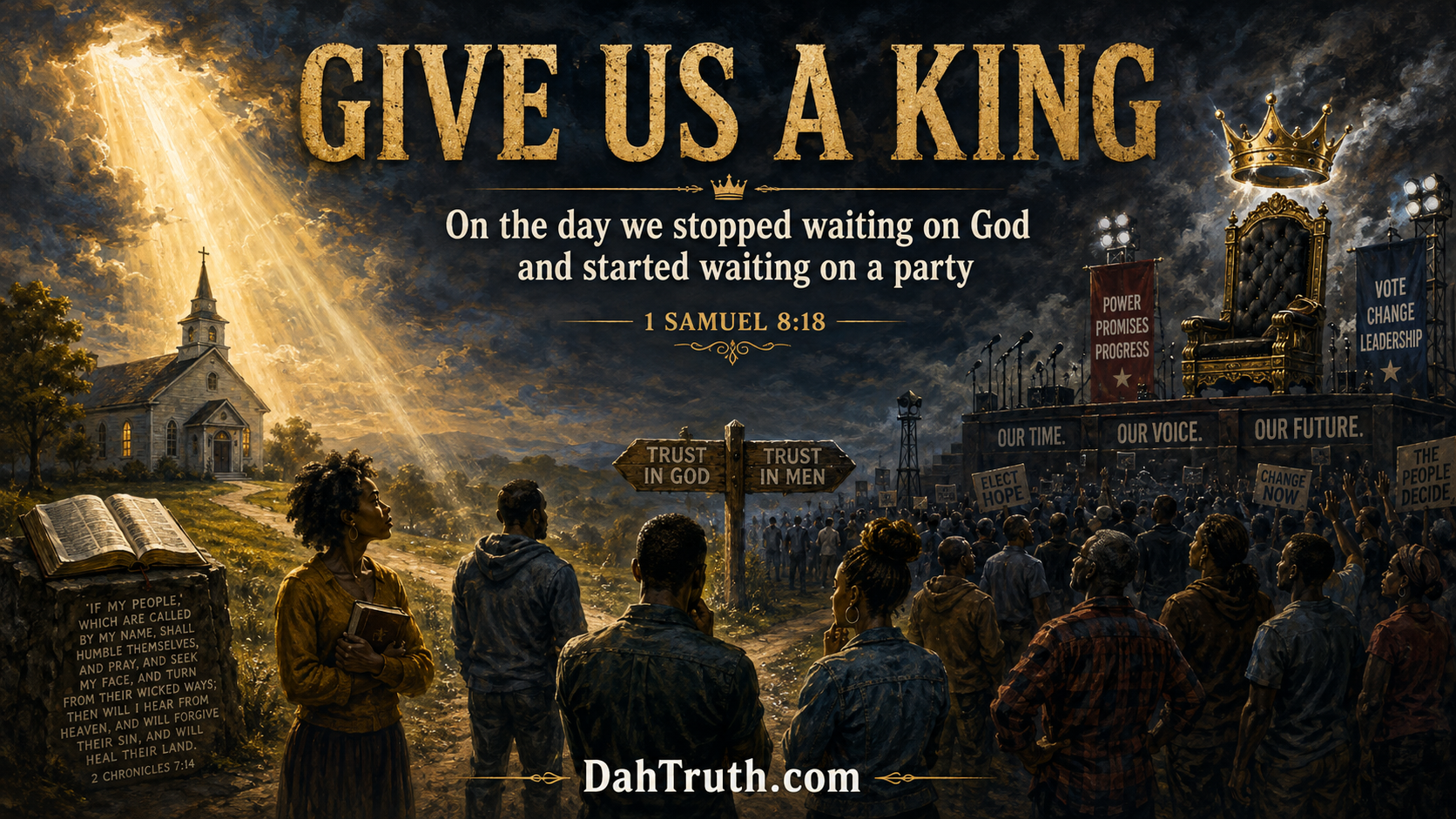
“And ye shall cry out in that day because of your king which ye shall have chosen you; and the LORD will not hear you in that day.” 1 Samuel 8:18
On the day we stopped waiting on God and started waiting on a party
I. The Waking
This Sunday I opened my eyes with a single thought, to get to the house of the Lord.
It was not a bright morning. The sky hung low and overcast, and rain waited somewhere behind it. I went anyway, because His promises are Yes and Amen, and what He asks of us is one thing. Trust. He has never failed me and He never will. That is a small thing, going out under a gray sky, and I would not have thought about it twice except for what I heard when I arrived at the small community of believers.
The sermon was about trust.
As believers in Jesus Christ we are called to trust God, not only with our salvation but with every area of our lives. God is Jehovah Jireh, our Provider. Our provision does not come finally from the government, the system, or humanity. It comes from God.
When the Israelites came out of Egypt, God provided for them every single day. He gave them manna from heaven, but only enough for that day. He did not permit them to store up tomorrow’s portion, because He was teaching them something greater than survival. He was teaching them dependence. Every sunrise required another act of faith. Every morning they had to trust that He would provide again.
I sat with that longer than I expected to, because the manna is not the end of the story. The manna stopped. Scripture says it ceased the day after they ate of the produce of the land, and from then on they ate the fruit of Canaan. God did not withdraw His provision. He changed its form. He moved them from bread they watched fall from the sky to bread that came up out of the ground, and that is a harder trust, because the hand becomes invisible. A people can eat every day of their lives and forget who is feeding them.
That is what happened to them. In the wilderness they had nothing and trusted God for everything. Generations later they had fields and cities and harvests, and they went to Samuel and asked him for a king, so they could be like the other nations. The demand for a king did not rise out of their hunger. It rose out of their abundance.
Somewhere along the way we made the same exchange. As an American Black community we had survived and thrived despite the obstacles of Jim Crow and racism, and despite leaving the South behind and forging north into an unknown world. We traded our trust in God for trust in systems, institutions, and government. Our desire for more government has drawn us away from the One who has always been faithful and toward the belief that security is found in what man and his systems have built rather than in what God provides.
That shift is not only political. It is spiritual. When a people stop trusting God to provide, they begin trusting government to become their provider, and once that happens, dependence becomes a useful thing to the people who administer it. Useful for control. Useful for votes. Before a nation changes politically, it changes spiritually.
We are not a people waiting on God to move. We are a people standing at Samuel’s door, asking for a king.
❦
II. Give Us a King
The elders of Israel came to Samuel at Ramah with a request that sounded reasonable. Samuel was old. His sons walked in their own ways, took bribes, and perverted judgment. Give us a king to judge us, they said, like all the nations.
Samuel was grieved, and he took it to the Lord. The answer he received did not concern him at all.
They have not rejected thee, God told him, but they have rejected me, that I should not reign over them.
That is the verse the whole account turns on. The elders had a governance complaint and God heard a spiritual transfer. They believed they were asking for better administration. He told Samuel they were asking to be ruled by something other than Him.
Then He instructed Samuel to warn them, and the warning is not vague. Read what a king does.
He will take your sons and appoint them for himself, for his chariots and to be his horsemen. He will take your daughters to be confectionaries and cooks and bakers. He will take your fields and your vineyards and your oliveyards, even the best of them, and give them to his servants. He will take a tenth of your seed and give it to his officers. He will take a tenth of your sheep. And ye shall be his servants. 1 Samuel 8:11-17
The word repeats until it becomes the whole meaning of the office. Take. A king was not described to them as a giver. He was described, in advance and in detail, as a taker, and the taking would begin with their children and end with the tenth part of everything they owned.
Then the last warning, which is the one nobody quotes.
And ye shall cry out in that day because of your king which ye shall have chosen you, and the LORD will not hear you in that day.
Not that He could not. That He would not. There is a kind of suffering that comes from an arrangement a people asked for, and God told them plainly that He would let them keep it.
They heard all of it. Scripture says they refused to obey the voice of Samuel, and they said, Nay, but we will have a king over us, that we also may be like all the nations, and that our king may judge us, and go out before us, and fight our battles.
Go out before us. Fight our battles. That is the exchange stated in their own mouths. They were willing to be taken from if someone else would do the fighting.
We know what the king took from Israel. The question worth asking is what he is taking now, and from whom, and whether the people paying have noticed the price.
❦
III. If You Want to Win
A reel came across my timeline this week, posted by Native Land Pod. In it, Tequila Johnson, co-founder and chief executive of The Equity Alliance in Tennessee, a woman who has registered our people by the tens of thousands and has more field experience than most of the men who go on television to explain us, was answering a question about why Democrats will not invest in the South, given that more than half of all Black voters live there.
Her answer was that the party is not afraid of the South. It is afraid of Black leadership. Afraid of funding our media, our strategists, our organizations, our operatives, our candidates at the rates they actually require. Afraid, she said, of Black power and what it would do to their agenda.
She said something else that I have not been able to put down. Being a Black organizer in the South, she said, is full-time work, and the point of it is to humanize us in this work, to make sure we are not just a number on a door sheet. She does not want to be funded as a conduit to knock on doors when elections come. She wants to be funded so that people get fed and their needs are met, so that when elections come around, they know us and trust us.
Then she closed: invest in Black leadership if you want to win.
This was a clip, and a clip is always somebody’s choice about what to show. I am responding to what was put in front of me, and to what Native Land Pod decided was the strongest part of what she said.
I want to give her every bit of her due, because she has earned it and because I think she is right about nearly everything she describes.
We are a number on a door sheet. Anyone who has worked a cycle knows it. The vans arrive in September and leave in November, the consultants who never set foot in the neighborhood collect on the contract, and the people who actually know which house has a grandmother who will talk to you are paid in pizza and a T-shirt. Her frustration is real, it is specific, and it is the frustration of somebody who has done the work.
Sit with that last sentence, though.
If you want to win.
Who is the you?
It is not us. The entire argument is addressed to the Democratic Party, and the return on investment she offers is the party’s victory. Fund our leaders, and we will feed the people, and the people will trust us, and we will deliver them to you.
Follow the circle, because every step in it is rational and not one step produces ownership.
The party funds our organizations. Our organizations meet needs in the community. The community, having been met, comes to know and trust the organizations. The organizations deliver the community at election time. The party wins the seat. Then the party funds our organizations again, at whatever rate seems warranted by last cycle’s yield.
Turn that circle for sixty years and the party has thirty terms in office and we have thirty rounds of programming. On the day we stop turning it, we have nothing, because nothing in it was ever transferred to us. We were never buying. We were being paid, and the payment was calculated against the value of the delivery.
She is not asking for the land. She is asking for a bigger share of the crop, and she is asking the man who owns the land, and she is making her case by promising him a better harvest.
I have called this policy sharecropping before and I will call it that again. The sharecropper who negotiates his share up from a third to a half has negotiated well. He has also agreed, in the act of negotiating, that the land belongs to somebody else.
Now the part that stopped me, and it is the reason this essay exists.
She said the purpose of the funding is to feed people and meet their needs, so that they know us and trust us when the election comes.
Read that as a believer and not as a strategist.
The feeding is instrumental. It is not the end, it is the mechanism, and the product it manufactures is trust. Trust to be harvested on a Tuesday. I do not say that as an accusation against her, because I do not think she is being cynical. I think she has been so long inside an arrangement that she has stopped being able to hear what she is proposing, which is a machine that converts our hunger into our loyalty and then converts our loyalty into somebody else’s seat.
That is manna administered by a king. It comes daily, it comes from a hand you can see, and it teaches dependence on the giver. That is exactly what it is designed to do.
The difference between that and what God did in the wilderness is not the bread. It is who you are looking at when you eat it.
There is one more thing in what she said, and I am going to say it gently. She noted that white people are going to be white people, that even the well-meaning ones hold themselves a class above when it comes to political strategy because they believe they built this system and understand it.
She may well be right about the men she has dealt with. Look at what that observation concedes, though. If the people who control the money cannot help themselves, then the strategy she is proposing is to keep bringing our harvest to a class of people she has just told us cannot be changed. That is not a plan for power. That is a description of a permanent arrangement, offered by someone who has correctly identified that it is permanent.
They are not asking for Black power. They are asking for a king.
Read the mechanism again and it is Samuel 8 in modern dress. Give us someone to go out before us and fight our battles. Give us someone whose business it is to see about us. We will bring what we have and he will send back what he decides we need, and we will be like the other nations, who also have someone to see about them.
Because the faces on the mailer are ours, and the organizers are ours, and the cadence is the one we grew up hearing on Sunday, we have been taught to call the arrangement Black power.
It is not Black power. It is Democratic power with our name on the invoice.
The elders of Israel got the king they asked for, and he was one of their own. From the tribe of Benjamin, a head taller than any man in the nation, an Israelite through and through. He took their sons and their daughters and the tenth part of their seed exactly as Samuel warned, because what made him a taker was never his ancestry. It was the office. A king from among your own people is still a king, and the first thing any king requires is that you keep bringing him something.
We want a king. We have agreed to pretend that he is ours.
❦
IV. The Best of Your Fields
He will take your fields and your vineyards and your oliveyards, even the best of them, and give them to his servants.
On Tuesday, Michigan Democrats choose a nominee for the United States Senate. The contest is between Congresswoman Haley Stevens and Dr. Abdul El-Sayed, and by the time the polls open, something close to sixty million dollars will have been spent to decide it.
Consider what that number means before you consider anything else about the race. Sixty million dollars, in a primary, in one state, for one seat.
Where it came from is a matter of public record. As of late July, the AIPAC-aligned United Democracy Project had spent roughly twenty million dollars supporting Stevens, and a group called A Stronger Michigan had spent almost seventeen million more on her behalf without disclosing a single one of its donors, being funded almost entirely by an organization that does not disclose either. On the other side, the largest outside group supporting El-Sayed had spent a little over two million, and its filings show money from the Institute for Middle East Understanding. Counting everything, outside groups committed something near fifty-one million dollars to boosting Stevens or attacking El-Sayed.
He has run against that money and made it the center of his campaign. He has also pledged to refuse super PAC support while a super PAC formed to counter pro-Israel PACs spends on his behalf anyway, and he released a tax return only under weeks of pressure, and not the full ones his opponent demanded. She released hers and demanded he release his, while quietly requesting extensions on her own financial disclosures every year she has served in Congress. Each of them is transparent about exactly the thing the other is hiding.
Set all of that aside for a moment and ask a different question.
What were they fighting about?
Sixty million dollars came into Michigan, and nearly every dollar of it was deployed in a quarrel over a war seven thousand miles from Seven Mile Road. One side’s money came from people whose central commitment is the state of Israel. The other side’s money came from people whose central commitment is opposition to it. That is a real disagreement, and men of conscience hold both positions.
It is not a Detroit position. Neither one of them is.
Not one of those sixty million dollars was fighting over whether a child on the east side can read. Not one was contending over the nine in ten of us who die of overdose without ever having been reached by treatment. Not one was spent arguing about who owns the buildings on the block, or what happens to the men coming home from Jackson, or why the neighborhood clinic closed. Two armies met in Michigan, spent a fortune, and the thing they were fighting over was not us.
Both of them want Detroit, and both have spent the final weeks trying to get it. She has been working the churches in Wayne County. He points to his years as the city’s health director and then the county’s, the free eyeglasses he put on children’s faces, the polluters he went after, the lead he took out of the pipes. Those things happened. Neither one of them is a stranger here and I am not going to pretend they are.
What I notice is the shape of it.
When Bernie Sanders and Alexandria Ocasio-Cortez came to Detroit to rally for him, the room was overwhelmingly white, in the largest majority-Black city in America. Congressman Clyburn said afterward that he saw a photograph of that rally and did not see a single person who looked like him, and that this told him all he needed to know. Meanwhile an AIPAC-funded super PAC has been running an advertisement featuring Barack Obama praising Haley Stevens, and Barack Obama has not endorsed Haley Stevens.
Our faces are in the commercial. We were not in the room.
He is down forty-six points with us. So today, two days out, he is walking our streets and sitting for our media.
Larry Nix is a sixty-three-year-old Army veteran. He pulled into a cookout hosted by the El-Sayed campaign, rolled down his window, and said he needed answers. Haley Stevens had come to his house during previous campaigns, spoken with him, and put a sign in his yard.
That is what showing up means to a man who has been here the whole time. Not a cookout in the last fortnight. A knock on the door in a year when nothing was at stake.
Tequila Johnson said she does not want to be funded as a conduit to knock on doors when elections come. She named the thing exactly, and here it is, forty-eight hours out, both campaigns on our blocks, sixty million dollars spent, and the block itself learning nothing about either of them that it did not already know.
Keith Williams, who chairs the Michigan Democratic Party Black Caucus, said the truest thing anybody has said about this race. He does not want to see people die in the Middle East, he said, but his people are dying every day in the hood, from gun violence and from not having the education they need to survive in this community.
He is right, and nobody spent sixty million dollars on what he just described.
That is the vineyard. The harvest of a place, gathered up and handed to the servants of a court, to settle disputes the people who grew it were never consulted about. Samuel told them the king would do this. He said the best of it, not the leavings. Then he told them the part we forget, which is that when it began to hurt, they would cry out and would not be heard, because the arrangement was one they had asked for.
I have no counsel to offer either side of that war. What I know is that our fields are being harvested for it, and that both armies will be in our churches by Sunday.
❦
V. The Silence
On July 2, Andrew Gillum was pulled over in Daphne, Alabama, for driving erratically. An officer saw a glass pipe on the center console. The search that followed turned up rolled marijuana cigarettes and three packages of a substance that tested positive for methamphetamine. He was booked into the Daphne City Jail, transferred to the Baldwin County Correctional Facility, and released the following day.
He is forty-six. He was mayor of Tallahassee, and in 2018 he came within roughly thirty-four thousand votes of becoming the first American Black governor of Florida. He co-hosts Native Land Pod with Angela Rye and Bakari Sellers. This was not the first time. In 2020 he was found in a Miami Beach hotel room in an incident involving suspected crystal meth, and no charges were filed.
His colleagues did not abandon him. The podcast told its audience he would be absent and asked for prayer. Angela Rye spoke about it on the air, plainly and with feeling, and said she had no intention of turning her back on him, that a person should not be reduced to his worst moment. She was right. I will not pretend otherwise, and anyone who watched that segment saw something real.
Then the show went back to work.
The episode that carried the audience’s messages of support for him also covered a security breach at a concert, a governor turning down summer food funds, and a rapper who paid for a presidential pardon that never came. Two days after the arrest he appeared at the Essence Festival in New Orleans, on a panel about the midterm elections, and said nothing about it. The stage went on.
I want to be careful here, because this is not about one man’s failure. It is about what his failure reveals.
Andrew Gillum has money, a national platform, and colleagues who love him publicly. He could not get free of the addiction that runs rampant through our communities. If a man with all of that cannot get free, what do we imagine is happening to the woman on the third floor of a building nobody has repaired since 1994, who has neither the access nor the resources?
Here is what is happening to her.
In the most detailed federal analysis of overdose deaths by race, among American Blacks who died, only 8.3 percent showed any evidence of having received substance use treatment beforehand. That is the lowest share of any group measured. More than nine out of ten died having never been reached by anyone. Nationally, in 2023, an estimated 54.2 million Americans needed treatment for a substance use disorder and 12.8 million received it.
Now hold that next to this. Overdose rates were higher in areas with more treatment program availability than in areas with less, and among American Blacks the gap was 34.3 against 16.6.
Read that again. The buildings existed. The grants were awarded. The ribbon was cut and somebody stood behind a podium and called it an investment in the community. The death rate in those places was double.
That is the whole argument in a single line of data. A program is not a person. An appropriation is not an outreach. A facility down the street that no one on your block has ever walked into is not help, it is architecture, and we have been taught to accept the architecture as the answer.
I will tell you the part that complicates my own case, because you deserve it and because someone will say it if I do not.
Things improved. The CDC reported in January of this year that overdose death rates fell for every group between 2023 and 2024, and that the largest decline of all was among American Blacks, down 30.9 percent, from 48.9 to 33.8 per hundred thousand. Provisional figures through January 2026 project another 13.2 percent national decline.
That is real and I thank God for it.
It is also not what it appears to be. A rate of 33.8 still sits far above the national rate of 23.1. We fell the furthest and we are still dying at the highest rate in the country. The decline came largely through changes in the drug supply and through the distribution of naloxone, which is to say we got better at reviving people after they stopped breathing. That is worth having. It is not restoration. The bleeding slowed. Nothing was rebuilt. No father came home. No man was discipled. No young woman was taken in by anybody’s church and taught who she is.
We were revived. We were not delivered.
Through all of it, count the hours of commentary you have heard on the recovery of American Black men from addiction, and set them beside the hours on the last election, the next election, and the man in the White House. Count the segments on prison reform, on family formation, on homeownership, on business formation, on why our children cannot read, and set them beside the segments on what some senator said on a Tuesday.
The elders told Samuel they wanted a king to go out before them and fight their battles. We have people who will go out before us and fight our battles on television every week. The battle they fight is not the one that is killing us.
❦
VI. The Name
On July 2, Native Land Pod published an episode. The description in the feed promised its listeners a case study of Clarence Thomas, perhaps the most powerful self-hating Black man.
That was not a slip of the tongue in the middle of a live conversation. It was written. It was edited. It was placed in the feed where subscribers would see it before pressing play.
I will tell you plainly that I admire Clarence Thomas, and I will tell you why, because it is not the reason people assume. It is not that I agree with every opinion he has written. It is that he reasons from somewhere. He argues from what a people are owed and what a people are capable of, and not from what a party will permit, and he has paid for thirty-four years in a currency most men will not spend.
Argue with the man. Take apart his reasoning, his method, his votes, his silences. All of that is legitimate and some of it is necessary. What is not an argument is the word they used.
Self-hating is not an argument. It is a diagnosis of a man’s interior life, delivered by people who have never sat with him, and it does a particular kind of work. It says that an American Black man who reasons his way to an unapproved conclusion is not mistaken but sick. It relocates the disagreement from what he said to what is wrong with him. Once a man’s dissent is a symptom, nobody has to read it.
It also belongs to a family. Coon. Uncle Tom. House negro. Sellout. That vocabulary was not built to help us. It was built to describe us, and we borrowed it, and we now aim it at each other with a fluency our enemies never achieved. I notice, too, that whoever reaches for Uncle Tom as an insult has not read the book, in which Tom is beaten to death for refusing to say where two women had gone.
Now consider what was actually in the record when that description was written.
Two days earlier, on June 30, the Supreme Court decided Trump v. Barbara, upholding birthright citizenship for children born on American soil to undocumented parents and temporary visa holders. The vote was six to three. Only five justices reached that conclusion on constitutional grounds.
Clarence Thomas dissented, at ninety-one pages, occupying nearly half the length of the Court’s entire opinion. His argument was that the Fourteenth Amendment was designed and understood to secure equal rights for the freed blacks and has since been repurposed for political projects the Reconstruction Congress did not support. He wrote that the majority’s reading devalues citizenship. He leaned heavily on Dred Scott, the decision that held our ancestors could not be citizens at all, and argued the Court had gotten it wrong because Blacks were entitled to citizenship as Americans.
Whatever else is true about the man, that is the particularist claim. It is the argument that the covenant made after the war was made with a specific people, for a specific injury, and that it belongs first to their descendants.
Ketanji Brown Jackson concurred with the majority, in twenty pages, and she came for him directly. She noted that despite his long endorsement of a colorblind Constitution, Thomas now surprisingly suggests the Citizenship Clause was a race-conscious remedial measure. She called his treatment of the history myopic. She wrote that the Reconstruction Amendments were an anticaste, antisubordination reset for the nation, not a mere spot treatment for the dark stain of slavery. She wrote that his account pitches Black Americans against immigrants when the advocates who promoted the Fourteenth Amendment did no such thing.
Her strongest blow is historical, and I will not pretend it is weak. She spent much of her opinion on the decades before ratification, when American Blacks organized local and national conventions and pressed a universalist vision of citizenship grounded in birth on the soil. Freed Blacks, she wrote, did not advocate for a unique set of rules that catered only to their situation.
That is a serious argument and it is aimed at people who think like me.
Here is my answer. Our ancestors argued universally because particularity was the instrument being used to destroy them. Dred Scott was a particularist ruling. It held that this specific people, uniquely, could not be citizens. A man fighting that decision could not win by requesting a carve-out, because the carve-out was the weapon. The only road to being covered was to make the rule cover everyone. That is a strategy adopted under duress, and reading it as a renunciation of what they were owed asks us to believe that a people arguing for their lives were also, in the same breath, waiving their claim.
The citizenship rule is not the same question as the debt, either. Whether every child born on this soil is a citizen, and whether this nation owes a particular people for two hundred fifty years of unpaid labor, are two separate questions. Jackson answered the first. She did not answer the second, and neither did the Court.
I will concede what should be conceded. Thomas’s reading served the position of an administration that wanted to end birthright citizenship, and that alignment is not nothing. A man can be right about the origin of a promise and still be wrong about what to do with it, and I would rather say that than pretend the alignment is not there.
His critics reach past this case for two others, so let me meet them. Shelby County did not end the Voting Rights Act. The Court struck a coverage formula Congress had not updated since 1975 and handed the pen back to Congress, which has declined to pick it up for thirteen years, and Section 2 stands untouched.
What preclearance actually produced is worth remembering. Under the rule against retrogression, the Justice Department spent the nineties pressing what were called max-Black plans, concentrating our voters into a handful of safe seats and bleaching everything around them. We got districts nobody had to compete for, held by people who never had to earn us, in states where every surrounding seat went the other way. That was the machinery, and the people mourning its loss were the ones it served. The fight over packing did not end there and has not ended now, and it is being waged over Section 2, which is still standing.
As for affirmative action, I will say plainly what many of us say quietly. A program whose beneficiaries extended far past us, and whose Black beneficiaries were disproportionately the children of immigrants and professionals, was never built for the descendants of slaves. It bought us a stigma and somebody else’s advancement.
The record is longer than a feed description, and I have read the ninety-one pages. They did not.
What I am asking you to notice is smaller and harder.
The man they call self-hating made the argument that the Fourteenth Amendment belongs particularly to the descendants of slaves. The woman they celebrate made the argument that it does not. Both of them are American Black. Both of them are serious. The vocabulary we have been handed predicted the opposite of what happened, which should tell us the vocabulary is not for thinking.
It is for sorting. It tells us who is inside and who is outside, and it saves everyone the trouble of reading ninety-one pages.
There is one more thing about that date.
The description went into the feed on July 2. That night, in Daphne, Alabama, one of the show’s hosts was pulled over for driving erratically, and an officer saw a glass pipe on the console. The word self-hating was published, in writing, on the same day, by a program that would ask its audience the following week to pray for a man in the grip of an actual affliction.
They located the sickness in the wrong man.
❦
VII. The Cry in That Day
Somebody reading this is preparing an objection, and it is the right one, so let me state it better than they would.
The Black church built the Civil Rights Movement, and the instrument of that movement was federal power. The Voting Rights Act was legislation, not revival. Men and women who prayed all night went to Washington in the morning and demanded that the government act, and it acted, and lives were saved. An essay that says a people should not look to government would have told them to stay home.
It would not, and here is the distinction.
Moses went to Pharaoh. He stood in the court of the most powerful man in the world and made a demand of the state, and the demand was righteous, and God sent him to make it. Read what he asked for, though. He did not ask Pharaoh for bread. He did not ask to be fed better inside the arrangement. He said let my people go, and every plague that followed was an argument about departure, not about terms.
A people can approach power out of covenant or out of forgetting, and the difference is not the approach. It is what they are carrying when they arrive. Moses came to Pharaoh’s court with God behind him and a demand in his mouth. The wilderness generation, a few chapters later, wept for Egypt and remembered the fish they ate freely there, and wanted to go back. Same people. Same God. Different thing being asked for.
We have been taught to ask for the fish.
We should be honest about how it happened, because nobody chose it in a single afternoon. The manna stopped when they entered the land. God did not withdraw. He changed the form of the provision, and ordinary provision is where trust gets hard, because the hand becomes invisible. Then generations pass, and the elders walk to Ramah and ask for a king so they can be like the other nations, and the request does not come out of hunger. It comes out of having enough to be embarrassed about what they look like to everybody else.
Samuel told them what a king costs. Their sons. Their daughters. The tenth part of their seed. The best of their fields, handed to his servants. He told them and they said, nay, but we will have a king over us, that we also may be like all the nations, and that our king may judge us, and go out before us, and fight our battles.
Go out before us and fight our battles.
We have men and women who will go out before us and fight our battles every week, on television, on podcasts, in the well of the Senate. They are good at it. Some of them love us. The battles they fight are not the ones that are killing us. Sixty million dollars moved through Michigan in ninety days over a war on another continent while nine out of ten of our dead went to the grave without anyone reaching them. A man was called self-hating in writing for saying the covenant was made with us, on the same day another man was pulled over with a pipe on the console.
And ye shall cry out in that day because of your king which ye shall have chosen you, and the LORD will not hear you in that day.
That is the hardest sentence in the chapter and I have carried it all week. Not that He could not hear. That He would not, because they asked for it, and He let them keep what they asked for.
I do not believe we are past hearing. I have too much history with Him to write that sentence and mean it. I believe we are somewhere in the taking, though, and I believe we have been trained not to recognize it, because the taking arrives with a press release and a ribbon and a man in a good suit saying he is fighting for us.
The question is not who we voted for. It never was.
The question is who we are waiting on.
❦
SOURCE NOTES
Scripture: 1 Samuel 8; Joshua 5:12; Numbers 11:5; 1 Samuel 9 and 10 (Saul of the tribe of Benjamin).
Tequila Johnson: Native Land Pod Instagram reel, viewed this week. Quotations transcribed by the author from the clip as posted.
Michigan spending figures: AdImpact and FEC filings as reported by Bridge Michigan, CBS News and CNN, as of late July 2026. United Democracy Project roughly $19.9 to $30 million; A Stronger Michigan $16.8 million, donors undisclosed, funded by Center Forward; Fighting for Michigan roughly $2.3 million, filings show Institute for Middle East Understanding.
Transparency: Michigan Advance and The Hill, July 2026. El-Sayed released his 2025 return in mid-July under pressure; Stevens pressed for full returns at the July 27 debate. House records show Stevens has requested disclosure extensions annually since 2019.
Detroit rally and Clyburn: Punchbowl News and WDET, July 2026. Larry Nix and the New Bethel Missionary Church appearance: CNN, July 27, 2026. Keith Williams: MS NOW, July 31, 2026. Forty-six-point deficit among Black voters: polling as reported July 2026.
Gillum arrest: Daphne Police Department release; NBC News, Detroit News, CNN, July 2026.
Overdose data: CDC SUDORS analysis, MMWR 71(29), covering 2019 to 2020 across 25 states and DC (8.3 percent prior treatment; 34.3 vs 16.6 by treatment availability). CDC NCHS Data Brief No. 549, January 2026 (30.9 percent decline; 48.9 to 33.8; national rate 23.1). CDC provisional data, June 2026.
Trump v. Barbara, decided June 30, 2026. Thomas, J., dissenting; Jackson, J., concurring. Quotations as reported by Bloomberg Law, The Hill, NPR and HuffPost.
Native Land Pod episode description, published July 2, 2026, Apple Podcasts feed.
Policy Sharecropping
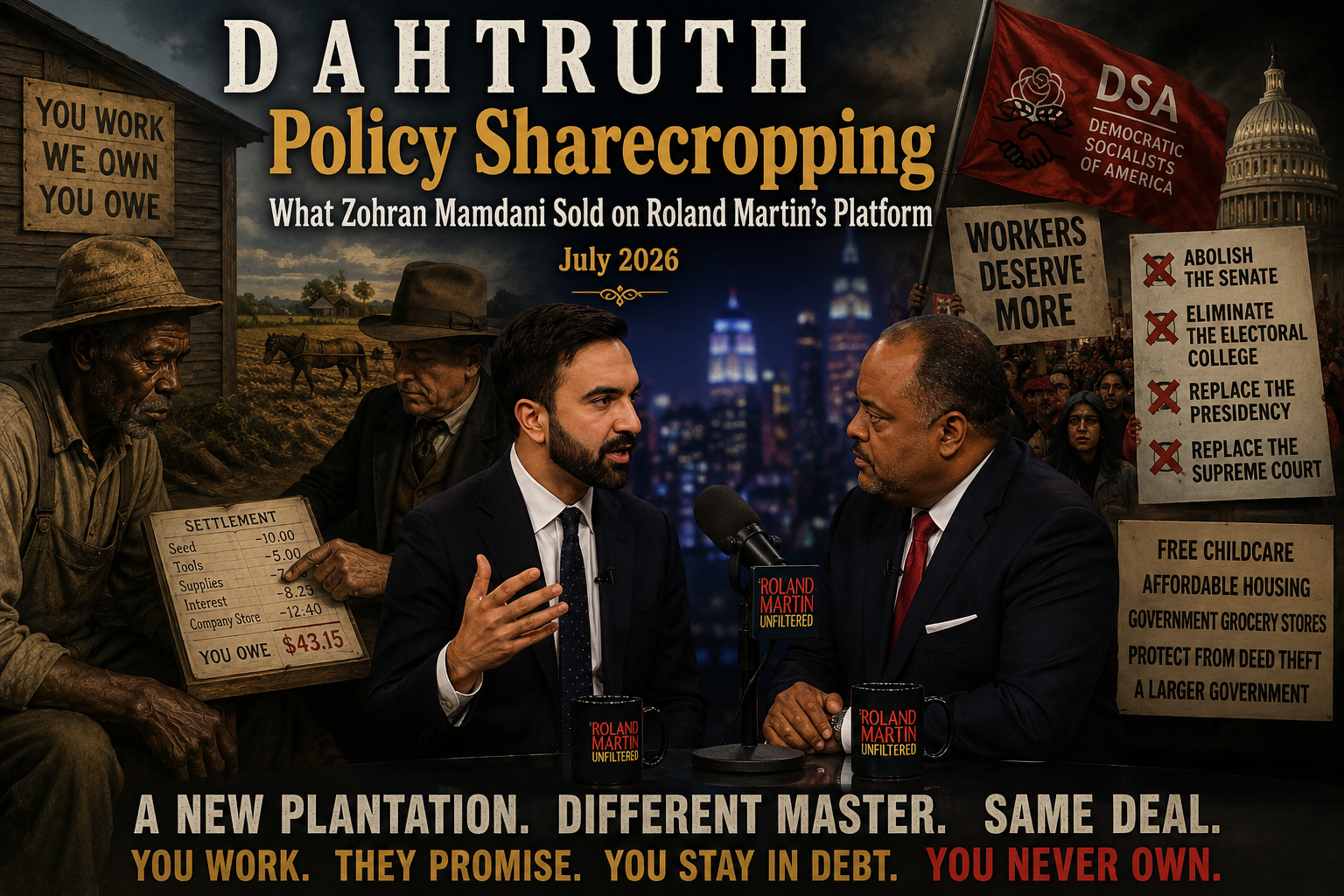
“Power concedes nothing without a demand. It never did, and it never will.” —Frederick Douglass, West India Emancipation, August 4, 1857
What Zohran Mamdani Sold on Roland Martin’s Platform
❦
After emancipation, the men and women who had been slaves were handed something that looked like freedom and operated like a lease.
The sharecropper worked land he did not own. He supplied the labor, the sweat, the hours before daylight and the hours after. He planted the crop, tended it and brought it in. At settlement the books were read to him by the man who owned the field. He could not audit those books, could not dispute them and could not walk away, because the debt always came out just above the harvest.
He was free. He was also never going to own anything.
That arrangement never fully ended in American Black life. It changed clothes.
❦
Over the last several weeks, we have watched a widening fracture inside the Democratic Party between its centrist establishment and the Democratic Socialists of America. I must admit that it has been a joy and a pain to watch. For years, centrist Democrats tolerated the socialist wing, borrowed its language, encouraged its activists and assumed they could control its growing influence. Now the faction they helped cultivate is attempting to take possession of the party itself, and the centrists have finally begun to fight back with a vengeance.
The next several months will be critical. A number of states will hold important primaries and elections in August and September as both parties move toward the November 2026 midterm elections. These contests will help determine whether the Democratic Party remains under the control of its traditional establishment or whether the DSA succeeds in moving the party further toward democratic socialism.
At the center of this struggle stands New York City Mayor Zohran Mamdani. He may not carry an official title as the national leader of the DSA, but he has become its most recognizable elected spokesman and one of its most valuable political organizers. In June his endorsements carried socialist and progressive candidates past established Democrats in three New York congressional primaries, and the movement is now attempting to reproduce that success in other states, including Michigan.
The DSA has recently faced damaging publicity, and its own documents have done more damage than its critics ever could. In July the organization released a program titled Workers Deserve More, drafted between April and June and approved by its National Political Committee. That program calls for a new democratic constitution. It would abolish the United States Senate. It would eliminate the Electoral College. It would replace the presidency and the Supreme Court with an executive and a judiciary chosen by Congress and answerable to it.
Asked whether any of that was extreme, DSA co-chair Ashik Siddique answered that they do not think so.
Even as one of the movement’s favored candidates seeks a seat in the United States Senate, the movement has now put in writing that the Senate should cease to exist.
That is not ordinary political reform. It is an attempt to reconstruct the American system.
Prominent Democrats have begun saying publicly what centrists long avoided. Van Jones, no one’s idea of a conservative, wrote this month that the youth movement he waited his whole life to see is being hijacked by people with insane, outlandish and nutty ideas.
The problem underneath is real. Mamdani won the 2025 primary without us. A New York Times analysis found that in precincts where at least seventy percent of residents were Black, Andrew Cuomo more than doubled him, fifty-nine percent to twenty-six. Black voters moved toward him in November, after months of outreach and a deliberate pivot to pocketbook language. That is a movement that had to run from its own brand to survive a primary.
That presents the DSA with a serious problem.
The Democratic Party cannot consistently win national elections without the American Black vote. Yet the socialist faction attempting to take control of that party is overwhelmingly white, advances very few American Black candidates and increasingly promotes immigrants, the children of immigrants and white progressive candidates as the new faces of the Democratic coalition. American Blacks remain the party’s most dependable voting bloc, but we are becoming less central to the leadership, ideology and candidate selection of the party our votes have sustained.
So what does Mamdani do?
He appears on Roland Martin Unfiltered, one of the most recognizable Black political platforms in the country, to sell democratic socialism directly to the American Black community.
The timing was strategic. Mamdani appeared after weeks of negative press for the DSA, and in the same week his own rhetoric collided with the limits of his office. He had said his administration was in active conversation with the city’s Law Department about arresting Israeli Prime Minister Benjamin Netanyahu when he comes to New York for the United Nations General Assembly in September. Days later he conceded the city has no authority to execute a warrant from the International Criminal Court, and asked the federal government to carry it out instead. The retreat was jurisdictional. The accusation never softened.
Now Mamdani is moving through the media circuit attempting to present the DSA as reasonable, practical and far less radical than its critics claim.
His sales presentation to Roland Martin’s audience was built around familiar promises: free childcare, affordable housing, protection from deed theft, government grocery stores and a larger government prepared to provide more services. The message was clear. Democratic socialism, he argued, is not something American Blacks should fear. It is simply government working on behalf of ordinary people.
That sales presentation rests upon an assumption that deserves to be confronted.
It assumes that American Black voters can be won by promises of free programs. It assumes that we are more interested in government dependence than homeownership, entrepreneurship, educational excellence, safe communities and generational wealth. It assumes that if politicians tell us often enough what they are prepared to give us, we will not examine what their policies prevent us from building for ourselves.
Most importantly, it assumes that we will not notice the political sharecropping taking place directly in front of us.
Mamdani and the DSA need the American Black vote to capture the Democratic Party. The policies they offer do not place American Blacks at the center of their agenda. We are expected to provide the turnout, defend the coalition and deliver the election, while other groups select the candidates, define the ideology and inherit the political power.
That is why Mamdani’s conversation with Roland Martin deserves closer examination. Not simply because of what Mamdani said, but because of what he avoided, what Roland failed to press and what the entire interview revealed about the DSA’s effort to gain control of the Democratic Party through a voting bloc it has done very little to represent.
❦
What He Reached For
Asked about the shortage of senior African American leadership in his administration, Mamdani named Deputy Mayor Renita Francois and Chancellor Kamar Samuels, then said he wanted a city government that looks like New Yorkers, a gorgeous mosaic. He credited the phrase to David Dinkins. He called Dinkins the first democratic socialist mayor of New York and our first Black mayor, and called him an inspiration. He left out that David Dinkins was an strong supporter of Israel.
Roland Martin asked one follow-up question and moved on.
He might have asked one more. Kamar Samuels was born in Jamaica. David Dinkins, the man whose standing was being borrowed, was an American Black New Yorker who served in a segregated Marine Corps and spent a lifetime inside the party. Between the two of them sits the whole argument this movement will not have.
Understand what happened in that moment. A movement with almost no American Black leadership reached back more than thirty years to borrow the standing of a Black man it did not elect, in order to sell itself to Black voters it needs but does not intend to promote.
That is the transaction. Everything after it is terms.
❦
The Sales Presentation
Mamdani did not come before Martin’s audience to defend the hardest edges of his movement. He brought the softened version, packaged for us.
Childcare. Affordable housing. Deed theft. Groceries. Potholes.
Everything framed as something the government could give.
Childcare
He opened by saying his administration had put the city on a path to universal childcare, saving parents more than twenty thousand dollars a year for every two-year-old enrolled.
The word carrying that sentence is path.
By his own administration’s announcement, the first phase provides two thousand free seats this fall in four communities: Washington Heights and Inwood, Fordham and Kingsbridge, East Brooklyn including Canarsie, Brownsville and Ocean Hill, and Ozone Park and the Rockaways.
Look at that map. Washington Heights and Inwood, the largest Dominican community in the United States, is 8.7 percent Black. Fordham and Kingsbridge run roughly seventy percent Hispanic. Ozone Park is heavily Indo-Caribbean and South Asian, and the Rockaway peninsula is 35.1 percent white against 33.8 percent Black. One of the four, East Brooklyn, is predominantly Black, and Brownsville and Ocean Hill earned every seat they received. Brownsville’s poverty rate is 29.3 percent.
One of four. Three of the first four communities are immigrant-heavy neighborhoods, in a program his administration advertises as available regardless of income or immigration status, paid for with tax dollars including ours.
The program is expected to reach roughly twelve thousand children by the fall of 2027 and full universality by the end of his term, serving an estimated fifty-five thousand two-year-olds.
Two thousand today. Fifty-five thousand at completion. Available regardless of income or immigration status.
Martin did not ask how the two thousand families would be selected, how many qualified families would be turned away this fall, or what share of the first seats would go to American Black children. He accepted the twenty thousand dollar figure and moved on.
A promise can be universal while the benefit in hand stays very small.
Housing
Martin raised the departure of Black residents from the city, and he was right to. Mamdani acknowledged that more than two hundred thousand Black New Yorkers have left over recent decades, that the population of Black children and teenagers fell nineteen percent between 2010 and 2019, and he called it a reverse Great Migration.
His answer was to build two hundred thousand affordable homes and preserve two hundred thousand more over ten years.
Ask what affordable means in that sentence.
Affordable housing is not ownership. It is most often another regulated rental, another income-restricted apartment, another household living inside a system where a public authority, a nonprofit developer or a private landlord holds the deed and the government sets the eligibility. That housing keeps families from being displaced. It prevents homelessness. It provides stability, and stability is worth something. Stability does not appreciate, and stability cannot be left to a grandchild. It is stability administered by the government, renewable at the government’s discretion. Socialism at its finest.
New York City already holds roughly one million rent-stabilized apartments housing about 2.4 million people. In June the Rent Guidelines Board voted seven to one to freeze rents on one-year and two-year renewal leases, the first two-year freeze in the city’s history. That freeze is real relief for tenants already inside the system, and Black tenants are among them. It produces no additional apartment for the family still searching, and it converts no monthly payment into equity.
Meanwhile, according to the Furman Center’s most recent figures, homeownership in New York City in 2024 ran to 45.2 percent for Asian households and 41.7 percent for white households, against 25.9 percent for Black households and 17.2 percent for Hispanic households. Black borrowers were the only group whose refinancing activity fell further that year, down 7.3 percent.
Those numbers should have driven the entire interview.
Where was the plan to raise Black homeownership? Down-payment assistance aimed at long-established working families. Affordable mortgage products. Protection of inherited property. Black-owned housing development. A pathway out of public housing and into a deed.
Martin asked the ownership question and Mamdani answered a different one.
He mentioned homeownership, then moved to what he had built to protect it. The city’s first Office of Deed Theft Prevention. A pause on the Giuliani-era tax lien sale, which he correctly noted had been applied in Black neighborhoods at six times the rate of white ones.
Both are worth having. Neither is what he was asked.
Here is the scale of what he offered. The Independent Budget Office reports that at least 1,008 lien-sale properties completed foreclosure and went to auction over the past decade. Two hundred fourteen of them were one-to-three family homes. About twenty-one small houses a year. Nearly six hundred more sit in active foreclosure now. Deed theft draws roughly three hundred complaints a year across the five boroughs, and the Queens District Attorney has recovered twenty-three homes since 2020.
Every one of those families deserves protection and every case deserves prosecution.
Now set that beside the question. Black homeownership in New York City is 25.9 percent. White homeownership is 41.7 percent. Closing that distance means tens of thousands of families holding a deed who do not hold one now.
Protecting the house a family already owns is not the same as helping a family buy one. The first defends the few who made it inside. The second is how a community builds something it can hand down. He was asked about the second and answered with the first.
He did not mention the partition suits either. Roughly 350 are filed in this city every year against families whose parent died without a will. The homes average $1.1 million and they cluster in Central Brooklyn and Southeast Queens. A speculator buys one heir’s fractional share for a fraction of its worth, then uses the courts to force the sale of the whole house. The Center for NYC Neighborhoods has identified $400 million of equity sitting in those disputes and estimates the true figure closer to $4 billion. It is asking for ten million dollars to lend heirs the capital to clear title before an investor arrives, and calculates that every dollar lent preserves thirteen to fifteen dollars in family wealth.
Ten million dollars, to keep families in houses worth a million each. He has committed seventy million to five grocery stores.
Taxes
Martin asked the right question. What happens to homeowners, especially seniors on fixed incomes, when you raise the revenue to pay for all of this? Which is to say, what happens when you draw on the middle class and the elderly to expand services offered without regard to citizenship?
Mamdani answered that the burden would fall on non-resident owners of second homes worth more than five million dollars. Very few and far between, he said.
The flip repeated itself. He had two proposals of his own aimed squarely at ordinary homeowners, and he named neither.
In March his office circulated a memo to state lawmakers proposing to cut New York’s estate tax exemption from $7,350,000 to $750,000 and raise the top rate from sixteen percent to fifty percent. It would have given New York the lowest estate tax threshold in the country. The figure is not new to him. As a state legislator he co-sponsored a bill built on the same $750,000 exemption.
The median New York City home price reached a record $800,000 in the third quarter of 2025. The median home in this city already clears the line he proposed. A family in St. Albans or Cambria Heights that bought in 1975 and held on through everything the city did to them would cross that threshold on the house alone, before a single retirement account is counted.
Council Member Phil Wong of Queens said the change would hit closer to home than people realize, and that families could be forced to sell the very homes they hoped to pass on to their children. Bloomberg Tax, writing in favor of taxing inherited wealth, called the design a policy that would land on asset-rich, cash-poor households whose primary asset is housing.
Asset-rich and cash-poor. That is the identical phrase housing researchers use for the families losing homes to partition suits in Southeast Queens. Same families. Same houses. Two mechanisms reaching for the same equity.
It did not pass. Neither the legislature nor the governor included it. He asked for it anyway, and then sat in Roland Martin’s studio and answered a question about the burden on Black homeowners by talking about five-million-dollar second homes.
Deed theft is the story he tells about Black homeowners. The estate tax memo is the one he does not.
What he did not volunteer, and what Martin did not raise, is that in February he had proposed a 9.5 percent citywide property tax increase in his preliminary budget as a fallback if Albany refused to raise taxes on high earners and corporations. It would have touched more than three million residential units. The Citizens Budget Commission estimated roughly seven hundred additional dollars a year for a typical homeowner.
Mamdani knew exactly who it would land on. He said so at the announcement. He acknowledged the increase would fall hardest on homeowners in mostly Black neighborhoods, a constituency he had struggled to win, and framed it as asking those working-class New Yorkers to fork up.
He was not the only one who noticed. Council Deputy Speaker Nantasha Williams of St. Albans said that advancing a tax increase without first addressing the underlying inequity feels deeply tone-deaf to Black, Brown, and working-class homeowners like the families she represents in Southeast Queens, who are already shouldering a disproportionate share of the property tax burden.
That is a Black Democratic official describing a Black Democratic constituency being asked to finance a program built for someone else.
Speaker Julie Menin said significant property tax increases should not be on the table whatsoever. Mamdani dropped the proposal from his executive budget in May, after Governor Hochul delivered enough state aid to close the gap.
He backed off because Albany paid, not because the constituency he named held leverage he was obliged to respect.
Martin had every element of that history available to him. He asked about the burden on Black homeowners and let the answer about five-million-dollar second homes stand.
Groceries
Five city-owned stores, one per borough, seventy million dollars in capital funding. The first is scheduled to open in the Bronx at the end of 2027. The East Harlem location is not expected until the end of 2029. The city will own or subsidize the space while a private operator runs the store.
That does nothing for the grocery bill a family is paying this week. It is a promise whose distance is concealed inside the phrase city-run grocery stores.
None of it is free. The childcare worker is paid. The bus is fueled and repaired. The store buys inventory, employs staff, runs refrigeration and carries its property costs. Government can move a cost, bury it in another account or collect it from a different taxpayer. Government cannot make a cost disappear.
❦
A Chancellor Without an Accounting
Martin raised the schools and asked the right question again. If a parent has a child in the ninth grade, that child cannot wait four or five years for a turnaround.
Mamdani answered by praising Chancellor Kamar Samuels, who is doing a very good job, and emphasized his commitment to rigor and to an integrated school system.
A very good job is not a measurement.
Samuels has a real record and it deserves examination rather than a wave of the hand. He began as a Bronx classroom teacher, became principal of the Bronx Writing Academy, served as superintendent of Brooklyn’s District 13 and Manhattan’s District 3, oversaw the NYC Reads literacy rollout that his own department credits with a five percent increase in literacy outcomes, secured more than ten million dollars for integration work across two districts and launched seventeen International Baccalaureate programs.
Five percent of what, and for whom?
There is the question Martin never asked. What happens to Black children in the districts this man has led, and in the system he now runs?
The answer is public. It has been sitting on the New York State Education Department website the entire time.
Take Brooklyn’s District 13, which Samuels ran from 2019 until 2022 and which is the district most associated with his integration work. The most recent state report card is not his tenure, and I will not pretend it is. It is worth reading anyway, because of what it says about what integration accomplished and what it did not.
In District 13, Black students were proficient in English at just under fifty percent. White students, in the same district, in many of the same buildings, sitting the same tests: eighty-seven percent. In mathematics, Black students came in at forty percent. White students, eighty-four.
A thirty-seven point gap in reading. A forty-four point gap in mathematics. Inside one district.
Now understand what makes that number land. District 13 is not a failing district. All students, grades three through eight, came in at sixty-two percent in English, above the city and above the state. The four-year graduation rate is ninety-one percent. On the aggregate it reads as a success story, and that is precisely how it gets told.
The aggregate is the disguise. A district can post excellent overall numbers while the Black children inside it are educated in a different system entirely, and nobody is ever required to say so, because press releases do not disaggregate.
Citywide the same pattern holds in the system Samuels now runs. Forty-seven percent of Black students read at grade level, against seventy-four percent of white students. Black scores rose eight points last year, the largest gain of any group, and the gap is still twenty-seven points wide.
That is the emergency. Neither man in that studio named it.
Longevity inside a struggling system can demonstrate expertise. It can also demonstrate participation. Samuels was appointed, not elected, and the case made for the appointment was assembled out of adjectives. Rigor. Integration. A very good job. When a man is handed nine hundred thousand children and the strongest public argument for him is a five percent literacy improvement in a single district, the parents asked to applaud are entitled to ask what he produced for Black children specifically, and to be handed a number rather than a word.
Then Mamdani redirected. Asked about a ninth grader who cannot wait, he returned to the investment in two-year-olds.
Early education matters, and it does not answer the question. The Black ninth grader who cannot read at grade level today will be a grown man before the first universal cohort reaches the third grade.
❦
The Interviewer Becomes Part of the Presentation
Roland Martin has built a career on one explanation of American Black life. He published White Fear in 2022, and the argument is that white anxiety over demographic change drives our politics, that the Republican Party has made itself the leader of that fear, and that what happens to us traces back to that source.
The explanation has one convenient quality. It can never be tested, and it never has to account for sixty-two years of results.
American Blacks have voted for Democratic representation in overwhelming numbers since 1964. We have delivered the presidency, the Senate, the House, governorships and city halls. In New York City the last Republican to win the mayoralty did so in 2005. Democrats hold the City Council, the state legislature, the governor’s mansion and both United States Senate seats.
Black homeownership in that city stands below twenty-six percent. Black children in the nation’s largest school system are not reading at grade level. More than two hundred thousand Black New Yorkers have left. No Republican legislature drew those numbers.
There is also a question about the platform itself.
Martin built Black Star Network with three hundred fifty thousand dollars of his own money and the backing of one sponsor, the American Federation of State, County and Municipal Employees, the union of public employees. He has since leaned on viewer donations while publicly demanding that brands and agencies spend more with Black-owned media.
Set that beside the product Mamdani carried into the studio. City-owned grocery stores. Universal childcare requiring a workforce the city funds. An expanded municipal government presented as the answer to housing, food, transportation and early education. Every item in that catalog enlarges the public payroll.
A platform launched on the sponsorship of the public employees’ union is not a neutral room in which to question a mayor whose entire program grows public employment. I am not saying anyone was paid for this interview. I am saying the incentives were never aimed at a hard question, and the transcript shows it.
Martin raised homeownership and accepted deed theft prevention as the answer.
He raised taxes on fixed-income seniors and never mentioned the 9.5 percent increase Mamdani had put forward in February, the one Mamdani himself conceded would land hardest on homeowners in mostly Black neighborhoods.
He raised failing schools and asked nothing about what Kamar Samuels had actually produced.
He raised the exodus of Black New Yorkers and never asked which Black families would receive the first childcare seats.
He raised democratic socialism and then helped Mamdani peel the label off the ideology, suggesting Democrats lead with policy instead of terminology.
Then he called the campaign a model for 2026 and asked the mayor to teach other Democrats how to reach African American voters.
Somewhere in the middle, the interview stopped being journalism and became distribution.
❦
The Harvest
On the plantation the overseer did not own the land. He protected the arrangement. He kept the laborers moving, watched the field, enforced the pace and made certain the crop reached the owner before nightfall.
In this new field, Roland Martin warns American Blacks about the danger of leaving the Democratic plantation and never asks who now owns its machinery, who selects its candidates or who will collect the political harvest.
Keep voting. Keep organizing. Keep defending the party. Keep plowing as nightfall comes on.
This season the crop is being claimed by a movement that is overwhelmingly white, that draws its strength from young professionals in gentrifying districts, and that advances almost no American Black candidates while reaching back three decades to borrow David Dinkins.
I am not telling anyone how to vote. I am telling you to read the settlement before you sign it.
Ask what we own when the harvest is in. Ask whose name is on the deed. Ask whose children are reading, whose businesses opened this year, and whose grandchildren will inherit something more than a lease.
Sixty-two years is long enough to know the answer.
❦
DAHTRUTH
The Power We're Told We Don't Have

"Nothing ever comes to one that is worth having except as a result of hard work." Booker T. Washington
When I was eighteen years old I got my first car. I was determined to get my license and to own a vehicle, because I wanted to be different from my mother, who could not drive and never owned a car in her life. At eighteen I bought a Ford Mustang, a four speed, and I learned to drive a stick on that very car. That blue Mustang meant the world to me. In many ways it was the beginning of the rest of my life. It took me out of New Brunswick, north into New York, south to Philadelphia, down through Delaware and Maryland. It was the thing that set me free.
It was a Ford. Today you could not get me to drive a Ford if someone handed me the keys and the title for nothing. Somewhere between that blue Mustang and now, my aspirations changed, and I changed with them. I wanted a BMW. So did the people around me. The cars in our driveways went from Ford and Chevrolet and Cadillac to Lexus and Mercedes and BMW, and none of us called a meeting about it. We just moved our money.
That is the thread I want to pull this week. What our money does when we move it, and what it says about a power we are constantly told we do not have.
The Story They Tell About Us
There is a story the world tells about us, and I have heard it my whole life. It says American Black people are the poorest, the most dependent, the least consequential piece of the American economy. A community to be spoken about, marketed to, studied, but not a force. That story travels. You can hear a version of it abroad, where American Blacks are imagined as a permanent underclass with nothing to offer but struggle.
Look around the world and the story falls apart.
The buying power of Black Americans is estimated at more than two trillion dollars, and it has grown two and a half times over since the year 2000. That is not a rounding error in the American economy. It is larger than the entire economy of most nations on earth. And it is not passive money. Surveys of Black consumers find that more than two out of three of us will walk away from a brand that does not align with what we value. We are not only spenders. We are a community that spends with intention, and that is a different and more dangerous thing for any company that forgets it.
The culture tells the same story. Hip hop, born in the Bronx among Black American young people with nothing but genius and a turntable, is now a fifteen to sixteen billion dollar industry and the most consumed music on the planet, replicated everywhere from Seoul to Sao Paulo. Black American music is now counted among America’s leading cultural exports, a pillar of the country’s soft power abroad. Our beauty spending anchors a market that every major brand chases, nearly ten billion dollars in a single year on beauty alone. Our style sets the runways. Our movements for justice have crossed oceans and lit fires in London and Brazil and Australia.
So let me say plainly what the numbers say. The world runs, in no small part, on what Black America makes and what Black America buys. The power is not in question. What is in question is what we get back for it.
The Dollar Has Teeth
If anyone doubts that our dollar carries weight, look at what happened to Target.
In January of 2025, Target announced it was rolling back its diversity commitments, the programs meant to hire us, promote us, and stock the shelves with businesses built by us. The community answered the only way a community can. We stopped shopping there. And the retreat that Target thought would protect it did the opposite.
Target’s sales fell. In the first quarter of 2025 its net sales dropped to twenty three point eight billion dollars, down from twenty four point five billion the year before, missing every projection Wall Street had set. Its comparable sales fell close to four percent, with store sales down almost six. Foot traffic dropped month after month, as much as nine percent in a single month, while competitors who kept their commitments gained ground. And this is the part I want you to hold onto. Target’s own chief executive stood on an earnings call and named the backlash to the diversity rollback as one of the reasons the company was bleeding. He could not separate it cleanly from the tariffs and the cautious consumer. He only knew it was real.
That is the power we are told we do not have, showing its teeth in the plain language of a balance sheet. We closed our wallets and a corporation the size of Target felt it in its bones. So the question was never whether the Black dollar has power. The question, the one this whole essay is walking toward, is why an institution built on that same dollar returns so little of it to us.
Party With a Purpose
Which brings me to Essence.
For most of us the magazine faded from the coffee table long ago. What remained was the festival, held every July in New Orleans, the largest annual gathering of Black women and Black culture in the country. It draws as many as half a million people. It is our homecoming, our reunion, our marketplace, and it runs almost entirely on us. Our attendance. Our spending. Our music. Our culture. The festival calls itself the party with a purpose, and the purpose, we were told, was economic.
The dollars are not small. By the accounting of Essence’s own leadership, the festival has driven more than four billion dollars into New Orleans across three decades. A Dillard University study estimated that a single recent festival generated roughly three hundred forty five million dollars for the city in one weekend. For a Black woman selling body scrubs or edge control or lip color, Essence weekend is what one vendor called her Black Friday, the weekend she earns the capital she lives on all year. When we show up, an entire city runs at capacity. Hotels sell out months ahead. Restaurants fill. That is our money, our bodies, our culture, converting into somebody’s revenue in real time.
Now look at what came back to the community that generates all of it.
What Comes Back
Early in 2026, public records told a story that did not match the party.
Essence, through its parent company, owed the Ernest N. Morial Convention Center in New Orleans more than four hundred thousand dollars from the 2025 festival, over sixty percent of its charges for the convention center space, long past the thirty-day deadline to pay. A fifty-thousand-dollar payment brought it down, but the balance sat there past due. Reports also said local vendors were still waiting to be paid for their work on the festival, and cited a claim that one local production company was owed more than a million dollars, a figure the company’s owners dispute, so I hold it loosely. The convention center debt, though, is a matter of record.
Sit with the arithmetic. A festival that moves hundreds of millions of dollars, that has poured billions into one city over thirty years, that fills every hotel and restaurant downtown, could not, or would not, pay a four hundred-thousand-dollar bill to the very city that hosts it. And at the same time, Essence was going to the Louisiana legislature to ask for a larger public subsidy, taxpayer money, to help fund the next festival. The 2026 event was already set to receive at least one point seven million dollars in public money. It takes in our dollars by the hundreds of millions, asks the public for more, and leaves the local bill unpaid.
The Louisiana House Appropriations Committee chairman, Jack McFarland, said the obvious thing, that an event which does not pay its bills after receiving public funding has a problem, no matter which event it is. He was right, and he did not even need to be Black to see it.
The Debate We Started Having
The year 2025 was when many of us began to say out loud what we had been feeling. That an institution built by and for American Black women, the descendants of the slaves who built this country, had drifted from us. That the festival’s frame had widened toward a broader, pan African celebration, and that we were being moved to the edge of a room we built. The ownership itself sharpened the question. Essence passed in 2018 to Richelieu Dennis, a successful entrepreneur who is Liberian-born, an immigrant, not a descendant of American slavery. The Kenyan-born Caroline Wanga, who had previously served as Target’s chief diversity officer, was named to lead the company’s parent venture soon after.
I want to be precise, because there is a version of this conversation I will not join. Some of the loudest voices slid into open hostility toward African immigrants, and that is not my argument and I want no part of it. My argument is not about whether anyone is Black enough. It is about lineage, ownership, and accountability. It is about who an institution was built for, who owns it now, and who it answers to when the money is counted. When American dollars are gathered by the hundreds of millions and the local bills go unpaid, and when there is a sense that resources and orientation flow toward other shores while the community that fills the seats is treated as a given, those are fair questions to ask. They are questions about stewardship, not about anyone’s right to belong.
By 2026 that feeling had organized into a boycott. It drew on more than one grievance, a Louisiana voting rights ruling, the anger over Target still appearing as a sponsor, the complaint that the whole thing had gone too corporate, and the lineage grievance I am tracing here. I will be honest about what the boycott did and did not do. The festival did not collapse. It still drew crowds and still moved hundreds of millions of dollars. The full verdict on the boycott is not in, and I am not going to tell you a satisfying story that the numbers do not yet support. What I will tell you is that the boycott was a righteous instinct, the same instinct that made Target bleed, and that the deeper reckoning it points to is real whether or not one July weekend proves it.
What We Are Left With
I loved that blue Mustang. It carried me into my own life. And I walked away from Ford anyway, quietly, on my own schedule, certain my leaving would be felt. Sometimes it is felt. Ask Target. The lesson of Target is that our leaving is felt, powerfully, when we mean it and when we move together.
So here is the question I am left holding. If the Black American dollar is strong enough to bend a corporation the size of Target, strong enough to build a global culture the world imitates and monetizes, strong enough to pour four billion dollars into one city over thirty years, then what would it take to build an institution that answers to us, and only us? An institution that pays its own bills, in the community that fills its seats, because that community is not its afterthought but its owner?
I think we already know the answer, and I think we have been circling it for years without saying it. The answer is that we stop waiting for institutions built on our backs to finally turn around and reinvest in us, and we build our own. We keep the dollar. We keep the culture that dollar creates. We keep the reunion, the marketplace, the homecoming, and we hold the deed to it ourselves. The power was never the thing we lacked. We have been told we do not have it precisely because someone else has been living off of it. The task in front of us is not to prove the power exists. Target proved that. The task is to stop lending it out, and start building with it at home.