
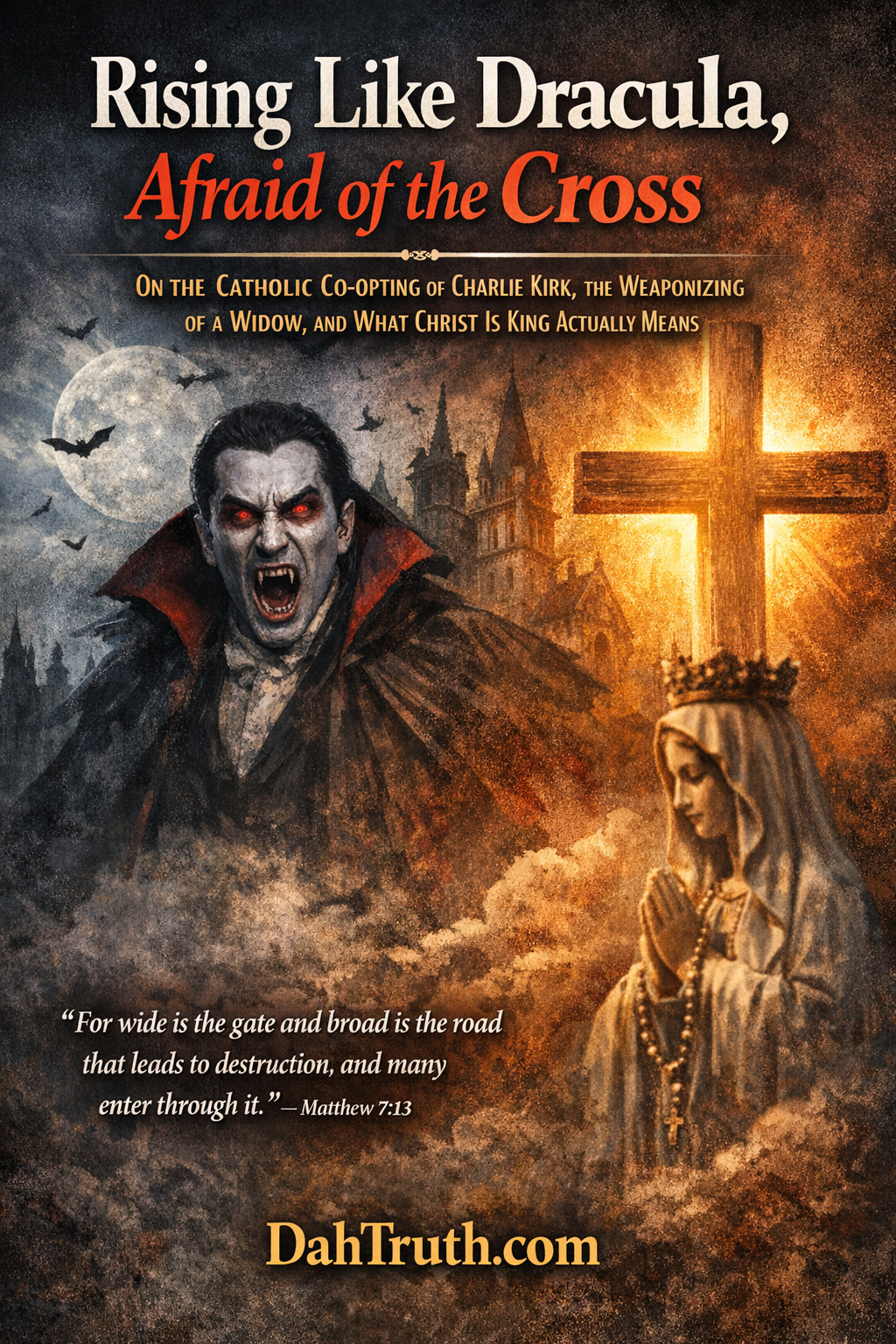
Rising Like Dracula, Afraid of the Cross
“I say then, Hath God cast away his people? God forbid.” — Romans 11:1 (KJV)
On the Catholic Co-opting of Charlie Kirk, the Weaponizing of a Widow, and What Christ Is King Actually Means
To Catholic Worshippers and to Those Who Believe They Are Doing God's Work by Tearing Down the Dead,
I speak as a Bible-believing Protestant Christian who is paying attention. And what I am watching deserves to be named plainly.
Charlie Kirk was a Protestant. That is not a detail, it is the foundation of everything that follows. He was not a Catholic. He did not embrace the worship of Mary, the authority of priests as mediators between man and God, confession in a booth as the pathway to redemption, or any of the rituals that define Roman Catholic practice. He said so. He demonstrated it through the theology he defended publicly and through the ministry he supported. The fact that photographs exist of him attending Catholic services is not evidence of conversion or spiritual sympathy with Catholic doctrine. It is evidence that his wife, Erika Kirk, was raised Catholic. A husband attending a service with his wife is not a theological statement. It is what married people do.
Charlie Kirk is dead. He was shot and killed, and a man named Tyler Robinson is facing trial for that death. There is substantial evidence in that case. A weapon with fingerprints. Camera footage placing Robinson near the scene. A prosecution building its argument on documented facts. A jury will decide the outcome. That is how justice is supposed to work. You present evidence. You make your case. You let the facts lead.
And yet here we are watching something entirely different operate in the media space around his death. What we are watching is the use of a dead man's name and a grieving widow's image to build audiences, drive engagement, and advance a religious narrative that Charlie Kirk himself did not endorse while he was alive.
Figures like Candace Owens, Nick Fuentes, and others operating in their orbit have used the circumstances of Kirk's death as fuel. They have circulated speculation that Erika Kirk had involvement in her husband's death. There is no evidence for this. She was not present. There is no communication tying her to the act. There is no motive established. There is a man on trial for the crime with physical evidence attached to his name, and still the speculation about Erika Kirk continues because speculation generates clicks, clicks generate followers, followers generate income, and income is the actual god being served in these conversations. You also have figures like Druski putting content out there that disparages Erika Kirk directly, using her grief and her name as material, as though a widow navigating the death of her husband and the future of his organization is content to be consumed. George Farmer, Candace Owens' husband, has been particularly active in shaping this environment, positioning his wife as an investigator of Kirk's story when what she is actually doing is harvesting the grief of a widow to grow a platform. That is worth saying directly.
There is a religious divide running underneath all of this that also deserves to be named. The loudest voices casting suspicion on Erika Kirk tend to come from the Catholic ideological camp, while figures like Matt Walsh and Michael Knowles, who are also Catholic, have been less willing to make that leap without evidence. What Owens and Fuentes represent is not Catholicism at its most honest. It is Catholicism weaponized for audience capture, dressed in the language of truth-seeking while operating entirely on the logic of the algorithm. And the algorithm rewards outrage. It rewards accusation. It rewards the kind of content that makes people feel they are witnessing something being exposed when what they are actually witnessing is someone's grief being monetized.
This is the modern echo of what Martin Luther confronted in Wittenberg. Not the theology alone, though the theology matters enormously. It is the institution's willingness to dress greed in the robes of righteousness. Luther saw a Church selling indulgences, selling access, selling the idea that redemption could be purchased through a system designed to enrich itself. What we are watching now is that same spirit operating through a different medium. Instead of indulgences, it is impressions. Instead of confession booths, it is comment sections. Instead of a priest deciding your penance, it is an algorithm deciding your reach. The commodity being sold is outrage, and the currency being collected is attention. Charlie Kirk's name is the product. Erika Kirk's grief is the inventory. And the consumers are the followers who believe they are receiving truth when they are being fed a narrative engineered for engagement.
Now I want to address something specific that has emerged from this space, and it requires a direct confrontation with Scripture. The phrase Christ is King has been used by figures in this orbit, particularly by those with documented hostility toward Jewish people, as a slogan. As a weapon. As a way to signal contempt for Israel and for Jewish identity while wearing the costume of Christian devotion. Candace Owens has posted Christ is King publicly while her disdain for Jewish people has been equally public and documented. Nick Fuentes has used that same language in spaces that are openly antisemitic. These are not theological declarations. They are slurs with a cross attached to them.
But here is what Scripture actually says. In Romans chapter 11, the Apostle Paul addresses the question of Israel directly and without ambiguity. He asks whether God has rejected His people and answers his own question immediately. He has not. Paul describes Israel's partial hardening as something that has come in order that the fullness of the Gentiles might come in, and then he states plainly that all Israel will be saved. This is not a peripheral verse. It is a doctrinal cornerstone about the faithfulness of God to His covenant people. Paul himself was a Jew. The disciples were Jews. Jesus Christ, whose name these individuals invoke while spreading contempt for His own people, was born of the tribe of Judah. He came first to the lost sheep of the house of Israel. He wept over Jerusalem. He came to save sinners, and Jewish people are among the sinners He came to save. To take His name and weaponize it against the very people He mourned over is not Christianity. It is a counterfeit wearing Christianity's face.
And here is where the poison inside this particular use of Christ is King becomes fully visible. The narrative being pushed in certain Catholic media spaces carries an undertone that goes beyond theology into something far darker. It suggests, not always openly but consistently enough to be felt, that Christ came to save the world with a silent exception. That somehow the Jewish people stand outside the reach of His redemption because of the crucifixion. That the Jews killed Christ and therefore Christ is King is a declaration against them rather than an open door for them. That is the venom dressed in the slogan.
But consider what that argument destroys the moment you apply it to Scripture. If the Jews who participated in the crucifixion are permanently condemned by that act, then what do you do with the Jews Christ personally chose to build His Church on? Peter, who preached the first sermon at Pentecost and saw three thousand souls added to the Church in a single day, was Jewish. John, the beloved disciple who stood at the foot of the cross and received the mother of Jesus into his own home, was Jewish. Paul, who wrote the letters that form the theological backbone of Christian doctrine and who carried the gospel to the Gentile world at the cost of his own life, declared himself a Hebrew of Hebrews. The Church did not begin among Gentiles and reach outward toward Jews. It began among Jews and through them reached outward toward every nation under heaven. You cannot condemn the branch while standing in the fruit it produced. You cannot declare Christ is King as a weapon against the very people He used to establish His kingdom.
The crucifixion itself does not support this narrative either. The theological weight of the cross is not that a group of people committed a crime for which their descendants bear permanent guilt. It is that the death of Jesus Christ was the willing sacrifice that opened the door of salvation for the entire world, for Jews and Gentiles alike, for every person who has ever lived and will ever live who comes to Him in faith. If the cross is the price paid for sin, and if the resurrection is the proof that death did not win, then the cross is not a weapon to be handed to one group to use against another. It is the door. And Christ is King means He is King over everyone who walks through it, not a selected few who have decided they hold the guest list.
This is how you discern the spirit behind what you are watching. Not by the size of the following. Not by the boldness of the declaration. Not by how many times someone posts Christ is King or how forcefully they claim to love truth. You discern it by the fruit. Jesus said you will know them by their fruit. A tree that produces antisemitism, that mocks a grieving widow, that builds its platform on the suffering of a dead man's family, that calls Protestants demons while practicing a form of Catholicism that Luther himself identified as idolatry, that tree is not bearing good fruit. It does not matter how large it grows.
The largest crowd is not always the right crowd. Scripture is full of moments where the majority was wrong, where the popular position was the corrupt one, where the voice with the most followers was the voice leading people away from God rather than toward Him. Elijah stood alone against the prophets of Baal. Noah built an ark while the world mocked the forecast. The road that leads to life is narrow, and the road that leads elsewhere is wide and well-traveled and very loud.
So when you see a widow with children being attacked without evidence by people who proclaim Christ as their king, when you see a dead Protestant man's name being harvested for Catholic algorithmic gain, when you see the phrase Christ is King deployed as a weapon against the Jewish people that Paul explicitly says God has not abandoned, you are not watching a revival. You are watching a counterfeit. And the way you stay on the right side of it is the same way it has always been. You go back to the Word. You test what you hear against what is written. And you refuse to follow noise into the place where truth used to be.
Charlie Kirk was a Protestant who supported Israel and defended Scripture as the authority over tradition. His name deserves to rest in the hands of those who honor what he actually believed, not in the mouths of those who are using his death to build what he spent his life pushing back against.
