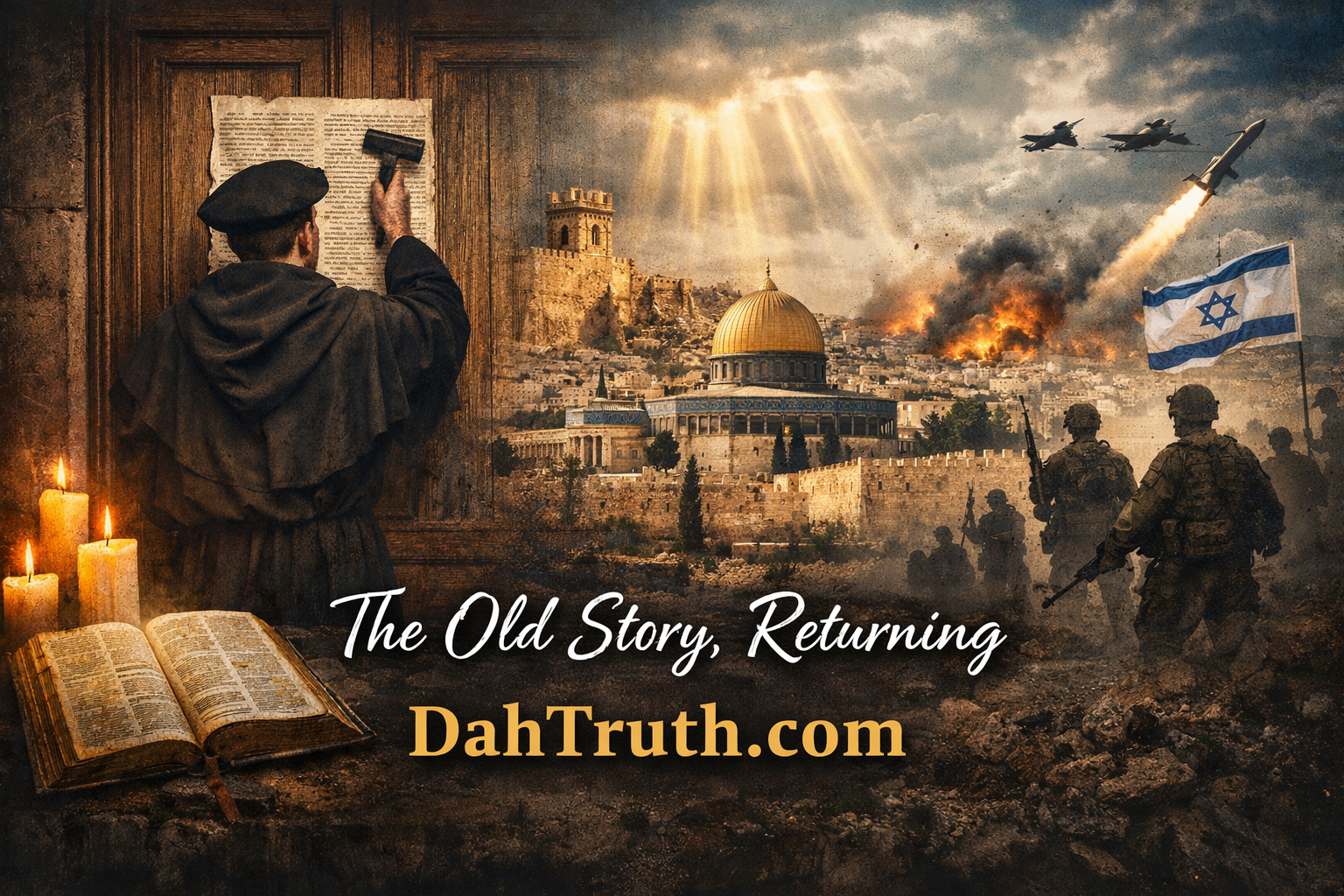
The Old Story, Returning
“My conscience is captive to the Word of God.” — Martin Luther
Dear True Believers. To those who stand on the Word of God without apology and without revision.
Not you who pretend. Not you who scoff at the idea that Israel will stretch its borders and that Christ will return according to Ezekiel Chapter 40. Not you who pray in dark booths to sin-filled priests as though another man holds the key to your redemption. Not you who call sin salvation, who have constructed a lifestyle according to your own definition of good, and who believe Christ will grant you access on the basis of your sinfulness rather than His righteousness. And certainly not you who wage war consistently against truth, and when defeated by it, cry foul and rewrite the record.
Let us call a spade a spade. Scripture is the standard. Not tradition. Not culture. Not the algorithm. Not the crowd. And what I am about to show you is how a world running in chaos is frantically attempting to construct a narrative that aligns every belief, every ideology, and every ambition with the Word of God, while God Himself refuses to be mocked. History tells the story. It has always told the story. And that story ends the same way it was always going to end, with God reigning supreme over every kingdom that dared to believe otherwise. To those who wait on the Lord, you shall inherit the Kingdom of God. This is for you.
In the 1500s, when Martin Luther nailed his 95 theses to the church door in Wittenberg, Germany, it was not simply an act of protest. It was a declaration that truth had been buried beneath centuries of tradition. It was a refusal to accept that access to God could be mediated through men, through systems, or through rituals that Scripture itself never commanded. Luther challenged the worship of saints and Mary. He challenged the authority of a pope elevated above other men as though proximity to an institution could substitute for proximity to God. He challenged the act of sitting in a dark booth, whispering sins through a screen to another sinner who would then decide what penance you must perform before you could be made clean. He challenged the counting of rosary beads as though God responds to repetition rather than repentance. And he challenged the idea that the body of Jesus must be manifested again in the flesh each time believers eat the bread and drink the wine, as if His sacrifice had not already been completed once and for all. These are not practices supported by Scripture, and Luther knew it.
While the Church turned inward and consumed itself with arguments over authority and doctrine, something was rising beyond its walls. This too was not without precedent in Scripture. In Genesis 16, before Ishmael was even born, the angel of the Lord declared over him that he would be a wild and untameable force, that his hand would be against everyone and everyone's hand against him, and that he would live in hostility toward all his brothers. That prophecy did not expire. It described a spirit, a posture, a perpetual reach for conflict that would mark his descendants across generations. The Ottoman Empire was the fullest historical expression of that prophecy ascending to its peak, expanding, pressing into territories once held by Christian powers, reshaping the balance of influence across regions that would take generations to fully reckon with. The moment was not only theological. It was civilizational. It was geopolitical and spiritual simultaneously, the fulfillment of a word spoken over a child in the wilderness centuries before any of those empires existed. And yet the attention of the Church remained largely fixed on its own internal fractures, blind to what God had already announced was coming. That pattern is very much with us now.
As we speak, history is being made as we watch a war campaign in Iran involving the United States and Israel. The conversations surrounding it are constant. Podcasters, politicians, and global leaders speak with certainty about strategy, strength, and who is gaining ground. I was listening to Triggernometry, where Mehdi Hasan appeared as a guest. For those unfamiliar, Hasan is a British American journalist and commentator who has been openly critical of American foreign policy and has consistently framed U.S. and Israeli military actions as aggression rather than defense. The giddiness with which he spoke on that episode was noticeable. There was a kind of delight in framing Donald Trump as ill-informed and outmaneuvered while positioning Iran's ability to absorb strikes and continue operations as proof that America is weakening and that Arab Muslim ideology is advancing on the world stage. Beneath that framing is something worth naming plainly. When survival becomes the definition of victory, it signals not just military confidence but ideological conviction, the belief that the West is unraveling and that patience will outlast it.
What is almost entirely absent from these conversations is any serious engagement with the spiritual dimension of what is unfolding. Throughout Scripture, Israel was not merely surrounded by hostile armies. It was consistently confronted with the reality that turning away from God always preceded its greatest moments of vulnerability. The external threat was real, but the internal condition was always the deeper crisis. That same dynamic is operating today, and very few voices are willing to name it.
When I look at what is happening with Israel, I do not see only conflict. In Genesis 15, God made a covenant with Abraham regarding land, borders, and descendants. As Israel presses into Lebanon, Syria, and now moves in relation to Iran, I see those promises in motion. I believe what is unfolding may be preparation, that this expansion of territory and influence may be part of something far larger than geopolitics alone. It may be pointing toward the return of Jesus Christ. To say that invites dismissal. It invites mockery. Even voices like Tucker Carlson, who claims belief in Christ and in Scripture, openly scoff at the idea that passages like Ezekiel 40 could carry present meaning. But what is laughed at today has a way of demanding recognition tomorrow.
Something else worth naming is the persistent denial of what Scripture already revealed and history has already confirmed. God spoke through His prophets that after the Messiah came, Israel would be destroyed and the Israelites would be scattered among the nations. That scattering was not the end of the story. It was part of it. The destruction of Jerusalem, the diaspora that followed, the centuries of displacement across continents, these things were spoken before they happened. God also promised that Israel as a nation would be restored and redeemed, and we have watched that unfold as well. After the decline of the Ottoman Empire and the events surrounding World War I, the Balfour Declaration opened the door for the reestablishment of a Jewish homeland. It was as though God whistled and called His people back. And even where there was hesitation, even where there was delay, His plan did not stall. There was suffering. There was destruction. A remnant returned nonetheless, just as He said one would. Now Israel stands again as a recognized nation, moving across the world stage in ways that continue to align with what was spoken long ago, and still humanity dismisses it. People see these realities with their own eyes and choose to call them coincidence, politics, or chance, anything except the possibility that God is conforming history to His Word. What is even more striking is that the rise and fall of kingdoms does not alter His larger design. Whether empires expand or collapse, whether power shifts east or west, salvation was never tied to any one nation's permanence. God's promise extends to both Jew and Gentile alike, and that promise has not changed regardless of what thrones have risen or fallen around it.
The fractures within America reflect the same pattern. On one side are those who believe themselves to be doing good, who speak the language of compassion and inclusion and social progress, and who also claim faith in God and in Jesus Christ. Yet in the same breath they affirm what Scripture calls sin, they celebrate and normalize it, they reshape identity itself and call that reshaping righteousness. The deception is thorough precisely because they do not see themselves as outside the will of God. They are fully convinced they are within it. On the other side are those who hold more firmly to Christian language and Scripture, yet even there the fracture persists. There are those who insist that righteousness flows through saints and Mary and priests and confession, through tradition as the authority over Scripture. And there are those who reject that entirely and say that worship belongs to God alone, that no institution stands between a believer and their Father. Within that space are also those who weave faith together with nationalism, defending culture and identity in ways not always examined against the Word they claim to uphold.
Layered over all of this is relentless noise. Figures like Jamal Bryant command wide audiences while offering a version of faith built on comfort and affirmation, a grace that requires no transformation. But Scripture teaches something different. When a person is genuinely filled with the Holy Spirit, there is a turning away. There is conviction that produces change. Salvation is not merely declared. It is evidenced in the life that follows it. A faith that leaves you exactly as it found you is not the faith described in the Bible.
At the same time, global institutions are attempting to write and rank history. The United Nations recently passed a resolution declaring the Western slave trade the most inhumane in history, without equal weight given to the Arab slave trade that devastated and displaced millions of Africans across centuries. Slavery is evil. Oppression in every form it has taken and in every era is evil. The history of those who were treated as cattle, severed from their people, their language, their land, that history is real and demands honest reckoning. But when that reckoning is issued without consistency, when the Arab slave trade is minimized or ignored entirely, the motive is not justice. It is leverage. It is agenda. And for ADOS, for those of us who are the descendants of Africans cut from the continent and replanted on American soil across generations of suffering and survival, our story deserves to be told in full and not used as a political instrument by those who did not share that experience. God had his hand even in that displacement. We are here. We are the progenitors of those who were re-rooted on this soil for a time such as this, and we look to the heavens for where our help comes from.
And that brings me to the deeper question underneath all of it. Not just who defines history, but who defines justice. Because what we are watching, in global institutions, in media narratives, in ideological movements, is man repeatedly appointing himself the final authority on what is right, what is fair, and what must be done to correct the past. Dostoevsky examined that impulse with surgical precision in Crime and Punishment. He gave us Raskolnikov, a man who convinced himself through elaborate intellectual reasoning that he had the right to take a life in service of a higher purpose. The logic was tight. The justification was philosophical. The conclusion was that some people are simply above the ordinary moral law and may act accordingly. And yet what followed was not liberation but torment, because the soul cannot escape what it has done by renaming it. Dostoevsky understood that when man appoints himself the author of justice, justice becomes whatever serves his ambition in the moment. He stretches it. He dresses wickedness in the language of righteousness and then expects the world to receive it as such.
We see this principle at work in every era of conquest and war, in every leader who frames destruction as liberation, in every ideology that promises freedom while demanding submission. Man is fallen. He will always reach for power. He will always construct a reason why this particular action, at this particular moment, is justified and necessary. That is not a reason for paralysis. It is a reason for discernment. It means we must be clear about the difference between the wickedness of unchecked human ambition and the genuine defense of truth.
I am not saying that America and Israel are beyond critique in all things. But I am saying that in this present moment there is a real effort to hold ground against forces that are not neutral, against ideologies that do not lead where they claim to lead. That matters. It is worth saying plainly and without apology.
What steadies me through all of it is this. God is in control. He moves whether or not He is acknowledged. He orders events whether or not the people living through them can see it. The call for those who believe is not to be consumed by every argument or to unravel with every headline. In the Gospel of Matthew, when Jesus stood before the crowds and spoke, many were near Him physically but only a few truly heard Him. The difference was not distance. It was focus. Some watched the crowd. Others watched Jesus. That is the same choice before every believer right now. Everything around us is fighting for attention, for loyalty, for alignment. The question is whether we will be pulled into the noise or remain anchored in what we know to be true.
And that brings me back to where we began. Back to Luther. Back to Wittenberg. Back to the door.
Martin Luther did not nail those 95 theses to start a conversation. He nailed them because he had read the Scripture and could no longer pretend that what the Roman Catholic Church was selling bore any resemblance to what the Word of God actually said. He drew a line. He named the lie. And the world has never fully recovered from that confrontation because the confrontation was necessary and the lie was enormous.
Here is what is worth watching now. Catholic ideology is not retreating. It is growing. The Catholic Church is expanding in influence, in reach, in cultural presence, at the very moment when much of Protestant Christianity is either fracturing, softening, or quietly stepping aside. And we are beginning to see the voices of prominent Protestants being co-opted and repositioned in ways that deserve direct examination. Charlie Kirk is worth naming here, and I want to be precise. Kirk is a Protestant. He has been openly so. He has also been a vocal supporter of Israel at a time when that position carries real cost in certain circles. He has not converted to Catholicism. But here is what is happening around him. There are podcasters and commentators with Catholic ideological leanings who are actively working to reframe his voice, to retell his story in ways that smooth over his Protestant convictions and absorb his audience into a different theological household entirely. The co-opting is not coming from Kirk himself. It is being done around him and to him, and the audience that trusts his name is being slowly repositioned without ever being told plainly what is taking place. That is not a conversion. It is something more subtle and in some ways more dangerous, because it operates below the level of open declaration.
So I ask the question directly. Is this about conviction? Is this a man who genuinely studied Scripture, wrestled with the Word, and arrived somewhere new after honest reckoning? Or is something else operating here? Because when a public figure shifts theology and the media apparatus around that figure immediately works to make the shift palatable, to reframe the narrative, to make sure the audience stays engaged and the brand survives the transition, you have to ask what spirit is actually being served. You have to ask whether the altar being approached is the altar of God or the altar of the algorithm. Likes. Comments. Reach. Engagement. The metrics that reward whoever can gather the largest crowd, regardless of what truth had to be softened or set aside to gather it.
Luther understood that the crowd is not the measure of correctness. He stood before an empire that had the full weight of tradition, institution, and political power behind it, and he refused. He refused because Scripture was clear and his conscience was bound to it. That kind of refusal is increasingly rare. In a world where algorithms reward what is popular and punish what is divisive, where the definition of divisive has somehow come to include standing firmly on what the Bible says, the pressure to soften, to shift, to make room, is constant and it is heavy.
The old story is not just circling back in war and geopolitics. It is circling back inside the Church. The same argument Luther fought in the 1500s, whether truth is located in Scripture alone or whether it can be mediated through tradition, through institution, through men who claim authority over access to God, that argument is alive and being contested right now, on platforms, in conversions, in reframings, in the quiet abandonment of convictions that once defined a public voice.
Justice does not ultimately belong to man, no matter how confidently he claims it. It does not belong to the algorithm, no matter how many people it reaches. It does not belong to the institution, no matter how ancient or how large. It belongs to God. His Word has not changed. His promises have not failed. His plan for both Jew and Gentile has not shifted because an empire fell or a podcaster converted or a platform rewarded something other than truth. That reality stood in Wittenberg. It stood through the Ottoman Empire. It stood through the scattering and the return of Israel. It stands today. And it will stand when every kingdom that has ever demanded our loyalty has turned to dust.
