
A Revelation on Resurrection Sunday: Take up your bed and follow Christ
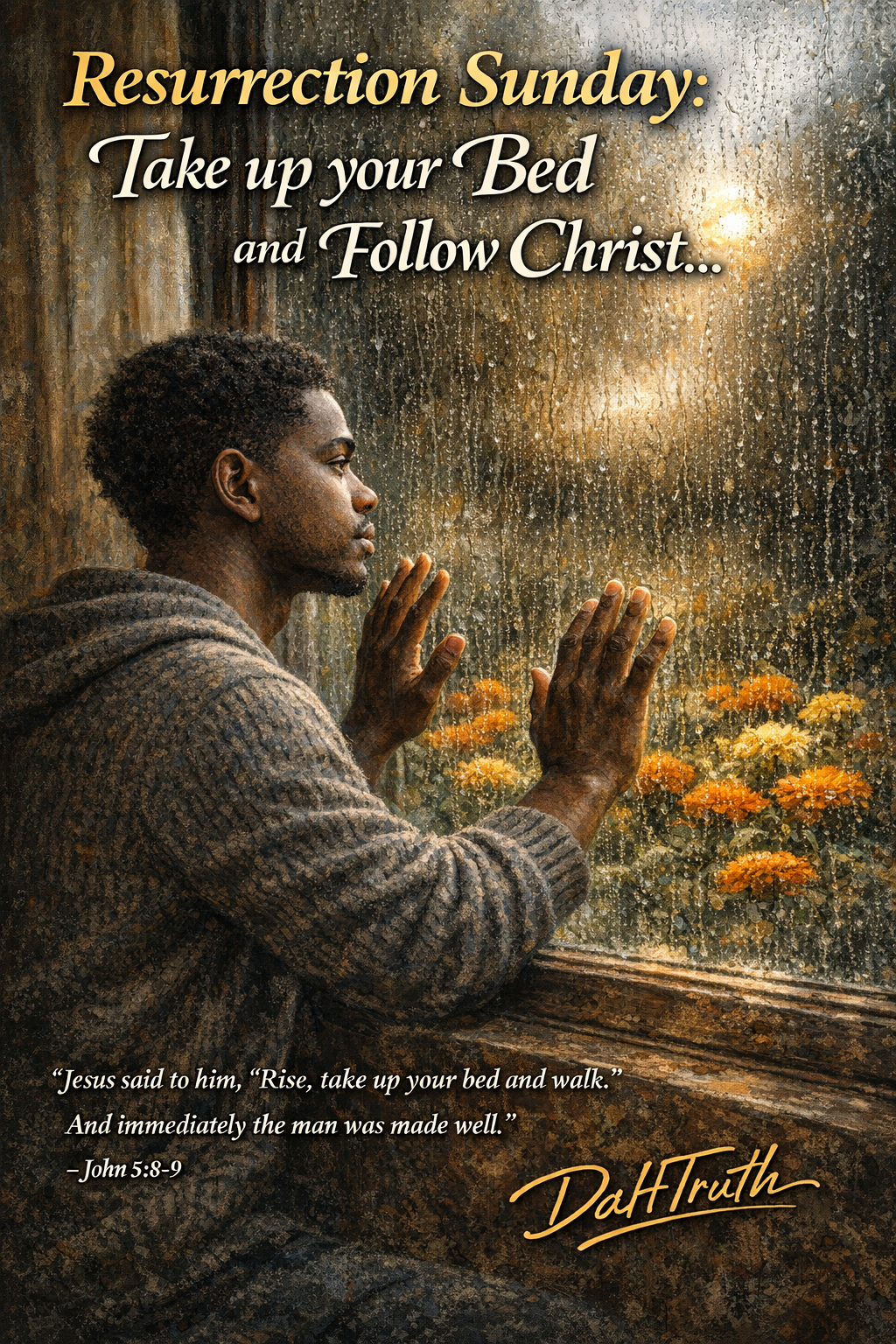
“If any man will come after me, let him deny himself, and take up his cross daily, and follow me.” Luke 9:23
My Dear Fellow Preachers, Teachers, and Fellow Worshippers,
It is Resurrection Sunday morning and it is raining here in New Jersey. The kind of soft, quiet rain that does not demand your attention but simply surrounds you. Outside my window I can see yellow marigolds, that stubborn, faithful yellow that blooms even when the sky is grey. And somewhere in the air is the fragrance of bell flowers, that clean and tender scent that arrives with spring as if it were its own announcement.
It is, without question, the season of resurrection. But I want us to sit with that word today and ask ourselves honestly: whose resurrection are we actually preaching? Because from where I am sitting, and from what I have been hearing, there are many resurrections on offer this spring. The resurrection of your finances. The resurrection of your career. The resurrection of your breakthrough season. And all of them, without exception, carry a price tag. On this morning when we ought to be standing in awe of an empty tomb, too many pulpits are occupied with a far more profitable miracle. And too many of us, preachers, teachers, and worshippers alike, have grown so accustomed to it that we no longer hear the difference.
The Season of the Refund
It is no secret that February and March have become the months of the federal tax refund. And it has become tradition in our community for ministers to know exactly when those deposits land. There is no greater season for what I will call spiritual financial manipulation than this one right here. Give a thousand and expect it returned threefold. Sow your seed in this ministry and watch your harvest come. Give your last and God will make a way. Some have even specified amounts. Some have promised triplets, three blessings for one offering. And the faithful, the struggling, the genuinely believing, reach into wallets already stretched thin and give because a man standing behind a pulpit told them God said so.
No man of God has the authority to make that promise. None. What is being sold in these spaces is not faith. It is fear dressed up as generosity, and it is keeping our people in bondage.
Fiddler on the Roof: A Story About God's Faithfulness When Everything Is Taken
One of my favorite films of all time is Fiddler on the Roof. Most people speak of it as a story about tradition, and it is. But before we get to Tevye's daughters, I want us to understand the full weight of the world in which this family lived. These were Jews living beyond the Pale of Settlement in Tsarist Russia, a people who had been tolerated just barely, confined to the margins of a society that did not want them, governed by a power that could revoke their existence at any moment. They were not simply people of faith living in difficult times. They were a people perpetually at the mercy of a government that viewed them as a problem to be managed. And in the end, the Russian government forced them out. Out of their homes. Out of their village. Out of everything they had ever known.
What Fiddler on the Roof shows us, underneath all of the singing and the tradition and Tevye's conversations with God, is a portrait of a people carrying their faith into displacement. And when the order finally came to leave Anatevka, Tevye's family did exactly what the gospel of Christ calls every one of us to do. They took up their beds. And they followed. They did not know where they were going with certainty. They did not know if they would ever see one another again. But in that moment, standing at the edge of everything familiar, they picked up what little they had and walked into the unknown. That is not just the story of a musical. That is the story of faith.
Take up your bed and follow Me. Jesus did not promise comfort. He did not promise that the road ahead would look familiar. He promised presence. He promised that the One calling you into the unknown would be with you in it. The tradition in Fiddler on the Roof was never the point. It was the container. The real story is whether the God inside the container is still being trusted when the container breaks.
The Daughters: One Degree at a Time
Now let us talk about Tzeitel, Hodel, and Chava, Tevye's three eldest daughters, and what each of them reveals about the nature of drift.
Tzeitel, the eldest, refuses the match her father arranged with the well-off butcher Lazar Wolf. She has already made a pledge to her childhood friend Motel, a poor tailor, and she pleads her own case before her father. Tevye wrestles with it, argues with himself, argues with God, and ultimately bends. He gives his blessing to a marriage born of love rather than arrangement. One degree from tradition.
Hodel falls in love with Perchik, a radical young man who wants to challenge the Russian government. He is eventually arrested and sent to Siberia. And Hodel, rather than accepting a safe arrangement at home, chooses to follow the man she loves into exile. On a snowtorn morning, when the wind was at its most fierce, she says goodbye to her father at a train station, not knowing when or whether she will see him again. Tevye bends again, though it costs him something. Another degree from tradition.
Then comes Chava, the third daughter, and this time Tevye cannot bend. Chava falls in love with Fyedka, a young Russian man, and chooses to marry him outside the faith entirely. Tevye disowns her. The tradition breaks. The family fractures. What restores them in the end is not the tradition returning to its original form but grace arriving through the most unlikely person. Fyedka, Chava's Russian husband, leaves Russia in protest over the government's persecution of the Jews, and through that act of conscience the family finds a way back to one another. But the tradition is permanently altered.
Each daughter pulled away from where they started by just one degree. Each step seemed reasonable in the moment. Each felt like love. And yet the cumulative distance from where Tevye began became impossible to ignore. As I watched Tevye and his daughters, I thought about my own youngest son and his struggle in this life. I understand his plight in a way that only a mother can. My prayer on this Resurrection Sunday morning is that God raises his faith and keeps him strong, and that He gives my son the opportunity to see clearly the difference between tradition and the love of God. Because tradition can shift and crack and fall away entirely. But the love of God does not move. This is the story of the American Black Church, and it is the story of every family that has ever watched someone they love drift one degree at a time from the truth that was meant to hold them.
How the Black Church Lost Its Way
When I grew up, fornication was addressed from the pulpit. Pregnancy outside of marriage was addressed. Living together without the covenant of marriage was addressed. Not because the church was cruel, but because the church understood what was at stake. That standard held the community together even in its imperfection, because we knew the difference between what God called holy and what the culture called convenient.
Then drugs entered our community. Then AIDS. Then mass incarceration. And under the crushing weight of that devastation, the conversations quietly shifted. One degree at a time. The preaching on holiness became labeled as judgmental. The call to repentance was reframed as harmful. The naming of sin became something to be avoided in the interest of being welcoming. And slowly, not all at once, not in a single dramatic break, but one small surrender at a time, the Black Church stopped having those conversations.
The trouble is that we still believe we are holding tradition. We still believe we are preaching the same gospel. We still believe we are the pillar and ground of truth. But the truth is demonstrating itself right in front of us, and too many of us are laughing at what we see rather than confronting it.
We Are Laughing at Our Own Chains
I recently watched a self-proclaimed minister on social media explain his approach to ministry. He stated openly that he does not discuss sin. He said he talks about love and doing no harm because addressing sin might cause harm, and it simply does not resonate with him. As I listened, I recognized something in that voice. Not just theological error. Something older and more dangerous than that. It was the quiet deception that has kept the Black Church in spiritual bondage for generations, the idea that love and truth can be separated, that you can genuinely care for someone while refusing to tell them the truth about where they are headed.
You cannot. A physician who will not diagnose disease because the diagnosis is painful is not compassionate. He is negligent. A minister who will not address sin because the congregation might leave is not feeding the sheep. He is leaving them to wander without a shepherd.
The gospel begins with repentance. John the Baptist understood this at the cost of his life. He stood before the most powerful people of his day and called out sin by name. He named the corruption of Herod Antipas directly, declared openly that it was not lawful for him to have his brother's wife, and he did not lower his voice to make the powerful more comfortable. He was imprisoned for it. And then, at the whim of a dancing girl and a foolish oath made at a birthday party, John the Baptist was beheaded. His head was brought on a platter to a woman who wanted him silenced. That is what preaching truth into the halls of power cost him. John did not preach a comfortable gospel. Jesus did not preach a comfortable gospel. The apostles did not preach a comfortable gospel. They preached repentance. They preached holiness. They preached the cost of sin and the grace of God, and many of them paid for that preaching with their lives.
Many of today's generation of American Black preachers will not lose their heads for naming sin from the pulpit. They will not be imprisoned. They will not be exiled to Siberia. They may lose followers on social media. They may see their attendance drop. Someone may post a negative comment. And yet the message has been so thoroughly softened, so carefully managed, so relentlessly shaped around what the audience wants to hear, that we have ended up with ministers who cannot even say the word sin without apologizing for it. John the Baptist went to his grave before he would compromise the truth. What is our excuse?
When comedians create skits mocking the Black Church and we laugh, that laughter is a confession. It means the satire resonates. It means somewhere inside us we already know the truth about what has happened to us. We laugh at the prosperity preacher, at the performative worship, at the minister who sounds more like a motivational speaker than a servant of Christ. We laugh and then we go back to the same pew the following Sunday. That laughter is not freedom. That is what resignation sounds like.
The Resurrection Christ Actually Promised
Here is what I want us to remember on this rainy Sunday morning, with the marigolds outside and the fragrance of bell flowers in the air. The resurrection of Jesus Christ was not the beginning of a comfortable life for those who loved Him. The disciples were still hiding behind locked doors when the risen Christ appeared. The road to Emmaus was walked by two men whose hope had shattered. Mary Magdalene wept at an empty tomb before she understood what the emptiness meant. The resurrection did not remove suffering from the picture. It redeemed it.
Christ never once told His followers that life would be easy. He told them that in this world they would have tribulation. He told them to take up their cross daily. He told them that the servant is not greater than the master, and that if the world hated Him, it would hate them also. He told them that the path was narrow and that few would find it. These are not the words of a gospel that promises comfort in all things. These are the words of a Savior who walked through suffering Himself, who had no place to lay His own head, who sweat blood in a garden before facing the cross, and who rose on the third day not to hand out financial blessings but to conquer death itself.
Our tradition has slowly replaced that risen Christ with a more convenient one. A Christ who wants you to prosper financially. A Christ who asks very little of you. A Christ whose primary concern is that you are comfortable and affirmed. And in building that version of Christ, we have robbed our people of the very hope that carried a displaced Jewish family out of Anatevka and across the world. We have robbed them of the hope that held John the Baptist steady in a prison cell. We have robbed them of the anchor that scripture says is sure and steadfast, entering into the presence of God Himself behind the veil.
Sometimes your bed is not made in this life. Sometimes the bed God has prepared for you is made in heaven. And there is nothing weak or defeated about trusting that. It is the most radical act of faith a believer can demonstrate in a world that is constantly trying to sell you a cheaper substitute. The hope we carry is not the hope of a tax refund multiplied. It is the hope of a resurrection that changes everything, not just for a season, but for eternity.
Stay Close to His Word
Traditions will shift. They always have. Tzeitel, Hodel, and Chava each pulled away from what Tevye had built, one degree at a time, and the world that shaped their lives kept moving whether the family was ready or not. The Black Church has been doing the same thing, one small compromise at a time, while believing all along that it was standing firm.
But the Word of God does not shift. The gospel of Jesus Christ does not renegotiate its terms based on the cultural moment. What was sin in the days of John the Baptist is sin today. What holiness required of the early church it requires of us. And what resurrection meant on that first Sunday morning, when the stone was rolled away and death itself was defeated, it still means right now, on this rainy Resurrection Sunday in New Jersey, with the marigolds standing in the rain outside my window and the fragrance of bell flowers somewhere in the air.
My prayer this morning is for my son, that God raises his faith and keeps him strong and gives him eyes to see the difference between the shifting traditions of men and the unchanging love of God. But my prayer is also for the church. That we would stop performing and start repenting. That we would stop selling and start preaching. That we would stop laughing at our own decay and start returning to the gospel that was never ours to edit in the first place.
Tevye's family took up their beds and followed into the unknown, and God was faithful to them in the wilderness of displacement. Christ rose from the dead and walked among His grieving disciples, and God was faithful to them in the wilderness of fear. We are called to do the same. To take up what God has given us, to follow where He leads regardless of the comfort of the road, to stay close to His words even when every tradition around us is shifting, and to trust that the bed He has prepared for those who love Him is far greater than anything this season, or this culture, or this generation of prosperity preachers could ever offer.
He is risen. That still means everything.
Truth spoken in love may wound for a season.
But silence in the face of sin wounds for a lifetime.
And the hope of the resurrection was never meant to be sold.
It was meant to be lived.
“Heaven and earth shall pass away, but my words shall not pass away.”
