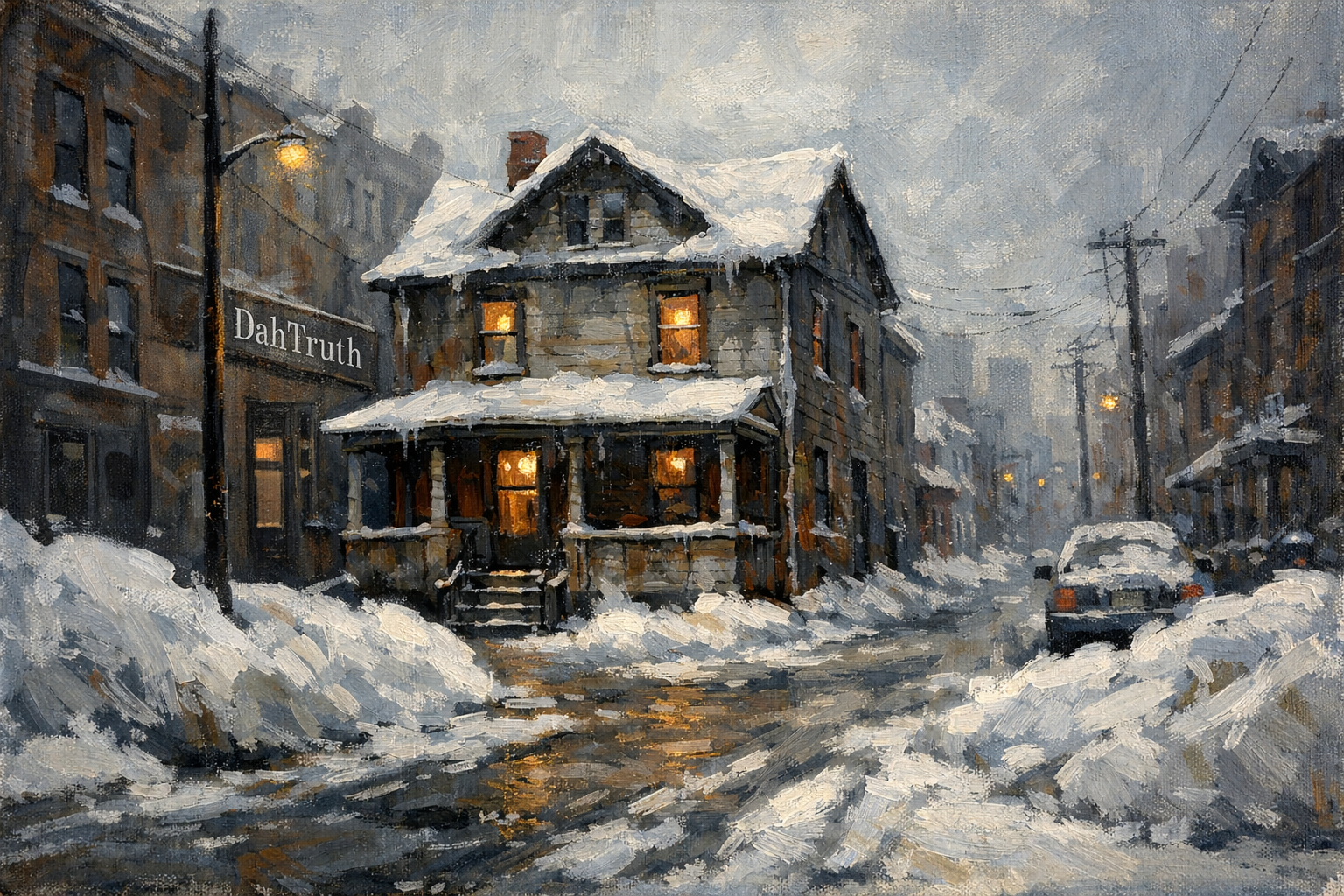
A House Divided in Winter
“Every kingdom divided against itself is brought to desolation, and every house divided against itself shall not stand.” Matthew 12:25
False Unity, Moral Substitution, and the Illusion of Agreement
This week was brutal.
A deep, frigid cold settled over much of the northern United States, followed by a snowstorm that buried streets, sidewalks, and cars. Many of us woke up to frozen mornings, shoveling ourselves out just to begin the day. Wind burned our faces. Roads narrowed. Progress slowed. February arrived not gently, but harshly.
Groundhog Day came and went, and as tradition would have it, there was no promise of early relief. Only more winter. More cold. More endurance.
There was something revealing about those mornings. Neighborhoods were divided by snowbanks. Streets were reduced to narrow, passable lanes. People stood alone on street corners and at bus stops, bracing themselves against the wind. Order required effort, coordination, and shared rules. Without them, nothing moved.
It felt like living inside one of those bleak winter stories where the cold is more than weather. It is atmosphere. A kind of moral frost that exposes what is fragile, what is fractured, and what cannot hold together under pressure.
And as we shoveled our driveways and listened to the news, something became painfully clear: the cold was not only outside.
A House Divided
Jesus takes that question further and issues a warning: “Every kingdom divided against itself is brought to desolation,
and every house divided against itself shall not stand.” — Matthew 12:25
What we are witnessing today is not healthy disagreement. It is something more dangerous: the illusion of unity. People stand side by side, speaking the same language of outrage, while remaining fundamentally divided on truth, authority, and allegiance.
A divided house can stand for a time, just as a roof heavy with snow can hold for a season, but eventually the weight becomes too much.
False Unity on Display
Recently, I listened to a conversation between Candace Owens and Bassem Youssef. On the surface, it appeared to be a thoughtful exchange between two people from very different backgrounds. One claims Catholic Christianity. The other is openly Muslim. But beneath the politeness was something more revealing.
At one point, Candace referenced “God,” and Bassem asked plainly, “Which God?” It was a moment that should have stopped the conversation cold. From a Christian perspective, a God not named as Jesus Christ is not the same God. That difference is not semantic. It is foundational.
Yet the moment passed quickly, unexamined.
Why? Because agreement had already been found elsewhere. That agreement was not rooted in shared theology, shared moral vision, or shared allegiance. It was rooted in shared hostility, particularly toward Israel, and in Candace’s case, toward Jews more broadly. Profound differences were glossed over because a common resentment provided the glue.
This is not walking together in truth. This is walking together in grievance.
Conflation and Convenience
There is a critical distinction between criticizing a government and condemning a people. Governments deserve scrutiny. Peoples do not deserve collective guilt.
When claims are made that Jews were responsible for the American slave trade, despite Israel not existing as a modern state during that period, and those claims are later defended as merely “criticism of the Israeli government,” the logic collapses. Language becomes a shield rather than a clarification.
If Israel did not exist as a nation between 1619, when the first enslaved Africans arrived on American soil, and 1865, when the Civil War ended slavery, then the accusation cannot be about Israeli policy. It is about Jewish people. That is not government critique. That is antisemitism dressed in political language.
Selective phrasing allows animosity to hide behind critique. Hatred conceals itself best when it borrows respectable vocabulary.
And when resentment becomes the common ground, people who are otherwise deeply divided can appear united, at least temporarily.
A Fractured Right
This tension reflects a broader fracture within the Republican Party itself, and the fault line runs deeper than policy disagreements. It is a moral and theological divide that the party has not yet been willing to confront openly.
On one side are figures like Matt Walsh, Michael Knowles, and for a time Charlie Kirk, who have affirmed Israel’s right to exist as a nation. They distinguish between the actions of a government and the identity of a people. They may not support every decision the Israeli government makes, but they hold that Jewish people have a right to nationhood, that Israel is an ally of the United States, and that the destruction of Israel is not a legitimate political position. Their argument is grounded in what they see as a Judeo-Christian moral inheritance that recognizes Israel’s place in both Scripture and Western civilization.
On the other side are voices like Nick Fuentes, Tucker Carlson, and increasingly Candace Owens, who have moved beyond policy criticism into something more corrosive. Fuentes has been open in his hostility toward Jewish people, barely disguising it behind irony and provocation. Carlson has platformed figures and narratives that blur the line between legitimate skepticism and conspiratorial thinking. Owens has publicly claimed Jewish involvement in the American slave trade and has framed her opposition to Israel in terms that repeatedly slide from government critique into ethnic resentment.
What unites this second group is not a shared theology or a shared political philosophy. It is a shared antagonism. They may disagree on nearly everything else, but their disdain for Israel, and in many cases for Jewish people themselves, functions as a binding agent. They use the distinction between “Zionism” and “Judaism” as rhetorical cover, but the pattern of their language tells a different story.
These two factions occupy the same party, appear on the same media platforms, and appeal to overlapping audiences. But they are not agreed. They are not walking together. They are marching under the same banner while heading in opposite moral directions. And Jesus already told us what happens to a house in that condition.
A Dostoyevskian America
As I recently began reading Dostoyevsky’s Demons, the parallels became impossible to ignore.
The narrator introduces Stepan Trofimovich Verkhovensky, a celebrated intellectual who produces no substantial work, carries no moral responsibility, and fails even within his own household. He is a negligent father, more invested in his social reputation than in the formation of his own son. His influence is social, not substantive. His authority is assumed, not earned.
And it is his son, Pyotr Verkhovensky, who becomes the more dangerous figure. Pyotr returns to the town not as a thinker but as an organizer. He gathers a small circle of radicals, each holding different grievances and different ideologies, and binds them together not through shared conviction but through shared destruction. They do not agree on what to build. They agree on what to tear down. Pyotr manipulates their differences, glosses over their contradictions, and directs their collective energy toward chaos. The group believes it is unified. In truth, it is merely useful to one manipulator’s agenda.
This is the pattern Dostoyevsky warns about: people who are fundamentally divided being organized around destruction rather than truth. Their unity is not real. It is manufactured. And it serves not the group but the agenda of whoever holds the strings.
Dostoyevsky is not attacking education or progress. He is exposing intellectualism without moral grounding. Ideas divorced from consequence. Influence without accountability. A generation inheriting language but not the values that gave that language meaning.
That is what increasingly defines our public life. We invoke God without theology, justice without law, compassion without consequence, and America without allegiance. Like the characters in Demons, we repeat moral language while hollowing out its meaning. We borrow fragments of belief systems while rejecting the discipline and structure that give those beliefs coherence.
From Fiction to Evidence
Demons was a fictional account of what Dostoyevsky saw happening in his own society: a culture drifting away from its foundations, seduced by ideas that sounded liberating but carried no moral weight. He wrote it as a warning. We do not need novels to see that warning fulfilled. We have current history.
Consider Iran. For decades, an Islamic theocracy imposed its values on a population through force, surveillance, and fear. Women were beaten for showing their hair. Dissent was met with imprisonment or death. The moral framework of the state was not chosen by the people; it was enforced upon them. And now we are witnessing a cultural uprising. Iranian citizens, particularly women and young people, are pushing back against the very values that have oppressed them for a generation. In this case, the divide is righteous. A people are rejecting a system that suffocated them.
But what is happening in response to Gaza is the opposite. We are watching individuals in the West voluntarily align themselves with the same ideological framework that has oppressed Iran.
Christian Smalls, the labor organizer and activist who co-founded the Amazon Labor Union and led the first successful unionization of an Amazon warehouse in Staten Island, has extended his activism into vocal solidarity with the Palestinian cause. Sabrina Salvati, the journalist and political commentator known as Sabby Sabs, has used her Boston-based podcast to frame the conflict in ways that go well beyond humanitarian concern and into ideological alignment. College students occupy campus buildings. Professors sign open letters. Activists chant slogans rooted in a worldview they have never lived under and do not fully understand.
This is the profound contradiction. In Iran, people are dying to escape the consequences of a belief system. In America, people are marching to embrace it, without recognizing the historical evidence of what that system produces when it governs. The oppression of women, the persecution of religious minorities, the suppression of free expression: none of this is hidden. It is documented, visible, and ongoing.
And yet the alignment continues. Youth and academics adopt the language of liberation while defending structures that have historically denied it. This is not solidarity. It is incoherence. And it is precisely the kind of moral confusion Dostoyevsky depicted in fiction, now playing out in real time. Pyotr’s circle believed they were revolutionaries. They were, in fact, instruments of someone else’s chaos. The same pattern repeats when Americans adopt causes whose full consequences they have never been asked to live with.
This too creates division. Not the productive kind that comes from honest disagreement, but the corrosive kind that comes from abandoning one’s own foundational values in favor of borrowed grievances. It is, in every sense, hypocritical. And hypocrisy, left unchecked, fractures a house from within.
Moral Substitution and Immigration Rhetoric
This pattern of borrowed moral authority surfaced again this week when New York Assemblyman Zohran Mamdani addressed a crowd and framed illegal immigration through the story of Muhammad’s migration to Medina, urging Americans to model their response after it.
What was striking was not the religious reference itself, but the assumption beneath it: that Islamic historical narrative should serve as moral authority over American law.
The United States is not built on Islamic theology. Its legal and moral framework emerged from Christian assumptions about human dignity, ordered liberty, and national sovereignty. To invoke a religious narrative foreign to that framework, while condemning American institutions like ICE for enforcing American law, is not moral persuasion. It is moral substitution.
The migration of Muhammad was not a neutral act of refuge. It marked the beginning of a political and religious order enforced through power. To present it as a simple parable of compassion, stripped of its historical and theological context, is the very kind of selective storytelling that hollowed-out ideologies rely on.
This is not an argument about the worth of individual immigrants. It is a question of authority and allegiance. A nation cannot be governed by moral frameworks it did not consent to, nor can it survive if its own foundations are treated as illegitimate.
America and Allegiance
At its core, America is not merely land. It is a constitutional order. Citizenship is not just presence; it is allegiance.
Yet we are increasingly divided over what America even is. Some still affirm it as a flawed but legitimate republic grounded in law, liberty, and responsibility. Others describe it as inherently illegitimate, stolen land, oppressive by design, unworthy of loyalty, while simultaneously demanding the benefits of belonging. Still others imagine America as an ethnic possession, a nation that was and should remain exclusively white.
What all three of these visions share, despite their differences, is a troubling tendency to erase American Blacks (ADOS) from the story.
American Blacks (ADOS) have been present on this soil since 1619, when the first enslaved Africans were brought to the Virginia colony. That is before the Mayflower. Before the Constitution. Before the Republic itself had a name. For nearly two and a half centuries, Black labor built the infrastructure, agriculture, and economy that made this nation possible. Black soldiers fought in every American war. Black thinkers shaped its moral conscience. Black families endured what no other group in this nation’s history has been asked to endure, and they did so not as guests or outsiders, but as Americans in the fullest and most costly sense of the word.
And yet, in conversation after conversation, commentary after commentary, American Blacks (ADOS) are written out. The progressive vision speaks of “immigrant contributions” as though the nation was built by those who chose to come, ignoring those who were brought here in chains and whose labor preceded nearly every wave of voluntary immigration. The white nationalist vision claims America as its own creation, as though the fields plowed themselves and the railroads laid their own tracks. Even mainstream conservative voices, like Michael Knowles, have spoken of American identity in terms that center whiteness so thoroughly that the American Black experience becomes invisible.
The Irish arrived in the 1850s. Germans, Italians, and Eastern Europeans followed in successive waves. Each group contributed to the American story. But none of them arrived to find an empty land. They arrived to find a nation already built in significant part by the hands of people who had been here for over two hundred years and had never been given the liberty to leave.
To exclude American Blacks (ADOS) from the founding narrative of this country is not merely an oversight. It is a distortion. And a nation that cannot tell its own story honestly cannot walk together in truth.
Agreement Matters
Amos was right. Jesus was right. Dostoyevsky saw it coming.
A society can temporarily unite around shared outrage. But outrage is not a foundation. Hatred is not agreement. And unity built on resentment cannot bear weight forever.
If we are no longer walking together, the question is not simply who disagrees with us, but what we have agreed to replace truth with.
Somewhere a podcast host glosses over the name of Jesus to keep a conversation comfortable. Somewhere a politician invokes a prophet foreign to this nation’s moral framework to shame its laws. Somewhere a student chants for liberation under a banner whose history would deny her the right to speak at all. And somewhere a woman in Tehran removes her hijab knowing it may cost her everything.
A house divided may endure a winter. But it will not survive the thaw.
