
This Is Not Selma
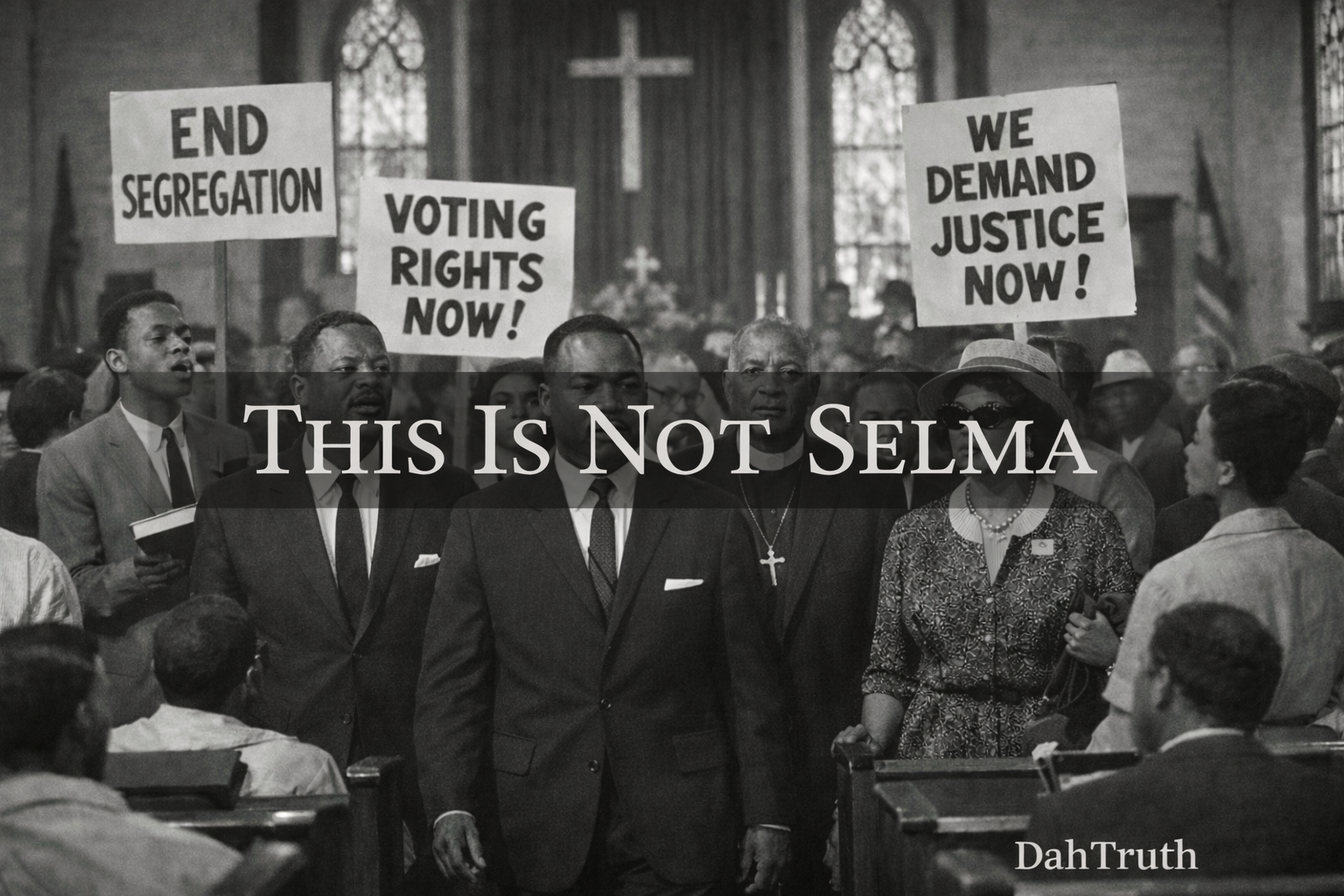
“The disfranchisement of the Negro is unjust to him, harmful to the white man, and a danger to the State. No man can be permanently wronged without the wrong reacting in some way upon himself.” — Booker T. Washington, circa 1900
The Exploitation of Black American History for a Different Fight
I am sick and tired of the lies being spread by many Democrats today, including American Blacks who claim to speak for our community but refuse to tell the honest truth. Lately, I have been reading Before the Mayflower, and the difference between that small book, which captures American Black history succinctly, and The 1619 Project by Nikole Hannah-Jones is immediately noticeable. Once you understand our history, the distortion becomes clear.
The distortion is nuanced. It is embedded in how the story is told. The 1619 Project presents history from a perspective that implies the racists of the Jim Crow South are somehow the same lineage or moral legacy as the Republicans of today. That implication is false. The historical record is clear: the violent suppression of Black Americans during Reconstruction and Jim Crow was carried out under a one-party Democratic system that controlled law enforcement, courts, and local government throughout the South. Hannah-Jones conflates history and omits this critical political context, and this approach is now used across modern media to twist the past into a narrative that does not align with the documented record.
The Minnesota Situation
This is why I decided to write this week's blog, prompted in part by the Don Lemon and Georgia Fort situation, which was quickly framed as a civil rights controversy. To me, it felt less like a genuine civil rights issue and more like a carefully constructed distraction from what is actually happening on the ground in Minnesota.
The protests themselves are not organic, and the viral clips circulating online are designed to be short, fast, and emotionally charged—just enough to rile people up around a distorted or incomplete story. This is exploitation in its purest form. The goal is not understanding, truth, or resolution, but agitation. Manufactured outrage keeps people distracted from the real issues affecting our communities.
Within a single week, the public was asked to absorb several emotionally charged events. Don Lemon was arrested after entering a church with protesters. Georgia Fort, an independent Minnesota journalist, was arrested in connection with the same incident. Around the same time, Representative Ilhan Omar claimed she was sprayed with apple cider vinegar during a public encounter. I watched the footage and reviewed her remarks without relying on outside commentary. Given the pattern of emotionally charged incidents emerging from Minnesota in rapid succession—each one perfectly calibrated to generate outrage against Republicans and immigration enforcement—skepticism is warranted. I am not claiming proof. I am noting a pattern that demands scrutiny rather than reflexive acceptance.
At the same time, a Native Land Podcast town hall was held in Minnesota, where speakers framed current immigration enforcement as morally comparable to the Civil Rights era.
That comparison is what I find most disturbing.
The Justice You Won't Hear About
We are programmed to hear stories of injustice in our communities. That is what drives engagement. That is what generates outrage. But last week, something else happened that received almost no attention: Sean Grayson, the former Illinois sheriff's deputy who shot and killed Sonya Massey in her home, was sentenced to 20 years in prison—the maximum sentence allowed under Illinois law.
When Sonya Massey was killed in July 2024, the story stoked the flames of racism and police brutality. She was a 36-year-old Black woman who called 911 to report a prowler. A white deputy shot her in the face in her own kitchen. The body camera footage was harrowing. Protests erupted. The case became national news.
And then? The system worked.
Grayson was fired, arrested, and charged. A jury convicted him of second-degree murder. A judge gave him the maximum sentence. The sheriff who hired him was forced to retire. Sangamon County agreed to implement more de-escalation training. Illinois changed its law to require fuller background checks on law enforcement candidates. And Sonya Massey's family—including her two teenage children—received a $10 million settlement, negotiated by civil rights attorney Ben Crump.
Justice was served.
But you don't hear much about that, do you? Because justice doesn't fit the narrative. The media wants to focus on injustice—on the outrage, the wound, the grievance. When the system actually holds a killer accountable, that story fades. It doesn't generate clicks. It doesn't keep people angry.
This is the difference between 1964 and today. In 1964, the men who murdered James Chaney, Andrew Goodman, and Michael Schwerner walked free for years. The state of Mississippi refused to prosecute. The system protected the killers. That was Jim Crow.
Today, a white deputy who killed a Black woman in her own home received the maximum sentence. Her children will receive restitution. Her name changed Illinois law. That is not Jim Crow. That is accountability. And pretending otherwise insults the people who actually lived—and died—under a system that offered no justice at all.
The False Equivalence
Black American history, particularly the Jim Crow and Civil Rights eras, is being used to make modern immigration enforcement feel morally equivalent to the violent suppression of Black Americans. The implication is that what happened to us is now happening to them. That comparison is emotionally powerful, but it is historically false.
The most glaring example is the repeated invocation of the 1964 murders in Mississippi, when James Chaney, Andrew Goodman, and Michael Schwerner were killed for helping Black American citizens register to vote. Those men were targeted because they were assisting citizens who were being denied a constitutional right by a one-party Democratic system.
What is happening in Minnesota does not align with that history. The killing of Alex Pretti, while tragic and rightly under investigation, occurred during a federal immigration enforcement operation. It was not a voter registration drive. Pretti was not targeted for advancing the civil rights of American citizens. These are fundamentally different legal and historical contexts, and collapsing them into a single narrative distorts both.
Civil rights were fought to secure citizenship and constitutional protection for Black Americans who were denied both by law. Using that history to guilt Americans into accepting disorder, selective enforcement narratives, or the erosion of the distinction between citizens and non-citizens does not advance justice. It distorts it.
The Church Incident and Due Process
Don Lemon and Georgia Fort were charged with conspiracy against rights of religious freedom and attempting to injure while exercising religious freedom. These are not charges against journalism. These are charges alleging that the civil rights of American citizens—the worshippers at Cities Church—were violated.
The protesters entered Cities Church in St. Paul to confront a man believed to be employed by ICE. That man is an American citizen, legally employed by the federal government, and legally entitled to worship without being confronted or harassed during a religious service. Whatever one thinks of ICE as an institution, entering a church to confront a private citizen during worship raises serious questions about the rights of worshippers and the limits of protest.
Yes, two judges initially rejected charges against Lemon, citing insufficient evidence of criminal behavior. But that does not establish innocence—it means the threshold was not met at that preliminary stage. What concerns me is what the footage shows: Lemon's presence with protesters before they entered the church, his coordination with them, the role he played in the lead-up to the disruption. Intent matters. The question is not whether Lemon held a camera, but whether he was a journalist documenting an event or a participant who used the journalist label as cover.
That is a question for the courts to decide. Lemon deserves due process, and he should have his day in court so that the facts can be examined and judged accordingly. But the rush to frame this as an attack on Black journalism—as though he was charged simply for being Black—obscures the actual legal question at issue.
Many Black journalists do not engage in this behavior. Black reporters across mainstream and independent media outlets manage to cover immigration and protest movements without entering churches or following protesters into worship services. Lemon and Fort's choices were their own, and they do not represent journalism as a whole or Black journalism specifically.
There is also an uncomfortable irony here. Historically, Black churches were surveilled, disrupted, and attacked by white mobs—often under Democratic control—seeking to prevent Black Americans from worshiping freely. In this case, protesters entered a predominantly white church to confront a worshipper over his employment. While the scale and violence are not comparable, the underlying logic is troubling: political intimidation was brought into a religious space, and the racial framing was later reversed to obscure that reality.
The Historical Lie
Left-leaning commentators increasingly frame these events as a struggle between Democrats and Republicans, or between whites and Blacks. That framing does not hold up under historical scrutiny. There are white Democrats and Black Americans who oppose current immigration policies. To maintain the narrative, the language expands to "Black and brown," folding immigrants into the Black American story despite vastly different histories, legal statuses, and relationships to the state.
This is not fundamentally about race. It is not fundamentally about party. It is about law.
Either we are a nation governed by laws, including borders, or we are not. To make federal enforcement appear inherently immoral, a familiar image must be resurrected. The violent white oppressor of Jim Crow memory carries emotional weight in Black communities, and that is precisely why it is invoked. Yet the historical oppressors people are being asked to imagine were not Republicans. They were Democrats operating within a one-party Southern system. By reviving that image and attaching it to modern immigration enforcement, commentators create a villain that does not exist in this context.
Civil Rights Funding vs. Modern Protest Funding
Some will point out that the Civil Rights Movement also had significant organizational funding and coordination. That is true. The NAACP received substantial donations. The Urban League was well-funded. CORE operated with donor support. Corporations like IBM, Coca-Cola, Ford, and General Motors contributed. Government funding supported the enforcement of the Civil Rights Act and Voting Rights Act.
But the existence of funding is not what distinguishes legitimate movements from manufactured ones. What matters is what the money was used for, who it served, and the legal context in which it operated.
Civil Rights–era funding supported the enforcement of existing constitutional rights. Money paid for court cases, attorneys, bail for unjust arrests, voter registration infrastructure, and protection against unconstitutional laws. The goal was access to the law, not pressure against it. These organizations supported American citizens who were denied the vote, denied equal protection, and denied access to public institutions. The Civil Rights Act of 1964 and Voting Rights Act of 1965 were responses to documented constitutional violations by state governments. That is why federal funding was justified—the federal government was enforcing its own Constitution against rogue states.
Most importantly, the Civil Rights Movement made specific, finite demands: end segregation, secure the vote, enforce equal protection. Once achieved, protests subsided because the legal objective was met. There was no demand to erase borders, suspend law enforcement, or collapse the distinction between citizen and non-citizen.
Modern protest funding operates under a fundamentally different logic. It often sustains continuous protest cycles, media amplification, legal defense for civil disobedience, and disruption as a permanent strategy. There is frequently no clear endpoint, because outrage itself becomes the product. Unlike the Civil Rights era, modern protest movements often treat law enforcement itself as illegitimate, blur the distinction between enforcement and abuse, and frame citizenship boundaries as immoral. This is a reversal of the Civil Rights framework, which demanded that the law finally apply to Black Americans.
Civil Rights funding fought for Black Americans inside the polity. Modern protest funding often advances causes involving non-citizens, transnational political goals, and ideological commitments unrelated to constitutional rights. That is not an extension of Civil Rights. It is a different project entirely.
Those perfectly crafted signs do not appear out of basements, bedrooms, or garages of the oppressed. They are printed, laminated, and carefully mounted on wooden sticks. That level of preparation suggests coordination. But coordination alone is not the issue—the Civil Rights Movement was coordinated too. The issue is what the coordination serves: finite goals for American citizens, or sustained agitation with no clear endpoint that conflates citizen and non-citizen interests.
This Is Not Selma
American Black media is feeding our community a lie: that illegal immigration enforcement is the same as Jim Crow oppression, that the Republicans of today are the Democrats of 1964, and that journalists who coordinate with protesters to disrupt church services are victims rather than participants who deserve their day in court.
The 1619 Project began this work of historical distortion by conflating timelines and omitting political context. Now that same approach is being used to exploit the Black American struggle for a completely different fight—one involving non-citizens whose relationship to the American legal system is fundamentally different from that of Black Americans who were born here, whose ancestors built this country, and who were denied rights they were owed under the Constitution.
Civil Rights–era funding enforced constitutional rights for American citizens who were denied them by law. Modern protest funding often supports sustained political agitation that challenges the legitimacy of law itself and blurs the distinction between citizens and non-citizens. Treating these two as morally or historically equivalent is not just inaccurate. It is an insult to the men and women who bled for our freedom.
When Sean Grayson received the maximum sentence for killing Sonya Massey, the silence from the same media that stoked outrage over her death was deafening. Because justice doesn't fit the narrative. Grievance does.
That is why this moment deserves scrutiny rather than slogans.
© 2026 Jacqueline Session Ausby. All rights reserved. This post and all original content published under DahTruth are the intellectual property of Jacqueline Session Ausby. No part of this publication may be reproduced, distributed, or transmitted in any form or by any means without the prior written permission of the author.
