Africa, You Do Not Speak For Us
“For I will set mine eyes upon them for good, and I will bring them again to this land: and I will build them, and not pull them down; and I will plant them, and not pluck them up. And I will give them an heart to know me, that I am the LORD…”Jeremiah 24:6-7
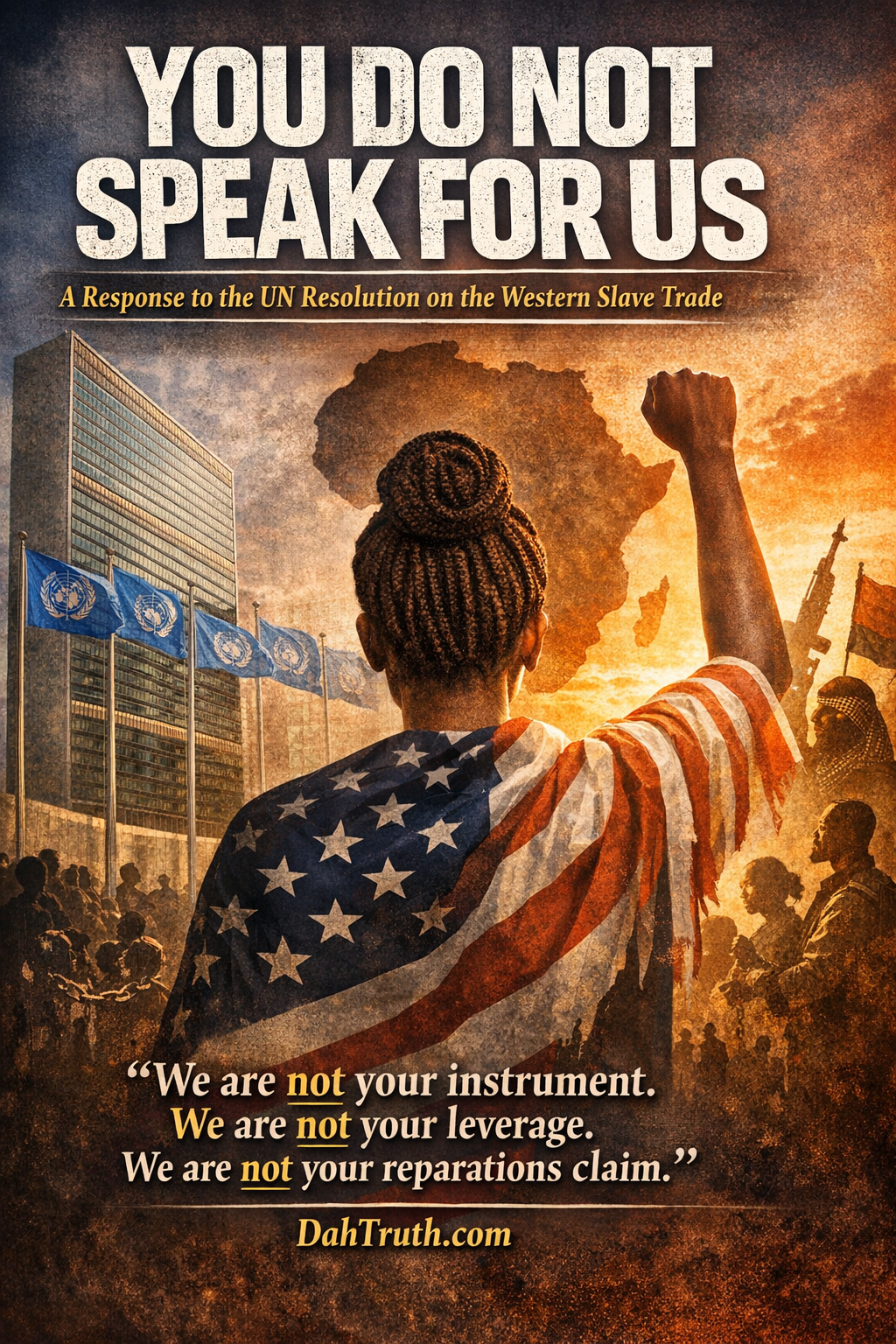
You Do Not Speak For Us
A Response to the United Nations Resolution on the Western Slave Trade
My Dear Brothers and Sisters, and Members of the United Nations,
I speak as a child of God, an American Black woman, and a descendant of slavery. I speak without apology and without permission from anyone who believes they hold authority over my story.
Last week, the world watched as the United Nations issued a formal condemnation of Western nations for their role in the trans-Atlantic slave trade. During the General Assembly's commemoration of the International Day to Remember the Victims of Slavery, Assembly President Annalena Baerbock declared that the slave trade and slavery stand among the gravest violations of human rights in human history. She went further, describing the transatlantic slave trade as mass resource extraction, arguing that African nations were hollowed out after losing generations of people who could have helped their countries prosper.
Even the language used is striking. Mass resource extraction. Because today they are describing slavery this way, speaking of human beings, our ancestors, in the same cold economic terms that once justified their exploitation. The very people who were kidnapped, chained, and sold as property are now being described as resources extracted from a region, as though generations of lives can be summarized as the removal of raw materials. Our ancestors were not resources. They were fathers and mothers, sons and daughters, innovators, leaders, and builders whose lives were violently interrupted. To reduce them to an economic category now, in the name of justice, is its own form of dehumanization.
Ghana's President, John Dramani Mahama, echoed similar sentiments, reinforcing the narrative that the Western slave trade stood apart as uniquely inhumane. He argued that racialized chattel enslavement made the Western trade distinctly more grave than other forms of slavery throughout history. He was specific. He named 1619, the year the first enslaved Africans arrived on American soil. He named the Virginia law of 1662, Partus Sequitur Ventrem, that which is born follows the womb, the law that declared a child born of a slave mother is also a slave, binding generations into bondage by legal design. He named Texas. He referenced Prager U. He built a careful, detailed case aimed directly at America.
“King Gezo said in the 1840’s he would do anything the British wanted him to do apart from giving up slave trade:
”The slave trade is the ruling principle of my people. It is the source and the glory of their wealth…the mother lulls the child to sleep with notes of triumph over an enemy reduced to slavery…””
And then, in the same speech, President Mahama said something that he intended as a defense but that I intend to hold up as an indictment. He acknowledged that some believe it is not acceptable to judge the social norms of the past by the standards of today, and he said that people use that argument loudly and proudly to escape accountability for the harm perpetuated by others. He is right about that. I agree with him completely. You cannot build a monument to selective memory and call it justice.
But President Mahama, that principle does not belong only to the West. If we are holding the past accountable by the moral standards of today, then that accountability must run in every direction without exception. He called to remembrance 1619, the year the White Lion arrived in the United States. I will name the slave forts. The barracoons. The castles. The factories. The dungeons along the West African coast where African men and women were held before being auctioned and shipped. Those forts may have been built by the British, the Dutch, the French, and the Danish, but the market was stocked by Africans. African rulers raided neighboring communities. African traders kidnapped and sold their own people for gold and ducats. African kingdoms profited from the transaction and used those profits to expand their own power. If we are judging by today's standards, that too must be named. You cannot invoke the moral clarity of the present when it serves your argument and then retreat behind the complexity of historical context when it does not.
And it was not only the Western slave trade. The Arab slave trade ran for more than thirteen hundred years, devastating populations across East Africa and the Sahel, stripping men, women, and children from their communities and selling them into bondage across the Arab world. Mauritania did not officially abolish slavery until 1981, and the practice continued into 2007.
Morocco also stood among those nations voting to declare the Western slave trade the most inhumane in history. Yet today, within its own borders, there are well-documented issues of anti-Black racism that remain largely unaddressed by its government. This is a nation on the African continent, not outside of it, and not removed from the history it now attempts to distance itself from. To stand on a global platform and condemn one form of inhumanity while ignoring the realities within your own society is not moral clarity. It is selective accountability.
Arab nations systematically trafficked and emasculated African men and boys, a practice that constitutes nothing less than genocide, and yet twenty-two Arab nations stood at that United Nations podium and voted to call the Western slave trade the most inhumane in history without a single word about their own nations' treatment of Africans.
China voted yes while actively repressing and exploiting the Uyghur people in Xinjiang.
The hypocrisy is structural. It is a deliberate attempt to condemn the West while refusing to pull the beam from their own eyes.
The horrors of slavery do not need to be introduced to us by international leaders’ centuries removed from the lived consequences. We carry that history in our families, in our communities, and in the very foundations of this country. We know slavery was evil. We know it was brutal. We know it stripped people of their humanity and fractured generations. What is troubling is not the acknowledgment of slavery. It is the selective framing of it. When slavery is discussed solely as a Western sin, detached from the global systems and participants that enabled it, history becomes less about truth and more about narrative. When international bodies reduce a complex and tragic chapter of human history into a moral indictment aimed at modern Western nations, remembrance shifts into political leverage.
I grew up hearing that American Blacks lack legacy. That we do not know our history. This is the same song Mahama sang as he attempted to absolve Africa of its most wicked sin, suggesting that because of slavery we are a people without roots or without a name, as if God did not have the power to give us new names in new soil. I have spent my life watching the continent respond to that charge not by honest reckoning but by continual deflection. Africans on the continent have largely refused to look in the mirror. They speak of the slave trade as something that happened to Africa, not something that Africa participated in, profited from, and in many cases orchestrated. They pretend they did not know how bad it would be, as though the evidence of what slavery produced was somehow hidden from the people who initiated the transactions.
This declaration is not justice. It is theater. It is a document crafted not to honor the suffering of the enslaved but to position certain nations and certain grievances for financial and political extraction. Reparations. That is what sits underneath this resolution. Not healing. Not truth. Not accountability from every party that bears responsibility. Just a demand aimed at the nations that, whatever their crimes, also fought wars to end the practice of slavery. Nations where the descendants of the enslaved have survived, built, created, contributed, and refused to be erased. Now those leaders look at their own continent, at the devastation in the land and the plight of their children, and they compare them to those of us in the West and declare that the West must pay.
Here is what I will say plainly on the matter of reparations. America does owe a debt to the descendants of slavery on American soil. Not to Africans on the continent. Not to the Caribbean. Not to any diaspora group that did not suffer the specific and documented brutality of American chattel slavery. To the descendants of those who were enslaved here, who built this nation, who were denied the fruit of that labor across generations through law and violence and systemic exclusion. That debt is real and it is specific. But if we are holding the logic of reparations consistently, then that same logic reaches back across the Atlantic. The African kingdoms and rulers who raided, kidnapped, and sold human beings into the Western slave trade profited from those transactions. If America owes for its part in the system, then those who stocked the market owe for theirs. You do not get to claim moral injury from a transaction you initiated and profited from. President Mahama said we should not use historical complexity to escape accountability. I am applying his own principle back to him.
Look at us. Look at what the diaspora produced. We are not a begging people. We are not a broken people stretching our hands toward the continent for rescue or recognition. Despite the betrayal of African ancestors, we survived and built this nation with our bodies and our blood and our genius and our faith, and we are still here, still standing, still producing, still breathing without a yoke on our necks. God took what was meant to destroy a people and made them strong. He turned poison into kryptonite when he planted a group of people in the most powerful nation the world has ever seen. Africa you sold your family into the hands of suffering and God made sure that suffering produced something you cannot purchase, cannot claim, and cannot take.
And now you want reparations. Now you want to arrive on the world stage and speak in our name, as though our history belongs to you, as though our survival is a resource you are entitled to harvest. You grin in dark rooms while the blood of your own people stains your hands, and you believe that because these things are done in darkness no one will name them in the light. God reveals all things. Every transaction made in secret. Every alliance built on the suffering of others. Every resolution drafted not for the healing of the wounded but for the enrichment of those who never bore the wound.
There is one more thing worth saying plainly. When the United Nations stands before the world and condemns the West, they speak as though the West is a white institution. They erase us from the very civilization we were forced to build and then chose to claim as our own. We are Western. Our roots were cut from the African continent and replanted in Western soil, and what grew from that replanting is Western in culture, in faith, in identity, and in contribution. We are Christian. We carry the values of a Western Christian civilization not because they were handed to us graciously but because we fought for our place inside them and inside them, we found God we had loss due to idolatry. To condemn the West without acknowledging that American Blacks are among its most foundational contributors is not just historically dishonest. It is another erasure, dressed this time in the language of justice. We owe nothing to the continent of Africa and its leaders who grin at global podiums while their own people go without. Nothing.
We did not give you this permission. We did not ask you to speak for us. We do not share your belief, your greed, or your audacity. The nerve of standing on a global platform and framing our history as your cause while refusing to account for your own ancestors' role in creating that history in the first place is not advocacy. It is theft of a different kind. And we see it clearly.
The children of the diaspora are not your instrument. We are not your leverage. We are not your reparations claim. We are God's remnant, placed on this soil for a purpose that was decided long before any resolution, any declaration, any United Nations chamber ever existed. And we will not be moved by those who pretend to love us while counting what they believe they are owed.
