
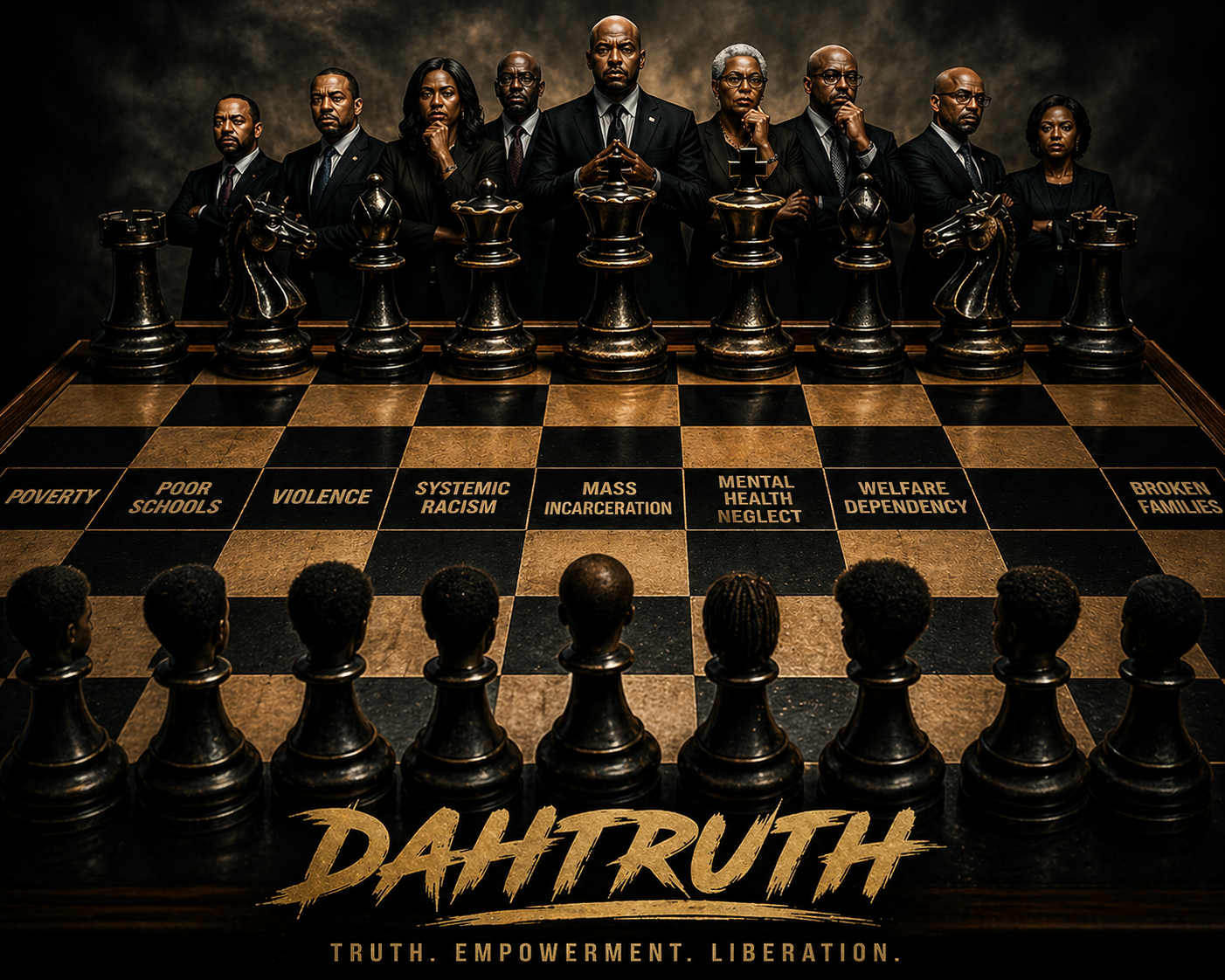
“A pawn that never questions the board will always be sacrificed for the game.” — Jacqueline Session Ausby
On Black Leadership, Borrowed Houses, And The Wages Of Loyalty
I came across a LinkedIn post this week from Wes Moore, the Governor of Maryland. The post opened the way they always open these days. It pointed at gas prices. It pointed at tariffs. It pointed at wars overseas. It pointed at Donald Trump. Once that throat-clearing was done, the post pivoted home and listed the wins. Lower electricity bills. New laws preventing grocery stores from gouging customers. More housing being built. Investments designed to help businesses build wealth. Protections around the right to be vaccinated.
It read like progress. It read like leadership. It read like a man who is doing the work.
Then I sat with it for a minute. I asked myself the only question that actually matters when a politician posts a list. Whose life looks different because of any of this? In Maryland, where the Governor is American Black, where the Mayor of Baltimore is American Black, where Black leadership is finally seated at the table the ancestors begged for, what has actually changed for the people those names are supposed to represent?
The honest answer is the answer nobody on a podium wants to give. Not nearly enough.
Here is what I have come to believe. We are not being led. We are being managed. The policies change packaging every four years. The faces delivering them get darker while those benefiting from them get lighter. The conditions in our neighborhoods stay the same. We are pawns on a board, moved two squares forward, two squares back, and sometimes pushed to the front line to be taken. Until we name that out loud, no vote and no victory speech is going to save us.
“My people are destroyed for lack of knowledge.”
The House You Do Not Own
Start with housing, because housing is where wealth either takes root or never grows. In a state celebrated for its first American Black Governor, in cities run by American Black mayors, homeownership for our people is still out of reach for far too many families. Lending is harder. Credit thresholds are higher. Down payments are heavier. The doors that other communities walked through fifty years ago are still being negotiated for ours.
Meanwhile, the policy emphasis remains on rental support. Section 8 expands. Voucher programs are praised. Politicians cut ribbons in front of new apartment complexes and call it progress.
Section 8 is not stability. It is the appearance of stability. A family living in a house they do not own, on a voucher they did not earn equity from, one missed payment away from eviction, is not secure. They are housed. There is a difference. Stability is what you can fall back on when life turns. Equity is what you draw from when the job ends, when the diagnosis comes, when the child needs college, when the parent needs care. Renters do not have that. They have a roof and a deadline. The wealth that should be building underneath their feet is building somewhere else, in the bank account of the landlord, in the portfolio of the management company, in the property tax base of a city that does not return the favor.
Programs that keep our people renting forever are not neutral. They are extractive. Every month that voucher hits, somebody who is not American Black gets a little richer off our presence in a property we will never own. That is not a conspiracy. That is just how rent works. The question is why the most visible housing solution offered to our community is the one that builds wealth for everyone except us.
If American Black leadership in Maryland was going to do something historic, it would have been a pathway to ownership. Not a voucher. A door key. A deed. A stake in the ground that says my people are not passing through. My people are staying. That is not the legislation being passed. The voucher is the legislation being passed.
Cities Run By Us, Failing Us
Look at Baltimore. Look at Chicago. Look at Memphis. Look at Detroit. Look at every urban city in this country that has been under unbroken Democratic leadership for forty, fifty, sixty years. Look at the school systems. Look at the homicide rates. Look at the percentage of children reading on grade level by fourth grade. Look at the number of fatherless homes. Look at how long the bus takes to get to the grocery store that finally opened ten miles away.
The Mayors are American Black. The City Council members are American Black. The Police Commissioners, the school superintendents, the housing directors, the prosecutors are American Black. Representation has been achieved. Representation has been celebrated. Representation has not changed the outcomes.
In Baltimore, the school system continues to rank near the bottom nationally year after year. In Chicago, Mayor Brandon Johnson stands at podiums talking about a city moving in the right direction while teenagers run circles around the police department and shoot each other in numbers most of America has chosen not to think about. In every one of these cities, the script is the same. Crime is down according to the press release. Crime feels different according to the grandmother who has not let her grandbabies play on the porch in three years.
If leadership, policy, and representation have all been pointed in the same direction for half a century, the outcomes are not an accident. They are a result. They are what the system was actually built to produce. We have to be honest about that, even if it costs us our comfort.
The Loyalty Industry
The next layer is the messaging machine that keeps us locked into the same vote no matter what the vote produces. Black political media has become an industry, and like every industry, it has shareholders to satisfy.
Roland Martin tells us how to vote. Joy Reid told us how to vote until her show ended and now she tells us from a podcast. Don Lemon, in his second act, tells us how to vote. Angela Rye tells us how to vote. Eddie Glaude Jr. tells us how to vote in the seminar voice that pretends it is just analysis. Jemele Hill tells us how to vote between sports takes. The Native Land Pod tells us how to vote in the cadence of friends who already know the answer before the question is asked.
None of these voices are wrong simply for having a position. The problem is that the position is non-negotiable. Disagreement is treated as defection. Independent thought is treated as betrayal. If you raise a question about a policy that has not delivered for our community in three generations, you are accused of carrying water for the other side. The conversation collapses before it begins.
Then there is the other flank. Briahna Joy Gray, Marc Lamont Hill, Sabrina Salvador, voices that present themselves as the more authentic alternative because they reject mainstream Democratic policy. Look at what they actually offer in its place. A more aggressive form of the same dependency. A socialism that requires even larger government. A pan-African or foundational frame that rejects American identity altogether and offers no functioning replacement, only grievance dressed in academic language. They are not a way out. They are the same trap with different paint.
All of these voices are paid. All of them have podcasts, speaking fees, brand deals, book contracts, university appointments. They are not suffering from the policies they recommend. They are profiting from the loyalty those policies require. Their bank accounts grow whether the boy on the corner of West Baltimore lives or dies. We carry the cost of the alignment they sell. They carry the receipts.
Why Is Israel Suddenly The Threat?
Now turn on any panel show, scroll any timeline, listen to any rally aimed at our community, and tell me what the loudest topic has been for the past two years. Israel. Gaza. Foreign policy. The map of a country most of us have never visited has somehow become the moral center of conversations about American Black freedom.
Foreign policy matters. Innocent life matters everywhere. None of that is in dispute. The question is why the energy spent on a war ten thousand miles away is not being spent on the war happening on our own blocks. Black boys are killing each other in our streets. Black girls are being trafficked through our cities. Black mothers are burying their children at rates that would shut down any other community in America. Black families are being priced out of neighborhoods their grandparents built. Black schools are graduating students who cannot read the diploma they are being handed.
None of those crises are trending on the panels. None of those crises are organizing the marches. None of those crises are setting the agenda for the next election.
It is easier to point outward than to look inward. It is easier to indict a foreign government than to indict the city council you voted for in eight straight elections. It is easier to grieve the children on a different continent than to grieve the children on the corner because the children on the corner require us to ask what we have allowed.
The outward gaze is not righteousness. It is avoidance. And the leaders directing our attention away from our own house know exactly what they are doing.
When The Pulpit Joins The Machine
Even the church has gotten in line. I listened to a sermon recently from Jamal Bryant. The text was Habakkuk 2:3, the vision tarrying but coming in its appointed time. The application was something else entirely. Write down what you want God to do for you. A new job. A house. Tuition paid. Healing. A breakthrough. Then plant a seed, by which he meant a financial offering, and watch every word on your list come to pass in God's perfect timing.
I am not naming Bryant because he is the only one. I am naming him because he is the latest example of a problem that has spread through American Black pulpits like rot through a beam. The problem is not faith. The problem is what faith has been reduced to. A vending machine. Insert seed. Receive desire. The vision is no longer about the kingdom of God advancing in a generation. The vision is about the individual believer's wish list.
Habakkuk was not writing a personal prosperity plan. Habakkuk was crying out about the violence and corruption of an entire nation, and God answered him with a vision about justice and the destruction of the proud. That is not the sermon being preached. The sermon being preached turns the prophet into a life coach and the offering plate into a coin slot.
Where is the pulpit calling our community to repentance for the children we have aborted, the marriages we have abandoned, the boys we have left to the streets, the girls we have surrendered to the screens? Where is the pulpit naming the conditions instead of monetizing the longing? Where is the pulpit telling us that the seed God actually requires is obedience, not currency, and that the harvest He promises is righteousness, not real estate?
When the church starts selling individual breakthrough while the community burns, the church has stopped being the church. It has become another podcast with stained glass.
There is one more thing about that sermon I cannot let pass. Bryant is a Baptist preacher. He preached the entire message and never once spoke the name of Jesus Christ. Not in the opening. Not in the application. Not in the close. He had time to walk the congregation through how to write a vision, how to plant a seed, and how to wait for the harvest. He had time, at the very end, to tell the congregation to get out and vote. He reminded that that early voting was beginning the very next day. He did not have time for the name of the Savior whose blood the church he stands in was built on. A Baptist pulpit that finds room for the ballot but not for the name of Christ has chosen its kingdom. It is not the one in scripture.
The Wounds Nobody Will Touch
Underneath all of this is a layer of pain leadership has refused to address for decades. Mental health in our community is a quiet catastrophe. Our boys are growing up traumatized and untreated, which is one of the reasons they are picking up guns and using them on each other before they can legally drink. Our girls are growing up traumatized and untreated, which is one of the reasons they are turning their bodies into commodities by sixteen and calling it confidence. Our mothers are exhausted and untreated. Our fathers, when they are present, are stretched and untreated. Our elders are grieving and untreated.
National incarceration numbers may be dropping, but the boys our system sweeps up are still disproportionately ours, and the boys it spits back out are still being released into the same neighborhoods that broke them in the first place, with no policy of restoration, no real reentry, no pipeline back to school or work or family or faith. They went in damaged and untreated. They come home damaged and untreated and now also marked. We act surprised when the cycle continues.
Gang violence is treated as a news cycle, not a policy priority. A child dies, the Mayor holds a press conference, the candle vigil is filmed, the headlines move on by Tuesday, and the next Friday another child dies on the same block. Where is the legislation? Where is the long-term mental health investment? Where is the trauma-informed schooling? Where is the federal task force? Where is the national conversation that lasts longer than a hashtag?
There is none. Because the leaders who are supposed to address it know that the conversation, if held seriously, would lead to questions they cannot afford to answer. So the silence holds. And the children keep dying.
Pawns On The Board
This is what it feels like to be American Black in this country in 2026. We are voted on, voted with, voted at, and rarely voted for. We are placed on the board to make a play look balanced. We are sacrificed when a sacrifice is needed. We are paraded forward when a victory needs a face. We are pushed to the front line when the casualty count needs to come from somewhere that will not cost the party anything important.
Our pain is currency. Our stories are evidence. Our faces are the defense when the institution gets investigated. Our votes are guaranteed. Our outcomes are optional.
That is not leadership. That is not representation. That is not progress. That is positioning. And every American Black man and woman with a microphone who is paid to keep us in formation is part of how the positioning holds.
The way out is not another election. The way out is not another speech. The way out is not another sermon promising you a job if you sow a seed. The way out is the truth, told plainly, told repeatedly, told regardless of who it offends.
Our leaders are not delivering. Our media is not protecting us. Our pulpits are not preaching repentance. Our policies are not building wealth for our people. Our cities are not safer for our children. Our schools are not teaching our babies to read. Our boys are not coming home. Our girls are not being protected. And every four years we are asked to vote again as if any of that has changed.
It has not changed because it was not designed to change. It was designed to keep us exactly where we are, useful enough to stay, broken enough to need them, loyal enough not to ask.
I am asking.
—
Jacqueline Session Ausby
