When the Violence Comes From Within
Reflections on a Bloody Week in the American Black Community
When I was growing up, we did not hear stories like the ones we are hearing now. There were no mass shootings inside our homes. There were no fathers walking through bedrooms killing children in their sleep. There were no headlines about former officials murdering their wives and then turning the gun on themselves. The neighborhoods were not perfect, but they were not graveyards either.
The older I got, the more violence began to invade our streets. It came in slowly at first, then all at once. The drugs arrived like weeds pushing through cracked concrete. Vials, needles, and broken glass scattered across sidewalks where children once played. Nobody could quite explain how it all got there. We were young, but we were not stupid. We knew the drugs did not grow in our neighborhoods. Somebody brought them in. Somebody profited. Somebody allowed it. The music shifted with the streets, and a generation that wanted out of the projects ended up celebrating the very things keeping them trapped.
That is the long backdrop. That is the soil. What grew out of it is what we are now forced to confront.
Here is what I have come to believe after watching this last week unfold. The deepest crisis in our community is no longer simply the violence done to us from the outside. It is the moral and spiritual violence we have learned to accept against ourselves. Until we name that honestly, no policy, no program, and no protest will save us.
A Week That Should Stop Us Cold
The middle of April 2026 was one of the bloodiest weeks the American Black community has seen in recent memory. A young woman traveled to an island for her birthday, met someone, and ended up dead. A Black podcaster went away with her white boyfriend to another island and never came home.
Then came the two stories that broke something inside me.
In Shreveport, Louisiana, a 31-year-old man named Shamar Elkins entered the homes of the two women who had borne his children and opened fire. When the morning was over, eight children were dead. Seven of them his own. The youngest was three. Most were shot in the head while they slept. He carjacked a vehicle, fled, and was killed in a confrontation with police a few miles away. In one act, he more than doubled the city's homicide count for the year.
That same week in Annandale, Virginia, former Lieutenant Governor Justin Fairfax shot and killed his wife, Dr. Cerina Fairfax, in their home. He then turned the gun on himself. Their teenage children were inside. Their oldest son made the 911 call. Court records released afterward described a man who had been ordered to leave the house by April 30, who had already lost custody of his children, who was drinking daily, and who had spent years obsessed with restoring a reputation damaged by a sexual assault scandal. He was, by every available measure, a man losing everything.
Two stories. Two households. Two communities forever marked. One carried out by a man the people around him describe as struggling with mental illness and untreated trauma. The other carried out by a man who once stood at the second-highest seat in Virginia government. Different worlds. Same outcome. Black families destroyed by the hands of Black men who were supposed to protect them.
I want to be careful here. I am not saying this kind of violence belongs only to us. It does not. White men, Latino men, Asian men, men of every background commit horrific acts of violence every day in this country. If you measured per capita, the picture would shift dramatically in places the cameras rarely visit. There are rural counties, suburban subdivisions, and quiet small towns where domestic violence is a way of life and nobody is reporting on it. The media zooms in on us because our urban centers are easy to map, easy to film, and easy to turn into a story. That is its own injustice, and I will not pretend otherwise.
Still, when the camera does find us, we have to look honestly at what it shows.
How I Knew Before I Knew
Before I saw a single face or read a single name in either case, something in the shape of those stories told me exactly what I was hearing. Not because Black men are more violent. They are not. The reason I knew was because of what the violence was aimed at. Not strangers. Not enemies. Not rivals. Their own. Their wives. Their children. Their households. That registered immediately. That sounded like us.
There is a particular pain when violence is directed inward. The Shreveport councilman said it plainly: more than thirty percent of homicides in his city are domestic in nature. That is not a statistic about strangers in the dark. That is families. Bedrooms. Kitchens. Front porches. People who shared a name and a meal and a child.
The Mental Illness Conversation
Whenever something like this happens, there is a rush to explain it away. Commentators like Roland Martin and others move quickly to mental illness, to systemic racism, to historical trauma. I do believe mental illness was part of what happened in Shreveport. The reporting confirms Elkins had been hospitalized for mental health treatment, had attempted suicide just two months earlier, and had told family members he was having dark thoughts. Something was wrong. Something was unaddressed. That is real.
Annandale feels different. That feels like a man who, faced with consequences he could not control, chose annihilation over accountability. He could not keep the marriage. He could not keep custody. He could not keep the house. He could not keep the reputation. So he took the only thing left he could control. That is not mental illness in the clinical sense. That is rage. That is pride. That is the refusal to be made small. That is what happens when a man decides that if he cannot have the life he wants, no one else gets to live either.
We must stop sanitizing every act of destruction by calling it mental illness. Sometimes it is. Sometimes it is not. Sometimes it is moral collapse. Sometimes it is generational sin finally walking into the open. We do ourselves no favors when we refuse to name what we are looking at.
What Our Children Are Being Taught To Want
Our community has become desensitized to self-destruction. We see it in domestic violence, in fathers abandoning children, in mothers suffocating under the weight of raising kids alone. We see it in drug culture, where poison is sold to people who look like us, live beside us, and trust us. We see it in the exploitation laid bare in the cases surrounding Sean Combs and R. Kelly, where countless American Black women and girls were used and discarded by men from inside the same community. We see it in how casually life itself is treated, as if children are disposable, as if family is optional, as if responsibility is a burden instead of a duty.
None of this stays inside our homes. It is being taught, hour by hour, to our children through the screens in their hands. Walk through any teenager's TikTok feed and tell me what you see. The rapper flashing a Draco at the camera while his toddler crawls across the floor. The athlete with three baby mamas, each one filming her side of the drama for content. The young woman explaining how she made fifty thousand dollars on OnlyFans last month and calling it entrepreneurship. The trapper teaching little boys how to count a stack and bag work in the kitchen, set to music, looped on a fifteen-second clip. The influencer who has never been in the streets pretending she was raised in them because that is what gets the views.
This is what our children are being taught to want. Not character. Not covenant. Not craft. Not calling. They are being taught to want clout, currency, and the appearance of power. They are being told that the fastest path there is to look dangerous, sound dangerous, and be desired by the dangerous. The boy who picks up a gun at fifteen did not invent that image. He saw it ten thousand times before he ever held one. The girl who sells her body at nineteen did not come up with that on her own. She was being marketed to since she was twelve.
The platforms know. The algorithms reward what destabilizes. Outrage, lust, violence, and humiliation move faster than virtue ever has. The companies count the money. The labels count the streams. The brands count the engagement. We count the funerals.
Why I Am Reading Nietzsche
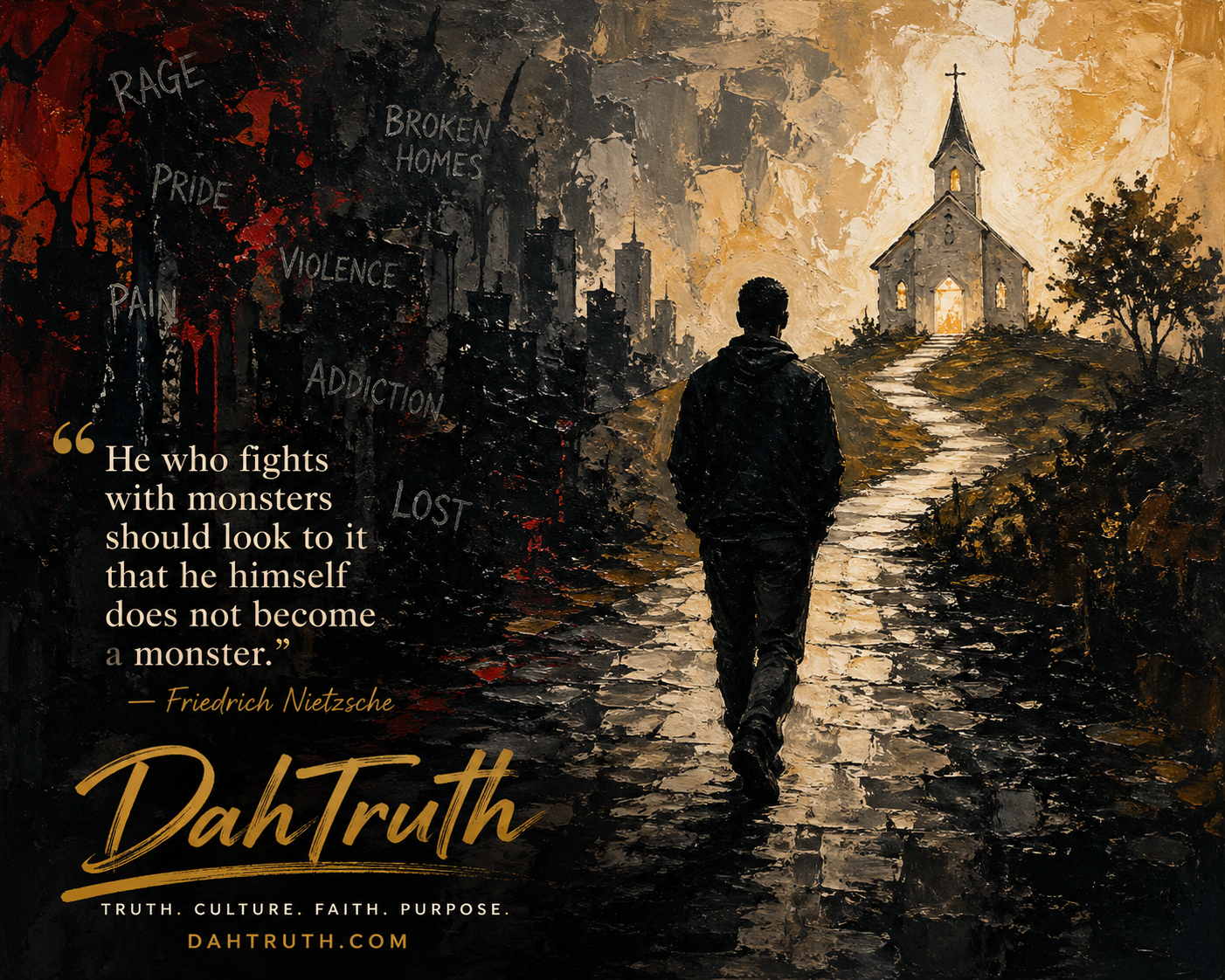
If you want to understand why a culture that has discarded God ends in funerals, you have to sit with the philosopher who told us, more than a hundred years ago, that the discarding was about to begin. So I have been reading him.
I have been reading Friedrich Nietzsche lately. Will to Power, specifically. I will be honest. When I first picked it up, I was opposed to him. He writes from hindsight. He writes without God. He writes as a man who believes the entire moral structure of Christianity was a long lie told to keep the strong from being strong. He called Christian morality slave morality. He believed humanity could move beyond God and create its own values through will, power, and self-definition. He believed people could decide for themselves what was right and what was wrong without needing any higher authority to tell them.
Something shifted in me as I kept reading. I realized Nietzsche is not arguing against God. He is arguing as if there is no God and then asking what follows. That is the experiment. That is the world he is describing. A world where man is the measure. A world where the strongest will writes the rules. A world where good and evil are inventions of the weak. The more I read him, the more clearly I could see something he could not. He was not describing a future he hoped for. He was describing the world we are already living in. And that world is exactly what is killing us.
That is the bridge from those murders to that book. Every act of violence we just discussed is a small Nietzschean act. The will of the self, exercised over the life of another, with no higher authority to answer to. The father in Shreveport decided whose children lived. The husband in Annandale decided whose wife lived. The trapper on TikTok decides his neighbor is prey. The girl on the live decides her body is currency. Strip away God, and this is what is left. Strip away the moral order, and the strong consume the weak. Reading a man who wrote without God has done the opposite of what he intended in me. It has driven me deeper into God. Because I have seen, in real time, what the world looks like when his ideas are left to run.
I know what some will say. Plenty of professed Christians have abused their wives. Plenty of pastors have preyed on the children in their pews. Plenty of so-called believers have done exactly the kind of violence I am condemning. That is true. I am not naive about it. The argument is not that Christians do not sin. They do. The argument is about what holds when the moral foundation itself is removed. A Christian who sins still answers to a standard outside himself. A man who has made himself the standard answers to no one. The first is a hypocrite. The second is the architect of his own permission.
Nietzsche thought he was freeing humanity. Look at us. According to CDC data, the abortion rate among Black women is nearly three times that of white women, and we account for roughly thirty-eight percent of abortions in this country while being only about thirteen percent of the population. Look at the children being told they can transform into something they are not. Look at the institutions, even our historically Black colleges, drifting into moral confusion they once would have stood firmly against. This is what self-made morality builds. Not freedom. Not flourishing. Graveyards.
When you remove God from the center, something else always takes His place. Money. Sex. Pride. Violence. Status. Self-worship. Survival at any cost. None of those things can save us. None of those things have ever saved anyone.
What Returning To Christ Actually Looks Like
There is healing that needs to happen in our community. Real healing. Not the performative kind that shows up at vigils and disappears by the next news cycle. Not the political kind that turns every dead child into a talking point. Returning to Christ is not a slogan and it is not a feeling. It is a thousand specific decisions made by a thousand specific people on a thousand ordinary Tuesdays.
It looks like a father coming home and staying home. It looks like a husband loving his wife enough to walk away from the argument instead of reaching for the gun. It looks like a mother turning off the live and opening the Bible at the kitchen table with her babies before bed. It looks like the church mothers in the neighborhood being free to correct somebody else's child again without fear of being cursed out on the porch. It looks like a teenage boy being walked into manhood by men who actually know his name. It looks like a teenage girl being told by her father that her body is not currency and her worth is not measured in followers. It looks like a marriage covenant that means something even when it gets hard, especially when it gets hard.
It looks like the deacon who finally tells the truth about what he saw the pastor doing. It looks like the sister who calls her brother out instead of covering for him one more time. It looks like the artist who decides he is not going to glorify the trap anymore even if it costs him the deal. It looks like the influencer who deletes the page because she finally counted the cost of who she was teaching her cousins to become.
It looks like policy too. We need illegal guns off our streets. We need real investment in our young people. We need real schools, real mental health resources, real intervention in homes where children are being raised in danger. We need to stop pretending that the absence of fathers is acceptable. We need to stop pretending that aborting our future is liberation. We need to stop pretending that what we glorify on a screen is not training the next shooter, the next abuser, the next mother weeping over a coffin too small for any mother to ever carry.
Most of all, we need to come back to Christ. Not as a sentiment. As a structure. As a daily, governing, household, neighborhood, community-shaping reality. Because a community without God will eventually become a community without restraint, without purpose, and without truth. We are watching that play out in real time.
The Word We Have Been Avoiding
A week of funerals. A week of headlines. A week of explanations that do not explain anything.
The word we have been avoiding is repentance. Not for what was done to us. For what we have allowed to happen among us. Repentance for the music we let raise our children. Repentance for the lifestyles we glorified. Repentance for the abortions we framed as freedom. Repentance for the husbands we never held to account. Repentance for the wives we did not protect. Repentance for the institutions we let drift. Repentance for the silence in our pulpits and the noise in our feeds.
Nietzsche bet his life that man could become his own god. We are the proof of what that bet costs. The way back is not forward into more self. The way back is down. To our knees. To the only One who has ever been able to heal a people.
And that One is not us.
—
Jacqueline Session Ausby
