The Rise of Lazarus
“Pain and suffering are always inevitable for a large intelligence and a deep heart.” Dostoevsky, From Crime and Punishment
We are living in a world that has lost its grip on truth. Not because truth has disappeared, but because we have decided we no longer need it the way we once did. What has replaced it is performance. What people present and construct for the eyes of others has become the new currency of reality. And beneath all of that performance is deception, sometimes deliberate, sometimes so deeply practiced that the person performing it can no longer tell the difference between what is real and what they have built.
We rely on one another's version of truth as though opinion were the same as fact and feeling were the same as foundation. Truth has been stretched and bent and reshaped so many times that it no longer carries the weight it was meant to carry. It has become something people claim rather than something people discover.
But what I have come to understand is that real truth does not disappear simply because we ignore it. It waits. And it waits. It sits beneath the noise and the performance and the carefully constructed versions of reality that we present to the world and to ourselves. And then it breaks through. When it does, there is no argument. There is no debate. It rises. It reverberates. It resonates at a level that goes deeper than anything that can be reasoned away. You do not decide to receive it. You recognize it. Something in you that was already awake to it finally has the language it has been waiting for.
That is what happened to me reading Crime and Punishment.
Crime and Punishment is a novel about a murder. But it is really a novel about a man who decided he could define truth for himself and live inside that definition without consequence.
Raskolnikov is the son of a deceased father, raised by a poor mother with a beautiful and devoted sister named Dunya. He leaves home to attend university but by the time we meet him he has already withdrawn. He has dropped out and is living in near isolation, cut off from society and from any real sense of purpose or direction. There is a heaviness to him, a quiet despair that sits beneath everything.
What stirs him is not ambition but desperation. He learns that his sister Dunya is preparing to marry a man nearly twice her age. It is not a marriage built on love. It is a sacrifice. She is willing to give herself over to a life she does not want in order to relieve the burden on her mother and her brother. Raskolnikov understands exactly what she is doing. And that knowledge does not humble him. It pushes him toward a darker kind of thinking.
He turns his attention to an old pawnbroker in the city, a woman who lends money to the poor at high interest, keeps what is given to her when people cannot repay, and hoards everything she collects. Raskolnikov convinces himself that her life holds little value. That her death would go unnoticed. That removing her from the world could even be justified as a kind of service.
He builds that reasoning piece by piece until it feels undeniable to him. By the time he is finished the act no longer appears as murder. It appears as something almost necessary. And that is the most dangerous place a human mind can arrive at, the place where sin has been reasoned into righteousness.
I will not walk through every detail of what happens after Raskolnikov commits the murder. What I will say is that the weight of what he has done does not leave him. It presses in. It follows him. And in the middle of his unraveling he finds his way to a young woman named Sonya.
Where Raskolnikov is divided, Sonya is grounded. Where he has built his life on reasoning and pride, she has built hers on faith. Sonya is a believer in the Word of God despite the life she has been forced into. She is a young woman who has sold her body to support her family, reduced to the lowest place that society could put her. And yet she is the one who carries truth. Not because she is powerful, educated, or recognized by the world. But because she knows what it means to suffer and remain faithful anyway.
Together they are brought face to face with what they have each done and what they have each endured. And in one of the most powerful moments in all of literature, Raskolnikov asks Sonya to read to him. He asks her to read the story of Lazarus.
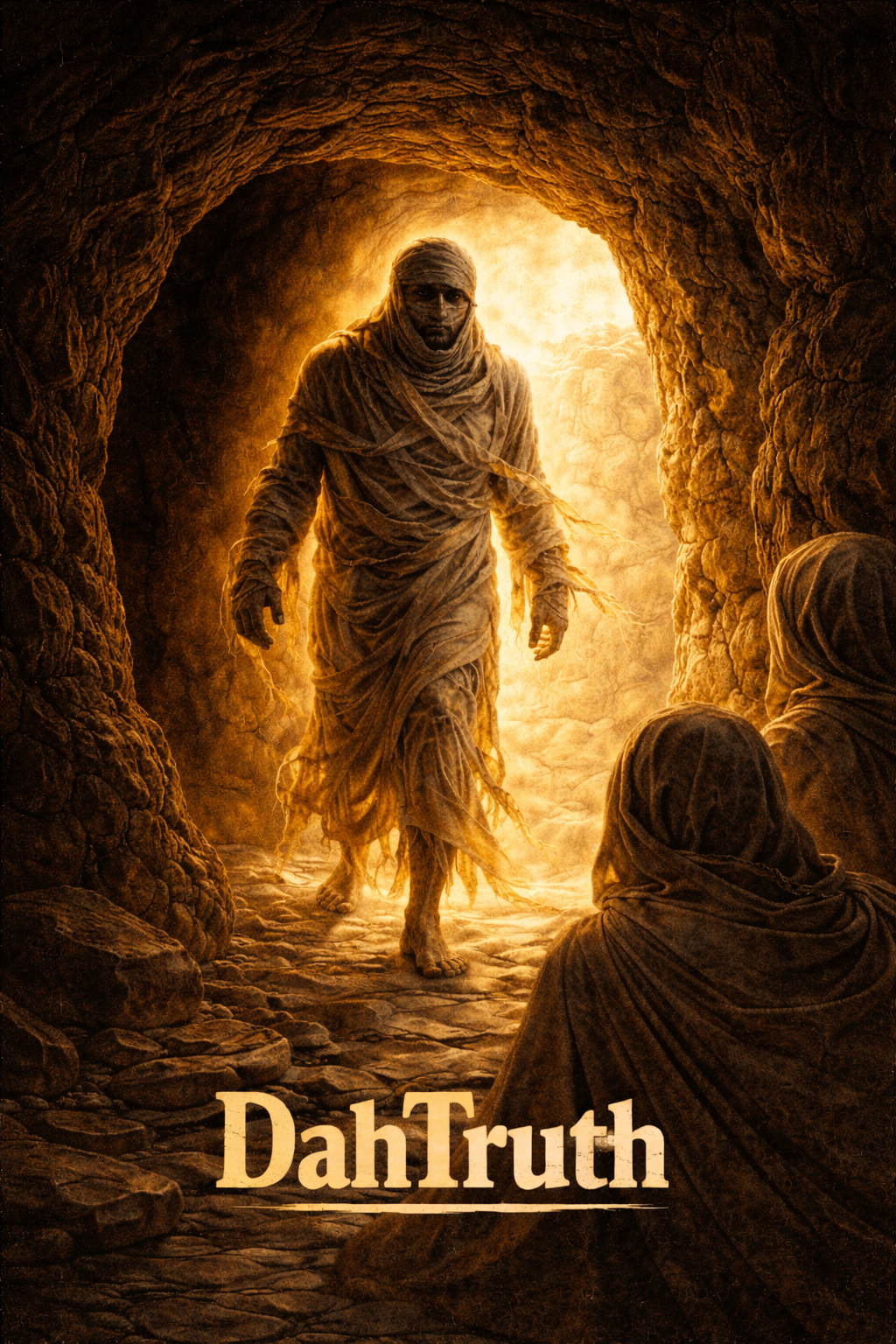
She reads of a man who had been dead. Not sick. Not weakened. Dead. And Christ called him out of that death by name. He did not argue Lazarus back to life. He did not reason with him. He called him and the dead man rose.
“Lazarus, come forth.”
That moment in the novel is not just a scene. It is the entire point. Because both Raskolnikov and Sonya are sitting in their own kind of death. He in his guilt and his constructed truth. She in her suffering and her sacrifice. And the story of Lazarus holds up a mirror to both of them that neither can look away from.
Truth had been waiting. And in that room it finally broke through.
Sonya does not excuse what Raskolnikov has done. She does not soften it or help him manage it. She tells him plainly that he must confess. That he must bear the weight of what he has done. That carrying his cross is not punishment alone but the road back to life.
And so they suffer.
Raskolnikov is sentenced to Siberia. Sonya follows him into that exile. She does not abandon him in his guilt. And in the midst of punishment and shame and the long road of consequence, something neither of them could have manufactured on their own begins to take place. Redemption moves in quietly the way it always does, not announced, not performed, but real.
By the end of Crime and Punishment we do not simply witness justice. We witness resurrection. Two souls bound together not by comfort or ease but by suffering. And standing in the middle of that suffering is Christ himself. Not distant. Not abstract. Present and active, calling two dead people back into life the same way he called Lazarus from the grave.
This is what the world has forgotten.
We have been told that the road to life runs through wealth and prosperity and recognition and power. That happiness is the destination and comfort is the sign that you have arrived. But Crime and Punishment tells a different story. And so does the Gospel.
The road to truth is narrow. It often runs directly through suffering. It requires that everything you have constructed about yourself and about reality be stripped away until what remains is only what is real. That process is not comfortable. It is not celebrated by the world. But it is the only road that leads anywhere worth going.
Raskolnikov had to lose everything he believed about himself before truth could reach him. Sonya had already lost everything the world valued and found that truth was still standing when everything else was gone.
That is the hope.
Not that suffering will be avoided. But that suffering is not the end. That Christ still calls. That no matter how deep the grave clothes have wrapped themselves around you, the voice that called Lazarus is still speaking. And when it reaches you, and it will reach you, there is no argument. It rises and settles in a way that cannot be reasoned away.
And you will know it is true.
