
Outside The Frame
“Test everything; hold fast to what is good.” — 1 Thessalonians 5:21
On the Epstein Letters, ICE, and Who Really Pays the Price
It’s February—the month we set aside to celebrate love. But this week, love didn’t show up the way the greeting cards promised. Instead, love revealed something far less romantic: the consequences of men unchecked and women willing to sacrifice everything for money, for survival, for proximity to power. What we witnessed this week was not a love story. It was a power story—dressed in the language of desire, wrapped in the politics of control, and played out across every screen in America. If love is supposed to teach us something in February, then this week it taught us what happens when power replaces intimacy, when exploitation masquerades as opportunity, and when the people who are supposed to protect us are too busy protecting themselves.
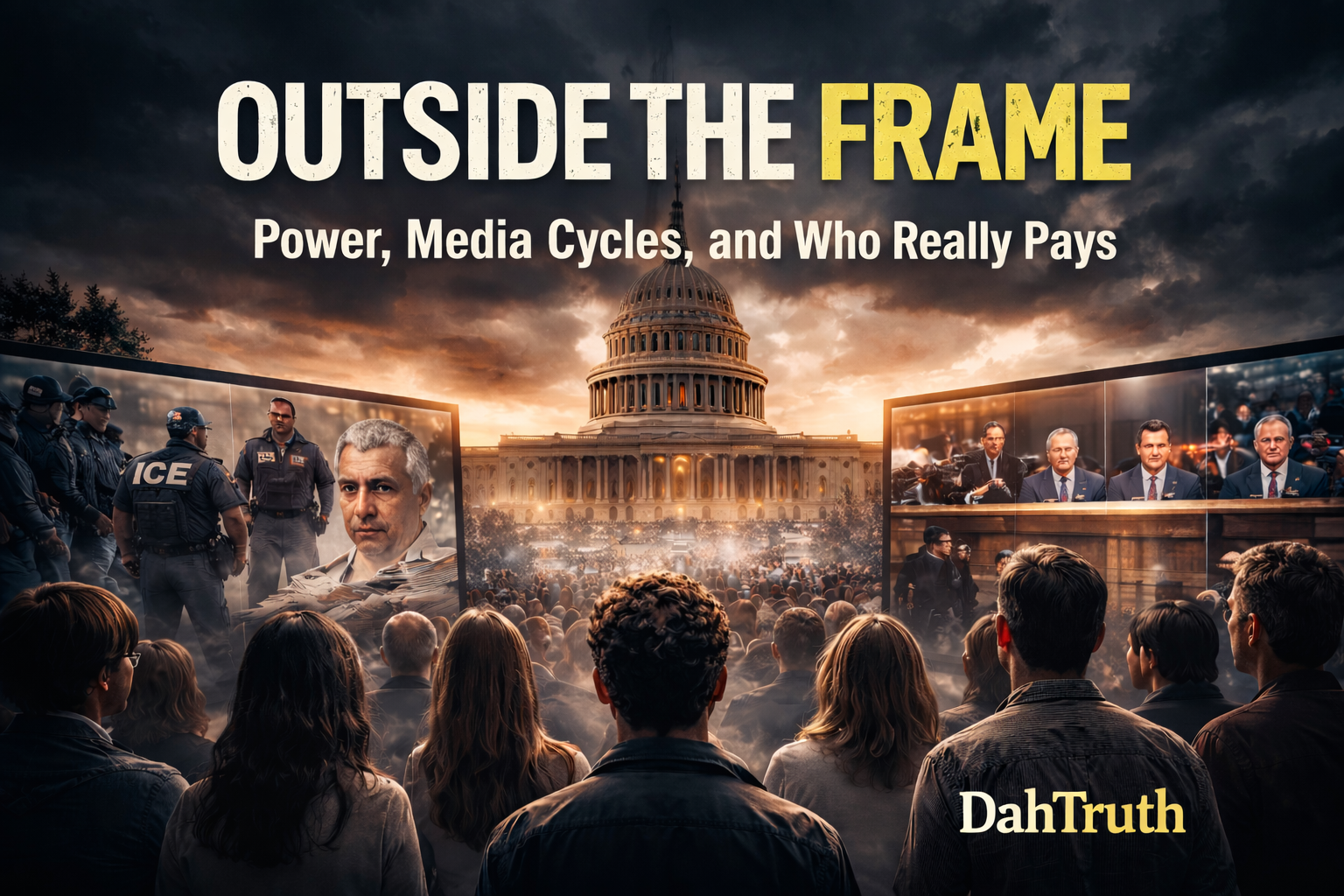
This week pulled back the curtain on something we already knew but keep pretending we don’t: power in America does not answer to the same rules as survival. What played out across our screens—from Capitol Hill testimony to cable news chyrons—was a collision of worlds that are usually kept carefully separated. The world of elite exploitation and the world of political theatre dressed up as moral conviction. The Epstein letters. ICE agents in Minneapolis. Pam Bondi before the House. These stories don’t just share a news cycle. They share a root system.
And the rest of us—the ones who are neither elite nor protected, the ones whose communities bear the real cost of broken borders and unchecked power—we sit outside the frame, watching both sides play chess with our reality.
— • —
I. The Epstein Letters: Power Without Consequence
Let’s call it what it is. The Epstein case was never just about one man. It was about a network—an architecture of access that allowed the wealthy and powerful to exploit young women while the institutions designed to protect them looked the other way. The “letters” that resurfaced this week are not merely correspondence. They are receipts. They are evidence of a world where influence shields harm and where transactional intimacy is not a scandal but a currency.
What we see in the Epstein saga is exploitation operating as a system, not an accident. Wealth doesn’t just insulate these men from consequence; it rewrites the moral framework entirely. When a billionaire’s name appears on a flight log, it’s a “connection.” When a teenage girl appears in the same record, she’s a “consenting participant.” The language of power always finds a way to sanitize itself.
And there is a gendered dimension here that we cannot ignore. Some of these young women recognized what their bodies could buy them in rooms where power was the only real currency. That is not empowerment. That is survival economics in a system that was rigged before they ever walked through the door. Meanwhile, the men at the center of these networks used sexual dominance as a means of reinforcing their authority—leveraging access to bodies as proof of status, as a perk of position, as the price others had to pay to be near power.
The public is fascinated by these revelations. We devour every headline. But fascination is not justice. Outrage without structural reform is just entertainment. And that is exactly what those at the top are counting on—that our attention span is shorter than their legal team’s retainer.
— • —
II. ICE, Minnesota, and the Rule of Law
For weeks before the Epstein story resurfaced, the national conversation was consumed by a different spectacle: ICE agents in Minneapolis, federal enforcement in the streets, and a media frenzy designed to make you feel something other than what the law actually says. And what the law says is clear: if you entered this country illegally, you are subject to deportation. Period. Whether or not you have committed a separate crime is beside the point. The act of illegal entry is itself a violation. That is the law. And the law must be enforced.
I say this not with malice but with clarity. There is a legal process for immigration. There are pathways to citizenship, to asylum, to lawful entry. Those who bypassed that process—regardless of their circumstances—made a choice that placed them outside the protection of the law they chose not to follow. Compassion does not require us to abandon the rule of law. In fact, abandoning the rule of law is itself the most uncompassionate thing we can do—because it is the communities where illegal immigrants settle, often our communities, that bear the burden. Overcrowded schools. Strained resources. Neighborhoods that change overnight without a single vote being cast.
And let us talk about Temporary Protected Status. TPS was designed for a specific purpose: to provide temporary refuge to people from countries experiencing war, natural disasters, or extraordinary conditions. The key word is temporary. When those conditions no longer exist—when the war has ended, when the disaster has passed, when the country has stabilized—then the status must be revoked and those individuals must return home. That is our law. That is the agreement. To extend TPS indefinitely is to turn a temporary measure into a permanent backdoor to residency, and that is not what the American people signed up for.
Minneapolis became a media battleground, but when the Trump administration began to wind things down—withdrawing ICE and Border Patrol from the streets—the cameras pivoted. Almost overnight, the Epstein letters re-entered the news cycle. Immigration coverage faded. Elite corruption returned. The choreography was seamless. In American media, stories don’t just appear and disappear organically. They are managed. They are timed. And when one story becomes inconvenient for those in power, another one is waiting in the wings.
— • —
III. Capitol Hill: Two Positions, No Innocence
Last week on Capitol Hill, these two worlds collided in a way that made the political theatre almost unbearable to watch. In one hearing room, ICE agents testified before Congress about the necessity of enforcement operations. In another, Pam Bondi appeared before the House of Representatives. And threading through all of it were the renewed questions about the Epstein files and what they reveal about the people who govern us.
Let me be direct: neither side is innocent, but one side makes more sense than the other.
On one side of the aisle, we heard the predictable cries. The cry of illegal immigrants being treated unjustly. The supposed destruction of voting rights because of the SAVE Act—a piece of legislation designed to ensure that only American citizens vote in American elections, which should not be controversial in a functioning democracy. And then there were the cries about exploited women—women connected to the Epstein case who have changed their names, whose identities are being weaponized for political points rather than pursued for justice. The left is not interested in protecting these women. They are interested in using them.
On the other side is a fight for American values—the sovereignty of our borders, the integrity of our elections, and the accountability of our leaders. But that fight has been misinterpreted and misaligned by those who are more concerned with power than with the principles they claim to defend. Officials maneuvering. Politicians posturing. Networks of influence where some only want to protect their own. The right has the better argument, but they are stumbling over their own execution, and that is a problem we need to talk about.
Congressional hearings have become performance art. Both sides know it. The questions are written for the clip, not for the record. Senators and representatives grandstand for their base, craft their fifteen-second moments for social media, and leave the hearing having advanced nothing but their own brand. The substance—the actual policy, the actual human impact—drowns beneath the theatre.
— • —
IV. Media Warfare: The Left Lights the Match, the Right Fans the Flames
This is where it gets personal for me. Because I have watched—for years now—how the media on both sides uses these stories not to inform us, but to arm themselves. Every headline is ammunition. Every revelation is a weapon aimed at the other side. And the people who are actually impacted by these events? We are collateral damage in a war that was never about us.
Let me start with the left, because right now, the left is the one lighting matches. It is the left that is using the immigration crisis to call out protesters to the streets. In New Jersey, Mikie Sherrill is actively rallying her district to protest immigration enforcement. Over the last few days, we have seen demonstrations pop up across the state, and there are reports of children running from ICE agents at bus stops—stories designed to pull at heartstrings and override common sense. The left wants bodies in the street. They want chaos on camera. They want footage that makes enforcement look like oppression.
But here is the reality on the ground that the cameras don’t show you: far too many people aren’t truly that sympathetic. Not because they lack compassion, but because they live in the communities that have been impacted. They see the neighborhoods that have changed. They see the resources that have been stretched thin. They know what unchecked illegal immigration looks like up close, not from a cable news desk. And it is my sincere hope that the crowds that flooded Minneapolis—many of them paid protesters, bused in to manufacture outrage—do not descend on our streets here in New Jersey. Because the reality is that there are neighborhoods where illegal immigrants have clearly overwhelmed communities, and we need to let ICE do their job and remove those who are here illegally.
Now let me turn to the right, because they are not blameless in this either. The right is poorly managing this immigration crisis. They are walking directly into the hands of the paid protesters, unable to manage crowds, unable to de-escalate. And the consequences have been deadly. We have seen agents who, rather than withdrawing from a volatile situation and coming back another day, choose to force the issue. They lie. They escalate. And American citizens—aggressive or not—end up shot and killed. That is unacceptable. When the enforcement of immigration law results in the death of an American citizen, something has gone catastrophically wrong. You leave the scene. You come back another day. You do not turn a deportation operation into a battlefield. Every death is a failure of leadership, and the right needs to own that.
Both sides control the language, and both sides use it as a weapon. On the right, it’s “illegal immigrants.” On the left, it’s “undocumented workers.” On the right, Epstein’s victims were “runaway girls.” On the left, they are “sex trafficking survivors”—but only when the accused is a Republican. Language is not neutral. Language is moral framing, and both sides wield it like a blade.
And underneath all of it is the economy of outrage. Outrage drives clicks. Clicks drive revenue. Revenue drives editorial priorities. The stories that survive the news cycle are not the ones that matter most—they are the ones that generate the most engagement. Our anger is being monetized. Our grief is content. Our trauma is a commodity.
— • —
V. The Ones Outside the Frame
So where does that leave us? The ones who are not running cable news networks or sitting on congressional committees or flying on private jets?
Let me be clear about something: I love this country. America is the land of the free. There is opportunity here for anyone willing to pursue it through the proper channels. That has always been the promise, and it is a promise worth protecting. But the focus of this nation must be on its citizens first. Not because we lack compassion, but because a country that cannot care for its own people has no business extending itself to those who are here outside the law—people who, let’s be honest, are often wanted not for their well-being but for their votes and their ability to justify the expansion of government resources and political power.
The media wants you to wonder about the immigrant mother. I wonder about the American mother. The one whose child’s classroom has doubled in size because her local school district was never funded to absorb the influx. The one whose wait at the emergency room has tripled. The one who watched her son get passed over for a job because someone will do it for half the wage under the table. The one who buried a child killed by someone who should never have been in this country in the first place. These are not hypotheticals. These are American families whose reality has been reshaped by a system that prioritizes political optics over their daily lives.
And then there are our veterans. Men and women who served this nation, who came home broken and were told there was nothing left for them. They sleep on our streets. They die in the cold. In New York City this winter, eighteen homeless people froze to death—American citizens, exposed to the elements—while the city spends billions housing illegal immigrants in hotels. In Chicago, homeless Americans ride trains through the night to stay warm while the city provides shelter, food stamps, and healthcare to people who have no legal right to be here. A nation that houses those who broke its laws while its own veterans die on the sidewalk has lost its moral compass. That is not compassion. That is a set of misplaced priorities that should trouble every citizen regardless of party.
American workers, too, are feeling the weight. Industries like construction, landscaping, and food service have been undercut by the availability of cheap, illegal labor. Employers exploit it because they can. And the American worker—the one who needs a living wage, benefits, and safe conditions—cannot compete. The American family’s standard of living erodes quietly while politicians on both sides look the other way because cheap labor is profitable for their donors.
And we cannot forget the Americans who have lost their lives at the hands of individuals who were in this country illegally. Every one of those deaths was preventable. If the law had been enforced—if the border had been secured, if sanctuary cities had cooperated with ICE, if deportation orders had been carried out—those Americans would still be here. Their names deserve more than a news cycle.
It leaves us exactly where power wants us: outside the frame.
The psychological toll is real. The story shifts week to week, but the weight on American communities remains constant. The cynicism deepens. The trust in institutions erodes. And ordinary citizens whose lives have been quietly disrupted by illegal immigration are told to be patient, to be compassionate—while their own country treats them as an afterthought.
Here is the truth that neither the left nor the right wants to say out loud: the powerful do not absorb the consequences of their own decisions. The left-wing politicians who advocate for open borders don’t live in the neighborhoods that absorb the impact. Their children don’t attend the overcrowded schools. They don’t wait in the overwhelmed emergency rooms. And the right-wing officials who militarize enforcement don’t suffer when their agents kill an American citizen. The consequences always flow downhill. It is the ordinary people—the ones whose lives become headlines without ever becoming priorities—who carry the weight.
I believe in the rule of law. I believe that illegal entry demands legal consequence. I believe that TPS must be enforced as written—temporary means temporary. I believe that ICE should be allowed to do its job. I believe our veterans deserve shelter before anyone who broke the law to be here. I believe American workers deserve protection in their own labor market. I believe the families who have lost loved ones to preventable violence deserve more than a moment of silence. And I believe that enforcement must be conducted with discipline, with strategy, and without the loss of American life. These positions are not contradictory. They are not extreme. They are the common sense of a citizen who loves her country enough to expect it to put its own people first.
— • —
The Reckoning That Never Comes
I write this not as a journalist and not as a pundit. I write this as a Black woman in America who has watched these cycles repeat for decades. I write this as someone who has seen her community’s pain become a talking point and then a footnote and then nothing at all. I write this because the truth—dah truth—is that none of this will change until we stop accepting the narrative we’re given and start demanding the one we deserve.
The Epstein letters will generate outrage for a few more weeks. The immigration debate will surge again when it’s politically useful. Capitol Hill will hold more hearings that produce more sound bites and less justice. And the media—left and right—will continue to feed us the version of reality that keeps their lights on.
But we don’t have to consume it uncritically. We don’t have to let them tell us which story matters and when. We can hold all of it at once—the exploitation, the enforcement, the theatre, the manipulation—and refuse to let any of it slide.
Because the ones outside the frame? We’re the only ones keeping score.
