A Week of Lies: When Everything Around You Speaks in Deception
We dare not forget today that we are the heirs of that first revolution. Let the word go forth from this time and place, to friend and foe alike, that the torch has been passed to a new generation of Americans--born in this century, tempered by war, disciplined by a hard and bitter peace, proud of our ancient heritage--and unwilling to witness or permit the slow undoing of those human rights to which this nation has always been committed, and to which we are committed today at home and around the world. -John F. Kennedy
The best way to describe this week is worrisome, confusing, and yet clarifying. It was one of those weeks that strips away comfort and forces you to confront a reality that has been quietly building for some time: we are being lied to. Not occasionally. Not selectively. Comprehensively. And the lies are coming from every direction at once.
The week started in warmth and light. Spring came early and arrived confidently. Families filled the parks. Children played basketball. People who had been cooped up all winter finally stepped outside to breathe again. There was a feeling of ease, almost of hope.
By the end of the week, it was snowing.
It sounds like a small thing. Weather changes. Seasons are unpredictable. But in the context of everything else that happened this week, even the sky felt dishonest. The warmth was a promise that did not hold. It felt like a fitting metaphor for the times we are living in.
The War That Is Not Called a War
All week the news was saturated with coverage of the conflict with Iran. Anchors and analysts used the word 'war' so freely you might forget that in the United States, only Congress has the constitutional authority to declare one. The president, however, holds executive powers that permit military strikes and troop deployments without congressional approval for a defined window of time. This legal gray area does not stop the media from packaging everything as war, and it does not stop the public from absorbing that framing without question.
There were also conflicting reports about Iran's leadership. Rumors had been confirmed that the supreme leader had been killed. Others suggested his son had assumed power but was too injured to make any public appearance. Statements were released, letters were presented, yet the man himself was nowhere to be seen. When a government releases words without a face behind them, it invites the public to fill in the blanks with whatever narrative serves the moment. That is exactly what happened this week, on all sides.
The most disturbing report of the week involved a missile strike that struck a school in Iran. The school was reportedly full of children, mostly young girls. Many people genuinely struggle to believe the United States would deliberately target a civilian school. Most of us would like to hold onto that belief. But the response from American leadership did nothing to reassure anyone. Instead of acknowledging an error, the answer was a vague reference to an ongoing investigation. No accountability. No clarity. No honesty.
The cover-up is always worse than the mistake. A nation that owns its failures, investigates transparently, and holds itself to account is a nation that earns trust even in painful moments. A nation that deflects is a nation that has decided the public cannot handle the truth. That decision dishonors not only the children lost, but everyone who is watching and trying to make sense of what is happening.
The Influence We See and the Influence We Miss
Alongside the military developments, a familiar debate was circulating in political commentary: the question of foreign influence on American policy. Much of that conversation focused on well-known lobbying organizations connected to Israel, particularly around arguments that Prime Minister Benjamin Netanyahu pressured Donald Trump to attack Iran. Whether or not that narrative is accurate in its specifics, it reflects a genuine anxiety about how decisions get made and whose interests actually drive them.
It is worth taking that anxiety seriously. It is also worth noting what the conversation consistently leaves out.
The lobbying space in American politics is not occupied by one actor. Countries and regions across the world attempt to shape American policy through a range of channels: economic investment, academic partnerships, cultural programming, diplomatic engagement, and direct political spending. Some of this influence is fully visible, openly reported, and regulated. Much of it is not. And when the public focuses exclusively on one visible target, it often misses the quieter, more patient work being done elsewhere.
There is a meaningful difference between a lobbying organization advocating for specific legislation and a long-term ideological effort to reshape how people think, what they are taught, and what values they consider worth defending. The first is a transaction. The second is a transformation. Transactions are traceable. Transformations are often invisible until the shift is already complete.
When billions of dollars move through universities, media partnerships, and cultural institutions over decades, the effects are not always obvious in the short term. By the time a generation of young Americans has been educated in a particular framework, the work of shaping that generation is already done. The narrative has been moved. The conversation has changed. The money that funded that change is rarely part of the headline.
Pointing this out is not the same as claiming a conspiracy. It is simply recognizing that power rarely announces itself. It works through patience, through positioning, through the stories that get told and the ones that do not.
When the Signaling Is Hidden in Plain Sight
This week, New York City Mayor Zohran Mamdani hosted an Iftar dinner at Gracie Mansion to mark the end of Ramadan. On the surface, this is a civic gesture. A mayor welcoming a religious community into the official residence of New York City's leadership. Many would call it inclusion. Many did.
But footage that circulated from inside the mansion gave me pause. Several guests were captured on video reciting 'Allahu Akbar' during the event. Others were filmed displaying the single raised index finger — a gesture that, in certain contexts, carries a specific ideological meaning. That gesture, used openly by groups including Hezbollah and ISIS, is a declaration of tawhid, the oneness of Allah. It is not simply a religious expression. In the context of militant Islamist movements, it is a recognized symbol of allegiance to that cause. Whether everyone displaying it in that room intended it that way, I cannot say with certainty. What I can say is that the symbolism was present, it was visible, and no one seemed troubled by it.
What makes that image harder to dismiss is what happened just outside. In the days surrounding the event, two young men from Pennsylvania were arrested after throwing explosive devices at protesters near Gracie Mansion. When taken into custody, they did not hide what they stood for. They declared their allegiance to ISIS — not to the United States, not to any principle of democratic life, but to a terrorist organization responsible for mass murder across the world. One of them was photographed displaying that same single raised index finger. The same gesture. The same signal. One inside the mansion at a mayoral event, one outside in handcuffs after an act of violence. The proximity of those two images in the same week, at the same location, is not something I am willing to write off as coincidence.
The First Amendment protects religious expression. That principle is not in question here. What is in question is the appropriate boundary between religious practice and the exercise of state power. Gracie Mansion is not a mosque, a church, or a community center. It is the official residence of the mayor of the most diverse city in the United States. When a government official uses that space to host a religious celebration, and when footage from that event shows guests engaging in religiously charged political signaling without any public examination or accountability from the mainstream press, that is a story. It is simply not being told.
This is not the first signal worth examining from this particular figure. One example that has stayed with me since he took office involves the inaugural address he delivered upon becoming mayor. In that speech, he referenced the story of the Prophet Muhammad entering Medina. He described how Muhammad arrived as a foreigner and, over time, became the dominant force shaping that city and its people.
Many in the audience likely heard a story of perseverance and community building. That is one valid reading of the historical narrative. But it is not the complete one.
The historical record of what happened in Medina also includes the expulsion and killing of Jewish tribes who had been living there before Muhammad's arrival. What began as coexistence ended as conquest. Telling that story in a city that holds one of the largest Jewish populations in the United States, without acknowledging its full weight, is not simply a matter of historical interpretation. It is a signal sent to some listeners and hidden from others.
Taken together — the inaugural address, the Gracie Mansion Iftar, the footage of guests inside — a picture begins to form. It may not be complete. It may not be what I think it is. But as a person committed to paying attention, I am not willing to dismiss what I see simply because the mainstream media has chosen not to look at it.
This is how the most consequential communication works. It does not announce itself. It speaks to those who recognize it and passes invisibly over those who do not. By the time the majority understands what was being said, the actions that follow have already begun.
What This Week Demanded of Us
Awareness is not comfortable. It is not a state of ease or certainty. It is the willingness to sit with discomfort, to hold competing possibilities at once, and to refuse the temptation of the simple explanation.
The weather lied. The media constructed narratives that did not hold up under scrutiny. Leadership in more than one country withheld the truth from the people they govern. Influence operated quietly while public debate focused on the loudest and most visible targets. Children died, and powerful institutions did not have the courage to tell us what they knew. In our own cities, signals were sent in plain sight that most people were too polite, too distracted, or too naive to read.
We are a nation that wants to believe the best about everyone who arrives at our shores. That generosity of spirit is one of the things worth protecting about American life. But generosity without discernment is not virtue. It is vulnerability. There are groups, movements, and ideological forces that are deeply systematic about the long work of dismantling Western values — not through open warfare, but through patience, positioning, and the slow erosion of a nation's willingness to define and defend itself. When we dismiss every warning sign in the name of inclusion, we do not become more welcoming. We become easier to reshape without our consent.
Faith Over Fear
In the middle of all of this, my mind turned to the Old Testament. When God instructed Israel to go to war, He did not leave the decision to political calculation or public opinion. He gave specific direction. He set the terms. Sometimes those terms were severe. Sometimes they required sacrifice that was difficult to bear. But the people of Israel were not sent into battle blind or alone. They were sent with purpose, under the authority of the God who had already seen the outcome.
God never promised His people they would not die. He promised something far greater than survival. To lay down your life in defense of what is righteous, in answer to a genuine call from the Lord, is not a tragedy. For those who believe, it is an honor that belongs to eternity.
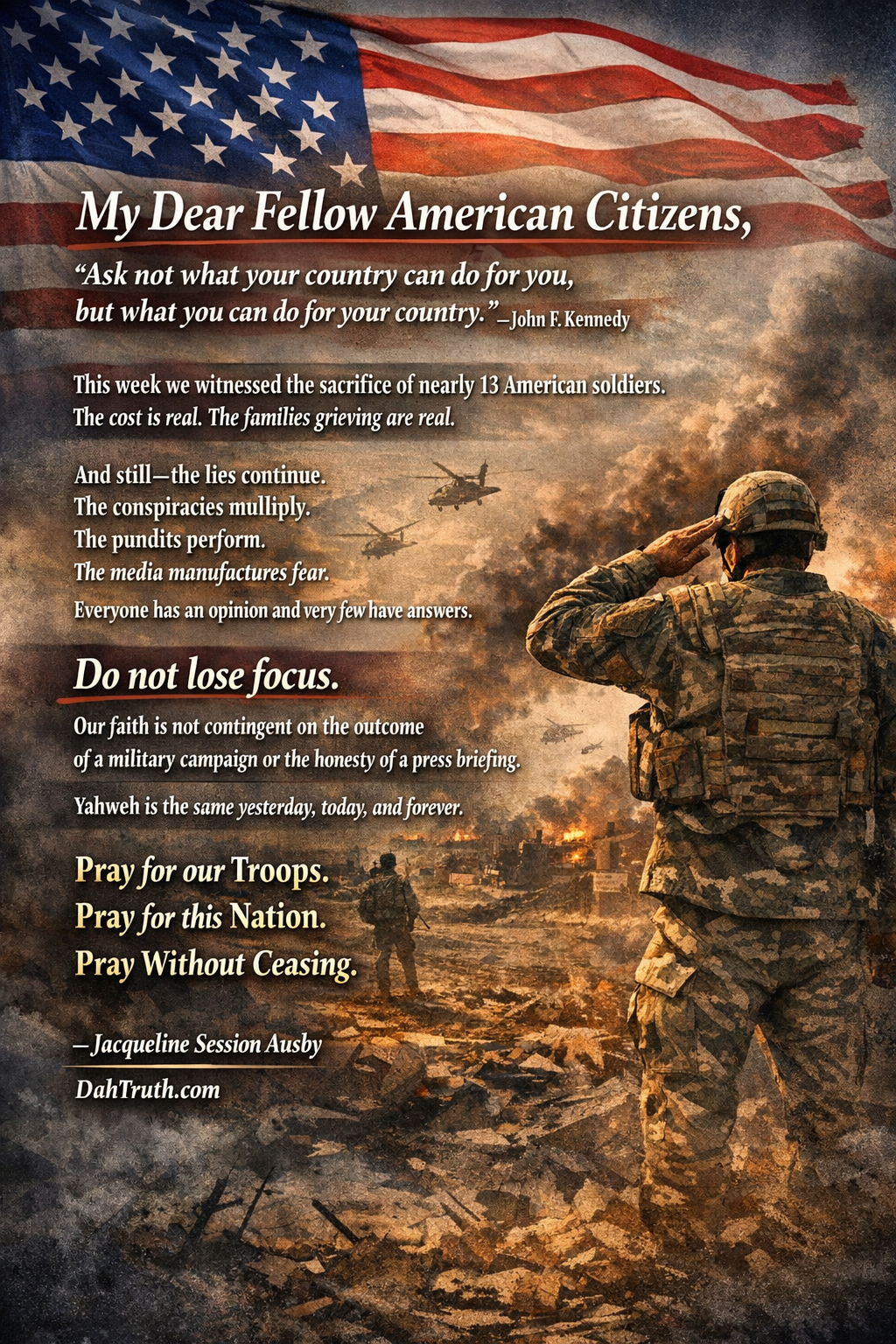
My prayer is that President Trump and the leaders of the United States military sought the Lord before initiating this campaign against Iran. My prayer is that those decisions were made with more than strategy in mind. Our responsibility as citizens in this moment is not to panic, not to be swept up in the fear the media is so eager to sell us. Our responsibility is to pray. Pray for the safety of our troops. Pray for the protection of American soil. Pray for wisdom in leadership that has the weight of countless lives in its hands.
The media wants us to measure this moment against Iraq. Against Afghanistan. Against Libya. Against every military engagement that ended in grief and confusion and unanswered questions. Those histories matter and they deserve to be studied honestly. But a nation that can only look backward will always be paralyzed at the threshold of necessary action. History is a teacher. It is not a god. We already have one of those.
The disconnect at the center of this week, at the center of this nation's anxiety, is not a lack of information. It is a lack of faith. We have been taught to trust polling numbers and pundit analysis and the shifting consensus of people who are no wiser than we are. We have forgotten how to stand on something that does not move.
So this is where I land at the end of a week full of lies. Not in despair. Not in fear. In a posture of prayer and watchfulness. We should protect our values. We should protect our way of life. We should protect the right to worship the God of the Bible, Yahweh, freely and without apology on the soil our ancestors built and bled for. If we believe, then we trust His will — whatever it costs, wherever it leads. That is not weakness. That is the only kind of courage that outlasts the news cycle.
“I will send my fear before thee, and will destroy all the people to whom thou shalt come, and I will make all thine enemies turn their backs unto thee.” Exodus 23:27
Jacqueline Session Ausby
Founder, DahTruth.com
