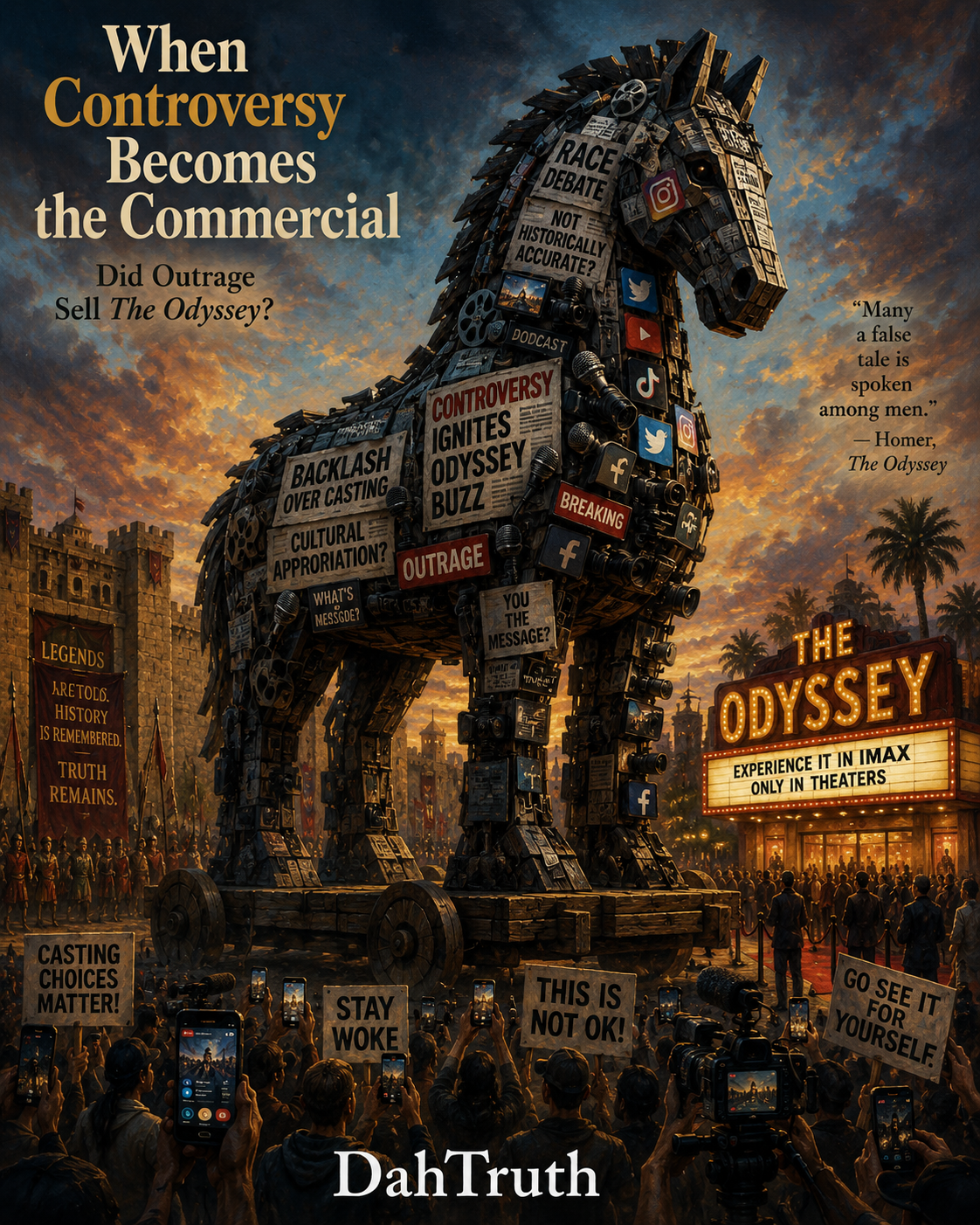
“But you, what grace you give your words, and what good sense within! You have told your story with all a singer’s skill.” — Homer, The Odyssey, trans. Robert Fagles
Long before social media, before podcasts, before YouTube reactions and viral hashtags, Hollywood had already learned how to tell a story.
One of the greatest examples is Gone with the Wind.
Released in 1939 with a production budget of approximately $4 million, the film became one of the greatest commercial successes in cinematic history. Generation after generation returned to theaters to experience the sweeping story of Scarlett O'Hara, Rhett Butler, and a South transformed by the Civil War. People did not buy tickets because of a marketing controversy. They bought tickets because they wanted to experience the story.
I will not pretend the film was free of controversy of its own. Gone with the Wind romanticized the Old South and the institution of slavery, and Hattie McDaniel, who became the first Black performer ever to win an Academy Award for her role in it, was barred from attending the film's premiere in segregated Atlanta. The movie has been debated on those grounds ever since, and rightly so. Yet the controversy was not what filled the theaters. The storytelling was.
Storytelling was the advertisement.
Today, I wonder whether that has changed.
Christopher Nolan's The Odyssey reportedly carried a production budget approaching $250 million, making it one of the most expensive films ever produced. Nolan, together with his wife and longtime producing partner Emma Thomas, has built a remarkable career through their production company, Syncopy, producing films such as Inception, Interstellar, Dunkirk, Tenet, The Dark Knight, and the Academy Award-winning Oppenheimer. Few filmmakers enjoy the level of creative and financial control that Nolan and Thomas possess.
Yet as The Odyssey approached its release, I found myself hearing remarkably little about Homer.
Instead, I heard about the casting.
The conversation seemed to be everywhere. Social media debated the casting of Lupita Nyong'o as Helen of Troy. Others focused on Elliot Page portraying the Greek soldier Sinon. Before I had watched a trailer, before I knew Nolan's vision for Homer's epic, before I had any appreciation for the scale of the production, I had already heard the controversy.
It caused me to wonder whether Hollywood has discovered something remarkably simple.
Controversy sells tickets.
Every article becomes free advertising.
Every podcast becomes another commercial.
Every reaction video becomes another trailer.
Every social media argument introduces the film to another potential audience.
Whether viewers purchase a ticket because they are excited or because they are offended matters very little once they have purchased the ticket.
Attention has become the product.
❦
As I thought about the controversy, I also found myself considering a larger question. Is every criticism of casting simply resistance to diversity?
I do not believe so. There are legitimate questions surrounding historical and cultural authenticity, and I say that as someone who has been on the wrong side of one of these arguments before.
The Little Mermaid provides an example I know firsthand.
When Disney cast Halle Bailey, a Black actress and singer, as Ariel in its 2023 live-action adaptation, the outrage arrived before the film did. A hashtag trended. I will be honest: I was pulled into it myself. I had opinions about the casting before I had seen a single frame.
Then I watched the movie.
It was lovely. Bailey was luminous in the role, and by the end I found myself asking a question I have not stopped asking since. Ariel is a fictional mermaid. She is not a historical figure rooted in a documented civilization. So why could a Black woman not play her? Reasonable people could disagree about the choice without a single line of the historical record being touched, because there was no historical record to touch.
The Odyssey is a different matter.
Helen of Troy is a legendary figure, not a documented historical person in the modern sense, yet she belongs to a literary tradition deeply rooted in ancient Greece. Homer distinguishes among Greeks, Trojans, Ethiopians, and numerous other peoples throughout his epics. These are not modern racial categories but rather differences of homeland, ancestry, kingdoms, and cultural identity. The world Homer presents is not culturally interchangeable, and that history is worth respecting.
I understand why some viewers questioned whether casting a dark-skinned Nigerian-born actress as Helen of Troy reflected the cultural world Homer created. At the same time, there is a real difference between asking thoughtful questions about historical authenticity and allowing outrage to define an entire film before anyone has seen it.
❦
After watching The Odyssey, I came away believing much of the public outrage was completely unwarranted.
Helen of Troy occupies such a small portion of the film that her casting hardly affects the overall experience. Months of debate suggested that Christopher Nolan had fundamentally reinvented Homer's epic around Helen's appearance. That simply is not the movie I watched.
The same proved true regarding Elliot Page's performance as Sinon.
Before the film's release, countless discussions centered upon Page portraying a male Greek soldier. Yet the role itself is remarkably brief. There was never any meaningful confusion about the character's identity within the story, and the performance occupies only a small portion of a three-hour film. By the character's later appearance, Sinon is so covered in dirt from battle that the actor is barely recognizable.
The controversy became far larger than the performances themselves.
That does not mean historical authenticity is irrelevant.
Ancient Greece possessed its own geography, ancestry, customs, mythology, and cultural identity. Those realities deserve respect whenever filmmakers adapt one of Western civilization's foundational literary works.
Still, after watching the film, I cannot honestly say these particular casting decisions damaged Christopher Nolan's interpretation of The Odyssey.
The conversation surrounding the movie was significantly larger than the issue itself.
❦
I also considered another comparison that many people raised.
What if a White actor portrayed Dr. Martin Luther King Jr.? Or Malcolm X? Would the American Black community object?
Absolutely. And we would have every reason to do so.
Martin Luther King Jr., Malcolm X, Harriet Tubman, Frederick Douglass, and countless others were real people. Their identities as American Blacks were inseparable from their lives, their struggles, and the history they helped shape. Their appearance was not incidental to their story. It was part of their story.
Helen of Troy occupies a different category. She belongs to the realm of legendary history rather than documented modern history, and while the Greek cultural setting remains essential, the comparison is not entirely equivalent.
There is another sadness hidden within that discussion. There are relatively few major cinematic portrayals of American Black historical figures compared to the enormous body of Greek, Roman, medieval European, or biblical literature adapted by Hollywood over the decades. Too often our stories are reduced to slavery, civil rights, or a small handful of familiar names, while countless other lives remain unexplored.
Perhaps that is why casting conversations become so emotionally charged. Sometimes they are about far more than the character on the screen.
❦
Yet I continue returning to the same question. Was the controversy intentional?
I have no evidence that Christopher Nolan, Emma Thomas, Universal Pictures, or anyone associated with the production deliberately manufactured the debate. We will likely never know what conversations occurred behind closed doors. Perhaps the controversy emerged naturally. Perhaps social media created it entirely on its own.
But I cannot ignore one simple fact.
I heard about the controversy before I heard about the movie.
That alone illustrates how dramatically Hollywood's relationship with marketing has changed. In another era, audiences discovered films through newspaper advertisements, television trailers, and word of mouth after opening weekend. Today, many films introduce themselves through outrage.
Whether that outrage is carefully planned or entirely organic almost becomes beside the point. It performs the same function. It captures attention, and attention fills theaters.
❦
If you are willing to spend nearly three hours in a theater, I believe The Odyssey is absolutely worth seeing. Christopher Nolan has crafted an ambitious adaptation filled with extraordinary landscapes, impressive performances, breathtaking cinematography, and a deep respect for the spirit of Homer's journey.
More importantly, the film reminded me of something I had nearly forgotten. Sometimes we should experience a story before allowing someone else to tell us what to think about it.
Perhaps that is the real lesson of The Odyssey. Not every online controversy deserves our outrage. Not every casting decision deserves months of debate. Sometimes the greatest journey is setting aside the noise long enough to encounter the story for ourselves.
Perhaps Hollywood has learned that controversy can sell a movie. I only hope audiences never forget that controversy should never become a substitute for watching the film itself.
