"Freedom is the freedom to say that two plus two make four. If that is granted, all else follows." — George Orwell, 1984
I can still remember the afternoon O.J. Simpson fled from police in his white Ford Bronco after the murders of his former wife, Nicole Brown Simpson, and her friend, Ronald Goldman. Like millions of Americans, I sat glued to the television as helicopters followed the slow-moving chase across the California highways. I remember listening to the media replay his conversations with law enforcement and watching every new development unfold as though it had happened only yesterday.
At the time, the country was captivated by one question: Did O.J. Simpson commit the murders?
The media reported each new development as it became available, but it did not decide the case. That responsibility belonged to the courtroom. Over the months that followed, the prosecution presented its evidence, the defense challenged every assumption, witnesses were examined, experts testified, and the jury weighed it all before returning a verdict of not guilty.
Whether one believed O.J. Simpson was innocent or guilty, everyone was forced to grapple with the same body of evidence. The defense exposed weaknesses in the prosecution's case, raised questions the public had not previously considered, and reminded Americans that a criminal conviction requires proof beyond a reasonable doubt, not public outrage or media speculation. The verdict did not convince everyone, but it demonstrated something that now feels almost foreign: the evidence was allowed to develop before the country reached its conclusions.
That was a different era of journalism.
News traveled more slowly. Information passed through editors, producers, investigative reporters, and legal departments before it reached the public. There were certainly mistakes, biases, and sensational headlines, but there were also gatekeepers whose responsibility was to verify facts before broadcasting them to millions of viewers.
Today, that world has largely disappeared.
The media landscape has evolved into something far more chaotic. Every smartphone has become a television studio. Every social media account has become a publishing platform. Every podcast host has become a commentator, investigator, prosecutor, and jury all at once. Information no longer trickles into the public square after it has been examined. It floods our screens instantly, often before investigators have completed their work.
The result is a media environment that spreads like syrup poured from an overturned bottle, thick, sticky, and nearly impossible to contain. Once it begins flowing, separating truth from speculation becomes increasingly difficult.
History has always produced events that ignite public outrage. The Manson murders. The killing of Fred Hampton. The assassination of Charlie Kirk. Whether the hand belonged to a wicked man or to the state itself, each event set off the same reaction: enormous attention, endless discussion, and a rush of competing theories straining to explain what had happened before anyone had finished counting the evidence.
Or at least it used to.
Today we are witnessing something fundamentally different. The modern podcast has transformed speculation into a business model. The incentive is no longer to wait for evidence. The incentive is to be first, to be provocative, and to hold an audience's attention long before the facts have had an opportunity to speak.
Charlie Kirk's death may ultimately be remembered not only as a political assassination, but also as the moment America was forced to confront a troubling reality:
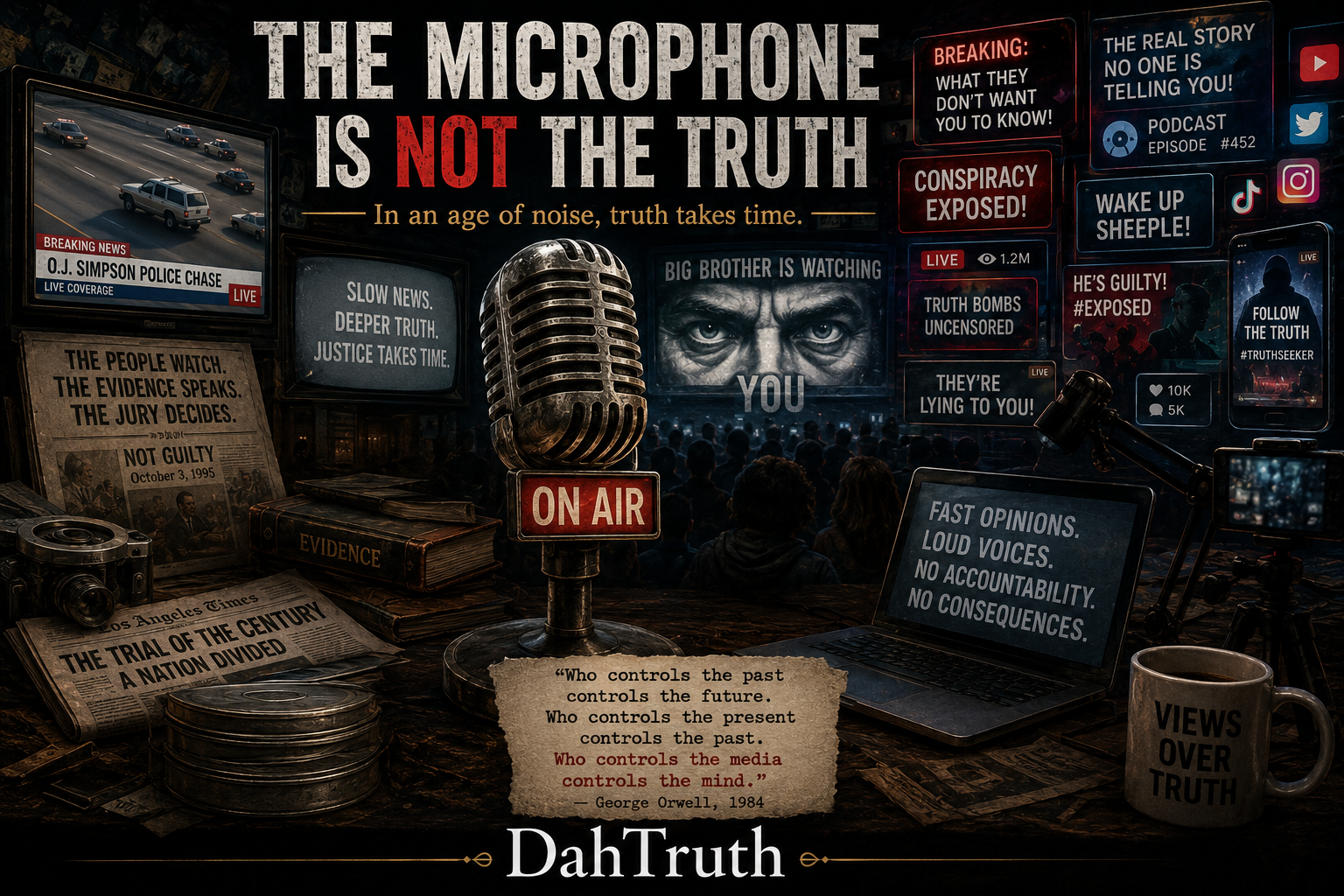
The microphone is no longer simply reporting the truth. For many, the microphone has become a substitute for it.
❦
To understand why Charlie Kirk's death has become such an important case study, we must first understand who Charlie Kirk was.
Charlie Kirk was the founder and CEO of Turning Point USA, one of the most influential conservative youth organizations in the country. An outspoken Christian and conservative commentator, Kirk spent years traveling to college and university campuses encouraging young Americans to engage in politics through a conservative lens. His speeches often centered on faith, limited government, constitutional principles, free markets, and personal responsibility.
He was also one of the most polarizing political figures of his generation.
His appearances regularly attracted hundreds, and sometimes thousands, of students. Some came to support him. Others came specifically to challenge him. Religion, race, immigration, gender, abortion, and American history became frequent points of contention between Kirk and the audiences who gathered to hear him speak.
Whether one agreed with Charlie Kirk or not, few could deny that he had become a significant voice within conservative politics.
That is precisely why his assassination immediately became national news.
Within hours of his death, social media had already begun constructing competing explanations of what had happened. Before investigators had completed their work, before the preliminary hearing had begun, and before a jury had heard a single witness, countless podcasters had already reached their conclusions.
Some would spend the following months attempting to convince millions of viewers that virtually every piece of evidence presented by investigators was either fabricated, manipulated, or misunderstood.
❦
To understand how those narratives spread, we must also understand the evolution of Candace Owens.
Candace Owens did not begin as the figure she is today. She first entered public life from the political left before rapidly reinventing herself as one of the most recognizable Black conservative voices in America. Long before the death of George Floyd, she had built a following by challenging the left's narratives surrounding race, Black Lives Matter, and high-profile cases such as the shooting of Trayvon Martin.
Her influence accelerated dramatically after the death of George Floyd.
At the time, I agreed with much of her criticism. I believed many media organizations and political activists had embraced a narrative that was driven more by emotion than by a complete examination of the available facts. George Floyd's death became a symbol around which an entire political movement was constructed, and Candace Owens became one of its most vocal critics.
From there, however, our paths began to diverge.
Owens became one of the most prominent Black voices within conservative media, by working alongside other conversations like Charlie Kirk at Turning Point USA and later joining The Daily Wire and alainging herself with the Ben Sharipiros, Matt Walsh and Tucker Carloson’s of the right. Millions of Americans came to trust her willingness to challenge mainstream narratives.
Then came October 7. Her public disagreements over Israel created fractures within the very institutions that had elevated her career. Her relationship with major conservative organizations deteriorated, culminating in her highly publicized departure from The Daily Wire. Rather than disappearing, Owens returned with an independent platform reaching millions of viewers without the editorial oversight once provided by larger media organizations. It is here that I believe we begin to see the broader problem.
This essay is not about Candace Owens. She is simply one of the clearest examples of a much larger transformation taking place in American media.
❦
Half the Truth
One of the most effective forms of propaganda is not the complete fabrication of evidence. It is the presentation of only half of the evidence. The preliminary hearing for the man accused of killing Charlie Kirk offered a week's worth of examples, and it also offered a warning to anyone willing to watch the whole thing rather than a clip of it.
Consider the DNA testimony. A forensic examiner from the FBI laboratory in Quantico testified that the genetic material recovered from the rifle was at least one trillion times more likely to have come from Tyler Robinson than from any unrelated person. On the towel that wrapped the weapon, the profile was not split evenly between two men. Ninety-five percent belonged to Robinson and five percent to his roommate, Lance Twiggs. On the screwdriver, the split was eighty-nine to eleven. The combined figure the state offered for the towel and screwdriver was thirty quintillion times more likely if the two contributors were Robinson and Twiggs than if they were Twiggs and a stranger.
That is the testimony. Now here is what the clips kept.
The defense pressed the same analyst until she acknowledged that FBI policy forbids her from calling any DNA result an absolute identification, that she could not declare a zero-error rate, and that in strict terms Robinson could not be excluded as a possible contributor rather than named as the certain one. Every one of those statements is true. Every one of them is also standard. No competent forensic witness in any American courtroom is permitted to claim infallibility, because science does not deal in infallibility. The defense did its job. But a podcast that plays only the words could not be excluded and not infallible, while cutting the trillion and the quintillion, has not reported the hearing. It has edited it.
The same method reappears with the microphone. Candace Owens has spent months promoting all thypes of conspiritors. She implicsyrf everyone to have been the murder from Israel (a nation) to boys in caps with red shirts, to individuals that work for Turn Points USA and her most vicious implication being alledgely hurled at Erika Kirk herself. She has theorized the weapon to be what has been called the exploding microphone theory, the claim that Kirk may not have been killed by a rifle shot at all but by a wireless microphone pack rigged to detonate against his neck. The technical version of the argument, advanced by Candace and another podcaster, Baron Colman, holds that the battery and magnetic clasp of the device were built into a shaped charge. Owens has pointed to enhanced images from the vehicle that carried Kirk away and asked her audience to look closer.
Investigators have not supported the theory. The court filings, the ballistics work, the autopsy fragments, and the recovered rifle all describe a single shot fired from distance. A body microphone is a small thing. It is also, apparently, large enough to hold an entire alternative reality, provided no one asks to see the rest of the footage.
This is the pattern, and the pattern is the point. Half the truth eventually becomes an entire lie. Not because the half that is spoken is false, but because the half that is withheld is the half that would have corrected it.
❦
The danger does not end with Charlie Kirk.
Once a personality with millions of followers advances a theory, hundreds of smaller podcasts repeat it. Those podcasts are then quoted by YouTube creators. Clips appear on TikTok. Facebook pages repost them. Soon, repetition itself becomes evidence.
Alex Jones demonstrated how conspiracy theories could survive on the fringes of American media. The podcast era has revealed something far more dangerous. Conspiracy theories no longer remain on the fringe. They have become mainstream entertainment.
❦
The question that remains in my mind is this: Where does this leave us?
How are ordinary Americans supposed to distinguish between fact and propaganda when, even after evidence has been presented, there are still people willing to sit before a camera, speak confidently into a microphone, and tell us not to believe what our own eyes are seeing?
The problem extends far beyond the question of whether Tyler Robinson killed Charlie Kirk.
We now argue over whether biology itself is objective reality or merely personal opinion. We argue over whether a woman is defined by her chromosomes or by her declaration. We argue over whether video evidence can be dismissed whenever it becomes inconvenient. We argue over whether witnesses are automatically liars whenever their testimony contradicts our preferred narrative.
At some point, this is no longer skepticism. It is a rejection of objective truth.
A free society cannot function without a shared body of facts. Courts cannot administer justice if evidence matters only when it supports our preferred conclusion. Journalism cannot survive if edited clips become more persuasive than complete testimony. Democracy itself cannot endure if citizens lose the ability, or the willingness, to distinguish between evidence and entertainment.
Perhaps that is the greatest danger of the podcast era. It does not merely spread misinformation. It teaches us that no evidence is ever enough. That no institution deserves trust. That every inconvenient fact is part of a conspiracy.
Once that happens, truth no longer has to be disproven. It only has to be made doubtful. And when enough doubt has been manufactured, the person holding the microphone becomes more powerful than the evidence itself.
The microphone is not the truth. It never was. The question before us is whether we still possess the wisdom to know the difference.
