
The Pot of Gold at the End of Your Rainbow
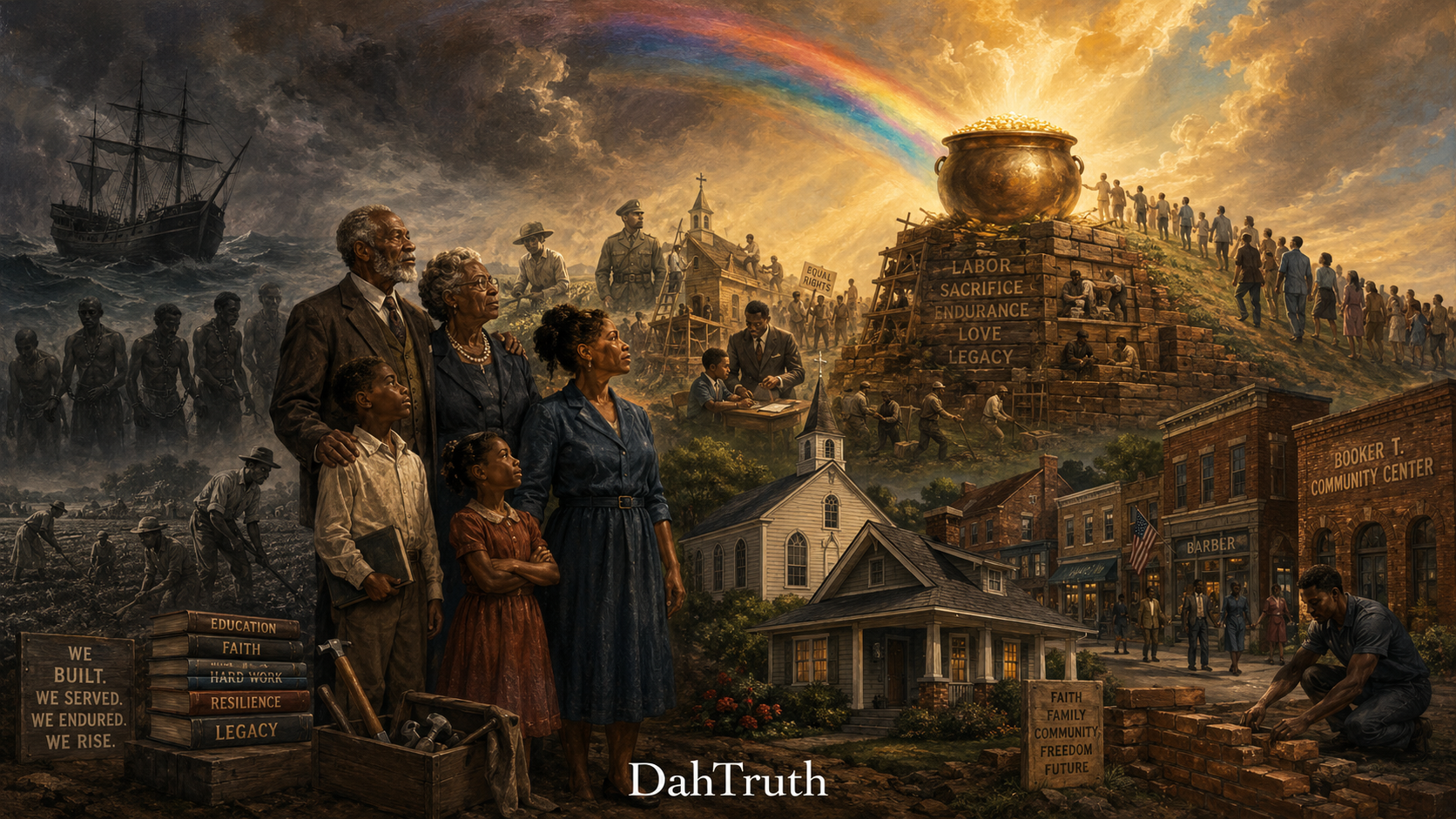
“At the bottom of education, at the bottom of politics, even at the bottom of religion, there must be for our race economic independence.”
—Booker T. Washington
The builders, the beneficiaries, and the American Black inheritance
The America That Builds
When I was a girl, I loved the movie Seven Brides for Seven Brothers. I loved the color, the music, the courtship, and the picture it painted of people carving a life out of open country. Men and women met, married, raised barns, planted fields, and built a community out of little more than labor and will. It was a story about making something where nothing had been.
That image stayed with me because it described a certain kind of America, the America that builds. My own family belongs to that America, though our version of the story was never so tidy or so cheerful.
My maternal grandparents moved from sharecropping toward military service and homeownership. My paternal family emerged from slavery and helped establish County Line, Texas, a settlement of American Black families who bought land, raised churches, and buried their dead in soil they finally owned. They built a community with their hands. The generation that followed was met by drugs, poverty, welfare dependency, imprisonment, and homelessness, and much of what had been built was scattered. My generation has had to decide, deliberately, to recover the building tradition our ancestors handed us.
I begin here because everything I am about to say rests on a single conviction. America's wealth did not simply appear. People built it. That truth is the ground I stand on, and it is the truth I find increasingly absent from our political conversations. That building tradition is the inheritance I carry, and it shapes how I see nearly everything, including a conversation I had not long ago that has stayed with me since.
The Conversation That Brought the Question Back to Me
This week I had a conversation with an associate, and as we spoke I found myself thinking about the difference between an American perspective and the perspective of those who are now immigrating into this country. We were not debating. We were simply talking about the current political and economic condition of the United States. She was speaking from a set of assumptions she seemed to take for granted that I shared. As she talked, I realized we were looking at America from two different histories and two different ideas about who this country is responsible for and what government assistance is meant to accomplish.
She spoke about corporate layoffs, the rollback of diversity programs, the political climate, immigration enforcement, and the deaths surrounding recent immigration protests. I did not push back. I nodded along and let her believe I shared her sentiment, because I did not want the conversation to turn adversarial. Inwardly, though, I was noticing something. Much of what she said was not the fruit of examining outcomes. It was the familiar language that surrounds these subjects, repeated as though its conclusions were settled.
What troubled me was not that she supported these policies. It was that she seemed to repeat the approved language surrounding them without ever asking who actually benefited, and that she assumed, without a second thought, that I stood where she stood. Nowhere was that clearer than when the conversation turned to diversity, equity, and inclusion, and to the reports that Black women were losing their jobs.
DEI: The Symbol and the Beneficiary
A story had been circulating since 2025 that roughly 300,000 Black women, most of them federal employees, had been fired as diversity programs were dismantled. My associate treated this as settled fact. It is not.
The figure comes from a decline in the total number of Black women recorded as employed across the entire economy during 2025, not from any count of federal termination notices. The losses were real and they were heavy. Drawing on Bureau of Labor Statistics data, the Institute for Women's Policy Research estimated that Black women lost roughly a quarter of a million jobs across much of that year. But that total counts private-sector and public-sector workers together, women who were laid off, women whose temporary positions ended, and women who left the labor force altogether. It is not a tally of federal workers fired, and it is not a tally of DEI positions eliminated. Federal reductions did fall on Black women with real severity, yet only about 5.1 percent of employed Black women work in federal jobs at all. The scale of the loss is not in question. What the talking point gets wrong is its cause. A quarter of a million Black women did not lose their jobs because diversity programs ended. They lost them across an entire economy, for reasons the single phrase DEI firings cannot hold.
It is also inaccurate to call those women DEI employees. Being a Black woman employed by the federal government does not mean she obtained her position through a diversity program, worked in a diversity office, or lost her job because such a program ended. Those are three separate claims, and the employment statistics establish none of them. To assume otherwise carries an insult buried inside it. It treats Black women's employment as evidence of DEI rather than as evidence of their education, training, and qualifications.
The deeper point is the one the numbers actually support. American Blacks became the public face of corporate diversity, but we were not consistently its principal beneficiaries.
Consider promotions into management. In 2024, for every 100 men promoted from entry level into their first management role, McKinsey and LeanIn.Org found that 99 Asian women were promoted, 89 white women, 65 Latinas, and 54 Black women. Black women held the lowest promotion rate among these groups. Their rate had actually fallen from 96 per 100 men in 2022 to 54 in both 2023 and 2024. (A more recent edition of the same study showed a modest uptick, to 60 per 100 men, still the lowest of any group.)
The picture at the top is similar. Women held 29 percent of C-suite positions, but women of color of all backgrounds combined held only 7 percent, while white women held 22 percent and white men still held 56 percent. Women of color made up 19 percent of entry-level employees and only 7 percent of the C-suite, meaning their numbers collapsed on the way up in a way white women's did not.
A Wall Street Journal analysis of roughly 13 million jobs at 250 large companies between 2020 and 2023 reached the same conclusion from another direction. After all the corporate promises that followed George Floyd's death, the demographic changes were modest. The gains among lower-level nonwhite managers were concentrated substantially among Asian employees. Only about one in twenty senior managers was Black in 2023, and white men continued to hold roughly half of senior-management positions.
One limitation matters for my argument. Neither the EEOC nor McKinsey distinguishes American descendants of slavery from Black immigrants. Their Black category combines American Blacks, African immigrants, and Caribbean immigrants together. Even the limited gains recorded for Black employees cannot automatically be credited to the American Black community.
So the story my associate accepted collapsed a series of distinctions. Black women became DEI hires. Federal reductions became DEI firings. The existence of DEI became proof that Black Americans had benefited from it. None of those conclusions follows from the facts. I did not say any of this to her. I let the moment pass. What the conversation exposed, at least to me, was the distance between representation and benefit. She was defending the symbol of DEI. I was quietly thinking about its actual results.
The Same Blindness in the Immigration Discussion
DEI was not the only subject that revealed the distance between us. When the conversation moved toward immigration enforcement, I noticed the same pattern, and again I kept it to myself. She could see the people publicly presented as the victims of government policy. She did not appear to see the American workers and communities also affected by illegal immigration. She had just spoken with real feeling about Black women losing their jobs, yet she did not connect that concern to the competition for jobs, housing, schools, healthcare, and public resources that American Black communities have been describing for years.
Immigration enforcement did not begin with Donald Trump. It operated under Democratic and Republican presidents alike. The moral emergency surrounding it grew far louder once Trump made illegal immigration central to his political identity. My point is not that any person's suffering is unimportant. My point is that public compassion has become selective, and that its selectivity consistently overlooks the same people.
A Case in Point: The Roof Over My Head
A case in point occurred recently when I had a new roof installed on my home. I am an American Black woman and a widow, and I was able to pay cash for a major repair. I mention that because American Blacks are so often portrayed as uniformly impoverished and dependent, incapable of participating in the economy as property owners. That portrait does not reflect the whole of our community.
When I began requesting estimates, every salesperson who came to my home was a white man. Not one American Black man appeared among them. These were the men who presented the products, arranged the financing, and represented the companies. Their complete lack of diversity was hard to miss.
On the morning of the installation, I woke to six or seven Hispanic men unloading materials across my front lawn. None of them appeared to speak English comfortably. A little later, a young white man, perhaps in his twenties, knocked on my door and introduced himself as the project manager. He was the overseer. He did not climb onto the roof, lay a shingle, or hang a gutter. From what I saw, he spent much of the day in or near his truck while the crew did the demanding work.
The company has asked me repeatedly for a review, and I have refused. I considered writing one that asked a single question. How can a company come to the home of an American Black woman, accept thousands of dollars from her, and operate without a single visible American Black worker as a salesman, manager, roofer, or tradesman?
One moment made the day more troubling still. While my grandson and I were looking into the backyard, one of the workers walked to the edge of my property and relieved himself near the fence, in plain view, without a meaningful effort to step out of sight. His conduct was disrespectful. It also made me think about the conditions under which these men may have been hired. His visible dental condition made me wonder whether the workers had access to adequate wages, healthcare, and benefits at all, and whether a company that advertises more than thirty years in business keeps its costs low and its profits up by leaving such things out.
I do not know whether any of them were in the country illegally. I do not know what they were paid or whether they received benefits. I cannot prove how they were recruited. What I could see was an arrangement in which white men sold and managed the service, Hispanic men performed all of the strenuous labor, and American Black workers were absent from the entire operation.
Companies have discovered that immigrant labor can hold labor costs down while the higher-paying sales and supervisory positions are preserved for others. Whether every worker is undocumented is not the only question. The larger question is that access to a workforce willing or compelled to accept lower wages reduces the incentive to recruit, train, and fairly pay American workers, including the American Black men who once found a path into the middle class through construction and the skilled trades.
We hear the argument constantly. Who will pick the crops, mow the lawns, clean the homes, care for the children, and install the roofs if immigration is restricted? American Blacks should listen closely to the assumption beneath that question. It treats an entire class of people as a permanent supply of cheap labor whose purpose is to make another group's comfort possible. The language has changed. Workers receive wages, but the expectation bears an uncomfortable resemblance to the arguments once used by southern whites to justify slavery. Rather than pay an American a decent wage, too many employers are content to pay an immigrant a much lower one. Once again, American Blacks appear in the language and disappear from the benefit.
The Pot of Gold and the Missing Taxpayer
That experience returned me to the conversation with my associate, because it exposed something larger than the practices of one roofing company. It exposed an assumption that increasingly governs our politics. America is spoken of as though its wealth exists apart from the people who work, build, save, buy homes, open businesses, and pay taxes within it.
America was once described as a melting pot. The image suggested that people arrived from different places, entered a shared national life, and contributed to what the country would become. Today, America is treated less like a melting pot and more like the pot of gold at the end of the rainbow. People see the abundance. They do not always consider who created it, who maintains it, or how quickly it can be emptied.
Government does not possess wealth separate from its people. It taxes what people earn, borrows against what future generations are expected to earn, and distributes what workers and businesses have produced. The treasury is not a magical source of abundance. It represents the labor, property, and future obligations of the American people.
There was another person missing from my associate's account of America, and that was the American taxpayer. When we contribute to the public treasury, most of us do not object to a safety net. We understand that families meet unemployment, illness, disability, widowhood, and low wages. We contribute because one day the system may have to help us, our children, or another American family unable to carry the whole burden alone. The system is not a private savings account. It is an intergenerational compact. One generation contributes while another needs help, and those who receive help often keep working and paying in, so that their children may become homeowners and taxpayers in turn.
That is what happened in my family. My grandparents worked, owned property, and paid into the systems under which they lived. Their children later needed some of those systems. My mother received welfare, food stamps, and housing assistance, but she was not a woman who refused to work. She worked two and three jobs at a time. Her wages were simply not enough to feed, house, and raise her children without help. The assistance supplemented her labor. It did not replace it. Her children did not remain dependent. We grew up, were educated, entered the workforce, bought homes, and paid taxes. One generation contributed, another needed help, and the next regained its footing and contributed again.
The question grows harder when government extends that compact to people who have only recently arrived, or who entered illegally and have not spent generations sustaining the institutions from which they may now draw. Defenders of the current arrangement say that newcomers contribute, that they work, pay sales taxes, and pay rent that supports property taxes. Some point out that they pay federal taxes too. What that argument leaves out is the other half of the ledger. A worker who files a federal return is often filing in order to receive money back, through refundable credits such as the child tax credit, which can return more to a household than it paid in federal income tax. It is also worth remembering how the compact is sometimes stretched. Many enter, have children on American soil, and draw on public programs through those citizen children, using resources meant for a child born here. Unauthorized immigrants themselves are generally barred from programs such as SNAP, though eligible citizen children in mixed-status households may receive benefits, and refugees and certain humanitarian entrants operate under different rules.
The more honest question concerns timing, scale, and obligation. How much can a state, a school district, a hospital system, or a housing market absorb before the people already sustaining it see their own services decline? The Congressional Budget Office examined the immigration surge that began in 2021 and found that in 2023 it produced about 10.1 billion dollars in additional state and local revenue, mostly from sales taxes, against about 19.3 billion dollars in additional direct spending, chiefly for public education, shelter, and border security. The result was a direct net cost of about 9.2 billion dollars to state and local governments in a single year. At the federal level, the CBO projected that higher revenues from the surge population would exceed higher mandatory spending over ten years, though that federal measure leaves out both discretionary spending and the local costs above, where the burden actually concentrates. The aggregate can look favorable in Washington while a particular working-class community experiences crowded classrooms, tighter housing, and fewer entry-level jobs.
Yet anyone who raises these concerns is told that America is wealthy enough to absorb everyone. America is discussed as though its prosperity were produced by some green giant who found a pot of gold and handed it to the government for safekeeping. The taxpayer disappears. The homeowner disappears. The laborer, the business owner, and the generations who built the schools and hospitals disappear. All that remains is the pot of gold and the insistence that everyone holds an equal claim to reach inside it. The pot was not filled by magic. It was filled by people, including families like mine, some of whom once needed help and kept working until their children could stand without it.
A Bridge, Not a Destination
That distinction between a bridge and a permanent destination was placed plainly before Congress in 2019. On June 19 of that year, the House Budget Committee held a hearing titled Poverty in America: Economic Realities of Struggling Families. Among the witnesses was Pastor LaTasha Fields, an American Black woman from Chicago, whose testimony reminded me of my mother's.
Fields did not pretend she had never received help. She was raised by her grandmother, a hardworking homeowner, in a poor Baton Rouge neighborhood, while her own mother struggled with drugs and moved in and out of prison. At seventeen, Fields became pregnant. She walked into a Planned Parenthood, was offered an abortion, and chose instead to keep her child, finish high school, and take responsibility for the life ahead of her. She graduated five months pregnant, kept working, and, at her grandmother's urging, went on food stamps and childcare assistance. She bought a three-bedroom home through a first-time homebuyer program at eighteen. After two years she removed herself from food stamps, though she stayed on childcare assistance while she worked and attended college. She became a licensed real estate agent, built nearly two decades of experience in the field, married, was ordained, and helped found a Christian homeschool academy. She later graduated from Trinity Christian College with a bachelor's degree in business administration and a 4.0 grade point average.
Fields never argued that government assistance should not exist. Her life demonstrated the opposite. Assistance helped her during a season when her own labor was not yet enough. What she rejected was the idea that assistance should become the permanent center of a life. She warned against families passing housing vouchers and welfare down like an inheritance, and she reminded the committee that Scripture calls us to leave our children an inheritance, not an entitlement. The system caught her. It did not become her identity.
Representative Ilhan Omar heard something different. She expressed frustration with witnesses who spoke of pulling themselves up by their bootstraps, noting that one of them had been able to finish college precisely because she received childcare assistance. Omar argued that government should more fully fund schools, healthcare, housing, and food for children, and described that provision as the moral course.
Omar was right about one thing. Fields had received help, and Fields had never denied it. That was not a contradiction in her testimony. That was the testimony. The disagreement between the two women was not whether poor families sometimes need assistance. It was what assistance is meant to accomplish. Fields described a system that held her up until she could stand on her own. Omar described government provision as a continuing expression of collective compassion. Fields measured success by what she eventually built. Omar measured moral responsibility by what government remained willing to provide.
One political philosophy measures success by how many people a program serves. The other measures success by how many people eventually no longer need it. That difference sits at the center of the argument America is having now. A nation can offer a hand without surrendering the expectation that people will one day use their own. It can feed a child without teaching that child that government is the source of all provision. The problem is not generosity. The problem is a philosophy that refuses to place any limit on generosity, refuses to ask whether its programs produce independence, and treats every mention of responsibility as an attack on the poor.
There is a sharper version of the contrast still. An American Black woman who does not ask for perpetual provision from a government that still owes her, as a descendant of slaves, stands in striking contrast to the Somali refugee who makes demands of a government that already gave her the chance at a decent life and is asked for more. The one with the deeper claim asks for less. The one with the newer claim asks for more. That inversion is worth sitting with.
The Political Opportunity Republicans Keep Missing
That difference between two philosophies is not merely a matter of private conviction. It becomes policy, and policy is written by parties. For sixty years, one party has claimed the loyalty of American Black communities while presiding over many of the very conditions it promised to end. If assistance is meant to be a bridge, then we are owed an honest accounting of where the bridge was supposed to lead, and why so many of our communities are still standing where they began.
The opportunity Republicans continue to miss is the damage that decades of Democratic policy have produced within American Black communities. For more than sixty years, Democrats have presented themselves as the guardians of Black progress. Yet in many of the cities where they have held the greatest power, American Black families remain surrounded by failing schools, persistent violence, low homeownership, dependency, and incarceration.
Our children are packed into school systems that too often fail to teach them to read, write, calculate, and compete. Many graduate from high school without the foundation needed to enter college, learn a trade, or build wealth. At the same time, those systems devote growing attention to social and political programming while the most basic obligations go unmet. Children who cannot yet read proficiently are introduced to complex debates about sex, gender, and identity before the schools have taught literacy, mathematics, history, and civics. That is abandonment dressed as enlightenment.
Our sons are overrepresented in prisons, and violence continues to consume neighborhoods that have absorbed decades of promises. The contradiction reaches into the language of life itself. Leaders proclaim that Black lives matter while encouraging American Black women to regard the lives within them as disposable, and then express confusion about declining birthrates and fractured families. A people cannot build a future while being taught that the creation of its future is a private inconvenience.
Many of these same cities now declare themselves sanctuaries for people who entered the country illegally, while the American Black citizens already there remain in failing schools, unsafe housing, and overcrowded neighborhoods. Rather than repairing the communities they were elected to serve, leaders expand the number of people competing for the same classrooms, clinics, jobs, and public resources. They add weight to structures that are already straining. Democratic policy keeps American Blacks reaching for a bootstrap while importing more hands to compete for the same strap. It offers subsidized apartments rather than ownership, benefits rather than businesses, and representation without measurable transformation.
That is the opening Republicans should recognize, but they must understand that repeating the words faith, family, and hard work will not be enough. Values have to be translated into policies that let people live by them. A party that believes in work should protect American wages and enforce immigration laws that keep employers from replacing citizens with cheaper labor. A party that believes in family should make housing, marriage, and homeownership more attainable. A party that believes in education should confront schools that pass children along without teaching them to read. A party that believes in law and order should reduce violence without treating every American Black citizen as a suspect. A party that believes in enterprise should make it easier for families to start businesses, enter the trades, obtain capital, and pass wealth to their children.
Republicans should offer pathways from public-housing dependency toward ownership. They should expand apprenticeships, vocational training, financial literacy, and first-time homeownership. They should protect the elderly, support veterans, and design assistance that restores independence rather than punishing people the moment they begin to earn more. They should also be willing to say plainly that the political arrangements governing many American Black communities since the 1960s have not produced what was promised. The schools have not improved and in many places are in steady decline. The wealth gap has not closed. Homeownership remains too low and violence too high.
Loyalty should be measured against results. No party is entitled to the permanent allegiance of a community it has failed to strengthen. Republicans can change the map only if they present themselves not merely as the opponents of Democrats, but as the party of rebuilding, and only if they can show that education leads to ownership, work leads to stability, and government can protect the vulnerable without keeping whole communities permanently vulnerable.
These are the things the associate did not even consider while we spoke. I am an American Black woman who believes this country is my home, and I want to see it grow, thrive, and sustain itself for our children. The associate I spoke with seemed to see this country as a pot of gold to draw from. She makes demands of the nation that I would never consider making, because she feels entitled enough as a first- or second-generation immigrant to do so.
The Story Beneath the Story
I began with Seven Brides for Seven Brothers, the film I loved as a girl. It was never lost on me that the story it told was a white American story. It was a polished account of men and women moving onto open land, building homes and forming families, colorful and musical and wonderfully uncomplicated. The American Black story could never be told that way.
Our story would not begin with wagons crossing a frontier. It would begin with a journey across a wide and violent sea, in the bottom of a great ship, with human beings chained side by side in a space where the air was filled with the stench of blood, sweat, and human waste. It would begin with names erased, languages silenced, families broken apart, and lives reduced to units of labor. We did not arrive seeking the American dream. We arrived as part of the labor on which portions of that dream would be built.
I have been reading The Count of Monte Cristo. There is a moment when Mercedes comes before the Count and calls him by the name he has tried to bury. Edmond. With that single name she reaches through the wealth, the disguise, and the years of vengeance to find the man who once vanished into the dark. Edmond Dantes had been betrayed, imprisoned, and stripped of his future. He entered the darkness an innocent man and came out of it carrying knowledge and power, but before he could step fully into the light he had to remember who he had been before the world tried to destroy him.
Something in that belongs to American Blacks. We were plunged into the belly of the darkness and were drawn back toward the light by a force we could scarcely understand. We came out of slavery and built communities before many of us could safely read. We opened schools when the law had forbidden us to learn. We bought land when violence was used to drive us from it. We built towns, businesses, benevolent societies, colleges, and newspapers, only to see some of them burned down brick by brick. We served in wars for a country that had not yet decided whether it would fully recognize us. County Line, Texas, is part of that emergence. My grandparents' movement from sharecropping toward homeownership is part of it. My mother working three jobs while relying for a time on housing assistance is part of it. My own generation's refusal to remain trapped is part of it.
That is why I reject the idea that American Blacks are merely one more interest group waiting in line before the government. We are not strangers who happened upon the pot of gold at the end of America's rainbow. Our labor helped fill it. Our suffering helped purchase it. Our taxes, our military service, our faith, and our endurance helped preserve it. Yet that history is increasingly overshadowed by movements that have little allegiance to it and little use for it, except when it can be borrowed to lend moral authority to their own claims. They invoke slavery and civil rights when those histories strengthen their cause. When American Blacks ask that our own unfinished claims be addressed, we are told to step aside for a broader coalition or a newer emergency.
Nothing in this nation came from nowhere. The schools, roads, hospitals, welfare systems, courts, and neighborhoods were built and funded by people. Some contributed through taxes, some through military service, and some through labor for which they were never properly paid. American Blacks contributed through all three. The question before us cannot be reduced to whether America should be generous. America has often been generous, and generosity has its place. The deeper question is whether a nation can keep giving when it no longer teaches people to build, contribute, and pass something forward, and whether compassion should require the descendants of those who helped create this country's wealth to accept displacement within it.
American Blacks do not need to be lectured about work. We have worked. We do not need to be lectured about patriotism. We have fought. We do not need to be lectured about building. We built while others were still debating whether we had the right to own what our hands had made. What we need is a political program that protects the communities our labor helped establish. We need schools that teach our children to read and reason. We need policies that make homeownership and business ownership possible. We need immigration laws that protect American wages. We need assistance that works as a bridge toward independence, safe streets, accountable government, strong families, care for our elderly, and honor for our veterans. Most of all, we need a nation willing to remember who helped build it.
Mercedes called the Count by his true name and forced him to face the man beneath the disguise. America must be called by its true name as well. It is not merely a pot of gold. It is an inheritance created through labor, sacrifice, suffering, faith, courage, and blood. American Blacks were not incidental to that inheritance. We were among its builders.
