
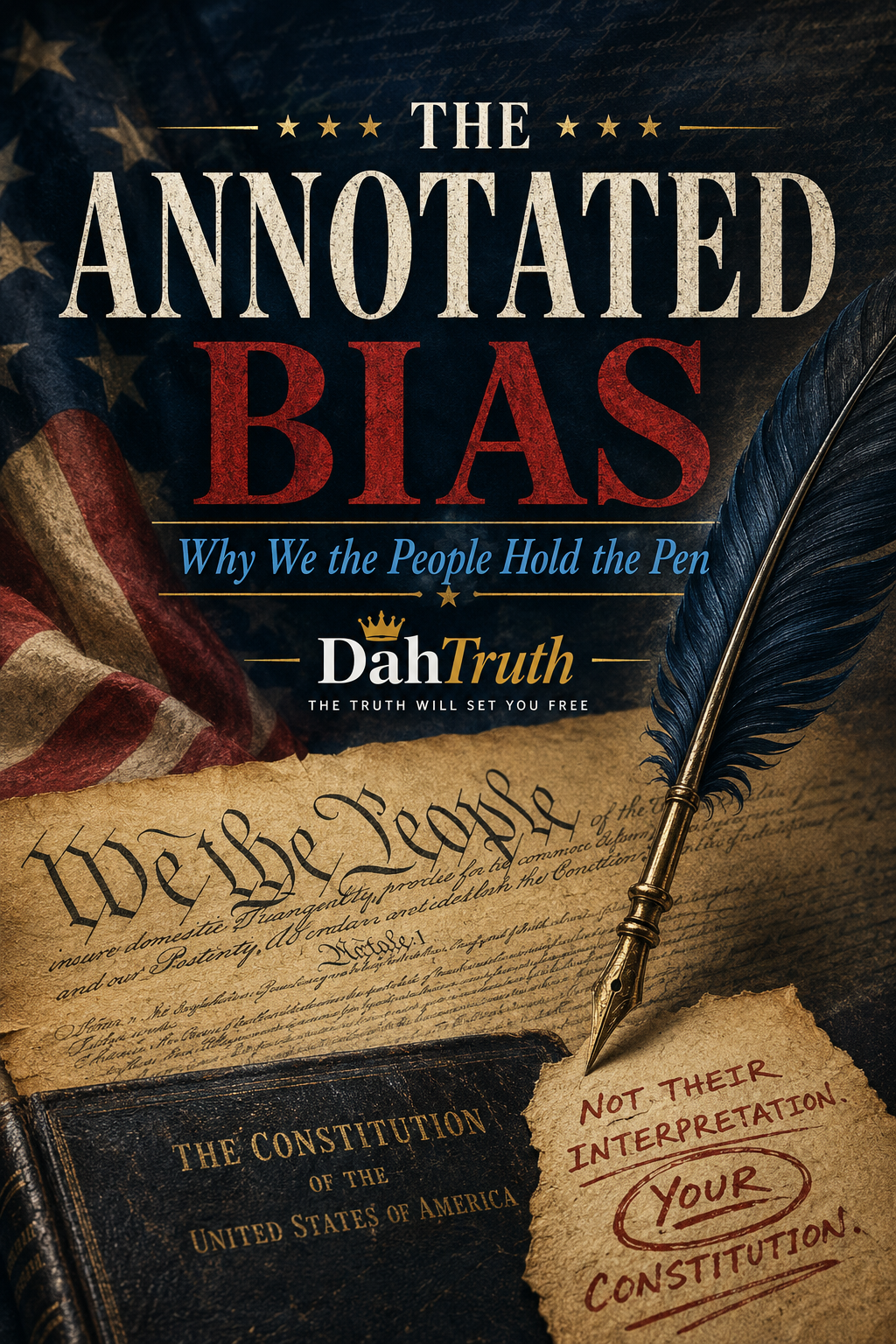
The Annotated Bias
"I know no safe depository of the ultimate powers of the society but the people themselves." — Thomas Jefferson
Why We the People Hold the Pen
We are approaching New Jersey's primary election, and I have already cast my ballot and will be working the polls on June 2 as a Black woman in America exercising a right that generations before me fought to secure.
Over the last few weeks, I have been reading the Federalist Papers while also working my way through Melissa Murray's book, The U.S. Constitution: A Comprehensive and Annotated Guide for the Modern Reader. Reading the two side by side has been a fascinating exercise because they approach the Constitution from very different perspectives.
Before discussing the book itself, it is important to understand who Melissa Murray is. Murray is a legal scholar, former dean of the UC Berkeley School of Law, and currently the Frederick I. and Grace Stokes Professor of Law and Faculty Director of the Birnbaum Women's Leadership Center at New York University School of Law. She is also one of the hosts of the podcast Strict Scrutiny, alongside Leah Litman of the University of Michigan Law School and Kate Shaw of the University of Pennsylvania Carey Law School.
By any measure, these women are accomplished scholars. They have spent years studying constitutional law, Supreme Court decisions, and the legal framework of the United States. Yet one of the things I have come to realize while reading Murray's book and listening to Strict Scrutiny is that scholarship alone is not enough. Knowledge, credentials, and expertise are valuable, but absent common sense, humility, and a foundation rooted in something greater than ourselves, expertise can become its own blind spot.
That realization shaped the way I read Murray's book.
Reading Murray's book alongside the Federalist Papers left me with a very different impression than I believe she intended. Rather than convincing me that the Constitution is a fundamentally flawed document in need of constant correction, the experience reinforced my appreciation for the durability of the Constitution itself. More importantly, it highlighted how constitutional interpretation is often influenced by the assumptions, cultural values, and political perspectives that readers bring to the text.
Murray's book is, at its core, a rereading of the Constitution with a heavy emphasis on the amendments. As I worked my way through the text, I found myself wondering whether that emphasis was intentional. It seemed to me that the amendments occupy center stage while the Constitution itself often recedes into the background.
I suspect this emphasis reflects a broader debate that has shaped constitutional interpretation for decades. On one side are those who believe the Constitution should be interpreted according to its original public meaning and historical understanding. This approach is often associated with jurists such as Antonin Scalia, Clarence Thomas, Samuel Alito, and, to varying degrees, Chief Justice John Roberts. While these justices do not always agree with one another, they generally place significant weight on the text of the Constitution and the historical context in which it was written.
On the other side are those who view the Constitution as a living document whose meaning evolves alongside society and culture. Under this view, constitutional interpretation is not limited to the original understanding of the text but must take into account contemporary circumstances, evolving social values, and modern realities.
As I read Murray's book, I came away with the impression that she largely embraces the latter view. The amendments are presented not merely as additions to the Constitution but as evidence that constitutional meaning expands over time as society changes.
What I found myself questioning, however, was whether the existence of twenty-seven amendments proves that the Constitution was fundamentally flawed. To me, the opposite conclusion seems more persuasive. The Constitution has existed for more than two centuries, yet only twenty-seven amendments have been adopted. The first ten amendments, the Bill of Rights, were ratified in 1791 out of twelve that Congress had proposed in 1789. Of the two left unratified, one concerned congressional pay, and it remained dormant for more than two centuries before it was finally ratified in 1992 as the Twenty-Seventh Amendment. Rather than demonstrating constitutional failure, the relatively small number of amendments demonstrates the durability of the constitutional framework.
More importantly, the amendment process itself suggests that the framers anticipated change. They created a mechanism by which the Constitution could be modified when necessary. That is very different from the idea that judges should revise constitutional meaning through interpretation based on evolving social and cultural values.
Before examining the broader constitutional debate, it is important to address what I believe is one of the central weaknesses of Murray's book: the degree to which her political and cultural assumptions shape her analysis of the Constitution.
No writer is free from bias. I certainly am not. The issue is not whether Murray has a perspective. The issue is whether that perspective is acknowledged and whether competing constitutional interpretations are given fair consideration.
Throughout the book, Murray frequently critiques positions associated with President Donald Trump and Supreme Court decisions that reach conservative constitutional conclusions. One example is the ongoing debate surrounding the Fourteenth Amendment and birthright citizenship. Murray appears to treat the issue as largely settled and views efforts to reconsider the scope of the Citizenship Clause with skepticism.
Yet it is not unreasonable to ask questions about the meaning of the Fourteenth Amendment. The amendment was adopted in the aftermath of the Civil War to overturn the injustice of the Dred Scott decision and to establish that formerly enslaved Black Americans and their descendants were citizens of the United States. The historical circumstances surrounding its adoption are well known. The modern debate is not whether those individuals were citizens. The debate concerns whether the Citizenship Clause extends as broadly as some modern interpretations suggest.
Reasonable people can disagree about that question. My concern is that Murray often presents one side of the debate as though it is the only intellectually serious position. Yet the issue is significant enough that it has found its way before the Supreme Court. The very fact that constitutional scholars, lower courts, and Supreme Court justices continue to debate the question suggests that it is not as settled as some commentators claim.
Another example of what I perceive as selective framing appears in Murray's discussion of Jim Crow and the racial oppression that followed Reconstruction.
To her credit, Murray does not ignore the discrimination, violence, and legal barriers that Black Americans faced in the South after the Civil War. Those realities are an undeniable part of American history and deserve serious discussion. What struck me, however, was the way the political actors responsible for many of those policies were often described.
Throughout these discussions, references are frequently made to historical movements, political coalitions, or broader social forces. Yet there is comparatively little direct acknowledgment that many of the Southern politicians who enacted and defended segregation, disenfranchisement, and Jim Crow laws were Democrats. The historical record on this point is not particularly controversial. Those individuals held office, passed legislation, and exercised political power under the banner of the Democratic Party of their time. I am aware that the political coalitions of that era differ from those of today. My point is simpler. If historical accuracy matters, the identities of the political actors involved should not be obscured. Readers should be given the full picture, even when that picture complicates contemporary political narratives.
I cannot know Murray's intentions, nor do I claim to. What I can speak to is the effect. The cumulative effect of the language, examples, and historical framing throughout the book is that certain aspects of the historical record receive considerable attention while others appear less central to the narrative being presented.
I also found Murray's choice of language and examples revealing. Throughout the book, she frequently refers to a hypothetical president as "she." There is nothing inherently wrong with using a female president as an example. Nor am I suggesting that America should never elect a female president. My observation is simply that examples are rarely chosen at random. They often reveal the assumptions and priorities of the writer.
Considering that every president in American history has been male, the repeated use of "she" struck me as a deliberate choice reflecting a modern cultural perspective. By itself, this would be insignificant. However, when viewed alongside the broader themes of the book, it becomes part of a larger pattern in which contemporary concerns about gender, identity, and social change shape the constitutional analysis being presented.
Before there was a Constitution, there was a Declaration. Before there were amendments, there was the belief that human beings are endowed by their Creator with certain unalienable rights, among them life, liberty, and the pursuit of happiness. The Constitution provides the framework for governing a free people, but the Declaration explains why those freedoms matter in the first place.
It is here that I find myself parting ways with Murray and many modern constitutional scholars. They frequently invoke the Constitution to defend the rights of the individual, yet when the discussion turns to abortion, the analysis often begins with the assumption that the question concerns only the rights of the woman.
If constitutional principles are rooted in the protection of individual rights, then the first question should not be whether a woman has autonomy over her body. The first question should be whether the life developing in the womb possesses any claim to protection under the law. If the answer is yes, then the constitutional analysis becomes far more complicated than a simple appeal to personal liberty. If the answer is no, then that conclusion itself must be defended rather than assumed.
What troubles me is that many modern discussions seem to bypass this question altogether. The debate is framed almost entirely around choice, autonomy, and reproductive rights, while the question of life is treated as secondary. Yet reproduction has already occurred. The issue is no longer whether life will begin, but whether a developing life will be permitted to continue.
Furthermore, I find myself wondering how the founding generation would have approached this question. The men who drafted the Declaration of Independence and later framed the Constitution were far from perfect, but they spoke often about natural rights, human liberty, and the protection of life. Their writings reveal a deep concern for limiting government power and preserving the rights of individuals.
“Jesus saith unto him, Thomas, because thou hast seen me, thou hast believed: blessed are they that have not seen, and yet have believed.”
Would they have viewed the unborn child as entirely outside those protections? I cannot say with certainty. What I can say is that it seems like a question worth asking.
Modern constitutional interpretation often extends certain legal protections to non-citizens because they are human beings entitled to due process and equal treatment under the law. If our constitutional tradition recognizes a measure of protection based on our shared humanity, then I struggle to understand why the humanity of the unborn is so often dismissed before the discussion even begins.
Even Christ told Thomas, blessed are those who have not seen and yet believe. He was speaking of belief in Himself, of the countless believers across the centuries who have never laid eyes on Him and yet hold Him as Lord. But the same principle reaches further. Before we hear his first cry, before we cradle her small body in our hands, we already believe it is a life, and we move to protect it.
After all, the unborn child is not a foreign invader, nor an outsider seeking entry into the nation. The unborn child is a developing human life, one that, absent intervention, will cross the threshold from the womb into the world and become a citizen of the United States. If constitutional principles are broad enough to recognize the humanity of those who do not belong to the political community, should they not at least compel us to seriously consider the humanity of those who are on the verge of entering it?
This question does not resolve the abortion debate, and I do not pretend that it does. What it does reveal is how incomplete the constitutional conversation becomes when one life is given consideration while the other is treated as though it does not exist. That same concern, the question of who is seen and who is overlooked, runs through the whole of how we read the Constitution.
Bringing me back to Murray's book, about the U.S. Constitution, I found it to be a relatively simple and accessible read. It is written for a modern audience and serves as a guided tour through the Constitution and its amendments. While Murray discusses some of the historical debates surrounding the Constitution, the book does not deeply explore the struggles, disagreements, and competing visions that shaped the document during its creation. Nor does it spend much time wrestling with the intellectual battles that took place between the framers and their critics during the ratification process.
To be fair, Murray does provide useful historical context and raises questions that readers should consider. There were sections of the book that I found informative and engaging. My concern is not that the book lacks intelligence. My concern is that it often presents constitutional interpretation through a particular ideological lens while giving the appearance of neutral explanation.
The danger is this: many readers, especially younger readers, may approach a work written by a respected scholar with the assumption that they are receiving an objective account of the Constitution. Yet constitutional interpretation is rarely objective. Every scholar, judge, commentator, and citizen brings assumptions to the text. Murray is no exception.
I worry that readers who have never read the Constitution for themselves may come away believing they understand the Constitution when what they have really encountered is one scholar's interpretation of the Constitution. There is a difference between the two.
If I have one recommendation after finishing this book, it is this: read the Constitution for yourself. Read the amendments for yourself. Read the Federalist Papers. Read the arguments of those who agree with Murray and those who disagree with her. Wrestle with the text before allowing anyone else to tell you what it means.
The Constitution belongs to the American people. It was not written exclusively for scholars, judges, professors, or constitutional experts. It was written to establish a government and preserve liberty for a free people. The best way to understand it is not through the lens of any single commentator, no matter how accomplished, but by engaging directly with the document itself.
After reading Murray's book alongside the Federalist Papers, I came away convinced of one thing: the Constitution is far more resilient, far more enduring, and far more capable of speaking for itself than many modern scholars seem willing to admit.
“A popular Government, without popular information, or the means of acquiring it, is but a Prologue to a Farce or a Tragedy.”
