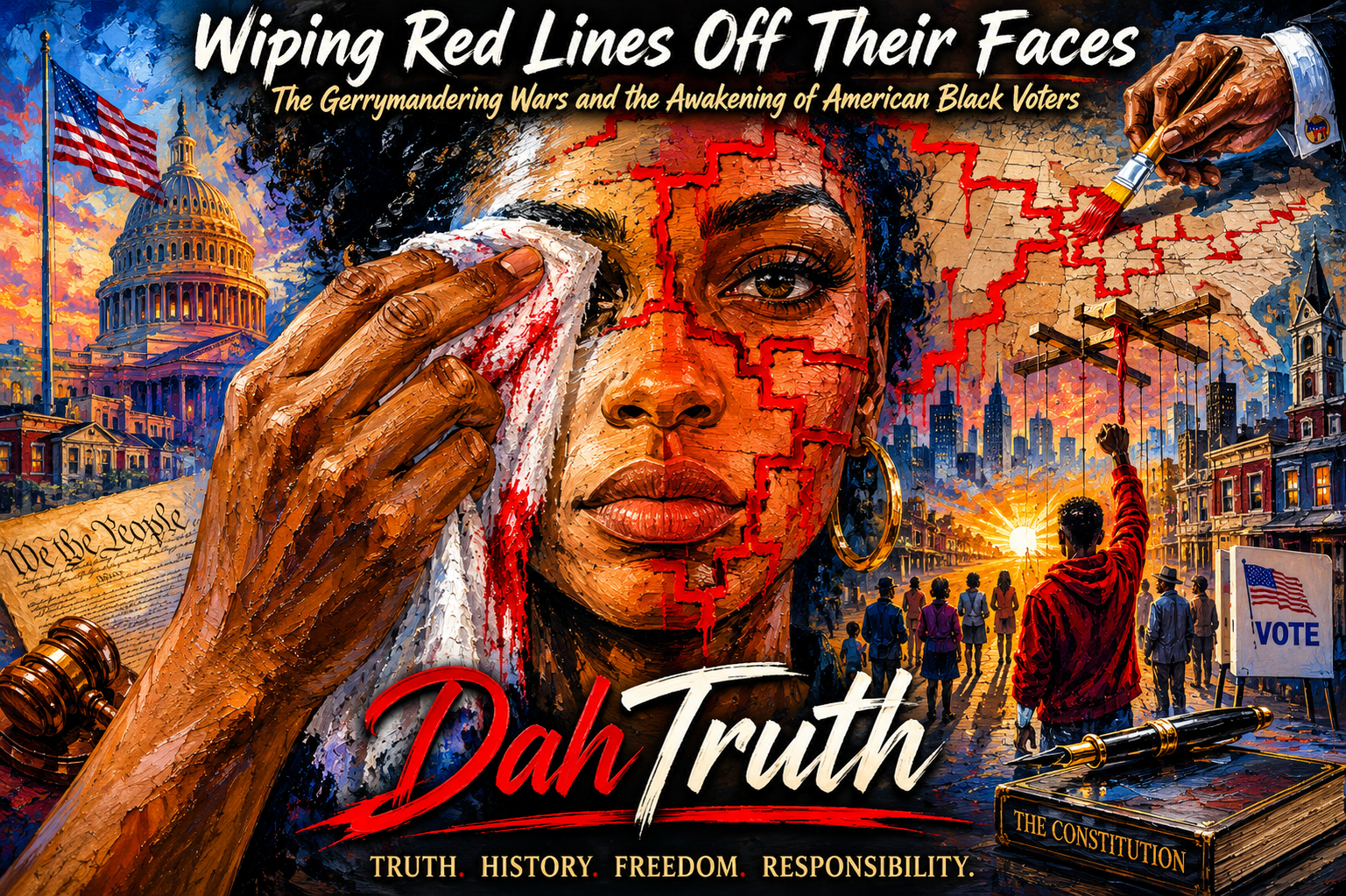
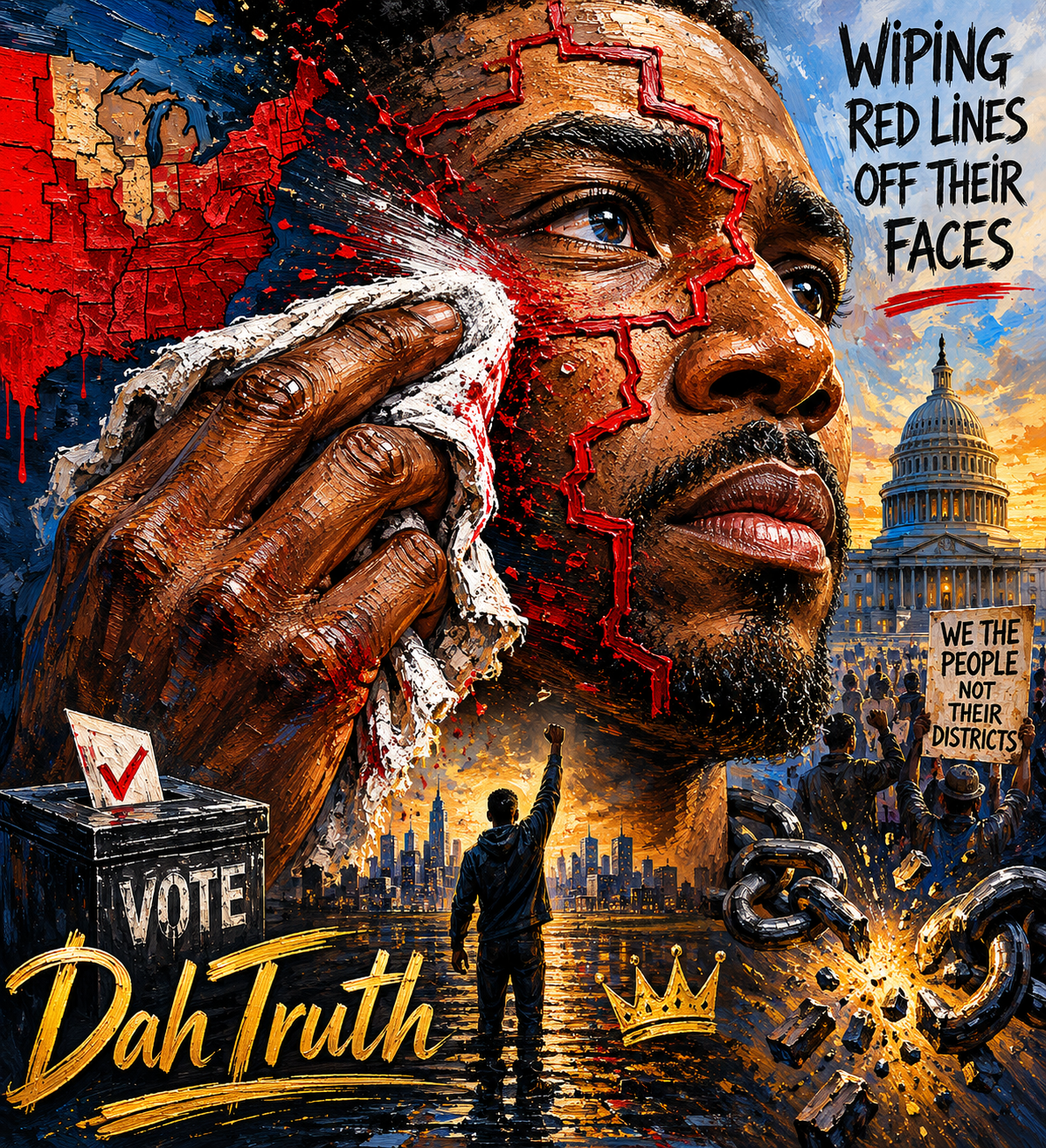
Wiping Red Lines Off Their Faces
“Nothing could be more ill judged than that intolerant spirit which has, at all times, characterized political parties.” — Alexander Hamilton
The Gerrymandering Wars and the Awakening of American Black Voters
What has become painfully obvious this week is the infighting beginning to ripple through the Democratic Party ahead of the 2026 midterm elections. Much of it centers around political gerrymandering, a tactic both parties have used for decades, but one Democrats long believed worked overwhelmingly to their advantage through modern Voting Rights Act litigation and racial bloc redistricting strategies. Republicans have now begun using many of the same structural tools with increasing effectiveness, and Democrats are suddenly up in arms.
When considering these battles over voting maps, representation, and political power, it is essential that we step back and examine the policies and historical shifts that helped create the political landscape we are living in today. Perhaps there is no better place to begin than with the conditions of the American South after the Civil War, through the New Deal era of the 1930s, and ultimately to the desk of Lyndon B. Johnson, where the modern political realignment of American Black voters accelerated in ways that still shape our politics today.
The Party Switch Myth
To keep many American Blacks voting for Democrat candidates, left-leaning scholars, commentators, and policymakers often invoke what is commonly called the party switch in the South. The argument generally goes like this. American Blacks, who were initially overwhelmingly Republican following the Civil War, gradually abandoned the Republican Party after Jim Crow, the New Deal, and the Civil Rights era transformed the political landscape.
There is truth inside parts of that history. American Blacks were historically aligned with Republicans after the Civil War. Men like Blanche K. Bruce, who became the first American Black United States Senator in 1875 representing Mississippi, emerged directly out of that Republican Reconstruction tradition. It is also true that Jim Crow violence, disenfranchisement, economic hardship, and later federal social programs changed Black political alignment over time. By the mid-twentieth century, Black voters increasingly aligned themselves with the Democratic Party, especially during and after the New Deal and the Civil Rights era.
Now before someone rushes to invoke the Southern Strategy, let me say plainly that I am aware political coalitions shifted after the Civil Rights era. Southern whites moved politically. Black voters increasingly aligned with Democrats. Electoral maps changed. None of that is disputed. What I dispute is the lazy conclusion that modern Republicans simply became the segregationist Democrats of the past. I also dispute the companion claim that Democrats transformed overnight into the moral opposite of their historical governing instincts. Neither party crossed the aisle ideologically. The coalitions shifted. The philosophies did not.
Political coalitions changed. Voters changed. Regional loyalties changed. The deeper ideological debates over federal power, economic control, dependency systems, labor expansion, local governance, and constitutional structure remained far more continuous than modern political shorthand admits. When people speak of the party switch today, it is often used less as a historical explanation and more as a moral accusation. The implication is that modern Republicans inherited the spirit of Southern segregationists while modern Democrats became the sole heirs of civil rights and racial progress. History is far more complicated than partisan mythology.
Even as voters shifted, the broader philosophical instincts of each party remained recognizable. Democrats continued expanding federal social programs, centralized economic management, and dependency-driven systems. Republicans continued emphasizing constitutional restraint, limited government, local control, markets, and fiscal conservatism, even if both parties evolved over time and often contradicted their own principles in practice.
Trapped in the Framework
Since 1965, American Blacks have largely been trapped within the framework of Democrat policies. For decades we have voted overwhelmingly Democrat, yet many of our urban communities have declined in measurable ways involving education, wealth, institutional stability, self-awareness, family structure, and economic independence. Still, we continue aligning ourselves almost exclusively with the same political machine.
This has everything to do with political power and gerrymandering. Voting maps have often been drawn in ways that pack Black communities into concentrated districts that maximize Democrat political control while limiting broader influence elsewhere. Our votes are harvested in bulk, but very little meaningful institutional investment returns to many of our neighborhoods. As Malcolm X once warned, politicians often help themselves first and only afterward return to Black communities asking, what do you need. The pattern has become painfully familiar.
Over the last several years we have also witnessed growing tensions surrounding illegal immigration and the expectation that Black communities should quietly absorb the economic, educational, and social pressures that come with rapid demographic change, often without serious public debate. These realities are not random. Many of the same voting districts are intentionally engineered and politically protected through racial bloc mapping and partisan redistricting strategies.
The Maps Begin to Fall
Earlier this month, in Louisiana v. Callais, Democrats suffered a major setback. On April 29, 2026, the United States Supreme Court ruled in a 6-3 decision written by Justice Samuel Alito that Louisiana's congressional map, which created a second majority-Black district stretched across the state, was an unconstitutional racial gerrymander. The Court concluded that race had improperly dominated the drawing of the district lines, and that Section 2 of the Voting Rights Act did not require Louisiana to use race as the basis for redistricting. The decision narrowed the standard that future challenges under Section 2 must meet, and it sent a clear signal to state legislatures across the country.
The next major blow came in Virginia. On May 8, 2026, the Supreme Court of Virginia ruled 4-3 to strike down the Democratic redistricting amendment that had been narrowly approved by voters in an April referendum, finding the General Assembly had failed to follow proper constitutional procedure in placing the measure on the ballot. The new map would have shifted Virginia's congressional delegation from a 6-5 Democratic edge to a 10-1 Democratic supermajority. The ruling killed the map. Democrats were left wiping red lines off their faces.
The consequences are now creating fractures inside the Democratic Party itself. Democrats believed aggressive redistricting efforts would help them flip the House. Republicans, encouraged by the Callais ruling, have successfully redrawn maps in several states in ways that now threaten Democratic incumbents and expose internal party conflicts over race, representation, and political survival.
Crockett, Cohen, and Wasserman Schultz
In Texas, the redistricting wars helped reshape the Democratic Senate primary. Congresswoman Jasmine Crockett, the Dallas representative known for her sharp tongue and her loyalty to Black Democratic constituencies, entered the Senate race in December 2025 after Texas Republicans redrew the congressional map in a way that scrambled Democratic House prospects across the state. On March 3, 2026, she faced state Representative James Talarico, a white seminarian from Austin, in the Democratic primary. Talarico won, 53.1 percent to 45.6 percent.
Black voters delivered for Crockett. Polling before the primary showed her winning more than 71 percent of Black Democratic voters. Prominent Black Texas politicians lined up behind her. Yet Talarico, the white challenger, outraised Crockett nearly three to one with money largely coming from outside Texas, including a viral surge of national exposure when his interview on a major late-night show went out on YouTube after being cut from the network broadcast. The Black base showed up for Crockett. The party machinery and the donor class showed up for Talarico. The pattern is familiar.
In Tennessee, the story took a different shape but ended in the same place. On May 15, 2026, Congressman Steve Cohen announced he would not run for reelection after the Republican-led state legislature dismantled the Memphis-based 9th Congressional District, Tennessee's only majority-Black congressional district, splitting Memphis into three districts all redrawn to favor Republicans. Cohen, who is white, had held that seat for nineteen years with the consistent support of Black Memphis voters. He called the redistricting Republicans silencing the Black vote, and he was right to call it that.
The harder question is one Black Memphis must eventually answer for itself. Why did the only majority-Black congressional district in Tennessee remain represented by a white Democrat for nearly two decades. Cohen by all accounts served his constituents well, and Black voters kept electing him. That was their choice and it must be respected. The deeper truth is that the district he served is also one of the poorest, most violent, and most institutionally neglected urban districts in the country. Memphis remains plagued by failing schools, concentrated poverty, generational public housing, and the kind of chronic disinvestment that nineteen years of representation by a senior Democratic congressman did not meaningfully reverse. The conditions did not change. The representation did not change. The political loyalty did not change either.
The Democratic Party's grip on Black political loyalty meant that when Republicans came for the district, no Black Democratic successor was in position to defend it. The political bench was thin because the machine had not built one. The district was vulnerable not only because Republicans drew the lines, but because the party that claimed to protect Black representation had spent two decades comfortable with a representation that did not have to be Black, and a constituency whose conditions did not have to improve.
Then came Florida. On May 22, 2026, just two days ago as I write this, Congresswoman Debbie Wasserman Schultz announced she would run for reelection in Florida's newly redrawn 20th Congressional District, a majority-minority district whose Democratic electorate is overwhelmingly Black, after Republican Governor Ron DeSantis signed a new Florida map on May 4 that carved up her current 25th District into five pieces. The 20th District seat had been vacated when Sheila Cherfilus-McCormick, a Black Democrat, resigned in April under the weight of ethics charges. Several Black Democrats had already declared for the seat. Wasserman Schultz, who is white, announced her run anyway, framing the campaign as a fight to preserve Broward County's political influence.
Black Democrats inside the Florida party did not stay quiet. Florida State Senator Shevrin Jones, the Democratic leader in the state Senate and an American Black, said publicly that he had personally asked Wasserman Schultz not to run. He told reporters, Black representation is a non-negotiable for me, and added that everyone deserves to have a seat at the table to ensure communities are represented by those with their same lived experience. Elijah Manley, a Black Democrat already running in the primary, called her Jim Crow Debbie and said her decision was an attack on Black representation. The criticism did not come from Republicans. It came from Black Democrats inside her own party.
The Mask Slips
The same party that endlessly speaks of protecting Black representation now finds itself openly fighting over who gets to control Black districts, who gets to inherit Black voting blocs, and which communities are politically useful enough to preserve. Democrats spent decades building political power through racial coalition politics, district engineering, and dependency-driven voting blocs. The very systems they cultivated are now turning inward, producing infighting over race, representation, identity, and political ownership inside the party itself.
The consequences of this political alignment have been devastating for many of our communities. Despite decades of initiatives, political theater, symbolic gestures, and the constant invocation of slavery and civil rights during every election cycle, many urban Black communities continue struggling under the same conditions generation after generation. We continue to see failing urban schools, generational public housing, concentrated poverty, violence, declining literacy, shrinking ownership, institutional collapse, and growing dependence on federal systems that rarely create lasting independence. Housing remains a crisis. Wealth creation remains limited in both scope and accessibility. Entire neighborhoods continue living at the edge of economic survival while political leaders return every few years offering the same promises wrapped in new slogans.
The tragedy is not simply that these conditions exist. The tragedy is that many politicians have learned how to politically survive because these conditions exist.
For decades Democrats used fear to keep Black voters politically aligned in the South during Jim Crow. Today many of those same fear tactics have simply been repackaged. The language changed. The strategy did not. Fear of Republicans. Fear of losing benefits. Fear of losing protections. Fear of stepping outside the political plantation. The whip became a carrot dangling from a thread, but the dependency remained.
The Awakening
Many of us are beginning to see clearly. The cracks started becoming visible in 2020, when Donald Trump received roughly twelve percent of the Black vote nationally, a notable increase over previous Republican performances. By 2024 that number had risen further, to roughly thirteen to fourteen percent overall, and the shift among Black men was sharper still, climbing to roughly twenty-one percent according to NBC exit polling. The trend was clearest among younger Black men, who cited the economy, inflation, and jobs as their top concerns and who increasingly judged Democratic governance by outcomes rather than rhetoric.
Whether or not one agrees with the political shift itself, the underlying point is harder to dismiss. American Blacks are beginning to question the political arrangement that has existed for generations. We are the voices of the underdog in our communities. It is up to us to stop depending entirely on organizations like the NAACP and the Southern Poverty Law Center, on politicians and commentators, and on podcasters and influencers who continuously insist we are better off permanently tied to one political party no matter the outcomes in our communities.
The NAACP and the SPLC are not the organizations they once were. The NAACP, founded in 1909 by an interracial coalition that included W.E.B. Du Bois, Mary White Ovington, and Ida B. Wells, was created to advance justice specifically for the colored race in America. That mission produced real victories. Brown v. Board. Voting rights litigation. The dismantling of legal segregation across the courts. In recent decades the organization has expanded its stated mission from securing the rights of American Blacks to securing the rights of all persons. Its advocacy now includes immigration reform, environmental justice, and broad civil rights coalitions that extend well beyond the specific historic mandate that brought it into being. Whatever one thinks of that expansion, the practical effect has been a diffusion of focus at a moment when the conditions in American Black communities require more focused advocacy, not less.
The Southern Poverty Law Center has traveled a stranger road. Founded in 1971 to fight Klan violence through the civil courts, the SPLC pioneered a strategy of using wrongful death suits to bankrupt white supremacist organizations. That work was real. In recent decades the organization became better known for its expansive hate group designations, which have been challenged in court by groups across the religious and political spectrum, including settlements such as the 3.375 million dollars the SPLC paid in 2018 to the Quilliam Foundation and Maajid Nawaz after wrongly labeling them anti-Muslim extremists. More recently, on April 21, 2026, a federal grand jury indicted the SPLC on charges of wire fraud, false statements, and conspiracy to commit money laundering. The indictment alleges that the SPLC operated a covert network paying individuals associated with violent extremist groups, including the Ku Klux Klan, and that roughly three million dollars in donor funds was paid to eight informants between 2014 and 2023 through bank accounts opened in the names of fictitious entities. The SPLC has defended the payments as standard infiltrator and informant practice and has not been convicted of any crime. The case is pending. What is undisputed is that an organization originally founded to combat the Klan stands accused of having funneled donor dollars to individuals embedded inside the very groups it publicly denounced.
Neither organization has demonstrated the political independence to challenge Democratic policy outcomes in Black communities, and neither has produced an honest accounting of why decades of political loyalty have not produced the conditions they promised.
While we are told to remain loyal, another reality is unfolding right before our eyes. The same political machinery that once relied almost exclusively on Black voting blocs is now preparing the next coalition of dependent voters to maintain political power. The strategy changes faces, but the structure remains familiar. That may sound harsh, but history often tells uncomfortable truths. Uncomfortable truths do not become false simply because they offend us.
At some point we must stop asking what a political party says about us and begin asking what decades of political loyalty have actually built around us.
It is time we counted what loyalty has cost us.
“Much depends upon us for the help of our colour.” — Richard Allen
