Do You Hear What I Hear?
"The Lord was not in the wind... nor in the earthquake... nor in the fire: but after the fire a still small voice." 1 Kings 19:11-12
The Sound of Desperation
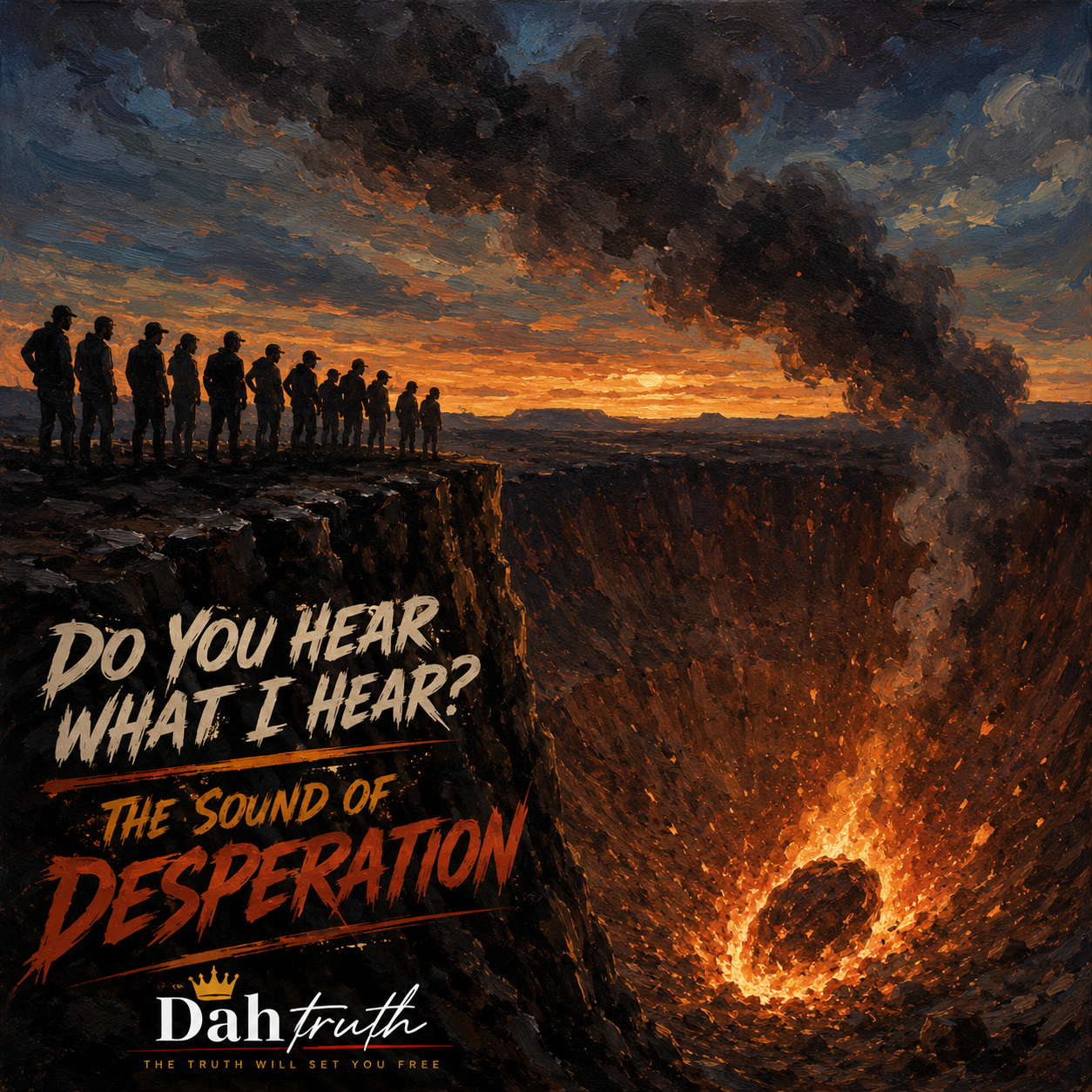
Do you hear what I hear? On the final Saturday of May, the sky over Massachusetts split with a sound like the end of something. A meteor, traveling at seventy-five thousand miles an hour, tore across the bedrock of these United States and broke apart in a blast that NASA measured at the equivalent of three hundred tons of TNT. It shook buildings and rattled windows, and the boom was heard from Delaware to Montreal. For one single second, that sound replaced every other sound. And then it was gone. What returned in its place was the sound that has been with us all spring, the sound that never truly left. The sound of desperation.
For that is the sound a party makes when it has run out of ideas. It is not the sound of vision or conviction. It is the sound of noise, of manufactured crisis, of recycled faces and borrowed fear. We are hearing that sound now, and anyone willing to listen can recognize it for what it is.
Begin with the cry about redistricting, because that is where the desperation shows itself most plainly. The Democratic Party would have us believe two contradictory things at once. They want us to believe they are winning the fight over the maps, and at the very same moment they want us to believe the maps are being stolen from us. Both cannot be true. A party that is winning does not cry foul. A party that is losing does, and loudly.
Consider what has actually happened. In California, Democrats redrew the map to gain five seats, and the courts let it stand. They celebrated. In Texas, Republicans did the same, and the courts let that stand as well. In Virginia, Democrats pushed a redistricting plan that would have handed them as many as four additional seats and reduced Republican representation to a single congressman. The Virginia Supreme Court struck it down. Democrats ran to the Supreme Court of the United States, which rejected their emergency appeal in a single terse sentence, with not one justice noting a dissent. The same tactic they praised in California they called a threat to democracy in Virginia, and the highest court in the land was unmoved.
What makes it worse is that they had already given up. Before the Supreme Court even ruled, the governor announced the state would proceed with the existing map regardless of what the justices decided. The appeal was theater. They knew it would fail, they had already moved on, and they filed it anyway so they would have someone to blame. And blame they did. When the one-sentence denial came down, the response was not reflection but outrage at the court, as though three million votes had been stolen by the justices rather than lost by a party that broke its own state's rules to draw the map in the first place.
The contradiction is not subtle. The principle is supposed to be the thing that matters. Either drawing maps for partisan advantage is acceptable or it is not. It cannot be democracy in one state and tyranny in another simply because of which party benefits.
What makes the Virginia story worth lingering on is what happened inside the party once the plan collapsed. Governor Abigail Spanberger, who signed the Virginia redistricting into law herself, has now publicly distanced herself from Hakeem Jeffries, the House Minority Leader whose allied groups poured tens of millions of dollars into the effort. When asked about Jeffries and future plans, Spanberger said that talk of some future point is a distraction from the task at hand, and that on redistricting, that time is over now.
It is obvious these are not the voices of a unified party. That is the language of a governor putting distance between herself and a failure. And it is worth remembering that this same governor once wrote that gerrymandering is detrimental to democracy and that opposing it should be a bipartisan priority. Then she signed a gerrymander into law. The voters are not required to forget what was said yesterday simply because it is inconvenient today.
There is more. After the Virginia ruling, some Democrats floated to Jeffries an idea so brazen it deserves to be named. They considered lowering the retirement age of the state Supreme Court justices to clear the bench, installing seven new justices, and rehearing the case to reach the result they wanted. Spanberger does not support the scheme. But the fact that it was floated at all tells us something. When you cannot win under the rules, you consider changing the people who enforce the rules. That is not a defense of democracy. That is the opposite.
And here is the part that should trouble every American Black voter in particular. As they lose these battles, they reach for the oldest tool in the drawer. They warn us that we are being returned to the days of Jim Crow. They invoke our grandmothers and our grandfathers, the marches, the dogs, the hoses, the blood. They do this not to honor that history but to harvest our fear. They need us frightened, because frightened people do not ask hard questions. Frightened people do not notice that the party invoking Jim Crow is the same party whose ancestors built it.
And it does not stop at fear. The same pundits who serve the party have found a new front in their war against the Supreme Court, and they are willing to spend our children to wage it. They are now suggesting that Black athletes at colleges in states with contested maps should stop playing, as though our young people should be made into instruments of a political fight they did not start. Think on what is being asked. They will invoke Jim Crow to frighten us and then turn our own sons and daughters into bargaining chips in the same breath. That is what desperation looks like when it reaches for leverage. It will spend our children to make a point.
I have written before about who wrote the laws of segregation and who defended them, and I will not relitigate the whole of it here. But I will say this plainly. A party that needs to frighten you with the past while offering you nothing for the future is a party that has run out of anything else to give.
Next listen to the outrage coming out of Los Angeles where Mayor Karen Bass may lose her seat. The race is a statistical tie. One of the candidates clustered at the top with her is Spencer Pratt, a figure who has gathered support from the right and a nod of approval from President Trump. Whatever one thinks of that race, the picture of an incumbent Democratic mayor in one of the most Democratic cities in America fighting for her political life is not the picture of a healthy party. It is the picture of a party whose own voters are no longer convinced.
How about Maine, where Senator Susan Collins faces Graham Platner. Platner is the kind of candidate a desperate party produces. He has been dogged by reports of a Nazi-linked tattoo, by resurfaced social media posts, and by reports that his own wife told campaign staff he had sent sexual messages to other women. This is who they are running. Not because he is the best they have, but because the anger they have stoked needs a vessel, and he is the vessel available.
Now listen to the sound the party makes about its own past. The leaked autopsy of the 2024 campaign, the party's own report, authored by a Democratic consultant and then disavowed by the party that commissioned it, described Democrats as incapable of projecting strength, unity, and leadership, and said voters have drifted away. The report was so damaging that party leaders tried to bury it. It was riddled with errors. It never once mentioned Gaza, despite the evidence that the war cost the campaign dearly. A party confident in its future does not hide its own analysis of its past.
And what is their answer to all of this? Who do they offer us as the way forward? The same faces. Kamala Harris, who declined to run for governor of her home state and left the door open for another presidential run, is making the rounds again. Alexandria Ocasio-Cortez is being positioned as a front-runner. The party that just lost is offering us the architects of that loss and calling it renewal.
Watch how Harris in particular comes back to us. She is once again presenting herself to the American Black community as one of us in the fullest sense, as a daughter of the American descendants of slavery, when her own story is more complicated than the image she sells. Authenticity is not a small thing in our community, because we have been sold counterfeit champions before. We have every right to ask whether the people who claim our struggle have lived it or merely learned to perform it when an election draws near.
And consider how Ocasio-Cortez courts the very communities she needs. She has stepped into our pulpits, and just days ago she appeared at an Eid al-Adha event in the Bronx alongside Mayor Zohran Mamdani wearing a hijab. Understand what that is. It is the putting on of a people's customs as a garment, worn for an afternoon and removed by evening, in order to harvest their support. The offense is not that she honored a community. The offense is the assumption underneath it, that we are too uninformed to see the performance, that we cannot tell the difference between someone who shares our condition and someone who has learned to dress like she does.
She was not the only one to hear the objection. Women who escaped life under compulsory hijab laws spoke up, among them an Iranian activist who has fought that very garment, who said plainly that the hijab is not cultural tourism, that women have died over the freedom not to wear it. When the people whose lived reality you are borrowing tell you that you have turned their suffering into a costume, that is not solidarity. That is spectacle.
And spectacle is the whole of it. Ocasio-Cortez believes she can win, not on the strength of any record of bringing people together, but on something as hollow as a follower count, a number inflated in places by accounts that are not even real people. She has mistaken visibility for leadership and attention for trust. Make no mistake about what she is reaching for. There is a Senate seat in New York she could pursue, the one Chuck Schumer holds, but a woman who has spent her time on the global stage and turned up everywhere a camera waits is not testing the waters for the Senate. She is testing them for the presidency. The party that lost in 2024 looks at her and sees its future, when what it is actually seeing is a mirror of the same performance that lost it the country.
Now the sounds thumping on the streets in New Jersey, where the pattern becomes impossible to miss. For months there was quiet. Now, weeks before our primary election, there is chaos outside the Delaney Hall detention facility in Newark. Sparks are flying between federal agents and protesters, and the timing deserves our attention. A party that needs energized voters has a powerful incentive to manufacture the kind of scene that energizes them.
Governor Mikie Sherrill is performing a familiar two-step. She calls the protesters peaceful while she sends state troopers into the very crowd she is praising. The state police have said that some in the crowd retrieved gas masks, fireworks, rocks, and projectiles, that they surrounded a law enforcement vehicle, and that they threatened the personnel inside. Federal officials say they agreed to pull back to lower the temperature, and that the governor refused to let state police assist them. And yet the story being sold to us is that the protesters are peaceful and the agents are the aggressors.
I want to be fair, because fairness is what separates argument from propaganda. There were two crowds outside Delaney Hall, one supporting ICE and one opposing it, but the pro-ICE presence was small and the anti-ICE crowd dwarfed it. The disorder, the fireworks and the projectiles and the arrests, came overwhelmingly from the larger side. The American Civil Liberties Union of New Jersey has condemned the state police response and called the protests overwhelmingly peaceful, and that view deserves to be on the table. The one thing genuinely open to debate is whether the police response was proportionate. But the governor cannot have it both ways. She cannot call a crowd peaceful and deploy riot police against it in the same breath, then blame everyone except herself when the two collide. Either it was peaceful, in which case the troopers were unnecessary, or it was not, in which case the word peaceful is being used to manage us rather than to describe what happened. And it is worth noting who was arrested. The governor herself admitted that five of the six people taken in on one night were from outside New Jersey, and that national extremist groups had involved themselves. That is not a neighborhood rising up. That is something imported.
These are the sounds. The sounds of desperation. The sounds of a party that cannot win on ideas, so it manufactures crisis. It cannot inspire, so it frightens. It cannot offer new leaders, so it recycles old ones. It cannot defend its record, so it buries the report that describes it.
Pete Buttigieg, Mark Kelly, and Gavin Newsom are already maneuvering quietly toward the front of the line for 2028, each of them carrying records and policies that have done little to bring people together and less to solve the problems in front of us. They are not running toward a vision. They are running away from a wreckage, hoping we will not notice the difference.
It is the cries of utter madness, and it is the particular madness that comes when a movement has no effective policies and no ideas capable of uniting people. When you cannot build, you burn. When you cannot persuade, you panic. And when you cannot win, you cry that the game is rigged, even as you reach for the levers to rig it yourself.
We are not required to be frightened. We are not required to forget. And we are most certainly not required to follow a party off the cliff of its own desperation simply because it shouts the name of Jim Crow while marching us backward. We have eyes. We can see. And what we see is a party that has lost its way, dressing its panic in the language of principle and hoping we will not know the difference.
We know the difference.
