The Document They Cannot Rewrite
“We are Americans, not only by birth and by citizenship, but by our political ideals, our language, our religion.” — Frederick Douglass
Memorial Day, the Constitution, and the American Black Inheritance
May is quickly being washed away, and June is coming in with the heat of summer. Monday is Memorial Day. It is a day Americans set aside to honor those who gave their lives, not only for the United States, but for the Constitution upon which this republic stands. The flag they died under was not merely cloth. It was a document. It was a framework. It was the deliberate handiwork of men who feared concentrated power and built a system designed to outlast them.
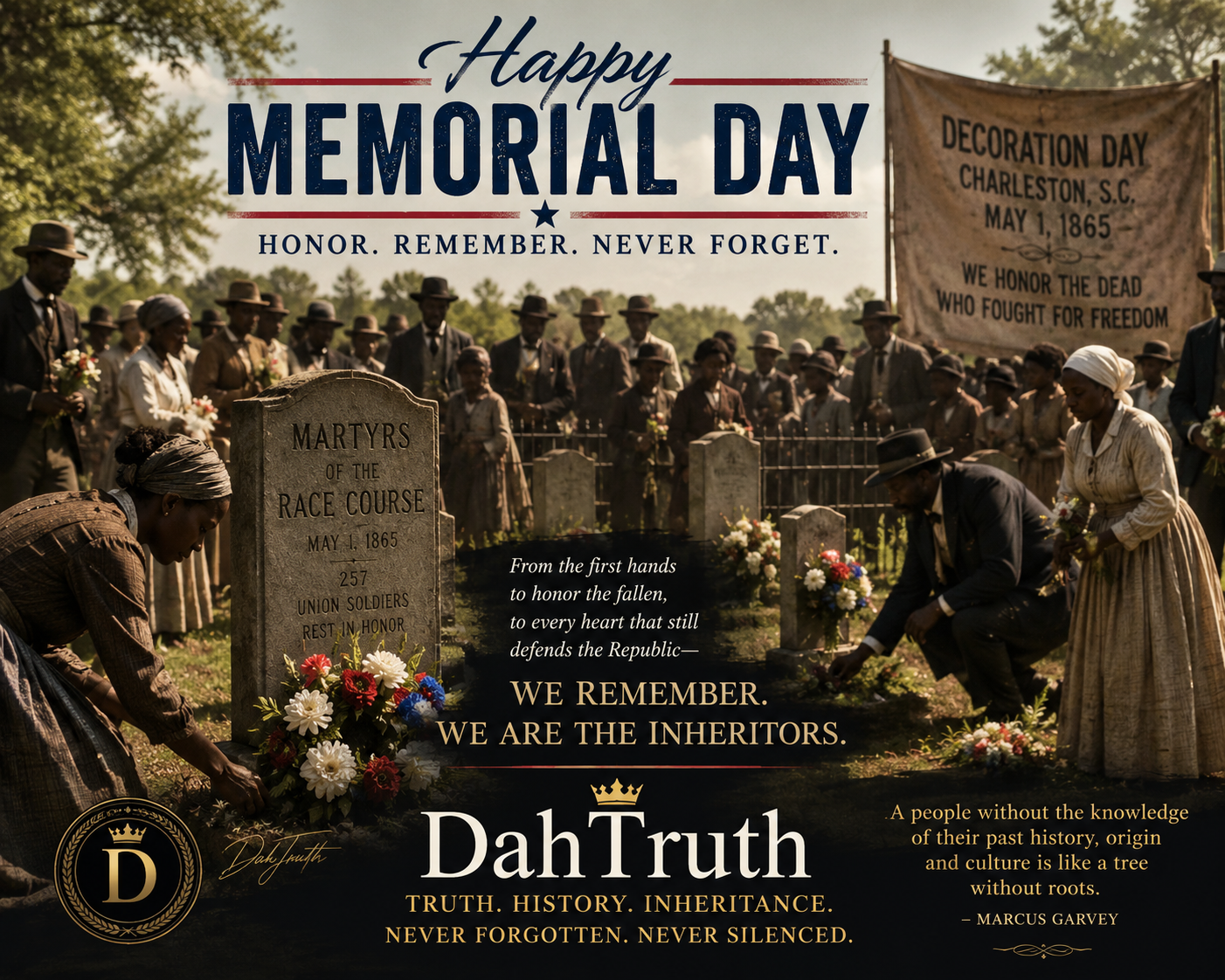
It is not lost on me that one of the earliest such observances on American record was organized by American Blacks who had been slaves only weeks before. They did not call it Memorial Day. That name came later. They called it Decoration Day, because the act itself was the decoration of the graves of the Union dead with flowers. On May 1, 1865, in Charleston, South Carolina, freed men and women exhumed the bodies of 257 Union soldiers who had died in a Confederate prison camp at the Washington Race Course. They reburied those men with dignity. They built a fence around the graves and inscribed it with the words, Martyrs of the Race Course. Then ten thousand people, most of them American Blacks newly released from bondage, walked in procession with flowers and song to honor the dead who had fought for their freedom.
You probably did not learn this in school. There is a reason for that. The Decoration Day at Charleston was buried in the American memory for more than 130 years. It was Yale historian David Blight who recovered it in the late 1990s, finding a file labeled First Decoration Day in a Harvard archive. Blight has said openly that white Charlestonians suppressed this founding from memory. When the United Daughters of the Confederacy later asked the Ladies Memorial Association of Charleston whether the May 1865 commemoration had actually happened, the response was that no official information could be gathered. The event of ten thousand people, the parade of three thousand schoolchildren, the reburial of 257 Union soldiers, the inscription Martyrs of the Race Course, all of it had been quietly washed out of the record.
Sit with that for a moment. The first hands to consecrate what would become Memorial Day in this country were the hands of former slaves, and the act was suppressed because the witnesses were Black. They understood something many of their descendants and many of their critics still do not understand. The Constitution of the United States, even imperfect, even bloodied, was the document that contained the seeds of their freedom. They honored the men who died defending it. They aligned themselves with the Union, with the framework, with the republic. And the record of that alignment was hidden because it told the wrong story about who built this country and who has bled to keep it standing.
That alignment is not accidental. It is prophetic. And the suppression of it is part of the same pattern we will trace through the rest of this piece. American Black loyalty to the Constitution gets minimized so the framework itself can be reinterpreted by people who arrived later with different commitments. Decoration Day got buried for 130 years. The Electoral College is the next thing on the chopping block. The instinct is the same. Only the century has changed.
The Federalist Papers and the Fear of Faction
I have been spending time in the Federalist Papers, and the more I read, the more I see that the framers were not naive men. They were students of history. They had watched republics rise and fall. They knew that pure democracy, unrestrained majority rule, tends to devour itself. James Madison, in Federalist 10, warned plainly about the danger of faction, by which he meant any group, majority or minority, animated by passion or interest hostile to the rights of others or the permanent interests of the community.
Madison's solution was not to abolish faction. He understood you cannot abolish human nature. His solution was structure. A republic, not a pure democracy. A union of states, not a single undifferentiated mass. Representation rather than direct mob rule. Multiple chambers, separated powers, layered checks. The Electoral College sits inside that architecture. It was placed there deliberately so that presidential selection would not be a simple headcount dominated by the largest population centers, but a federal process in which states themselves carry weight.
That design is the brake. Without it, the most densely populated and ideologically uniform regions of the country would forever decide the fate of every other region. Wyoming would never have a voice against California. Rural Pennsylvania would be erased by New York City. The framers knew this. They built a system in which competing interests must form coalitions to win, in which no single faction can run the table by sheer numerical weight.
The Seeds the Framers Refused to Plant
Now here is something worth saying plainly. The Constitution as ratified in 1787 did not free anyone. The framers wrote slavery into the document in three explicit places. The Three-Fifths Clause, which counted three out of every five slaves toward congressional apportionment, inflating the political power of the slave states in the House of Representatives without granting any voice, vote, or right to the slaves themselves. The Fugitive Slave Clause, which required free states to return escaped slaves to bondage. And the twenty-year protection of the international slave trade, which guaranteed that the trafficking of human beings would continue uninterrupted until at least 1808. So at the moment of framing, slaves did not gain. They were written into the document as property and as a bookkeeping entry that rewarded the men who owned them.
Yet the principles inside the framing contained the seeds of abolition, even when the framers themselves refused to plant them. The Declaration of Independence, which the framers treated as the philosophical ground of the constitutional project, asserted that all men are created equal. The Preamble of the Constitution itself named the blessings of liberty as a constitutive purpose. The Bill of Rights named due process and equal protection under law as foundational. None of this applied to slaves in 1787. The framework was built such that, once the moral and political will arrived, the document could be extended to honor what its own principles already declared. The Thirteenth, Fourteenth, and Fifteenth Amendments did exactly that. The framework absorbed the correction without breaking.
Frederick Douglass made this exact argument in 1860. On March 26 of that year, speaking before the Scottish Anti-Slavery Society in Glasgow, Scotland, in an address titled The Constitution of the United States: Is It Pro-Slavery or Anti-Slavery, Douglass broke with the Garrisonian abolitionists, the followers of William Lloyd Garrison, the prominent white publisher of The Liberator, who held that the Constitution was a covenant with death and an agreement with hell. Douglass had once agreed with that view. He changed his mind. He came to argue that read on its plain text, the Constitution contained no explicit endorsement of slavery as a permanent institution, that the document had to be accepted at face value rather than read through the secret intentions or political compromises of its writers, and that its principles were ultimately incompatible with chattel bondage. He argued that the Constitution, properly read, was an anti-slavery document whose own logic would eventually break the institution that the framers had compromised with.
Douglass was right. The compromise did break. The principles held. And the people who held the principles to their own text, against the compromise written around them, were overwhelmingly American Blacks and the abolitionists who stood with us. We were not strangers to this document. We were its most insistent readers. We took the framers' words at face value and forced the country to honor them. We held the Constitution to its own oath.
So when I say American Blacks have a peculiar and prophetic relationship to the Constitution, I am not being sentimental. I am being accurate. The document was not written to free us. It was written with us already inside it as property. But the principles it contained were larger than the compromise its writers made with our owners, and we have spent the entire history of this republic insisting on those principles against that compromise. Every gain we have ever made in this country has come from holding the Constitution to its own stated commitments. That is the inheritance. That is the witness. And it is exactly the witness now being shrugged off by scholars who would rewrite the document and officials who treat their oath as one consideration among many.
Melissa Murray and the Interpretive Bias
A few weeks ago, on May 5, Melissa Murray appeared at NYU's Kimmel Center for a live recording of The Briefing with Michael Waldman, promoting her new book, The U.S. Constitution: A Comprehensive and Annotated Guide for the Modern Reader. Murray is a professor of constitutional law at NYU and a co-host of the Strict Scrutiny podcast. At the end of the conversation, she was asked what single thing she would change about the Constitution. Her answer was the Electoral College.
Let me say first that Murray's book is not, in my judgment, a book worth your serious time if you are looking for a faithful guide to the document itself. It is an annotated guide filtered through a particular ideological lens. It is the Constitution as Murray wishes to interpret it, not the Constitution as the framers wrote it. That distinction matters.
This is the problem of interpretation. Interpretation is the move people make when a document does not say what they wish it said. You see it constantly with the Bible. When a passage cuts against a person's preferred belief, they reach for interpretation rather than submission to the text. The text does not change. The reader changes the text in their own mind to fit their own life. The Constitution suffers the same fate at the hands of modern legal scholars who treat it less as a binding framework and more as a living suggestion to be rewritten by each generation's sensibilities.
Murray is the daughter of Jamaican immigrants. She was born in Brooklyn and raised in Florida. I do not raise her background to dismiss her. I raise it because it is honest to name where a person's instincts come from. Her family arrived in America by choice, into a system built by others, and her scholarly career has been spent reinterpreting the foundations of that system through frameworks she finds more congenial. When she says she would change the Electoral College, she is saying the quiet part out loud. She would remove the very constitutional safeguard that prevents her preferred ideological coalition from running the country uncontested.
She is a scholar, yes. She is also a partisan. Both can be true at once.
Invasion By Other Means
The framers feared foreign invasion. They wrote about it. They built provisions into the Constitution against it. When most people hear the phrase foreign invasion, they picture armies and warships. The framers understood the threat was broader than that. A republic can be invaded by ideas as well as by armies. A republic can be reshaped from within by populations who do not share its founding commitments. A republic can be hollowed out by representatives who serve the interests of other nations or other ideologies more loyally than they serve the Constitution they swore to uphold.
We are watching that happen now. Sanctuary policies in states like New Jersey, where I live, divert the resources of citizens to support populations who entered the country in violation of its laws. Foreign born officials are seated in legislatures and city halls while still holding the passports of the countries they came from. The constitutional framework is being tested not by armies at the border, but by the slow ideological reshaping of the country from within its own institutions.
Dual Loyalty in the People's House
Let me be precise here, because precision matters. American law currently permits dual citizenship. A naturalized citizen may legally retain the passport of the country they left. A sitting member of Congress may legally maintain ethnic, cultural, or international attachments. None of what I am about to describe is, strictly speaking, illegal under current law. That is not the argument I am making.
The argument I am making is constitutional and cultural, not criminal. The oath taken at naturalization and the oath taken upon entering Congress both demand the same thing. To support and defend the Constitution of the United States against all enemies, foreign and domestic. To bear true faith and allegiance to the same. Without any mental reservation or purpose of evasion. Those words are not procedural. They name a hierarchy of loyalty. They say that whatever else a person may also be, attached to, descended from, or culturally aligned with, the Constitution sits first. Everything else sits below.
What has changed in this country is not the oath. What has changed is the cultural assumption that constitutional allegiance is the primary frame at all. We now live in a political culture that increasingly treats constitutional loyalty as one option among many, sitting alongside ideological loyalty, ethnic loyalty, transnational loyalty, religious loyalty, and a vague global cosmopolitanism. These competing frames are no longer subordinate. They are openly named and openly preferred, and the Constitution is treated as a procedural backdrop rather than the binding hierarchy it was written to be.
Consider Representative Ilhan Omar of Minnesota. She was born in Somalia, fled with her family during the civil war, spent four years in a Kenyan refugee camp, and immigrated to the United States in 1995. She became a naturalized citizen. She swore the oath. In January of 2024, she stood in a hotel in Minneapolis and addressed a Somali audience in the Somali language. The translation she herself reshared has her telling that audience that for as long as she is in the United States Congress, Somalia's waters will not be taken, that she sits in Congress to represent their interests, and that they should sleep in comfort knowing she is there to protect the interests of Somalia from inside the United States system.
Her defenders point to context and to translation disputes, and that is fair. The argument is not that she has committed a crime. She has not. The argument is that a sitting member of the United States House of Representatives stood before a foreign-language audience and described her congressional seat as a platform for advancing another nation's interests, and the framing did not strike her, her audience, or much of her party as a contradiction. That is the cultural shift. A generation ago, that framing would have ended a career. Today it barely registers.
Consider Zohran Mamdani, the new mayor of New York City. He was born in Kampala, Uganda, in 1991. He came to the United States at age seven. He was naturalized in 2018. He swore the oath. He was elected mayor of the largest city in the United States and took office on January 1, 2026. He still holds Ugandan citizenship. He chose to retain it. That choice is legal. It is also revealing. A Ugandan journalist who mentored him as a teenager told the Associated Press that Mamdani is basically global, not so much Ugandan and not so much American.
Global. Not so much American. Again, that framing came from a friend, not a critic. And again, it is not illegal. What it is, is symptomatic. The mayor of New York City describes himself, and is described by those closest to him, in transnational rather than constitutional terms. He campaigned on freezing rents, fare free buses, city run grocery stores, and aggressive taxation of wealth, a platform openly drawn from democratic socialist tradition rather than from the American constitutional order. He has refused to clearly condemn slogans calling to globalize the intifada. He has positioned himself rhetorically against the closest American allies in the Middle East. All of this is legal. All of this is also a portrait of a political culture in which constitutional allegiance is no longer the primary frame.
The framers anticipated this risk. They did not anticipate it in the form of dual passports or hyphenated identities, because those categories did not exist in their world. They anticipated it in the form of faction. They knew that men would form attachments to particular interests, particular regions, particular causes, and that those attachments would compete with loyalty to the constitutional whole. Their answer was structure. The oath. The federal design. The separation of powers. The Electoral College. The deliberate friction that prevents any single faction from running the table.
What we are watching now is not the violation of those structures. It is the quiet abandonment of the assumption that those structures matter most. When a Representative names a foreign nation as the interest she serves from inside Congress, when a mayor of New York keeps the passport of the country he left, when a constitutional law professor announces she would erase the Electoral College, the issue is not that they have broken the law. The issue is that they no longer treat the Constitution as the document that ranks above their other loyalties. They treat it as one consideration among several, and often not the highest.
That is the invasion the framers feared. Not armies. Not ballots alone. The slow cultural displacement of constitutional allegiance by every other available identity. And when that displacement is complete, the document does not need to be repealed. It simply stops being the frame anyone is arguing from.
Who Is An American
The deeper question underneath all of this is the question of identity. Who is an American. The answer cannot only be legal status, because legal status can be granted to anyone who clears a procedural bar. The answer must include something about allegiance. Allegiance to the Constitution. Allegiance to the framework. Allegiance to the principle that no faction, no ideology, no foreign attachment, takes precedence over the document that holds this country together.
American Blacks, the descendants of those who were brought here in chains, have a peculiar and prophetic relationship to that question. We did not arrive by choice. We did not arrive with another country in our pocket as a backup loyalty. We were built into the soil of this nation by force, and we fought for the Constitution to be honored on our behalf. We bled for the Union. We organized the first Memorial Day. We marched, sat in, sued, voted, served, and died to make the Constitution mean what it said. We are not strangers to this document. We are its most insistent witnesses.
That is why it should disturb every American Black who reads carefully when a constitutional law professor announces she would erase the Electoral College, or when a sitting member of Congress describes her seat as a platform for protecting another nation's interests, or when the mayor of New York City keeps the passport of the country he left. The issue is not whether any of these acts crosses a legal line. The issue is that they reflect a political culture that has stopped treating the Constitution as the binding hierarchy of loyalty. They are not breaking the framework. They are quietly walking out of it, and inviting the rest of the country to walk out with them. The federal structure is what gave smaller and dissenting communities room to fight back through the long civil rights struggle. Hollow out the cultural commitment to that structure, and you hollow out the protections that came with it.
Memorial Day and the Watch Ahead
On Monday I will think about the soldiers buried at Hampton Park in Charleston. I will think about the freed slaves who washed their graves and laid flowers on the soil. I will think about the men and women in uniform who have died since, defending not a piece of cloth but a written document. I will think about the framers who feared faction and built a republic instead of a democracy, knowing that pure democracy is one of the surest paths to tyranny.
The Constitution is not yours to rewrite because you do not like the outcome. It is not Murray's to rewrite. It is not Omar's to rewrite. It is not Mamdani's to rewrite. It is not the sanctuary movement's to rewrite. It is the inheritance of every American who has paid in blood, in labor, in struggle, in faith, for the promise contained in those pages.
American Blacks have stood with this document longer and harder than its current critics. We will not be the ones to hand it over.
Memorial Day exists because somebody died for it. Honor that. Read it. Defend it.
