"Comfort is the rock." DahTruth
What the Music Made of Us, and What We Are Beginning to See
I tell most anyone that will listen that I grew up during the rise of Hip Hop. The shift from Kool & The Gang to N.W.A. to Jay-Z marked both the rise and the fall of the Hip Hop Generation. There was nothing better than the rap battle between Nas and Jay-Z, or the beef between Tupac and Biggie. The rise of Kanye with Graduation. Our streets were cluttered with KRS-One, Mos Def, The Roots, Lauryn Hill, OutKast, and a hundred others. We are the generation that gave Hip Hop its names, its attitude, and its street creed.
My generation truly believed we were the hustlers. The ones who made it happen. By any means necessary. I came up running from pillar to post with Jay-Z and Nas and Kanye blasting from the radio, never once thinking about what those anthems would cost the blocks they came from. None of us thought about it. That is the part I keep returning to. We were not standing outside the culture judging it. We were inside it. We loved it. It shaped us, and we never felt the hand doing the shaping.
What we never recognized was the moment hope for tomorrow turned into the poison that crippled our community.
I will not pretend our boys were not armed. The culture put weapons in young hands and called it authenticity, and that is devastating. The same songs that told one boy to pick up a pen told the boy next to him to pick up a pistol. Both of them were learning what a man was supposed to be. Both were told that toughness was the measure of it, that fearlessness was the same as courage, that wealth by any means was the same as freedom. One boy chased a record deal. The other chased a corner. The soundtrack was identical.
That is what this is really about. Not one performance, not one verdict, not one trial. It is about the messages we celebrated, the images we normalized, what those images did to our boys, and why we are surprised when the same images are later used against them.
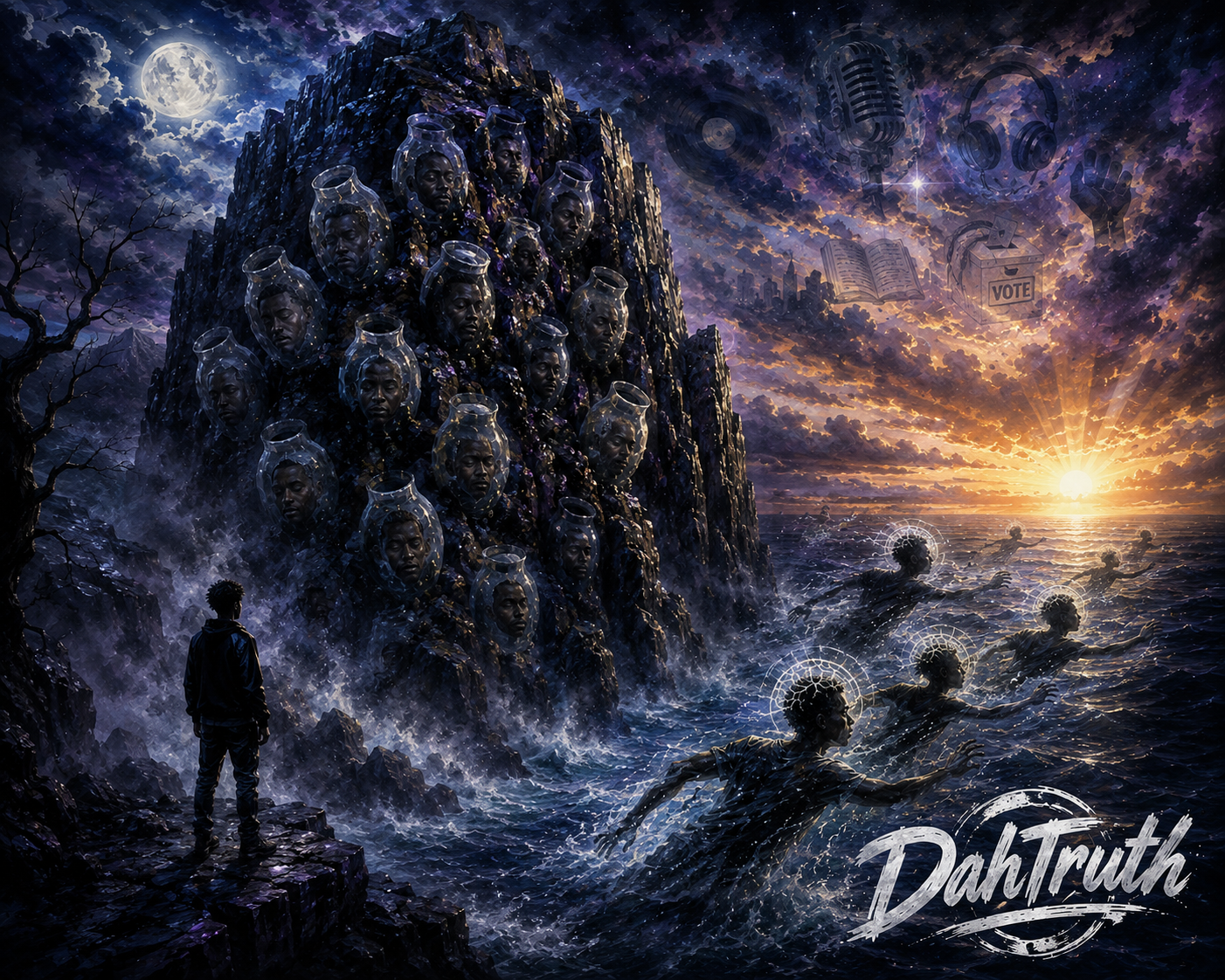
We were the generation of the sea squirt, otherwise known as the tunicate. In its youth the tunicate swims freely through the ocean. It carries a primitive brain and nervous system that let it move and think. Once it finds a place to settle, it attaches itself to a rock for good and digests its own brain, because it no longer needs to think. It no longer intends to move.
Over the last several years, Jay-Z has become one of the main tunicates.
The Performance
This week the media was in hysteria as Jay took the stage in Philadelphia at the Roots concert with a performance mixed of freestyle, spoken word, and his own Public Service Announcement. He cut off the wicks and replaced them with an afro. It was a flashback to the Revolution, a reminder of a time when Black men challenged the system instead of becoming it.
Jay-Z has long been one of the men from our community criticized because he made it out and never really looked back. Not even to save his own clique. He got rich, then he got with Beyonce, and they lifted off and sailed straight to the moon. So when he comes home, those left behind feel cheated. Gilted. Robbed of the chance to have done the same thing.
I do not think Jay-Z set out to harm anyone. That is the heart of it. He may not have known what he was cooking any more than the rest of us knew what we were eating. The egg had already been cracked by those who came before him. Jay-Z simply scrambled it, and got rich doing it, while many of the boys who followed the path his music laid out stayed trapped exactly where they started. He is not responsible for every choice made by every young man who bought one of his albums. At some point a boy becomes a man, and a man must answer for himself. There is no denying, though, that generations of Black boys grew up believing they could climb out of the ghetto on the back of rap and crack, and for every one who became a millionaire, thousands chased the image into cells, into graveyards, and into courtrooms.
The Alarm
Still, there is hope. Hope arrived in the form of a man many of us were instructed to throw away.
Kanye West.
When Kanye began sounding the alarm about the music industry, the media did not engage his argument. They engaged his character. We were told he was crazy. We were told he had lost his mind. We were told to discard him. Yet Kanye forced many of us to stop and think about what has happened to our artists, and what is still happening to our children. From Billie Holiday to Michael Jackson, from Prince to Whitney Houston, to DMX, there is a pattern that is hard to unsee. The industry profits from Black talent, feeds on Black pain, and waits patiently while the artist destroys himself. Then it stands beneath the falling body and catches every penny that drops from his pockets. The same industry that used Black men to entertain America used those same men to trap Black boys.
Kanye saw the machine clearly and turned around to warn us. This week I watched another man see just as clearly and make the opposite choice.
A fourteen-year-old boy named Cyrus Carmack-Belton was chased down and shot in the back in South Carolina. I will return to what happened in that courtroom, because it belongs to a larger story. One piece of it belongs here, though, beside Kanye, because it is about sight. The lawyer who delivered the closing argument that helped set the shooter free was Shaun Kent, the only Black attorney on the defense team. He was not a boy raised on a soundtrack he never questioned. He was a grown man who looked at a child shot in the back and chose the payday. For Kent it was not about the life of a Black boy who could have been his own son. It was about the check. That is my opinion, and I will own it.
Kanye saw, and warned. Kent saw, and sold. That is the difference between a man the culture shaped without his knowing and a man who knew exactly what he was doing. Most of us were the first kind. We were moved by a current we could not see. Kent stood in clear water and chose the rock.
What Happens When We Do Not Stay in Our Place
I said I would come back to that courtroom. Here is what the jury was shown.
Rick Chow and his son chased Cyrus more than a hundred yards from their store and shot him once in the back, over an accusation that he had stolen four bottles of water. Authorities said the surveillance video did not support the theft. A pistol was found near the body, and the defense built its case on it, yet four separate witnesses from four separate vantage points testified they never saw the boy point a weapon as he ran. The coroner confirmed the bullet entered his lower back, consistent with a child running away. Chow was found not guilty. The question that should have led the conversation, why a grown man hunted a child and fired into his back over a bottle of water, was treated as an afterthought.
At the same time, Karmelo Anthony, a Black teenager who alleges he acted in self-defense, was dragged through the media before the jury had heard all the evidence. By his account, the other boy approached him under a tent, threw his book bag, and pushed him, and he defended himself against what he believed was an attack. A White boy died. The first question the public asked was not why the confrontation began. It was why a Black boy had a knife. As his trial opened in Texas, the prosecution struck every qualified Black juror from the panel. The defense objected. The judge allowed it. Not a single Black juror was seated. We are told it had nothing to do with race.
Then there was the Black woman in North Carolina struck again and again in the face by a White police officer while another officer had to step in and tell him to stop. The footage spread across the internet within hours, reinforcing a feeling we have carried for generations.
Taken one at a time, each story has its own facts and its own circumstances.
Taken together, they tell one story.
There are still people in this country who believe American Blacks can be chased, beaten, shot in the back, and put on trial without the same concern extended to everyone else. Stay quiet and submit, and all is well. Defend yourself, speak for yourself, or refuse the narrative handed to you, and suddenly you are the problem. Whether every reading of these cases is correct is almost beside the point. The pattern is real, the perception is real, and over time perception becomes culture.
Lyrics Until They Are Held
Here is the contradiction I cannot stop turning over. We armed our own children with a soundtrack, and that is on us. The wider country, though, treats weapons as decoration until the hand that holds one is Black. The Glock, the semiautomatic, the blade, are everywhere. They are an aesthetic, a brand, a bar in a verse, a virtue in half the country where a man can carry one openly and be called responsible. Nobody sounds an alarm. The weapon is ambiance until the hand that holds it is Black.
A knife is nothing until a Black boy uses one to survive an attack, and then it becomes the whole story. A pistol is nothing until it is found in the street beside the body of a Black child, and then it becomes the reason a grown man and his son are forgiven for chasing him down. The object was inert. It became a capital offense the moment it was his, and the moment it gave someone a reason after the fact.
Cyrus had a gun. Karmelo had a knife. I will not hide either one to make my point easier, because hiding it would be the same dishonesty the culture practiced on us. We owe our children an accounting for the soundtrack we handed them. We are also owed an accounting from a country that drowns in weapons and only discovers its fear when the trigger finger is Black.
A Bridge Too Far
I sit here having just washed my little BMW, and I will not knock the hustle. I am part of what I am indicting. That is precisely why I can say it.
I will be honest about something else. When I heard what happened to that store in South Carolina, a part of me did not grieve for it. I do not condone violence. I do not believe the answer is to tear down stores, and I will not pretend otherwise. The idea that a man can shoot a Black child in the back and then open his doors the next morning as if nothing happened, ring up his sales, count his money, and carry on as usual, was a bridge too far. Something in me refused to call that normal. The honest name for what I felt was not a wish for destruction. It was a refusal to let him have his ordinary day.
That refusal has a disciplined form, and it is the one I am choosing. It is called a boycott. After the Chow verdict, the NAACP and others called on our community to do exactly that. Normally I am not down with boycotting. This time is different, and the difference matters.
This is not the Target boycott. This is not a campaign about corporate respect or buying power or proving what our dollars are worth. Those are arguments about commerce. They say value us as customers or lose our money, and there is nothing wrong with that argument. This is not that argument. A child is dead. No redirected dollar brings Cyrus back. No withheld purchase reverses a verdict. The boycott is not about commerce. It is about life. We are not asking to be respected as consumers. We are refusing to subsidize the ordinary day of a man who took a boy's life and expected to keep it. The dollar is only the instrument. Life is the stake.
A Wider Circle
What is even more striking is that this attitude is no longer confined to one group. Some ethnic immigrant communities who arrived in America long after our ancestors fought their battles have adopted the same dismissiveness toward American Blacks. They walk through doors our struggle pried open, freedoms secured by the Fourteenth Amendment and paid for in blood they never shed, and then they ridicule the very people whose sacrifice made their welcome possible.
Shortly after the call to boycott, another Asian man went online and started drilling the Black community for daring to organize. He mocked us. He asked who would sell us liquor. Who would sell us groceries. Who would do our nails. Who would sell us our Jordans. As he disparaged us, he never realized that it is our community keeping his community in business. He was a dog barking at the table that feeds him, snapping at the very nickels and dimes that butter his bread.
The Power We Forgot We Had
When we look back over time, it has been our community that has buttered the bread of nearly every industry in this country. We drive the money in entertainment. We drive the money in fashion. We drive the money in music. We drive the money on the streets and in the arenas. We sell the books. We fill the theaters. We set the trends. We turn podcasts into platforms and platforms into fortunes. We have the power to move whole markets.
Yet we remain the ones ridiculed, scorned, shot in the back, and placed on trial for defending ourselves.
Perhaps the greatest deception ever sold to American Blacks was not that we lacked value. It was convincing us that everyone else understood our value while we stayed blind to it ourselves. That is the same blindness the music worked on us. We could not see the current while we were swimming in it.
The Awakening
That is why I keep returning to the sea squirt.
Here is the part of its story we tend to forget. The tunicate does not lose its brain because something attacks it. It loses its brain because it stops moving. Once it settles onto the rock and decides it no longer needs to go anywhere, the body absorbs the very organ that made it free. Stillness is what kills the mind. Comfort is the rock.
Perhaps the Hip Hop Generation did exactly that. We settled. We grew comfortable being consumers instead of builders, comfortable being marketed to instead of owning the market, comfortable being influenced instead of being the influence. We stopped swimming, and a people that stops swimming begins to eat itself alive.
The good news, the thing that gives me a quiet hope I did not expect to feel this week, is that I see us moving again. Regardless of politics. Regardless of who voted for whom. We placed it aside and moved together over a boy named Cyrus. That is our community refusing to call the unthinkable normal. I see us choosing the discipline of unity over the despair of going numb. That motion is the whole answer. A community in motion together does not digest its own mind, because it never settles long enough to. Unity is not only how we honor Cyrus. It is how we keep from being eaten alive.
The awakening is not about anger.
It is about recognition.
Recognition of our value.
Recognition of our influence.
Recognition of our history.
Recognition that a people who stay in motion together can never be consumed from within.
The tunicate survives by giving up its brain and clinging to the rock. A people survive by reclaiming theirs and refusing to let go of one another. The only question left is whether we will stay fastened to the rock and be eaten alive, or finally start swimming again, together.
