"The right of citizens of the United States to vote shall not be denied or abridged by the United States or by any State on account of race, color, or previous condition of servitude." — Fifteenth Amendment, United States Constitution (1870)
Democracy Behind the Table
As an American Black woman, politics has always interested me. Working at the polls this week was not my first time inside the election process, but it was the first time I sat behind the table instead of standing in front of it.
Over the years I have made phone calls for candidates, walked neighborhoods recruiting voters, handed out flyers on election day, and pressed family, friends, and complete strangers to use their right to vote. When I was a Democrat I walked for Barack Obama and Hillary Clinton. I knocked on doors across South Jersey for local candidates whose names never made the evening news. These days I am a Republican, and this week I was the only one assigned to my polling location. There should have been a second Republican worker, but the seat sat empty all day. I mention this not to make a point about party, but because of what it taught me by the end of the day. The woman who once walked for Obama and the woman who now registers Republican were watching the same neighbors file through the same door, and not one of those neighbors could have told you which was which.
Let me say, it was a very interesting experience.
This was a primary election, so the turnout was not overwhelming. There were no long lines stretching out the door and no confusion about districts or polling locations. For the most part, everything ran smoothly. Ironically, the most complicated part of the day was not the voting machines but the manual counting of voters. The machines counted the ballots without issue. The people counting the people occasionally had a harder time.
What struck me throughout the day had very little to do with party affiliation.
What struck me were the people.
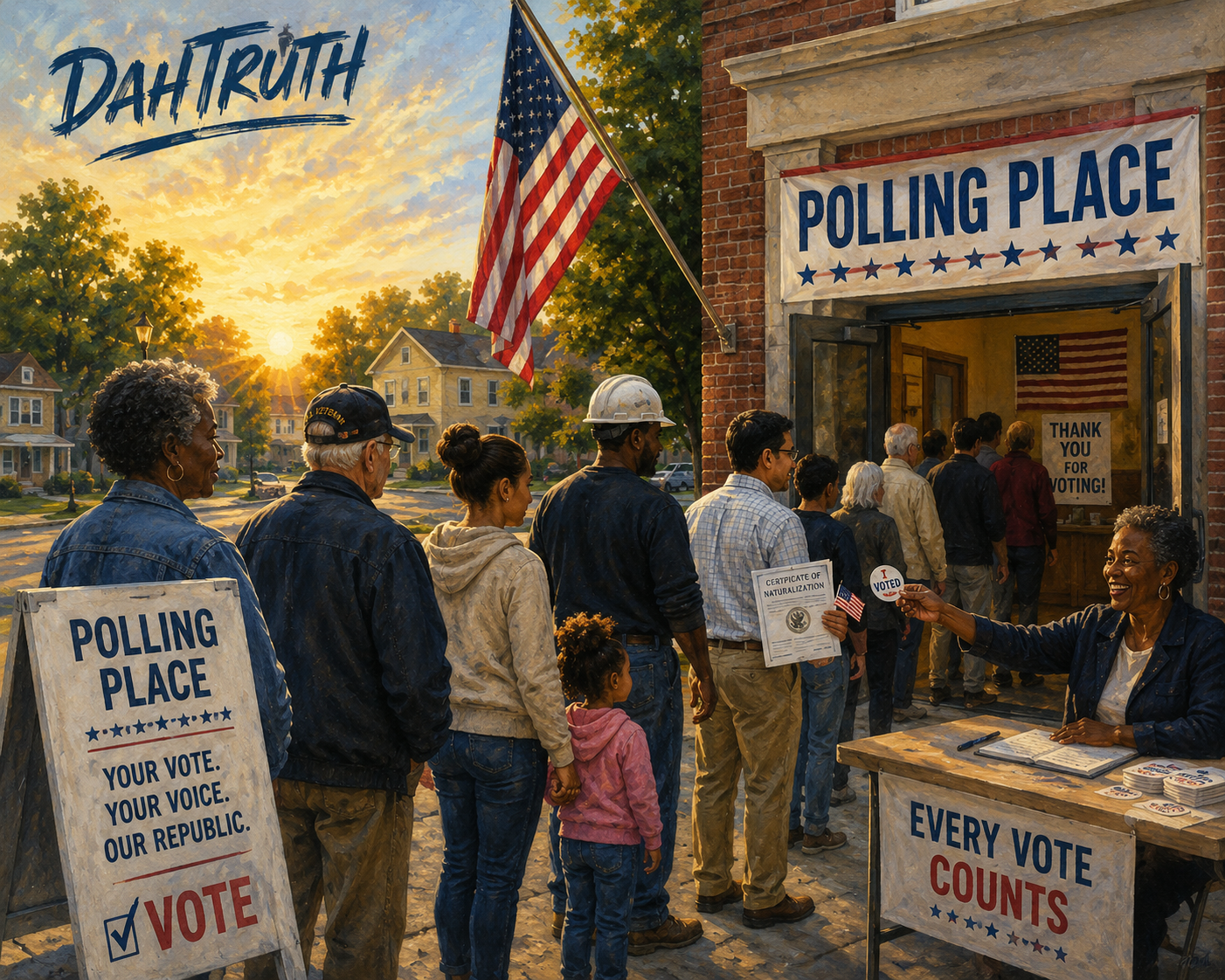
From six o'clock in the morning until eight o'clock at night, they came through the doors one by one. Some arrived on their way to work. Others stopped in after work. Mothers brought children. Husbands came with wives. Retirees arrived with the patience that comes from having seen a few decades of elections come and go. As I checked names, helped voters who needed assistance, and handed out I Voted stickers, it slowly dawned on me that the people who make up my community are, for the most part, simply regular people trying to live regular lives.
There is something grounding about watching democracy at work from behind the table. Politics often feels loud when viewed through television screens, social media feeds, and campaign advertisements. Yet inside the polling place there was very little drama. There were only neighbors carrying out a civic responsibility that many of us take for granted.
I also learned something about my community. The majority of the voters who came through the doors were Black and White. There were very few Hispanics, Asians, or members of other groups. Part of me wondered whether our community was diverse enough. Another part wondered whether I was asking the wrong question entirely. Perhaps what I was looking at was simply a neighborhood, people who share the same streets, schools, churches, and businesses, and who carry the same worries home at night, whatever party they claim.
One of my favorite moments came when an Indian gentleman arrived to register. He had not come to vote in this election. He had come to fill out his application, the one that would go into our binder and travel to the county office to be processed, so that his name would be ready the next time the doors opened. He told me he had recently become an American citizen and that registering to vote was one of the first things he wanted to do with that citizenship. We spent several minutes talking about the test and the hundred questions he had studied. He laughed about memorizing all of it, from the number of senators to the year the Constitution was signed.
I could not help but appreciate the seriousness with which he approached citizenship. Here was a man who had worked to become an American and who viewed voting not as a burden but as a privilege. In that moment I was reminded that democracy survives because people keep believing it is worth participating in.
The day also left me with a deeper appreciation for poll workers themselves. Many of the people working alongside me were elderly, retired, or between jobs. The training is extensive, the responsibilities are significant, and the day is long. We arrived before dawn and left long after most people had finished dinner. While I understand the argument that poll work is a form of community service, I also believe our election process deserves greater investment.
If our elected officials can earn six-figure salaries, then surely the citizens responsible for helping administer elections deserve compensation that reflects the importance of the work. Poll workers should be paid more. The hours are long, the training is intensive, and the responsibility is enormous. We place our faith in the election process, yet the people who help run that process are often compensated with little more than a token of appreciation.
More than anything, the day reminded me that democracy belongs to ordinary people. Not the politicians. Not the commentators. Not the consultants. It belongs to the mother carrying her child into the polling place, the retiree who has voted in every election for forty years, the new citizen filling out his first registration, and the workers who give fourteen hours to keep the process honest.
For all our disagreements and all our campaigns, the Republic still rests in the hands of regular men and women who take the time to show up. Sitting behind the table let me see that more clearly than I ever had before. Democracy is not sustained by speeches or campaign commercials or social media posts. It is sustained by ordinary citizens who keep participating, election after election, generation after generation.
For one long day in June, I had the privilege of watching them do exactly that.
