The Anthem Was Already Ours
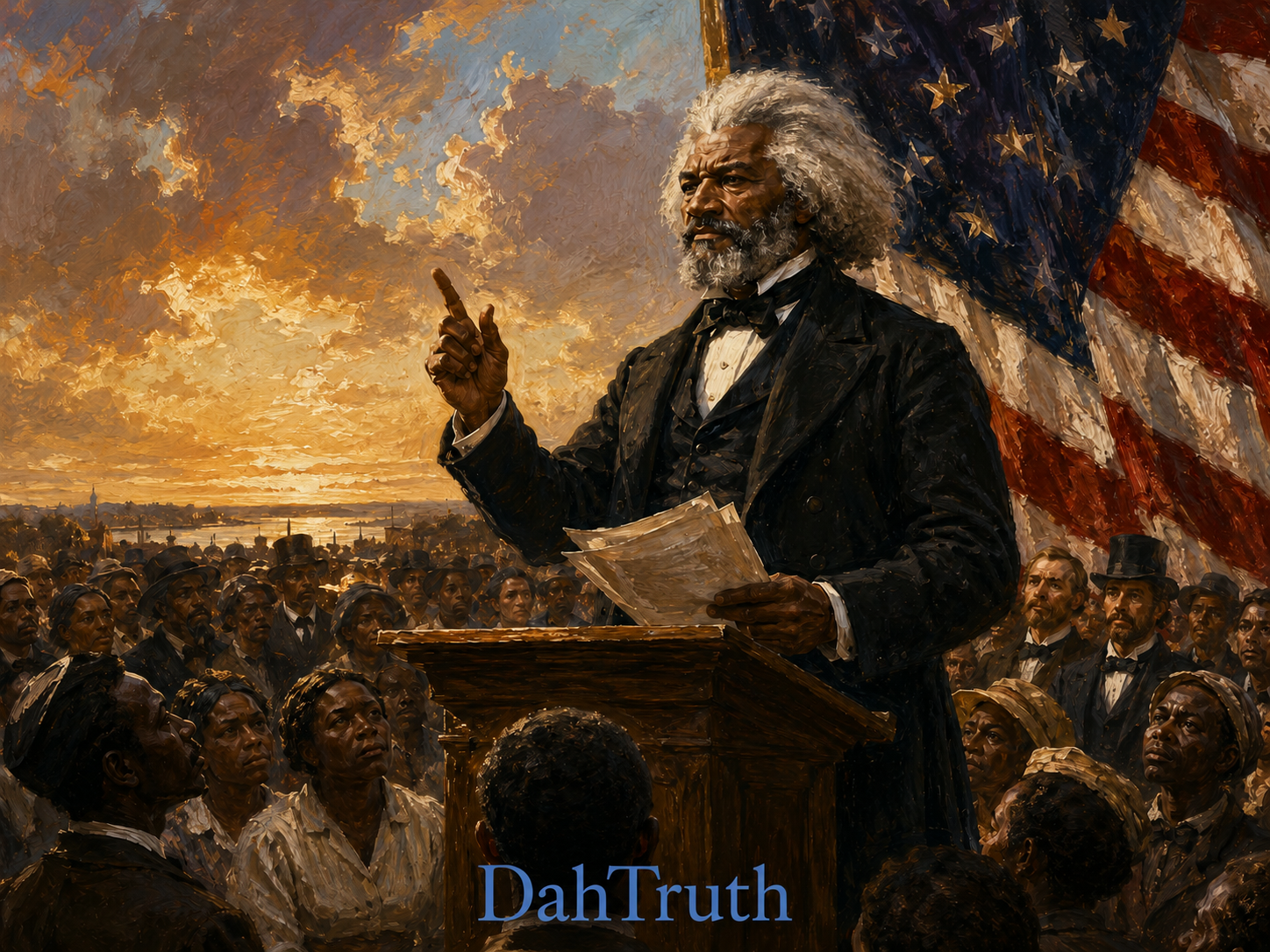
“I do not despair of this country.” — Frederick Douglass, July 5, 1852
What the Fourth of July Means to a People Who Were Here Before the Statue
On January 27, 1991, ten days into the Gulf War, a woman from Newark, New Jersey stood in the center of Tampa Stadium and sang the national anthem so completely that the country has never fully let go of it. Whitney Houston, backed by the Florida Orchestra, took a song written in awkward meter and turned it into the definitive American performance of the American song. The recording charted in the Top 20. When the towers fell ten years later, the nation reached for that same recording again, and the proceeds went to the police and firefighters of New York. Twice, in its two moments of deepest fear, America wanted the sound of a Black woman from Jersey telling it who it was.
I remember that January. I had graduated from high school five years earlier, and I was a single mother trying to find my footing and my place in a world that had not made room for me. There was talk of war in the Gulf, of Desert Storm, of young Americans shipping out to a desert most of us could not have found on a map. Then Whitney sang, and something in me settled that had never settled before. That performance was the first time I felt an allegiance to this nation as a fact about myself, the first time I understood that I was an American. Not tied to a place called Africa that I had never seen and that had never known my name, but tied to this place, this hard and beautiful country, this America even with all its flaws. My life was changing drastically in those years, and that song showed me exactly where in the world I was rooted.
I raise Whitney first because she settles a question before it is even asked. Whitney Houston did not sing the anthem from the window of an arriving plane. She sang it from inside. Her people did not see the Statue of Liberty and decide to begin anew. Her people were here before the statue was cast, before the harbor had a name in English, before there was an anthem to sing. When she reached the line about whether that banner yet waves, she sang a question as though it were an answer, because for American Black people the answer was purchased in a currency no immigrant has ever been asked to pay. That is the claim to this nation that no arrival story can match, and it is the claim that was quietly written out of a speech delivered this same week.
A Speech at Washington's Desk
On July 3, on the eve of the country's 250th birthday, Zohran Mamdani, the mayor of New York City, delivered a major address from City Hall. He sat behind a desk once used by George Washington. He was flanked by men and women who had recently become citizens. He spoke hours before the president gave his own address, and he framed the day as a contest over what America means. Some would argue that being fair to the speech means admitting he did not simply recite every grievance ever leveled against this country. It was, in its own register, a patriotic speech, delivered by a first generation immigrant, a foreigner who now proclaims America as home. Mamdani praised the founding ideals. He called the country exceptional. He described patriotism as an act of love expressed through dissent rather than through silence. Yet listen closely and the language he used could be spoken of any nation by any newcomer critiquing what does not belong to him but which he means to change and to commandeer. Mamdani wants the guarded reader to lower the guard and admire the picture without noticing that it is a carbon copy.
He shaped his own story as the American dream. He came to this country from Uganda at the age of seven. He recalled seeing the Statue of Liberty from the window of the plane that carried his family here, and seeing in it the promise of America. He is himself a naturalized citizen, and he said the topic lives close to him. Then he turned to the others standing beside him, the newly naturalized, and told them they now hold a special power, the power to determine what America means. That is the sentence I want to sit with, because it is too generous, and for my people and other legacy Americans it is, without question, false.
He reached for a tool that Frederick Douglass once wielded, the Fourth of July oration that turns and points its finger at America. But the difference is the whole matter. Douglass pointed that finger on behalf of slaves born on this soil, the jus soli people of this American land, who had no rights though they had bled for this nation, who had lived and died right here on this ground. Mamdani takes up the same tool to speak for people who share none of that history, whose only claim to America was learning the answers to a hundred questions on a citizenship test. Douglass demanded that America keep a promise it had already made to its own. Mamdani hands the newly arrived the authority to decide what America should become. Those are not the same act, and no borrowed cadence can make them the same.
An Old Creed in Borrowed Clothes
Here is where the picture and the policy part ways. A man may love a country and still misunderstand what made it, and a man may praise the founding while building on a foundation the founders never laid. The words of Mamdani's speech reach back to 1776. The governing beneath the words reaches somewhere else entirely. To see it, you have to stop listening to the melody and read the sheet music.
Mamdani speaks the language of the founding, the Declaration, the pursuit of happiness, the ideals enshrined in 1776, but he pours a different content into those words. He is a democratic socialist, and he governs as one. His signature promises, the rent freeze, the price controls, the machinery of a city that decides how much a person is permitted to keep, all rest on a premise the founders would not have recognized as freedom. The premise is that your wealth is a public matter, that what you build belongs first to the collective and only second to you, and that a just society is one that reaches into the marketplace to level the outcome. That is not the American creed. That is a rival creed wearing the American one as a costume.
Life, liberty, and the pursuit of happiness are not decorative phrases. They describe a specific idea of the human person as free to labor, to acquire, to rise, and to keep what that rising earns. I am not claiming the founders built a nation of pure self-interest with no common structures. They built roads and schools and a public square, and every generation since has added to that common inheritance. The question is not whether America has guardrails. The question is which comes first. The founding put the striving person first and made the shared structures the assist, the brace that helps a free man stand and climb. Socialism inverts that order. It makes the collective the engine and the person the residual, the one who receives whatever is left after society has leveled the outcome. That inversion is the whole quarrel. A nation built on self-perseverance, aided by some social supports, is not the same nation as one built on social control, tolerating some private effort. Mamdani is selling the second and calling it the first.
The pursuit of happiness assumes that the fruit of the pursuit is yours. All of it, and not the government's to ration when it decides one person has made too much or holds too much or keeps too much. Take away the freedom to obtain unequal things and you have not perfected liberty, you have canceled it, because you have made the government the arbiter of how far any one person may climb. A creed that caps the climb in the name of fairness runs directly against the grain of the document Mamdani stood on. He can quote the Declaration all he likes. The policy he builds beneath the quotation would have been foreign and alarming to the men who wrote it, and it should be to us.
There is a deeper sleight of hand in the speech, and it lives in the way it sorts Americans. Mamdani divides the nation into two camps, the welcomed many and the guilty powerful, the oligarchs and the ones they oppress. It is a tidy division and it is a false one, because it quietly codes the people who built this country, the founding stock, white and Black alike, as the weight the nation must be freed from rather than the foundation it was raised on. A politics that makes your standing conditional on which side of that ledger you land is not a politics of belonging. It is a politics of suspicion. It asks you to earn your place in America by joining a grievance, and that is a stranger's idea of this country, not an heir's.
Who Gets to Define the Fourth
There is a reason this stings on the Fourth of July in particular. Frederick Douglass asked the question a century and a half ago and it has never been answered, only postponed. What, to the American slave, is your Fourth of July. The holiday celebrates a freedom that my people were promised in the abstract and denied in the flesh for almost another century, and then denied again in practice for another century after that. When I celebrate this day, I do not celebrate an arrival. I celebrate a bill that was finally, partially, paid to a people who had already earned it many times over. That is a different Fourth than the one Mamdani offered, and it cannot be dissolved into an immigrant's gratitude without erasing exactly what makes it ours.
Look again at the picture he made. A man sits at George Washington's desk and surrounds himself with the newly naturalized, and he builds his whole America out of arrival, the pogrom, the famine, the crossing, the harbor. He even reaches for our history when he needs it, naming Weeksville and the Great Migration to give his speech the ring of the authentic American struggle. Yet the peoples with the oldest and deepest claim to that desk, the descendants of the founders and the descendants of the slaves who built the house the desk sits in, are not the face he chose to stand beside. He borrows our story and excludes our standing. He needs Weeksville to sound American, but the children of Weeksville are not who he seats at the center. That is the hypocrisy of the whole performance. It mines the American Black story for its moral weight while treating the American Black present as one more color to be folded into someone else's coalition.
I hold no hatred toward the immigrant. The family fleeing the pogrom, the family fleeing hunger, these are real sufferings and this country was right to become a home to them, lawfully and in the light. What I find telling is that Mamdani does not even represent the fleeing and the persecuted he invokes, for by his own account he did not wash up on a shore in desperation. He flew in. My quarrel is not with those who come here legally, nor with those who seek genuine refuge or asylum. My quarrel is with a movement that uses the moral weight of the Black American story to sell a creed that answers to no part of the American tradition and to no part of the American Black community. They borrow the cadence of the civil rights movement to advance a politics our grandmothers never marched for. The Black vote is courted every season and the Black community is governed for last.
There is one more absence worth naming. Mamdani built a litany of the persecuted, the Puritan and the Quaker, the Sikh and the Muslim and the Jew, all banished, he said, for praying the wrong way. It is a generous list, and it flattens something it should not. For the American Black people he borrows from, Christianity was never one more minority faith standing in line to be tolerated. It was the measuring rod we held against the nation itself. When Frederick Douglass indicted this country on that Fourth of July in 1852, he did not do it in spite of the Bible. He did it in the name of the Bible, charging that slavery had branded the nation's Christianity a lie and daring to denounce the sin in the name of the constitution and the Scripture both. He measured America against a Christian standard and found it wanting. A century later Martin Luther King did the same from a Baptist pulpit. The Black church was the engine room of every freedom we ever pried loose from this country. To fold that faith into a list of persecuted minorities is to miss that it was, for us, the very language in which we demanded America keep its word.
What the Anthem Answers
This is where I return to Whitney, because she answers the whole argument without saying a word of it. A people who were told they were anything but exceptional produced the most exceptional rendering of the nation's own anthem, and the nation knew it, and reached for it in war and reached for it again in mourning. That is not the posture of a guest. That is the posture of an owner. We do not need a newcomer, however sincere, to grant us the power to determine what America means. We have been determining what America means since before there was an anthem to sing, in the fields and the churches and the movements and the music, and the country has borrowed our definition every time it needed to remember its own better self.
That is also why it makes me cringe to hear people speak of September 11 as something this country had coming, as though the murder of thousands were a debt collected. They are talking about my nation when they say it. The same recording that first tied me to this country in a time of war was reissued after those towers came down, and its proceeds went to the widows of New York's firefighters and police. I loved this nation before that day and I loved it after, not because I believe it is innocent, but because loving a thing has never required pretending it is perfect. My people have loved this country through worse than it has ever shown a newcomer, and we have never once mistaken that love for approval. We hold it to account precisely because it is ours.
So let this be the indictment and the reclaiming both. The indictment is plain. Do not drape a creed that is foreign to this country in the language of its founding, and do not use our struggle as the moral currency for it. We did not bleed for a rent board. We bled for the plain words of the Declaration to be made true for us, the freedom to labor and to rise and to keep what the rising earns, the very freedom a leveling ideology would take back in the name of fairness. Do not borrow our story and exclude our standing. The reclaiming is simpler still. The Fourth of July belongs to us in a way it can belong to no one who came after, because we are the measure of whether its promise was ever true. Every generation of American Black people has held this nation to the words it wrote and refused to honor, and in doing so we have been the most patriotic people this country has ever produced, not because we pretended it had no flaws, but because we loved it enough to demand that it become what it swore it already was.
Whitney sang the question and answered it in the same breath. The banner yet waves. It waves in no small part because a people who were owned by this country decided to love it into keeping its word. That is our Fourth. No one at Washington's desk gets to give it to us, and no one gets to take it away, least of all Mamdani and his band of first generation immigrant socialists.
