The Right to Have Rights
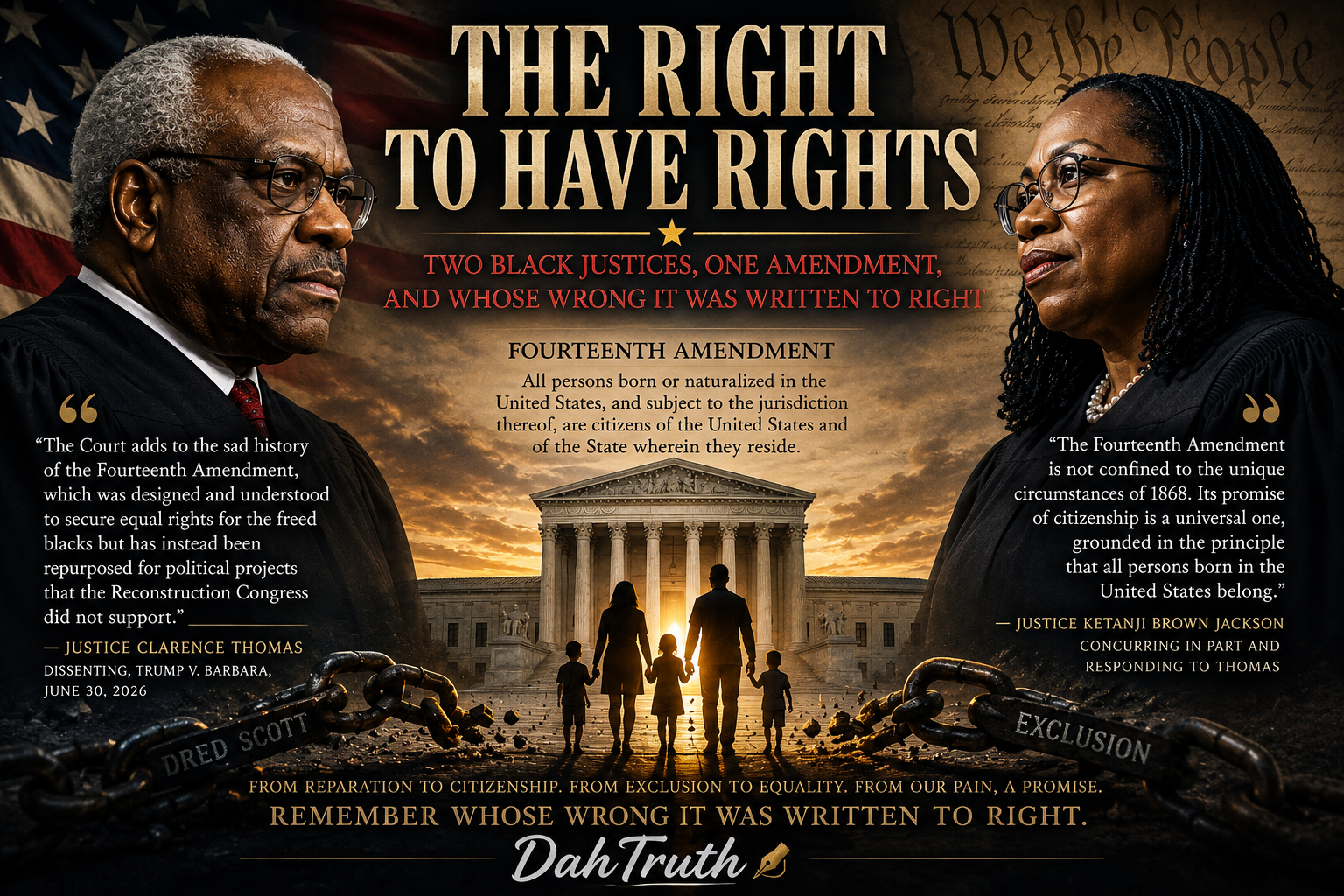
“The Court adds to the sad history of the Fourteenth Amendment, which was designed and understood to secure equal rights for the freed blacks but has instead been repurposed for political projects that the Reconstruction Congress did not support.” Justice Clarence Thomas, dissenting, Trump v. Barbara, June 30, 2026
Two Black Justices, One Amendment, and Whose Wrong It Was Written to Right
On the Fourth of July, while the rest of us were thinking about cookouts and beach trips and the fireworks after dark, something else was hanging in the air. A decision had come down that seemed to deny our own history, and it drifted over the holiday like a scent you cannot place, faint at first and then everywhere, until it thickened into pure perplexity. Many of us were stunned by it. And as the Fourth approached and the flags went up on the porches, we found ourselves turning over the oldest question this country has ever forced on us. What does it actually mean to be an American? Two days before the fireworks, on June 30, the Supreme Court handed down Trump v. Barbara and struck down the president's order ending birthright citizenship. On July 3, a naturalized mayor stood at Washington's desk and told a room of new citizens they now hold the power to decide what America means. The holiday sat between the two like a hinge, and buried in that Court decision was a quarrel between the two Black justices on the bench, a quarrel that cuts closer to my people than anything said from any podium that weekend.
Let me state the ruling plainly, because it matters. The Court held, six to three, that the Fourteenth Amendment guarantees citizenship to nearly every child born on American soil, including the children of parents here unlawfully or only temporarily. Chief Justice Roberts wrote the majority. He rooted it in the old common law rule of jus soli, the right of the soil, and in the Amendment's repudiation of Dred Scott, the 1857 decision that had ruled people of African descent could hold no rights a white man was bound to respect. Roberts described citizenship as the right to have rights, the legal standing that lets a person take full part in the political community. On the constitutional question the Court split five to four, with Justice Kavanaugh agreeing only that the order broke a federal statute rather than the Constitution. Justice Thomas dissented, joined by Justice Gorsuch, in an opinion that ran ninety-one pages. Justice Alito and Justice Gorsuch each filed dissents of their own.
The Amendment Was Ours First
Here is the thing the celebration will not say out loud. The Fourteenth Amendment was written for us. Not for everyone, first. For us. It was drafted by Reconstruction Republicans in 1868 for one overriding purpose, to make citizens of the freed slaves and their children and to bury Dred Scott so deep it could never rise again. The men who wrote it were answering a specific crime against a specific people, the people who had been born on this soil, held in bondage on this soil, and then told by the highest court in the land that the soil owed them nothing. The Amendment was the nation's confession and its restitution. It said, in effect, that the people this country had most brutally excluded were, and always had been, its own.
That is why Justice Thomas's dissent lands with me, whatever the wider politics of it. Thomas argued that the Citizenship Clause was built to secure the rights of the freed slaves, and that the majority had taken an amendment written to right one historic wrong and stretched it into a rule its authors never contemplated, a rule now serving political projects the Reconstruction Congress would not have recognized. He is right about the origin. The men of 1868 were not thinking about the global movement of peoples, about visitors and border crossings and the children of those who owe their allegiance elsewhere. They were thinking about Dred Scott. They were thinking about the auction block. They were thinking about us.
The Colorblind Contradiction
Now here is where it turns, and where the irony is almost too neat to believe. Justice Jackson, the first Black woman on the Court, wrote separately to answer Thomas, and she went straight for his own record. For years, she noted, Thomas has been the Court's great champion of a colorblind Constitution, the man who insists the government must never see race. Yet here he was, she wrote, suggesting the Citizenship Clause was a race-conscious remedial measure relating only to freed slaves such as Dred Scott and those who shared their characteristics. She called that a narrow vision that bears little relationship to the history of the Amendment's ratification. It was a clean shot. Thomas spent a career saying the Constitution is blind to color, and in this case he read a color into its most important clause.
I will grant Jackson the cleverness of the catch. It is a real tension in Thomas's thought, and she exposed it. But cleverness is not the same as being right, and on the thing that matters she is the one who misses. Because there is no contradiction in saying that an amendment can be born from the specific suffering of a specific people and still be written in principled language. The men of 1868 wrote for the freed slaves, and they wrote a clause that named the freed slaves nowhere, because they were legislators building a rule that would hold. To see the target of a law in its history is not to smuggle race into the Constitution. It is to read the Constitution honestly. Thomas is not betraying colorblindness by knowing whose wrong the Amendment was written to right. He is simply refusing to pretend he does not know.
The Insult in the Universal
What I cannot let pass is the deeper move in Jackson's reasoning, the one that should trouble every American descendant of slavery no matter how the case came out. To make the Amendment universal, she has to loosen its grip on us. She writes that the Reconstruction Amendments were an anticaste, antisubordination reset for the Nation, not, in her words, a mere spot treatment for the dark stain of slavery. Read that again. The redress owed to my people, the specific answer to two hundred years of bondage and to the Court that said we could be owned, is the spot treatment she wants to rise above. She reaches past it toward a reset for the whole Nation, and in the reaching the freed slave stops being the reason for the Amendment and becomes merely the occasion of it. That is the polite erasure I keep meeting this week. It takes the thing that was built out of our specific agony and dissolves it into a principle for all comers, and it calls the dissolving progress.
She goes further, and this is the passage that should stop every one of us cold. She situates the whole Citizenship Clause in what she calls a Nation of immigrants, and she describes the freed Blacks as a people who came to freedom, in her phrasing, with little in the way of possessions or opportunity. I want to say this carefully and plainly. The slave did not come to freedom with little. The slave came to freedom having been the possession, the thing itself, the capital counted as three-fifths of a person for the enrichment of the man who owned him. To describe that condition in the vocabulary of a poor arrival, a matter of scarce belongings and thin opportunity, is to misunderstand it at the root. No immigrant, however brutal his passage, was ever bred as property, sold from his mother, or beaten into submission to the will of another man who held legal title to his body. We were not newcomers who started at the bottom. We were the foundation the ladder was bolted to. To fold us into a Nation of immigrants is not to honor us. It is to lose the one thing that makes our claim to this country unlike any other.
Justice Jackson anticipates this objection and tries to close it off. Thomas's reading, she writes, pitches Black Americans against immigrants when the advocates who promoted the Fourteenth Amendment did no such thing. She adds that the freed Blacks did not seek a unique set of rules catering only to their situation. I reject the charge, and I do it with respect for the history she is invoking. To say that the freed slave was not an immigrant is not to turn against the immigrant. It is simply to refuse to disappear. That our forebears chose not to exclude others, that they reached for a language wide enough to hold everyone, is a mark of their greatness, not a permission slip to erase them. Choosing not to build a wall around your own suffering is not the same as consenting to have that suffering dissolved into everyone else's. I can hold the door open for the newcomer and still insist that the house was built on ground my people were buried in. Honoring the arrival does not require dissolving the descendant. The framers wrote in the language of all men because they had decided, at long and bloody last, that we were included in the word, not because they were quietly drafting an immigration policy for a century they could not see. To read their universal language as a reason to forget whose wrong it corrected is to get the whole thing exactly backward.
What the Founders Could Not See
None of this means Thomas's reading answers every question, and I will not pretend it does. The framers of 1868, like the founders before them, wrote for the world they knew. They could not see the shape of things now, the vast movement of peoples across borders, the arrival of millions who would seek in this country not land to build on but a system to draw from. When the earlier founders spoke of invasion, they were imagining armies, not maternity wards. The Reconstruction Congress was not sitting in judgment on birth tourism or unlawful entry. They had one wrong in front of them and they meant to right it. Whatever the Amendment has since been made to cover, its authors' eyes were fixed on the freedman, not on a future none of them could have charted.
So the honest conclusion is the one that respects both the origin and the limit. The Amendment was written for the freed slaves, and it was written in words that a later Court has read broadly. If the country now believes those words reach too far, the remedy is not to pretend the words were always narrow, and it is not for a president to erase them with a pen. The remedy the Constitution offers is Congress, and beyond Congress the amendment process, the same deliberate machinery that produced the Fourteenth Amendment in the first place. Justice Kavanaugh said as much, that the people's representatives could act where the Court would not. That is the lawful road. Anything else asks the judiciary to invent a history that did not happen.
Whose Fourth, Whose Amendment
This is why the timing struck me so hard. In one weekend the nation asked its question twice, from the bench and from the desk, and both times my people were spoken about rather than spoken to. The Court fought over an amendment born from our bondage, and the one Black justice who read it as ours was accused of betraying his own principles by the other. The mayor built a nation out of arrivals and folded our story in among them. In both rooms the American descendant of slavery was the material and never the authority, the reason invoked and the people overlooked. We are forever the case study and never the constituency.
I hold the same thing I held about the mayor, and I hold it about the Court. The Fourteenth Amendment is the closest thing this country ever wrote to an apology to my people, and I will not watch it be turned into a generic welcome mat while the people it was written for are told our specific history is a narrowness to be transcended. Read it broadly if the law requires, amend it if the country dares, but do not tell me it was never really about us. It was always about us. It was written in the language of all men precisely because the men who wrote it had finally decided that we were included in that word. That was the whole point. That was the right being restored, the right to have rights, and it was restored first to the people who had been denied it longest, on the soil that had been worked by their hands, in the only country any of us have ever called home.
