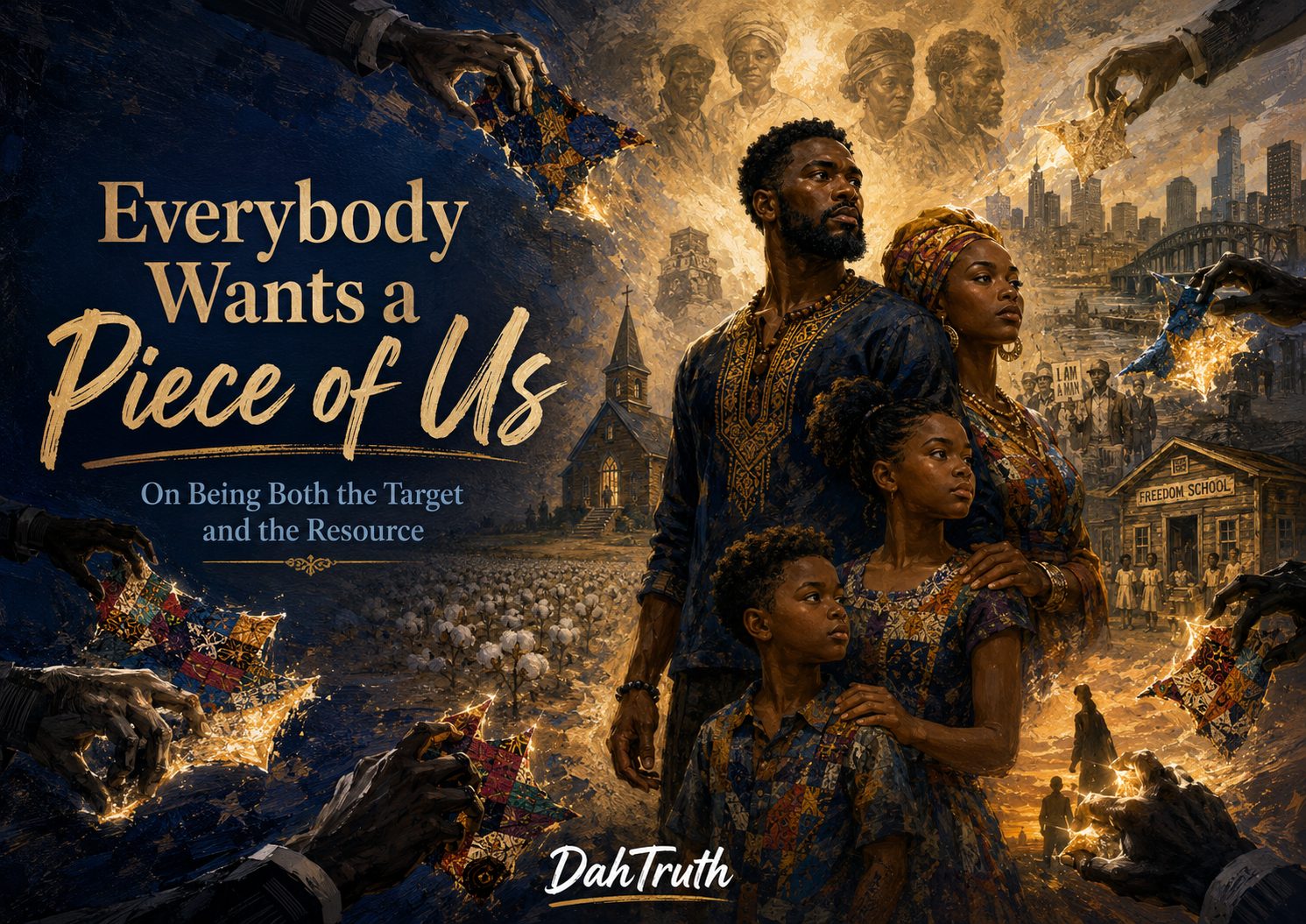
Everybody Wants a Piece of Us
“The snare is broken, and we are escaped.” — Psalm 124:7, KJV
On Being Both the Target and the Resource
There are times when it feels as though the American Black community stands in a position unlike any other in this nation. We are criticized from every direction, and yet everyone seems to want something from us. We are told we are broken, and then asked for our culture. We are told we are ignorant of our own history, and then asked to lend our moral authority to causes that are not ours. We are told we are insignificant, and then studied, imitated, and mined for profit. It is a strange kind of standing, to be the permanent defendant and the prize at the same time.
That is the contradiction I want to sit with. We are treated as a problem when someone wishes to criticize us, and as a resource when someone wants our culture, our votes, our money, our moral authority, or our history. Both at once, and from every direction.
Everyone Explains Us to Ourselves
June has been another example. The release of the man who shot a Black youth in the back, the incarceration of Karmelo Anthony, and the endless stream of social media narratives have once again created an atmosphere where truth is hard to separate from fiction. Information is amplified, distorted, and repackaged until no one is quite sure what is real anymore. And while those stories unfold, a familiar pattern emerges alongside them. Voices from outside the American Black experience step forward, eager to explain us to ourselves.
Consider the recent episode with the British actor David Oyelowo, who played Dr. Martin Luther King Jr. in the 2014 film Selma. Asked on the One54 Africa podcast, a show built around the fifty-four nations of the continent and the experience of growing up African in America, about a comedy skit on Black British actors taking African American roles, he dismissed the objection as a product of insecurity and a scarcity mindset, as though American Blacks who notice their own stories being handed to others were simply being small. Then, asked to perform a Southern accent, he described it as a Nigerian accent slowed down with, in his words, a lot of slavery and a little subservience folded into it. The backlash from Black Americans was swift, and he later apologized. But the moment is worth holding onto, because it captures the very thing I am describing. A man from outside our experience, in a single conversation, told us our concerns came from insecurity and then reduced the speech of the descendants of slavery to a sound shaped by submission.
And one has to ask where the animosity people keep assigning to us actually lives. Most American Blacks spend little time worrying about British actors, African artists, or Caribbean entertainers. We have concerns enough of our own. You will rarely see an American Black artist go on television to attack performers from the diaspora. The resentment that is spoken of seems to be projected onto us far more than it ever comes from us. It is named by those who carry it, and then assigned to us. We are asked to embrace everyone else while being told, at the very same time, that we are dysfunctional, disconnected, and lost. Our children are singled out. Our neighborhoods are singled out. Our struggles are treated as though they were our peculiar invention rather than the common inheritance of every people on earth.
The Engine Nobody Names
Here is what the criticism conveniently leaves out. Despite decades of being portrayed as broken, the American Black community drives American culture and commerce in ways few are willing to name plainly. We shape the music, the language, the fashion, the sports, and the spending habits of this nation. Even those who mock us consume what we create. The very people who call us poor, broke, and tired turn around and build their fortunes on what we set in motion.
Take something as simple as the movies. Consider Harriet, a film about an American Black woman, produced by American Blacks, telling a story drawn straight from our own history. It came and went without ever generating the cultural force of a movie like Black Panther. Why? Because Black Panther offered millions of American Blacks an image of strength, capability, and belonging, a vision of an African homeland that resonated with something deep in us. We bought the tickets. We brought our families. We turned a film into an event. Marvel understood what many have come to understand. When the American Black community embraces something, it moves markets.
The same pattern repeats across the industry. When the Black community backs a film, it becomes a success. When we stay home, it struggles. The flop of Disney’s recent Snow White, which our community did not turn out to support, told the same story from the other direction. This is not a small thing. It is a measure of cultural power, and others have noticed it. They have tapped into the reality of American Black talent and American Black spending, and some who come here from elsewhere try to thread that same needle, even when it means crowding into and disrupting the very community whose influence they hope to borrow. When the borrowing does not go as planned, the frustration turns to insult, and we are told once again that we are less than, that we do not know who we are.
The same logic governs the recurring conversation about reparations. When the call goes up in Brazil, in the Caribbean, or in other nations shaped by slavery, the finger almost always points toward America. The expectation is that the economy American Blacks helped build, the economy we still work to sustain, should now pay for grievances that belong to other histories on other shores. But our history is not interchangeable with theirs. American Blacks did not immigrate to this country. We were sold here. We were forced to come, forced to labor, and then, having survived, we built communities under bondage and under segregation. The descendants of American slavery hold a distinct claim rooted in a distinct history, and recognizing that does not diminish the suffering of anyone else. If reparations are ever owed in America, they are owed to the descendants of American slavery, not redistributed to every nation that wishes to point at our economy and collect.
The Symbol and the Substance
If the culture shows how we are mined, politics shows how we are displayed. For years, Democrats have mocked Donald Trump for putting his name on buildings. Yet in Chicago, Barack Obama has built a monument to his own legacy in the form of the Obama Presidential Center, and to question it is treated as something close to heresy. The center opened on Juneteenth, in a historically Black part of the South Side, and the people who built those neighborhoods are now watching them slip out of reach.
This is not speculation. In the area covered by the city’s housing pilot around the center, median rents have climbed roughly forty-three percent since the project was announced, and home values have spiked around one hundred and thirty percent. In East Woodlawn, home prices doubled in a few short years to a median near four hundred and forty thousand dollars. Longtime residents and seniors have stood up in public meetings, even as the center opened, to say plainly that they are being priced out of the homes where their families have lived for generations. The shrine rises, and the people around it are pushed to the edges. So the question must be asked. Who benefits from symbolism? It does not pay a rising property tax bill. It does not keep an elderly homeowner in the house she has owned for forty years. We celebrate the pictures, the personalities, and the history. But who celebrates the people?
This is where I want to be careful and fair, because the comparison people reach for, Obama against Trump, is too often reduced to applause for one and contempt for the other. Let me set it instead as a question about outcomes. Barack Obama gave our community symbolism, representation, and eloquent speeches, and those things have real worth. They told a generation of children that the highest office was not closed to them. But symbolism alone does not build wealth, strengthen a school, or make a neighborhood safe. The Affordable Care Act expanded coverage, yet middle-class Black families like my own have watched premiums and deductibles climb while those at the bottom still receive the least. After eight years, many of us were left asking what specifically had changed for the descendants of American slavery.
By contrast, Donald Trump, a man his critics never stopped calling a racist, signed the First Step Act, which reformed sentencing and brought people home. He signed the FUTURE Act, which made funding for historically Black colleges permanent and ended the yearly ritual of HBCU presidents traveling to Washington to beg for their survival. Black unemployment reached record lows before the pandemic. One can debate how much of this any president can claim, and neither set of policies was designed specifically for the descendants of American slavery. But the contrast raises a question worth sitting with. We often celebrate those who look like us while dismissing those who may have delivered more tangible benefit. Perhaps the question is not who makes us feel proud, but who leaves our communities measurably stronger.
Without Apology
Underneath all of this runs one deeper question. Every other group in this country is permitted to organize around its own interests. Corporations lobby for profit. Unions fight for workers. Immigrant groups advocate for immigrants. Religious bodies advocate for their values. Political parties assemble coalitions to hold power, and no one finds any of this strange. But when the descendants of American slavery ask whether our interests are protected, we are called divisive. When we ask where our tax dollars go, we are told to think globally. Every group is allowed to pursue its interests. Every group except, it seems, us.
And so we arrive at the contradiction in its plainest form. We are told we are insignificant, yet everyone wants our culture. We are told we are failures, yet everyone studies our history. We are told we are irrelevant, yet our music, our language, our struggles, and even our victories become global commodities. People do not spend this much energy on communities they consider unimportant. The endless attention is itself the proof of our worth.
The American Black community does not need to apologize for being American. We do not need permission to honor our ancestors or to celebrate what we have built. We do not need to carry the insecurities and the burdens of everyone else. Loyalty should never mean silence, and unity should never mean carrying everyone else’s priorities while being told our own must always come last.
Until the descendants of American slavery advocate for ourselves with clarity, with discipline, and without apology, our interests will continue to be negotiated by people whose first loyalty is not to us. Everybody wants a piece of us. It is time we decided what belongs to no one but ourselves.
