
My Critique of Ta-Nehisi Coates’ Vanity Fair Article, Why Kamala Harris Lost
At this instant a bright light shot through the mind of Dantès, and cleared up all that had been dark and obscure before." — Alexandre Dumas, The Count of Monte Cristo
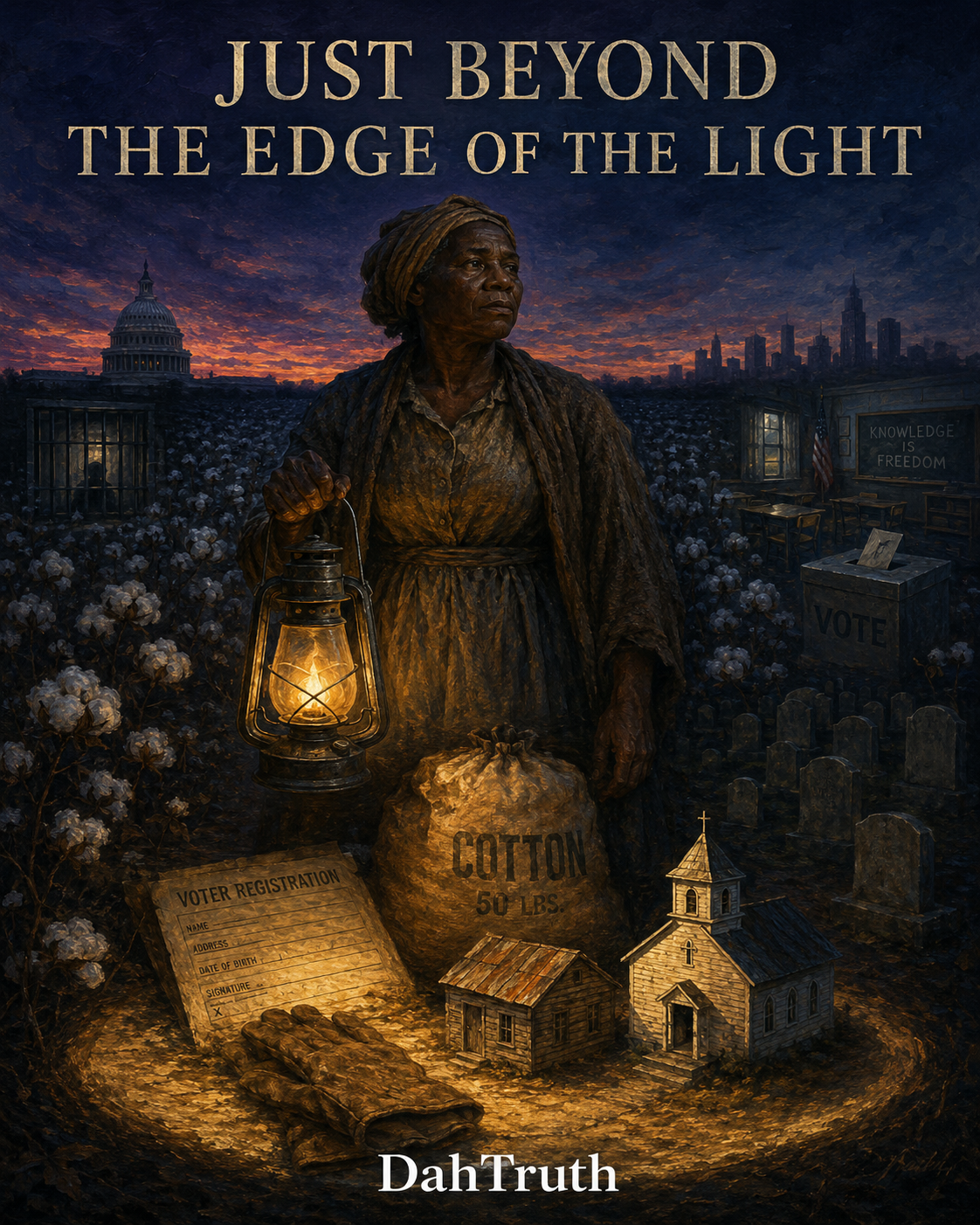
Just Beyond the Edge of the Light
This month, millions of eyes have turned toward America as the world gathered on our shores for the FIFA Club World Cup. As I listened to visitors from across the globe speak about their time in our nation, I found their words both surprising and refreshing. They marveled at our highways, our shopping centers, our restaurants, and even something as ordinary to us as central air conditioning. They described America as a place they had long dreamed of seeing, a nation whose reach extends far beyond its borders.
Their observations stood in sharp contrast to the story many of us hear every single day. We are told that America is a declining empire, a nation in retreat, a country whose finest days are already behind it. No group seems more devoted to advancing that narrative than modern Democrats and their progressive allies, who so often present America as fundamentally broken and in need of constant reconstruction. Yet the visitors walking our streets saw something else. They saw prosperity. They saw opportunity. They saw a destination, not a ruin.
That contrast stayed with me as I turned to Ta-Nehisi Coates and his recent essay for Vanity Fair, Did Kamala Harris’s Silence on Gaza Cost Her the White House? Like the visitors arriving on our shores, Coates is telling a story about America. The difference is that his America is not seen through the eyes of someone beholding possibility. It is seen through the lens of grievance, empire, and moral failure. The question is not whether America has faults. Every nation does. The question is whether those faults tell the whole story, and whether the storyteller has shown us everything, or only what serves the tale he wants to tell.
That is the question I want to sit with in this essay. Not whether Coates lies. He does not need to. The most powerful narratives are rarely built on falsehood. They are built on selective truth.
The World My Mother Knew
My personal story begins on the heels of slavery and sharecropping. One side of my family emerged from the aftermath of bondage in the great plains of Texas, a people who survived and set about building something of their own. The other side came from the fertile farmlands of Mississippi, sharecroppers who worked land that was never theirs. My history was not gathered from bound textbooks. They were stories carried to me by my great grandparents and my mother.
When I visited my paternal grandparents, I heard of their early life in Texas among devout Christians, and of their migration north to New Jersey, where they helped raise up a church. That church stood directly across the street from the building where we lived in the early 1970s. Their journey was the determination of a people who had survived slavery and meant to build something that would outlast them.
My mother’s people traveled a harder road still. She often spoke of life on the farm in Mississippi. She described the small wooden shack where the family lived, the pigs and chickens that wandered the yard, and the garden heavy with collard greens, turnips, and tomatoes that kept them fed. Life revolved around the land. Every member of that household worked from sunrise to sundown.
One story she told carried a permanent mark. As a young girl she was climbing a fence lined with barbed wire to feed the pigs their daily slop. She slipped and fell, and the wire tore deep into her foot. There was no doctor nearby. There was no program waiting to help. My grandmother and Aunt Sul saved her foot by packing the wound with a heavy dose of moonshine, cotton balls, and spider webs to stop the bleeding and draw it closed, and she carried that scar for the rest of her life. The calloused fingertips from picking cotton and the split that never fully healed were not stories we read. They were the record of a life that demanded hard labor from children and grown people alike.
This was the world Fannie Lou Hamer knew. She understood it because she lived it. She knew the weight of poverty, the demands of the field, the cruelty of segregation, and the daily struggle for dignity in a society built to deny it. When she spoke of freedom and the vote, she spoke from a life that had earned every word.
What Coates Leaves in the Shadows
When I read Coates on Hamer, I recognize much of what he describes. The poverty is real. The violence is real. The courage is real. Where I begin to part from him is not in what he includes, but in what he leaves unexamined.
Consider the Mississippi Freedom Democratic Party. Coates writes that Hamer cofounded it in 1964 to displace the segregated delegation at that year’s Democratic convention. That is true. But notice what the sentence quietly carries past the reader. The Freedom Democratic Party was the insurgent body, the civil rights organization formed by Black Mississippians and the activists who came to register them, precisely because they were being shut out. It existed to challenge the democratic establishment that was excluding them.
Now here is the part Coates will not say plainly. The people who jailed Hamer, who ordered her beaten in that Winona cell until her body was never the same, who turned her away from the registrar and put her family off the plantation, were not Republicans. The establishment that governed Mississippi in those years, the sheriffs and registrars and the official delegation the Freedom Democrats rose up to challenge, was Democratic. Coates never says this. He names the Mississippi Freedom Democratic Party, the Democratic National Convention, and President Lyndon Johnson, who feared Hamer’s testimony would cost him the Deep South. He uses the word Democratic freely when it serves the story. But he never once tells the reader that those who stood against Hamer carried the same label.
The effect is a narrative that lets the reader assume her tormentors were white Republicans. He does not say it. He does not have to. He simply leaves the truth in shadow and lets the silence do the work. That is the method. It is not only what Hamer was up against that the reader half sees. It is who was against her. And to leave that unsaid, while drawing a line from Hamer straight to the modern Democratic Party, is to ask the reader to forget the very history the essay claims to honor.
I am not interested in relitigating the long argument over party realignment. That is a rabbit hole, and it leads away from my point. My point is about method. Coates names the institutions he finds useful and leaves the rest unlit. He shows you the heroism and withholds the full picture of who held the whip. The result is a history the reader can only half see.
Gaza, and the Things Coates Cannot See
The same method governs his account of why Kamala Harris lost. Coates reaches for Gaza. He points to the erosion of support among Arab American voters and the weight of foreign policy. A faraway crisis is given pages, and the moral weight of the essay rests on the children of Gaza, the thousands of young lives lost in that war.
I do not dismiss that grief. The loss of any child is a wound. But here is where selective emphasis stops being a matter of literary style and becomes something closer to an indictment. Coates can weep for the children of Gaza, and he should. What he cannot do, anywhere in the essay, is turn that same gaze toward the children lost in his own community at home.
Consider what the silence covers. Black women undergo abortion at a rate several times that of white women, and account for nearly forty percent of all abortions in this country while making up only about thirteen percent of women. That is not thousands. Over the years it is millions. Yet Coates, who can name a distant war in detail, says nothing of this loss at home. He grieves the children of Gaza and passes over the children of his own people in silence. Worse, he props up the very party whose legislation guards and funds the machinery of that loss, the same party whose schools precondition Black minds with the lies told from the left. He points his finger across the world and places no responsibility on the leaders who created the crisis closest to home. He aims the reader’s outrage everywhere except at the guilty.
In this, Coates sounds like the very politics he is defending. He offers narrative and moral authority while saying nothing of policy that would actually change the conditions on the ground. He says nothing of the schools that fail our children, nothing of the prisons that swallow our young men, nothing of the healthcare that remains out of reach, and nothing of what unchecked illegal immigration has meant for Black neighborhoods, Black labor, and Black wages. This is the same offer the modern Democratic coalition has made for decades. Grievance and story in place of education that lifts, justice that frees, and policy that builds. The Gaza framing is the proof of it. A distant war earns his attention while the daily realities of American Black communities earn his silence.
Biden, and the Statistics That Glow in the Dark
The pattern holds when Coates turns to Joe Biden. He writes that Biden cut Black unemployment and Black poverty to record lows, and that a temporary expansion of the Child Tax Credit reduced Black child poverty by half in its single year of operation. He offers these as evidence that the coalition behind Harris had won real victories and had reason to expect more.
The issue is not whether the numbers are accurate. The issue is the story built around them. A record low is not the same as a closed gap. Through those very years, Black workers remained roughly twice as likely to be out of work as white workers, a ratio that has barely moved in half a century. Black youth unemployment stayed high even at the brightest moment, while the headline figure glowed. Coates shows the reader the number at its peak and lets the rest fall back into shadow. He does not pause on what happened when the Child Tax Credit expired, the very next year. He does not ask whether record low unemployment translated into lasting wealth, into stronger families, into communities that could stand on their own once the program ended.
And here is the deeper silence. Neither Biden nor Harris ever offered policy aimed at the part of the community where the crisis is sharpest, our young. There was no plan for Black youth, no answer to the conditions that wait for them. Biden did not formulate one. Harris, for all her promises, never addressed the American Black youth in any policy that would change the dynamic. It is plain that we have a problem. What is just as plain is that the coalition Coates celebrates produced a statistic to wave and no policy to heal. We hear of unemployment but not of wealth. We hear of poverty rates but not of the lasting condition of the people those rates are meant to describe. We hear of political victories but not of whether they produced safer streets, stronger churches, or greater independence.
Hamer’s Freedom, and What Was Offered Instead
Coates draws a line from Fannie Lou Hamer to Kamala Harris, presenting Harris as the inheritor of a tradition pioneered by Black women, a tradition forged by the generations who endured slavery, sharecropping, and segregation. As an argument about representation and narrative, I find the comparison not merely incomplete but troubling, because it treats distinct histories as interchangeable and hands the specific inheritance of American Descendants of Slavery to a figure whose own story differs from it.
Consider the record Coates passes over lightly. Harris built her career as a prosecutor and then as Attorney General of California. She championed the prosecution of parents over their children’s truancy, a policy that fell hardest on Black and poor families, a policy Coates himself concedes was chilling. She campaigned as the tough prosecutor and shifted her stance on the death penalty when the higher office called for it. This is the record. It is not hidden. Yet Coates still draws his line from the woman beaten in a Winona jail for trying to register her people to vote, to the woman who built her name putting people exactly like them through the courts.
And he wants us to believe her defeat was simply Gaza. As if we are so naive that we do not know her own record. As if the community whose history he borrows cannot remember what was done in its own neighborhoods, its own courts, its own schools. The line from Hamer to Harris is not a line of inheritance. It is a line drawn by a storyteller who needs the connection to hold, and who trusts that the reader will not look too closely at either end of it.
Fannie Lou Hamer fought for freedom from systems that denied her people opportunity and citizenship. She fought so that American Blacks could stand as full participants in the life of this nation, on their own feet, determining their own future. She fought to save American Black families, not to ignore them when inconvenient. Hamer’s struggle was rooted in a specific people and a specific history. To invoke that history while overlooking what has followed, the decline of our institutions, the weakening of our families, the schools and prisons and hospitals and neighborhoods that define the lives of American Blacks today, is to tell only part of the story.
The Conflation, and the Poison We Were Fed
In the end it is more than gaslighting. It is conflation. Coates takes the particular struggle of the American Descendants of Slavery and folds it into the struggle of the people of Gaza, as though they were one story, while the condition of our own communities, grown worse year upon year and near critical today, goes unnamed. He asks us to carry a grief from across the world while setting down the grief at our own door.
And we should be honest about the nature of that grief. Today we are not held down chiefly by systematic racism. It has been proven, in our own survival, that we can rise even where racism remains. The deeper oppression now is the policy fed to our communities since 1965, a slow poison handed out by the very party that claims to defend us. By many measures our condition is worse than it was before that bargain was struck, worse in the strength of our families, the safety of our streets, and the independence of our institutions. The chains today are not only the old ones. They are the policies dressed up as compassion that have hollowed out what earlier generations built.
Here is the part that ought to trouble us most. When the Democratic Party loses, it looks to everything else for the cause. It looks to Gaza, to Arab American voters, to misinformation, to forces beyond its control. It never looks at the community it has failed. It never asks whether the conditions it created drove anyone away. And yet it needs our voting bloc to remain relevant. It requires our loyalty while declining to examine its own record with us. Coates, whatever his intentions, has written the essay that coalition needs. He points the finger outward and spares the guilty at home.
That is my disagreement with Ta-Nehisi Coates. It is not that he tells lies. It is that he tells stories in which certain truths are lit brightly while others are left just beyond the edge of the light, hidden in a shadow the reader is never invited to look into. And the truths he leaves in the dark are the ones our communities can least afford to forget. And people listen to him because he wears the elite badge with honor.
