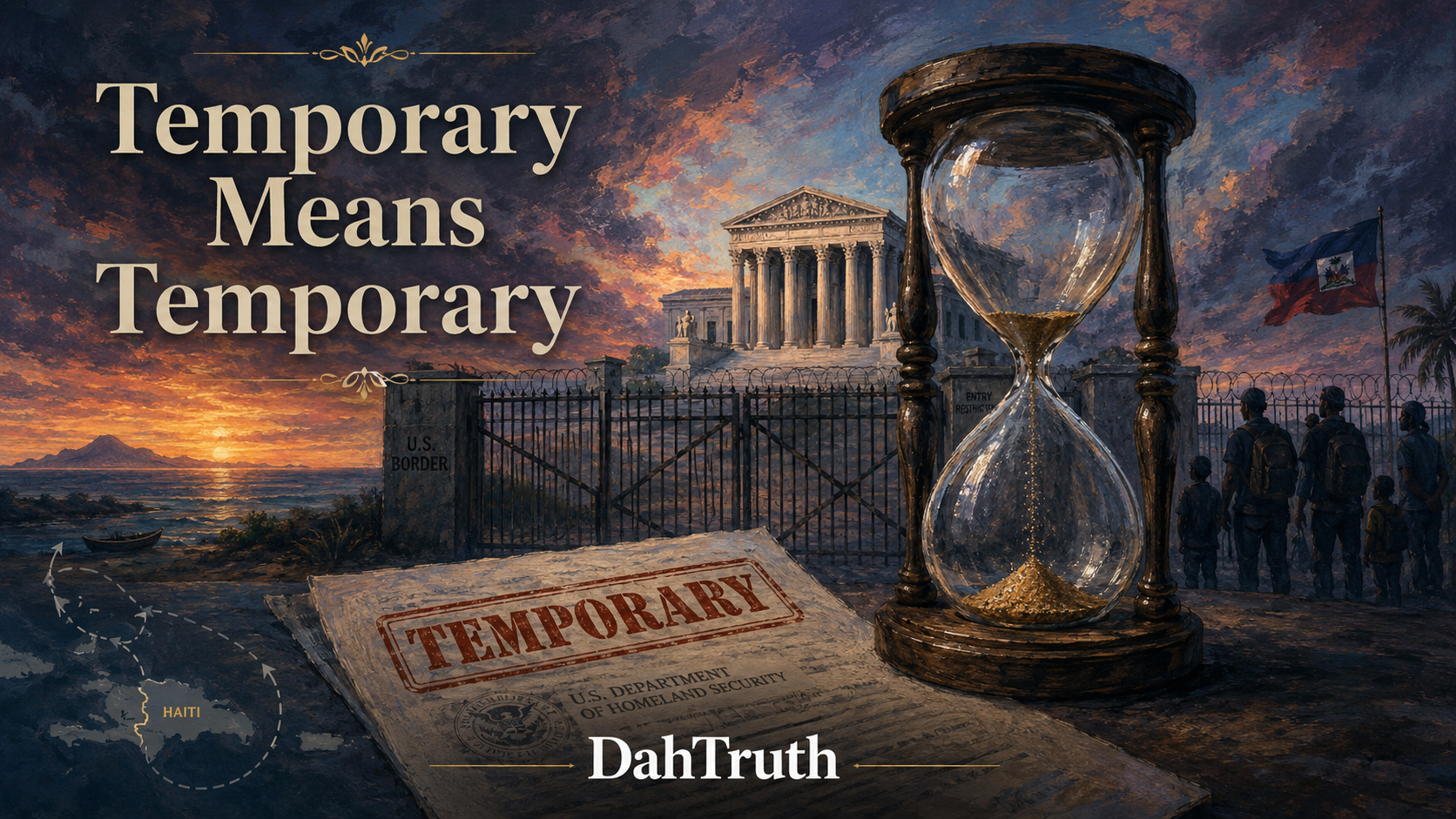
Temporary Means Temporary
“The Due Process Clause protects rights, not privileges.” - Justice Clarance Thomas
American Blacks, Haiti, and the Line We Refuse to Surrender
June is ending, indeed, with an unspoken war being waged against the American Black community and those of African descent in the diaspora. Once again, the possession of one thing among American Blacks, descendants of American slaves, has sparked animosity. This time, that animosity came after a single decision by the Supreme Court. Once again, the American Black community has been accused of abandoning its heritage, forgetting its loyalty to African roots, embracing Western values, and turning its back on our sisters and brothers from Haiti.
This has been a week of division in the global Black community. I say global because the spillover was not limited to American Blacks. The divide was fierce. Like an earthquake, it split American Blacks from Blacks throughout the diaspora, from Nigeria to Haiti. We were looked at as though we had created a crisis among nations simply because many of us agreed, as citizens of one nation, that we are not obligated to fight Haiti's battle.
It is not merely that we are not obligated. It is also that many of us do not want to fight this battle. Many of us agree with the Supreme Court that Temporary Protected Status means exactly what it says. It is temporary. There comes a moment when temporary must come to an end.
❦
All of this unfolded because of two decisions handed down by the Supreme Court on the same day. The first, Mullin v. Doe, addressed the Temporary Protected Status claims of Haitians and Syrians who sued the administration after former Homeland Security Secretary Kristi Noem revoked their status. The plaintiffs argued that the decision was unlawful and, in the case of the Haitian plaintiffs, that it was infected by racial animus. The case reached the Court by a 6 to 3 vote, with Justice Samuel Alito writing for the majority and Justice Elena Kagan writing in dissent.
The heart of the majority opinion was not a grand pronouncement about race. It was a question of who gets to decide. The TPS statute contains a provision that bars judicial review of the Secretary's determinations with respect to the designation, termination, or extension of protected status. Justice Alito concluded that this language is clear and its meaning broad. Under that bar, the courts could not review the procedural challenges brought against the Secretary. Congress gave that authority to the executive branch, and the judiciary was not free to take it back.
On the constitutional claim, the majority did not declare that race could never matter. The Court assumed, for the sake of argument, that the stricter standard of review applied, and still concluded that the Haitian plaintiffs were unlikely to prove that race was a motivating factor in the decision. The reason was striking. The plaintiffs themselves offered a race-neutral explanation. The administration had terminated every TPS designation that came up for review, thirteen in all, spanning nations across Asia, Africa, the Middle East, Central America, South America, and the Caribbean. To the majority, that record pointed to a policy position against the program as it had been implemented, not to a campaign against any single people.
Justice Kagan saw the matter differently. Her dissent treated the President's statements, the timing, and the human consequences as enough to keep the lower courts' orders in place while the litigation continued. The stories she told were sad. They were human. They were moving. Hardship alone, however, does not prove that the Secretary violated the Constitution, nor does it transform a temporary status into a permanent entitlement by judicial decree.
This matters because TPS is not granted simply because a nation is poor, violent, or broken. It is granted because of a specific and temporary condition: an earthquake, an armed conflict, an environmental disaster. Haiti received protection after the 2010 earthquake. Syria received it because of the war and repression under Assad. When the triggering condition changes, or no longer carries the same legal basis, the statute gives the Secretary the authority to determine whether that protection should continue. That is not cruelty. That is the design of the law.
❦
Justice Clarence Thomas, who joined the majority in full, wrote separately to make a sharper point, and it is the one that speaks most directly to the argument now being forced upon American Blacks. Thomas drew the old and unfashionable line between a right and a privilege. The Constitution protects rights. It does not convert every government benefit into one. Temporary Protected Status, like any immigration status extended to an alien, is a privilege granted by the nation, not a core private right that exists independent of the government's will.
That distinction carries more weight than the noise around it. To live in America as an alien is not, by itself, a constitutional entitlement. The nation may extend protection, and the nation may withdraw it when the temporary condition that justified it has passed. Due process guards life, liberty, and property. It does not guarantee the permanence of a humanitarian program that Congress built to be temporary from the start. Nor does it require American Blacks who reason from the Constitution to treat the end of a privilege as though it were the theft of a right. I should note that Thomas wrote this for himself, in concurrence, and not for the Court. Yet the principle is sound, and it is honest.
❦
The same day, in Mullin v. Al Otro Lado, the Court took up a second question that bears directly on this debate. Federal law permits a person to seek asylum if they are physically present in the United States or if they arrive in the United States. The question was what it means to arrive. The Court held that a person standing in Mexico has not arrived. Such a person has not yet set foot on American soil, and the statute does not entitle them to apply for asylum or require an officer to inspect them. Justice Alito, writing again for the majority, was careful to say that the wisdom of the policy was not the Court's concern. The Court decided only what the words mean. A person arrives when they cross the line, not before.
There is an irony worth naming. The practice at issue, known as metering, was not born in this administration. It was first used under President Obama, and it was first used against Haitians arriving at the California border from Tijuana. The policy now denounced as cruelty toward one group was first deployed by the very side that claims to defend them. We believe, as the Court now affirms, that asylum requires presence. There must be a legal line. There must be a border. There must be a process. A person cannot declare asylum from the road, from another country, or while still on the path toward the United States.
❦
After the TPS decision, Dr. Geralde Gabeau, a prominent Haitian-American advocate and founder of the Boston-based Immigrant Family Services Institute, spoke at a press conference in Massachusetts. She rallied the crowd and declared that this country is also the country of immigrants, because immigrants helped build it. American Blacks, whose legacy descends from the slaves who built this nation without citizenship, wages, protection, or inheritance, took rapid offense to those remarks. Rightly so.
Although hundreds of men from Saint-Domingue fought for American independence at the Battle of Savannah in 1779, they did not endure American chattel slavery. They did not build the plantations of Virginia, the rice fields of South Carolina, the cotton fields of Mississippi, or the auction blocks of New Orleans. They did not live under Dred Scott. They did not survive the Black Codes, convict leasing, Jim Crow, redlining, school segregation, and the long betrayal of Reconstruction.
Haiti has its own profound history. It was the first Black republic to defeat slavery and break the chains of French colonial rule. That history deserves honor. Honoring Haiti's history, however, does not require American Blacks to surrender the specificity of our own. Haiti fought off the bonds of slavery and defeated the French, yet Haiti as a nation has not changed the unfortunate welfare of Haitians within its own borders.
That is where the wound opened. When Haitian advocates say, “We built this country,” many American Blacks hear something very different. We hear another group reaching for our inheritance, standing on our graves, and asking us to hand over the language of our suffering so they may use it for their own political claim. That insist on solidary while erasing our history.
❦
Like so many other things, the divide was wide and the gates were open. Our social media timelines filled with Africans and Caribbeans castigating the American Black community for not standing on the side of our supposed sisters and brothers. Then came the rush of scorn against our community and our alleged lack of heritage. One sister I heard, speaking with a heavy African accent, said that she knew who her parents and grandparents were. The implication was clear. American Blacks do not.
I have said this before, and I will say it clearly again. We know that our roots were chopped from the African continent, carried across a wide ocean, and replanted in America before 1808. We understand that whatever heritage existed on that continent was violently severed once our ancestors landed here. From that moment forward, as brutal as the circumstances were, their names were replaced, their languages were stripped, and their roots were planted in American soil.
Now there is this thinking that American Blacks have no culture. Yet if you look across time, you will see that we danced our way through slavery while picking and planting in fields that did not belong to us. We fought through the Civil War. We marched through the Civil Rights Movement on the backs of preachers, church mothers, and Christian bands. We overcame every obstacle placed before us, including heroin, crack, mass incarceration, and the system of racism that tried to keep us permanently beneath the nation we helped build.
We made mistakes, without a doubt. Among them was embracing that which did not belong to us, settling for stools in restaurants that did not want us there, and sending our children into schools that taught us another people's heritage while leaving out our own. Eventually, we figured it out. We built history in art, music, literature, sports, politics, faith, and entertainment. We opened doors that others later walked through, including people from nations such as Haiti, Nigeria, and the Congo. Yet in return, some now demand that we fight their battles even when the Constitution we believe in does not quite support their claim.
They signed up for Temporary Protected Status, and we all understand what that word means. Temporary suggests that the status may eventually come to an end. Unfortunately, for many, that day has come. To turn around and tell American Blacks that we have no culture, that we have abandoned our heritage, or that they are waiting for our day to come is a bridge too far. It reeks of unmerited disdain.
❦
There is another insult that cannot be ignored. Consider the current condition of the Haitian nation, and yet some Haitians will turn toward a camera and call American Blacks dirty Americans. Then, when they are called to account for it, they apologize as though the insult did not reveal the contempt sitting beneath the request for solidarity.
That is the contradiction American Blacks are being asked to swallow. We are told we have no culture. We are told we have forgotten our roots. We are told we are selfish, Westernized, and detached from the global Black struggle. Yet the worst of our cities are in no way the equivalent of the current conditions in Haiti, a nation that freed itself from the bonds of slavery and has been governed by Black Haitians for generations. Despite its soil, its rice, its sugarcane, its history, and its revolution, Haiti remains impoverished and unstable. That reality cannot be laid at the feet of American Blacks.
When I hear the word culture used as a weapon against us, I pause. I am told to trade the culture American Blacks built under slavery, Jim Crow, segregation, redlining, heroin, crack, and mass incarceration for a vague appeal to diaspora loyalty. I am told to bow before a heritage that has not been mine for more than two centuries. I am told to defend another nation's crisis while being mocked for loving the nation my ancestors built with their blood.
As a Christian, I do not pretend to honor gods I believe are false, and I will not be shamed into reverence for a spiritual inheritance that was never mine. My faith, however, is not the reason American Blacks owe Haiti no constitutional debt. The Constitution is. As an American Black woman, I do not confuse poverty, disorder, and political instability with the fullness of a people's culture. Haiti has history. Haiti has suffering. Haiti has dignity. Haiti's crisis does not become my constitutional obligation simply because someone invokes Blackness.
If that makes me uncultured in the eyes of those who despise American Blacks while demanding our advocacy, then so be it. I would rather be called uncultured than be shamed into surrendering my own inheritance. American Black culture was not born from ease. It formed under pressure, the way a grain of grit lodged in an oyster is wrapped, layer over layer, until the wound becomes a pearl. They tried to grind us to dust. We became something they could not.
❦
This week revealed more than a disagreement over immigration law. It revealed the ongoing tension between American Blacks and a diaspora that too often wants our political power, our history, our language, and our sympathy, but does not want to respect our national inheritance. We are expected to be Black when others need our numbers, American when others want to insult us, and silent when others claim the very foundation our ancestors were forced to build.
We are not silent. We are American Blacks. We are descendants of American slaves. We are the children of those who were brought here before 1808, stripped of names, languages, and kin, then forced to build a nation that refused to recognize them as human. We are the children of those who remained after emancipation, after Reconstruction failed, after Jim Crow rose, after redlining spread, after crack entered our neighborhoods, after prisons swallowed our sons, and after every system tried to convince us that we had no inheritance at all.
Yet we are still here. We are not rootless. We are not cultureless. We are not confused. Our roots are in American soil, because that is where our ancestors bled, prayed, labored, buried their dead, and raised their children. Our culture was not borrowed from a continent we were severed from. It was built here, under chains, under law, under church roofs, under cotton sacks, under police dogs, under fire hoses, under prison walls, and under the mercy of God.
So no, American Blacks are not obligated to carry every battle in the diaspora. We are not obligated to abandon constitutional order because another group invokes a shared skin color. We are not obligated to pretend that temporary does not mean temporary. We are not obligated to call every hardship a constitutional violation. We are not obligated to erase our own suffering so that someone else can stand inside it.
Compassion is one thing. Obligation is another. Kinship is one thing. Erasure is another. Immigration policy is one thing. Constitutional right is another. Until those distinctions are honored, this divide will only grow wider.
Temporary Protected Status was always temporary. Haiti's suffering is real, but it is not ours to constitutionalize. The American Black inheritance is real too, and it is not ours to surrender. If the diaspora wants solidarity, then let it begin with respect. Let it begin with honesty. Let it begin with the recognition that American Blacks do have a culture, a people, a history, and a claim. We are not dirty Americans. We are not lost Africans. We are not a people without roots. We are a people with new roots.
