
Whose Side Wants Our Flourishing?
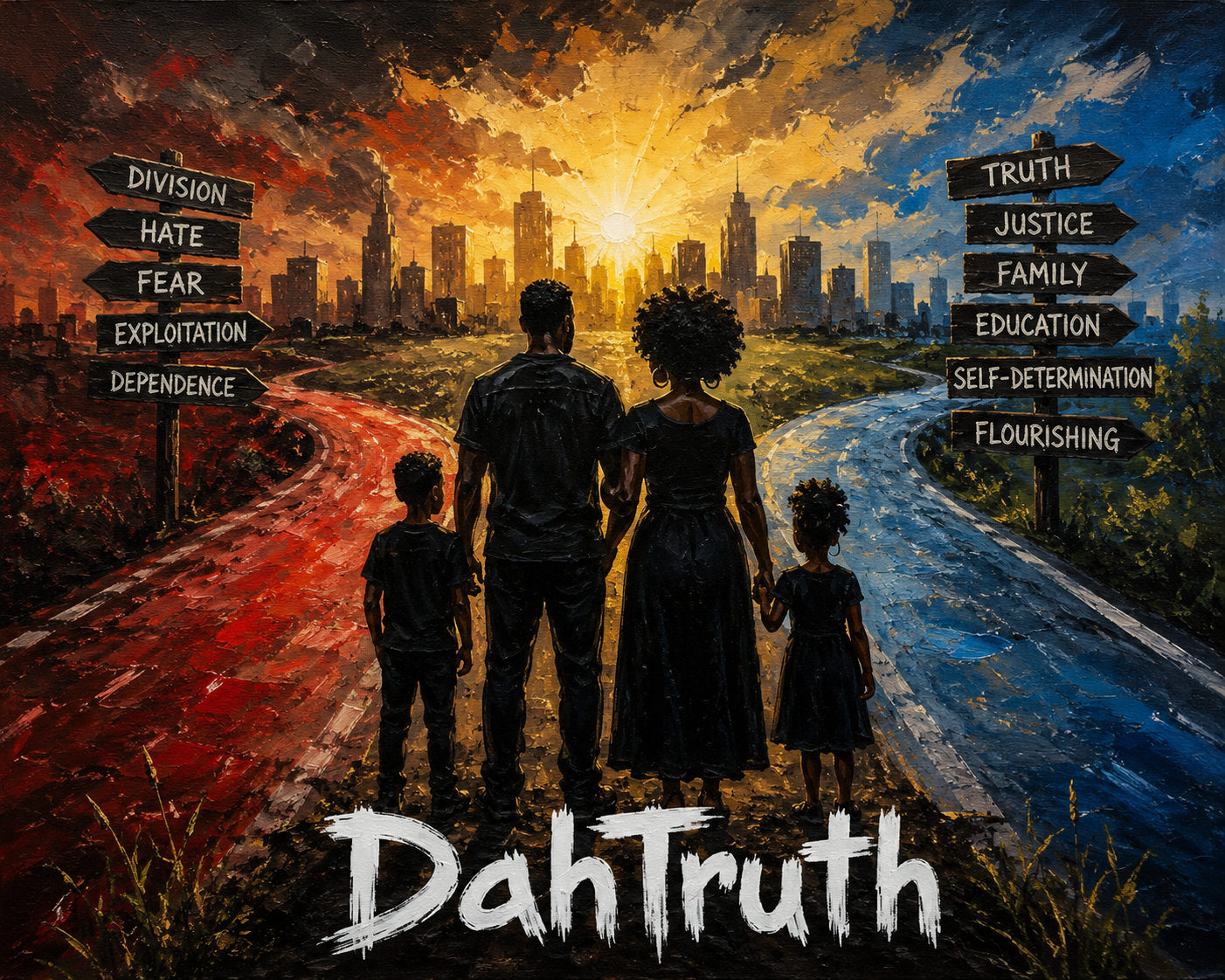
"And they shall build houses, and inhabit them; and they shall plant vineyards, and eat the fruit of them. They shall not build, and another inhabit; they shall not plant, and another eat... mine elect shall long enjoy the work of their hands." — Isaiah 65:21–22 (KJV)
On Being Politically Homeless, and the Courage to Tell the Truth from Every Direction
Last week I wrote about grief — about Cyrus Carmack-Belton and Karmelo Anthony, and the unequal measure this country applies to Black life and the right to defend it. That was a piece about how we are treated from the outside. This is a piece about something harder to say aloud: that even as we face hostility from without, we are also caught between political forces that each claim us and neither of which, I have come to believe, is truly invested in our flourishing.
The right may acknowledge our concerns about family and faith while dismissing our experience of racism. The left may speak the language of racial justice while advancing policies we believe have failed us. The message from both is the same: choose a side. But perhaps American Descendants of Slaves should stop asking which side wants our votes and start asking which side actually wants us to thrive.
The Right’s Blind Spot
We saw the right’s blind spot in full this month. When Black Americans grieved the verdicts, some of the loudest voices on the right answered not with empathy but with contempt — with slurs, with old stereotypes, with lectures about our supposed dysfunction. They spoke of our children as a problem to be managed rather than children to be protected. They condemned violence in our communities while saying nothing of the violence in their own. The pain of a tragedy became, for them, an occasion to resurrect the cruelty of another era.
I do not raise this to score a partisan point. I raise it because it is real, and because it is the kind of hostility that announces itself plainly. It is the other kind — the kind that arrives wearing the language of friendship — that is harder to name.
The Left’s Blind Spot
Many of us have grown weary of a political left that speaks fluently about racial justice while asking us to celebrate symbols in place of results. We are offered representation and told to be grateful, while our questions about failing schools, about economic dependency, about the conditions of Black family life, are treated as betrayals rather than concerns. We are expected to remain loyal regardless of outcomes, and when we ask whether the outcomes have actually served us, we are accused of being divisive or naive.
If a Black parent dares to ask whether her child might be better served somewhere other than a failing neighborhood school, she is too often met not with curiosity but with scorn, as though the question itself were a kind of treason. That is not the posture of a movement confident it is serving us well. It is the posture of one that would rather we not ask.
The Business of Hate
Even institutions that present themselves as guardians against hatred deserve scrutiny — perhaps especially those institutions. This spring, a federal grand jury indicted the Southern Poverty Law Center on charges including wire fraud, false statements to a bank, and money laundering. This month, its interim leader was questioned about the matter before the House Judiciary Committee in a hearing pointedly titled around the manufacturing of hate.
Let me explain the allegation carefully, because it is easy to get wrong, and the truth of it is stranger and narrower than the rumor. The charge is not that the SPLC paid hate groups to commit racist acts. It is that the organization secretly paid leaders inside violent extremist groups — including the Klan — to serve as informants, routing the money through shell companies, while telling its donors that their gifts were going to fight and dismantle those very groups. The fraud alleged is a fraud against donors: promising one thing and, prosecutors say, quietly doing another. The SPLC describes the program differently, as intelligence-gathering meant to monitor dangerous groups and share what it learned with law enforcement.
From that factual core, critics have built a larger and more troubling argument — and this is the part that first caught my attention. They contend that by paying the very actors it exists to oppose, the organization helped sustain the threat that justifies its own existence. Alveda King put it bluntly in that hearing room: you pay the same people to set the bomb and then comfort the ones who were bombed, she said, and that is a kind of fraud. An institution whose funding, prominence, and relevance depend on the persistence of racial hatred, the argument goes, has little incentive to see that hatred end. I want to be fair: this is an interpretation offered by the organization’s opponents, not a fact established in court. The indictment itself alleges deception of donors, not the manufacture of hate.
And I want to be fair in the other direction too. The SPLC denies the charges and calls the prosecution political retaliation for its criticism of the current administration, and given the broader posture toward that administration’s critics, there is reason to take the claim seriously. The case has not been proven. I do not know how it will end.
But the question lingers regardless of the verdict, and it is a question worth sitting with: when an institution’s standing depends on the persistence of the evil it was built to fight, what incentive does it have to see that evil truly end? I do not claim to know the answer. I only believe the question deserves more honesty than either side has offered. Racism is real; of that there is no doubt. The harder question is whether every institution that claims to fight it is actually invested in its defeat, or merely in its management.
When a Black Woman’s Grief Is Ruled Out of Order
It is not, in truth, shocking that an organization like the Southern Poverty Law Center would face these allegations; institutions chase their own survival like anyone else. What is striking, if the charges prove true, is that a body that built its name praising and protecting the vulnerable stands accused of turning on the very people it claimed to serve. And what I witnessed in that hearing room was not only the familiar divide between Democrats and Republicans. It was a divide within our own community.
Watch how it unfolded. When Alveda King raised her concerns, the white Democrat on the panel, Representative Jamie Raskin, simply dismissed her. He defended the organization, ran out his clock, and cut her off mid-sentence when she tried to press. That is one kind of disregard, and it is familiar enough. But the deeper cut did not come from across the aisle. It came from Representative Jasmine Crockett, an American Black woman like Alveda King, who chose that moment not to wrestle with King’s concern for Black children but to question whether King had any right to her own family’s name. When we lean left, our communities absorb policies many of us believe devastate them. When we turn right to protect our children, from abortion and from ideologies we did not choose for them, we are met not only with the left’s racial condescension but with the scorn of our own. That is what it means to be politically homeless: to be wounded from outside the family and from within it in the same afternoon.
Nothing crystallized this dilemma for me more than that exchange. Alveda King is the niece of Dr. Martin Luther King Jr., and she is no stranger to controversy. Her delivery that day was sharp, even disruptive, and her politics are not mine on every point. But beneath the heat was a conviction many of us quietly share: that the steady loss of Black children through abortion is a wound our community rarely allows itself to name aloud.
Rather than engage that conviction, Representative Jasmine Crockett questioned whether Alveda King had any rightful claim to her own family’s legacy, suggesting that Republicans had merely paraded a woman who happened to carry the King name. As Crockett left the room, King answered her: “You have suggested that I am a bastard to the King family legacy, but I love God, and I love you.”
Whatever one thinks of Alveda King’s politics, that exchange exposed something painful and familiar — the speed with which a Black woman’s concern for Black children can be ruled illegitimate the moment it departs from the expected script. The implication seemed to be that concern about racism disqualifies concern about abortion, that to mourn the unborn is somehow to betray the civil rights tradition. I reject that choice. I do not believe we must choose between opposing racism and mourning the loss of Black children. I do not believe we must choose between demanding justice from the world outside and confronting painful truths within.
Love Requires Honesty
I would be dishonest if I pretended all our wounds are inflicted from outside. The deepest grief is watching our own community discouraged from honest conversation about the things that weaken us from within. We open our arms to others. We spend our money in other communities. We defend people who do not always defend us in return. And then, when Black people raise concerns about our own interests, we are accused of being divisive, reactionary, or selfish.
If we lean too far right, we are called traitors to our race. If we question the left, we are ridiculed and dismissed. We are told where we belong politically before we are ever asked what our communities actually need. But love requires honesty. We have to confront the violence in our neighborhoods. We have to ask hard questions about schools that fail our children, and whether families should have greater freedom to seek something better. We have to wrestle plainly with incarceration, with fatherlessness, with economic dependency, and with the loss of Black children before they are born. None of these conversations belong to any party, and none of them are comfortable. All of them are necessary.
We Must Protect Our Legacy
One of the things I admire most about American Descendants of Slaves is that, despite everything, we still know how to come together. When crisis comes, something in us remembers who we are. The political labels fall away for a moment, and what remains is the older truth: that our fate is bound together. That instinct is among our greatest strengths. But too often, once the moment passes, we allow ourselves to be divided again, pulled apart by partisan loyalties and outside influences that would have us see one another as enemies rather than family.
Sometimes I wonder whether our hope lies in reclaiming the mindset our ancestors carried through some of the darkest seasons this country ever made. I do not mean a return to the injustice of Jim Crow. I mean a return to the resilience that endured in spite of it. Our ancestors built businesses when doors were closed to them. They raised up schools and churches. They pooled what little they had and raised one another’s children. They believed in faith, discipline, sacrifice, and shared responsibility, and they understood that survival depended not only on resisting the hostility outside, but on strengthening what lived within. Perhaps that is what we need now — not nostalgia for segregation, but remembrance of the values that carried our people through it.
We must protect our legacy. We must value our children. We must invest in our families. We must tell ourselves the truth.
If American Descendants of Slaves are to flourish, we cannot allow ourselves to be dismantled by hatred from the right or paternalism from the left, nor can we ignore the choices within our own house that weaken us. We do not need permission to demand justice, and we do not need approval to tell the truth about the harm done to us from any direction. Because before we were Democrats or Republicans, conservatives or liberals, we were a people who survived the unimaginable, because we chose, again and again, to stand together. The question before us is no longer which side wants our votes. It is whether we will choose our own flourishing before anyone else asks us to.
