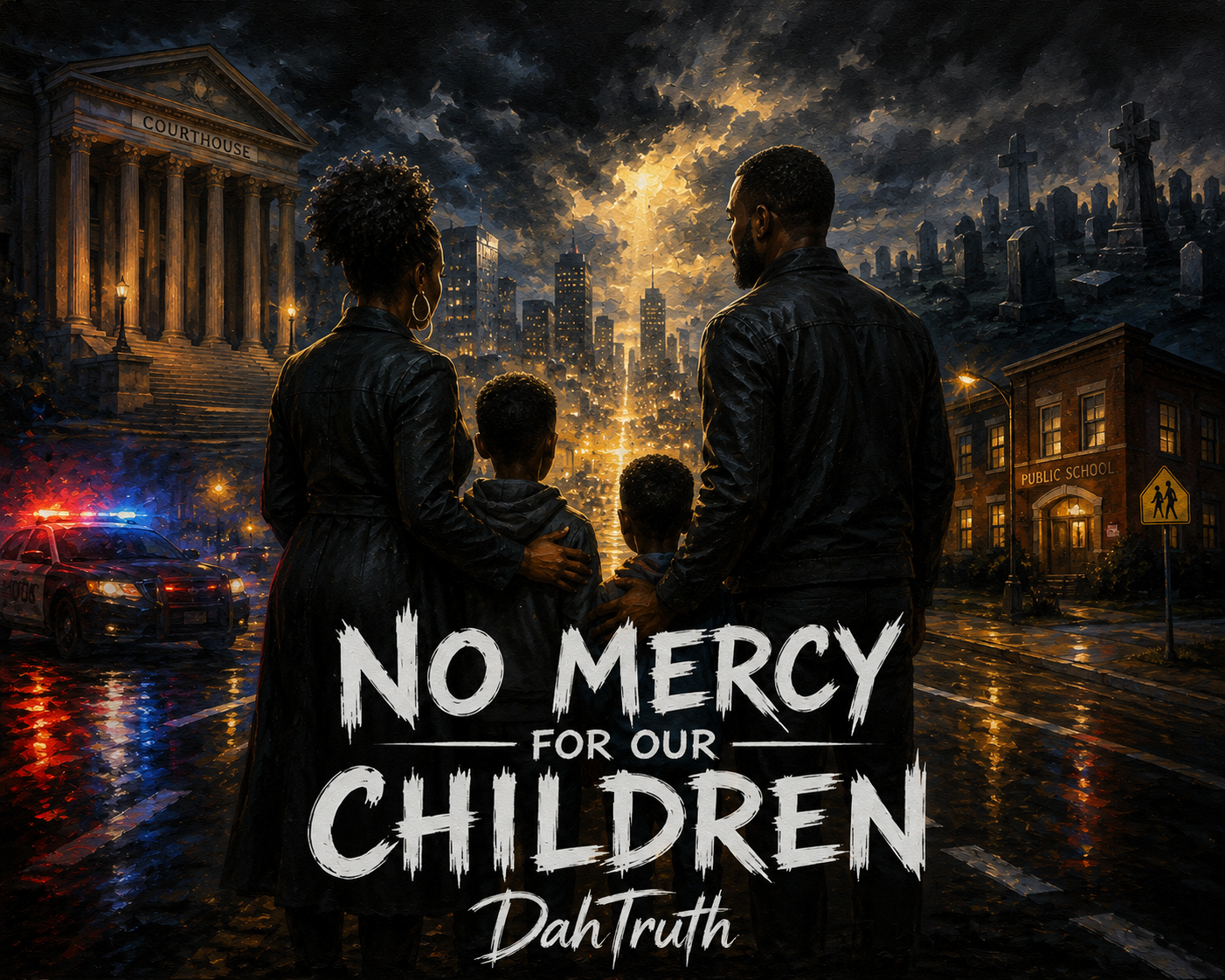
No Mercy for Our Children
"He hath shewed thee, O man, what is good; and what doth the Lord require of thee, but to do justly, and to love mercy, and to walk humbly with thy God?" — Micah 6:8 (KJV)
What These Weeks Revealed About Black Life and the Right to Defend It
There is a particular kind of exhaustion settling over many American Descendants of Slaves. It is the exhaustion of grieving in public while being told our grief is either misplaced or politically inconvenient.
These have been weeks of grief, and not because we buried our children in June. It is because we watched two courtrooms, within days of each other, tell us again how little our children’s lives and our children’s fear are worth. We grieve when our children die. We grieve when our children go to prison. We grieve when we believe the justice system has looked at one of our own and decided, before the first witness was called, that mercy was for someone else.
This is a piece about that unequal measure: about who is permitted to be afraid, who is permitted to defend himself, and whose life this country is willing to count.
A Child Shot in the Back
In 2023, fourteen-year-old Cyrus Carmack-Belton walked into a convenience store in Columbia, South Carolina. He was wrongly suspected of shoplifting. He took nothing; the sheriff said plainly afterward that there was no evidence he stole anything at all. When he left and ran, the store owner and his son chased him roughly a hundred yards, and the owner shot him in the back with a handgun and killed him.
This month, a jury acquitted the man who killed him. The family said it as plainly as it can be said: a jury watched their fourteen-year-old boy run away from two grown men on video, knew one of them shot him in the back, and still concluded that no one was to blame. He stole nothing. He was a child, and he was running for his life.
The wound this June was not the loss of Cyrus’s life, which we have grieved since 2023. It was the verdict — the official word that a child shot in the back while fleeing is a death for which no one must answer.
A Permission Slip, Not a Reason
Days later came the other verdict. On June 9, a jury in Collin County, Texas, found Karmelo Anthony, nineteen, guilty of murder in the 2025 stabbing death of seventeen-year-old Austin Metcalf at a Frisco track meet, and sentenced him that same evening to thirty-five years. He will be eligible for parole only after serving at least half of it. Two families were shattered by a single terrible encounter, and there is no version of this story in which a child is not lost.
I do not write to relitigate the verdict. A jury heard evidence none of us heard in full. But there is a deeper concern in this case, and it carries a precise constitutional name. When it came time to seat a jury, prosecutors used their strikes to remove the last three Black people remaining in the pool. Karmelo Anthony’s attorneys did exactly what the law provides for in such a moment: they raised a Batson challenge, named for the Supreme Court case that forbids striking jurors because of their race. The prosecution offered a reason that sounds neutral on its face. The three were educators, they said, and this had happened at a school event. Judge John Roach accepted that explanation and let the strikes stand.
The jury that resulted was not all one color. It included Hispanic and Asian members, and its defenders were quick to call it diverse. But not one Black juror sat on it. This is a pattern American Descendants of Slaves have learned to recognize: the language of inclusion deployed in a way that includes everyone except us. A jury can look varied in a photograph and still contain no one who shares the particular history, the particular vulnerability, of the young person on trial.
And here is what the stated reason cannot survive. A white juror who also teaches was permitted to remain, an instructor at a trade school in Dallas. We are asked to believe that being an educator disqualified three Black citizens from serving, while a white educator posed no such problem. The state will say she taught adults rather than children. But the principle they invoked was about teachers, and a teacher is what she is. When a rule bends in only one direction, and that direction runs along the color line, the reason offered is not a reason. It is a permission slip.
This is not idle complaint. Within twenty-four hours of the verdict, Anthony’s attorneys filed a notice of appeal, and legal observers expect the Batson question to sit at its center. And it matters because of what came next. The jury did have lesser options before it. They could have found manslaughter rather than murder. At sentencing they could have accepted the claim of sudden passion, which under Texas law would have reduced his exposure. They reached past both, all the way to murder and thirty-five years. I cannot prove what a different jury would have done. But a jury from which every Black member had been removed was never positioned to extend a Black teenager the benefit of the doubt those lesser charges exist to protect.
Who Gets to Be a Frightened Child
Consider another Texas case. In 2022, a student named Caysen Allison fatally stabbed eighteen-year-old Joe Ramirez during a fight in a bathroom at Belton High School. Allison, too, claimed self-defense, arguing he had been forced into the fight. There, the jury reached for the gentlest charge available to it, criminally negligent homicide, declining both murder and manslaughter. The sentence was ten years, and reaching even that required prosecutors to win a special motion adding a deadly-weapon finding.
This is not about the race of the people who died. It is about how differently the system can treat the accused. In Belton, a teenager who fatally stabbed another during a fight was met by a jury willing to call it the mildest thing the law allowed. His claim that he was cornered was heard, weighed, and largely accepted. In Frisco, a Black teenager who also said he was defending himself found no such grace. The question is not who was killed. The question is which defendant a courtroom was willing to imagine as a scared child who panicked, and which one it was determined to see as a murderer.
When the Cruelty Came for the Rest of Us
When many Black Americans expressed grief and anger at these outcomes, some voices did not respond with empathy or even disagreement. They responded with slurs, reaching for the oldest and ugliest stereotypes in the American vocabulary. A clip circulated widely on the right, and was featured on Michael Knowles’s program, of a young white woman describing Karmelo Anthony’s supporters as “chimping out” while reaching for the N-word. Another agitator, Jake Lang, called for Anthony to be lynched and built a group around the protection of white Americans, later facing a felony charge after the family said he had threatened the boy’s life.
And the word in that viral clip, chimping, was no isolated slip. Only weeks earlier, a livestreamer who calls himself Chud the Builder, a man whose own videos show him calling Black people chimps and worse, was charged with attempted murder for shooting Joshua Fox, a Black disabled veteran and father of three, outside a Tennessee courthouse. He has claimed self-defense. The same vocabulary that plays as edgy entertainment online has a way of ending with a Black man bleeding on the pavement.
Notice the asymmetry. A white commentator can broadcast a woman calling Black people apes and present it as cultural reporting. Imagine the response if a Black commentator described that same crowd in the animal terms this country has always reserved for us. One is treated as analysis. The other would be a national scandal. That gap, between what may be said about us and what we are permitted to say back, is the whole point.
The mercilessness even reached into Congress. Representative Randy Fine of Florida declared that Karmelo Anthony deserved the death penalty, and when questioned he doubled down, saying an execution would send a message. It was theater, and cruel theater at that. Under the Supreme Court’s ruling in Roper v. Simmons, a defendant who was seventeen at the time of the offense cannot be executed at all, and Fine surely knew it. He called for the death of a Black teenager not because the law allowed it, but because demanding it played well. There is a particular self-righteousness in pronouncing a death sentence from the safety of a microphone, in a case where a frightened boy says he fought back.
The Measure We Are Owed
Set the scenes beside one another and the unequal weighting becomes impossible to miss. A fourteen-year-old shot in the back while running away, and a jury that finds no one to blame. A Black teenager who says he defended himself, tried by a jury his own people were struck from, sentenced to thirty-five years. A man with a documented history of racial slurs, charged with shooting a Black veteran outside a courthouse, claiming self-defense. The presumption of innocence, so elastic for some, so brittle for others.
I am not asking anyone to abandon the presumption of innocence. I am asking why it seems to stretch so generously around some and snap so quickly around our children. This is the disparity that exhausts us. It is not always the open hatred. Sometimes it is the quiet arithmetic of who is treated as dangerous and who is treated as understandable, who is granted the benefit of fear and who is denied it.
We are not asking for special mercy. We are asking for the same mercy already extended to everyone else.
We have survived slavery, Reconstruction, Jim Crow, exclusion, and neglect. We have learned, again and again, how to grieve and still stand. We will grieve Cyrus. We will pray for Karmelo. And we will keep insisting, in the way of protest and the way of appeals and the way of telling the truth plainly, that our children are owed the same humanity this country extends so freely to its own. We do not need permission to demand it.
