
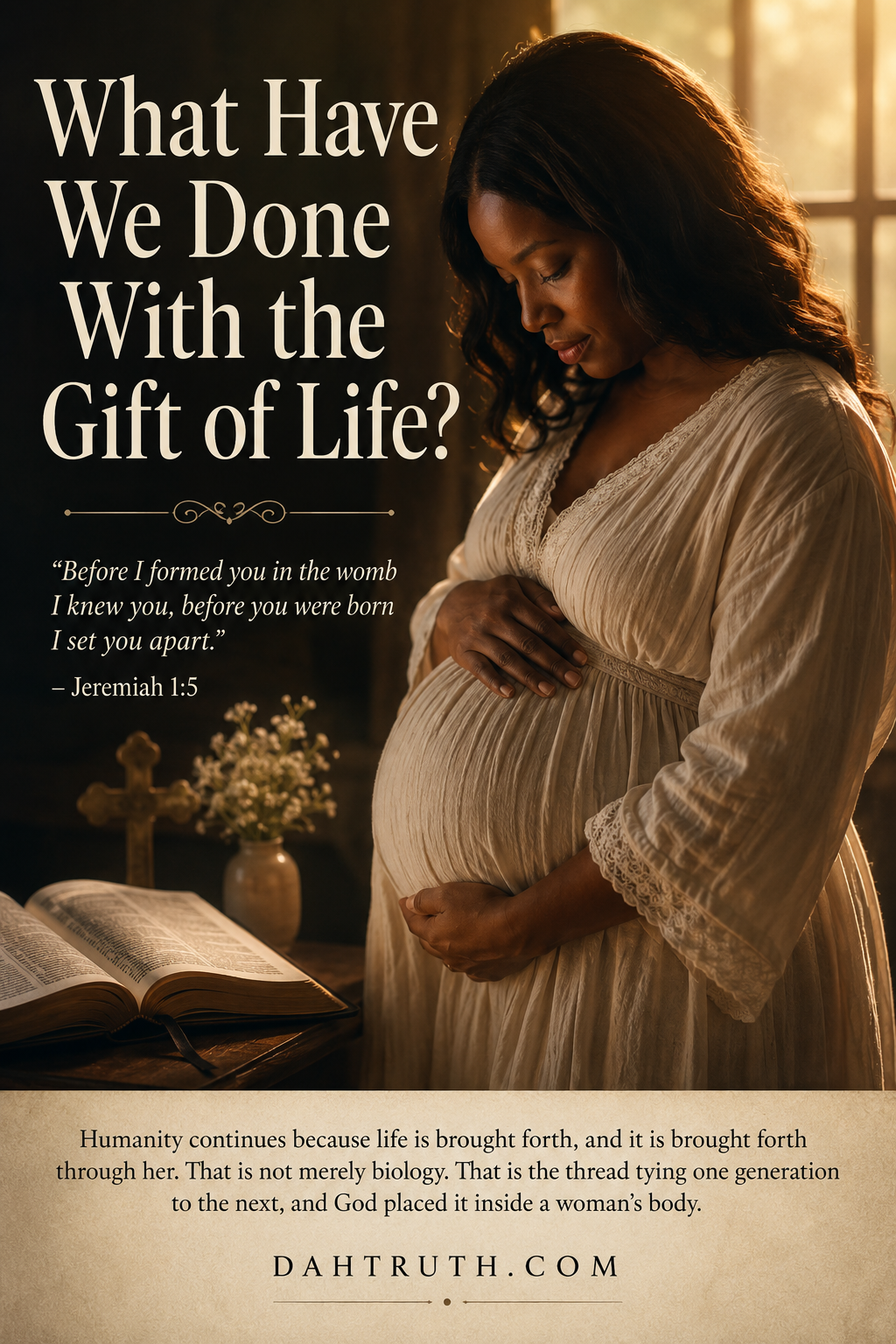
When God made Eve, He did not make a second Adam. He formed her from Adam's side, and Adam knew her immediately as bone of his bone and flesh of his flesh, but she was not a copy of him. She came into the world with a different body, a different temperament, a different way of moving through creation, and one capacity Adam would never have: the ability to carry a human life inside her own and bring it forth.
We argue endlessly in this culture about what womanhood means, and I understand why the argument exhausts people. But whatever else we say about it, we cannot talk our way around the design. God created humanity male and female, and He did not distribute the work of continuing the human race evenly or interchangeably between them. The man contributes; the woman carries. One body makes a life possible, and the other makes that life a home for the better part of a year. Neither function is insignificant, and neither one is an accident.
Not every woman becomes a mother. Some cannot conceive and grieve it privately for decades. Some never marry. Some make a deliberate decision not to have children and live full, faithful, consequential lives. None of that makes them less than women, and I want to be plain about that before I go any further, because this is precisely the point where people stop reading. But the fact that a design is not fulfilled in every individual case has never, in any other area of life, been treated as proof that the design means nothing. If anything, it makes the design more remarkable — that it holds at all, generation after generation, in a world this broken.
Genesis tells us that God blessed humanity and told them to be fruitful and multiply. And after the Fall, in the middle of the wreckage, Adam turns to his wife and gives her a name: Eve, because she would be the mother of all living. At the exact moment death enters the story, the woman is named for life. Humanity continues because life is brought forth, and it is brought forth through her. That is not merely biology. That is the thread tying one generation to the next, and God placed it inside a woman's body.
The Burden of Life
That is what I have been sitting with all week, and if I am honest, my heart is heavy about it. Somewhere along the way we became confused about the value of the very thing that makes the continuation of human life possible. First we separated motherhood from womanhood. Then we separated childbirth from its meaning. And finally we separated the child from the moral weight we once attached to any human life at all.
I finished John Steinbeck's East of Eden this week and have not been able to put it down mentally since. Cathy Ames is one of the most disturbing characters I have ever encountered in fiction, and what disturbs me is not that she is cruel — literature is full of cruelty — but that she is a mother. She has the biological capacity to give life and she treats everything surrounding that capacity as a weapon. She tries to end the pregnancy before the twins are born, and days after their birth she shoots their father and walks out of that house without looking back. Motherhood, it turns out, does not automatically produce tenderness. The womb does not sanctify the woman who carries it.
The Names They Did Not Have
There is a detail in that novel I cannot get past. After Cathy leaves, Adam falls into such a stupor that the twins go nearly a year without names. They are simply “the twins.” It takes Samuel Hamilton — an old Irish neighbor with dirt under his fingernails and Scripture in his mouth — to come back to that ranch, strike Adam across the face, and force him to sit down and name his sons. Lee is there too: the Chinese cook every white man in that valley underestimates, the one who has actually been feeding and raising those boys while their father grieves. The three of them open Genesis, argue their way through Cain and Abel, and finally give the children names. Caleb and Aron.
I keep returning to that scene because naming is not decoration. A name says: I see you. You are not an extension of me. You are somebody — distinct, present, real. Before the naming, the boys are a burden Adam cannot bear to look at. After the naming, they are Cal and Aron, two boys with two natures, two destinies, and by the end of the book two very different ends. You cannot look away from a person who has a name.
Which is exactly why I pay attention to the words we choose. When a child becomes a pregnancy, when a baby becomes a fetus, when a human being becomes a clump of cells or a piece of tissue or a product of conception, something has happened that is not merely clinical. Language either makes a person visible or makes a person easy to overlook, and an abstraction is far easier to end than a somebody. We have gotten very good at the vocabulary of disappearance.
The Children We Stop Seeing
That thought followed me straight into the news, because as I write this on a Sunday morning, a jury in Plymouth, Massachusetts has gone home for the weekend without a verdict.
Lindsay Clancy, thirty-six years old and a former labor and delivery nurse, has pleaded not guilty to three counts of murder in the January 2023 deaths of her children — Cora, five; Dawson, three; and Callan, eight months old — at their home in Duxbury. Her attorney does not dispute that she killed them. He argues she was in the grip of postpartum psychosis and therefore cannot be held criminally responsible for it. She attempted to take her own life the same night and has been paralyzed since. The jurors — nine women and three men — may return first-degree murder, second-degree murder, manslaughter, not guilty, or not guilty by lack of criminal responsibility. They resume Monday morning.
Massachusetts does not say the word insanity in a courtroom. The doctrine is called lack of criminal responsibility, and it comes from a 1967 case, Commonwealth v. McHoul, which asks whether a mental disease or defect left the defendant without substantial capacity either to appreciate the wrongfulness of her conduct or to conform her conduct to the requirements of the law. Notice that there are two doors there and not one, and the second one is wide. Notice something else, too: unlike most states, Massachusetts puts the burden on the government. Once the defense raises the question, the Commonwealth must prove beyond a reasonable doubt that she was criminally responsible. The state has to prove sanity. That is the wall prosecutors spent five weeks and more than seventy witnesses trying to climb.
I am not interested in pretending mental illness is not real, or that postpartum psychosis is not a genuine and devastating medical emergency, or that a human mind cannot come apart. But here is what has stayed with me about the testimony. Not one physician who actually treated Lindsay Clancy told that jury she was psychotic. Dr. Jennifer Tufts, her psychiatrist across months of appointments, testified she never observed psychosis and saw no serious sign that Clancy's safety or anyone else's was at risk. Dr. Alia Goodheart, who treated her during her inpatient stay at McLean Hospital, testified that she saw no signs of psychosis either. The prosecution's expert found severe depression and anxiety, found no evidence of postpartum psychosis, and noted that during a psychiatric hospitalization two weeks before the children died she never once mentioned hallucinations. The psychosis opinion at the center of this defense came from an expert retained by the defense, who reviewed her records but never met her.
I want to state the other side fairly. Postpartum psychosis can rise and recede quickly, and a person can be organized, deliberate, even calm and still be operating inside a delusion — which is precisely why the law asks about capacity rather than composure. Her husband testified that on the last full day of his children's lives, his wife was having one of her best days, and that the two of them spent it trading photographs of the children making snowmen. That fact can be read in two directions, and honest people in Plymouth are reading it both ways this weekend.
But whichever way the jury reads it, there is a question sitting underneath the verdict that the verdict will not settle: at what point does explaining a person's behavior become excusing it, and at what point do the people who died disappear from a conversation that is supposedly about what happened to them?
Read the coverage and count the paragraphs. We talk about her medications, her psychiatrists, her hospitalization, her discharge, the failures of a mental health system that may well deserve every accusation leveled at it. All of that may matter, and some of it may be a genuine indictment of how this country treats women after childbirth. But somewhere in the middle of that necessary conversation, three children became the setting instead of the subject. Cora was five. Dawson was three. Callan had been alive for less than a year. They had names, faces, futures, and a father who is still walking around this world without them. Whatever the jury decides about their mother's mind, we should not let the explanation of an act swallow the people it was done to.
Guilty of the Act
I want to put two more names into this, because Clancy's is not the only case of its kind, and I do not want to be the sort of writer who only becomes exercised when the defendant happens to fit her argument.
In October of 2024, in Marion, Iowa, a father named Matthew Schleier strangled his five-year-old son Jack. This past April a judge found him not guilty by reason of insanity, and the sentence the judge used to explain that finding is the most precise statement of my entire concern I have ever read: Schleier was guilty of the act, but was legally insane at the time and therefore not criminally responsible. He was committed to a state mental health institute rather than sent to a prison. In July a hospital physician testified that he had made progress but remained mentally ill or dangerous, and this month a judge ordered him to stay. The county attorney's statement afterward was short, and it is the reason I am writing any of this down. For us, he said, it has always been about Jack.
And last August, in Tuscarawas County, Ohio, an Amish mother named Ruth Miller drowned her four-year-old son Vincen at Atwood Lake and then attempted to drive her three teenage children into the same water. Her husband was found dead at a dock nearby. She waived her right to a jury. In March a judge found her not guilty by reason of insanity, explaining that all three psychiatric evaluations had reached the same conclusion — that she suffered from a mental disease that prevented her from knowing the wrongfulness of her conduct — and committed her to a secured behavioral health hospital.
I am not saying those judges were wrong. I was not in either courtroom, and in Miller's case three independent evaluations agreed, which is not nothing. What I am saying is that our legal system already contains a mechanism for the exact distinction I have been chasing all week. It can say, in a single breath, that a man did the thing and that he cannot be held to account for it. Guilty of the act. Not criminally responsible. The law itself knows those are two different questions.
And if the law can hold both halves of that sentence at once, then so can we. But holding both means holding both. It means we do not get to let the second half quietly erase the first. A child died, and that fact does not become smaller because the person who caused it was ill. Jack was five. Vincen was four. Cora was five, Dawson was three, and Callan was eight months old. Whatever we decide about the adults, those five sentences remain true, and they are the only sentences in this essay that nobody is arguing about.
Explanation Is Not Absolution
This brings me back to the Garden, because Genesis got to this question first.
When God confronts Eve, He asks her what she has done, and she does not simply say, I did it. She says the serpent deceived her — and she is not lying. He did. Adam does the same thing and does it worse, pointing first at his wife and then, unmistakably, at God: the woman whom You gave to be with me. Both answers are, as far as they go, factually true. Neither answer works. God does not respond by saying that since an influence existed, no one is responsible. The serpent deceived Eve, and Eve still ate. Eve handed the fruit to Adam, and Adam still ate.
That is the whole ballgame. We have become deeply uncomfortable with responsibility, and I understand the impulse, because I would also rather be understood than judged. Understanding matters — God Himself asks the question before He pronounces the consequence. But understanding was never designed to function as absolution. You can trace every influence acting on a human being, from biology to chemistry to trauma to the people who failed them, and still arrive at a person who chose.
And there is something in Eve's consequence I had never properly sat with. The very capacity tied to the continuation of life is the place where her pain would be multiplied. The gift and the suffering are located in the same body. Scripture never once presents the ability to bring forth life as effortless. Carrying a life can hurt, delivering a life can hurt, raising a child hurts, and loving one hurts most of all, because anything that matters that much will eventually cost you something. And yet even there, in the middle of the judgment, God speaks of the woman's seed and the crushing of the serpent's head. Judgment and promise arrive in the same breath. Motherhood in Scripture is never sentimental and never merely biological. It is a responsibility carrying enormous beauty and enormous cost at the same time.
Take Up Your Cross
Which is where this gets uncomfortable for all of us, and not only for the woman on trial in Plymouth. There is something in human nature that wants out from under whatever God has given us to carry.
Jesus did not accommodate that instinct. Take up your cross and follow Me, He said — not destroy whatever is making the cross heavy. Carry it. He never promised a life without suffering; He promised His presence inside of it. But we live in a culture that increasingly defines freedom as freedom from consequence, freedom from obligation, freedom from pain, and finally freedom from other people's needs. What if freedom was never meant to mean any of that? What if responsibility is precisely the thing that makes a choice worth something?
Steinbeck understood this, which is why the book has outlived him. Lee spends years chasing one Hebrew word, timshel, and comes back with thou mayest. Not thou shalt. Not thou must. Cal is not told he is good, and he is not told he is his mother's son and therefore doomed. He is told he may choose. That is the most hopeful sentence in the novel and also the most demanding one, because a person who may choose is a person who can be held to it. Strip agency out of a human being and you have not liberated him, you have erased him. If everything is caused, then nothing is chosen — and if nothing is chosen, guilt becomes meaningless, but so does love, so does faithfulness, and so does every act of courage anyone has ever performed. Genesis will not let us have that, and neither will Steinbeck.
The Distortion of Sacrifice
So let me say carefully what I think is at stake in that Plymouth courtroom, knowing I am not the jury and the jury has the harder job. If the account her defense has given of her thinking is accurate, then in the collapse of her own mind she came to believe her children were better off dead than left behind in the wake of her death. Set aside for a moment whether she can be held responsible for arriving at that conclusion. Look at the conclusion itself, because a tidier version of it circulates freely among people whose minds are perfectly intact. It says that when a life is going to contain unbearable suffering, the merciful thing is to end the life.
But she was making a decision about their suffering that was never hers to make. She decided that death was preferable to a future she believed would be too heavy for them to carry, and she decided it on their behalf, permanently, at ages five and three and eight months.
This is the thing I have been circling all week. A parent does not own a child. A mother does not own her children. A child is entrusted to us, and entrusted is not the same as owned. If a life has been placed in my hands, then my responsibility when the burden becomes heavy is not to eliminate the life. It is to carry the weight alongside it for as long as I am able, and to hand it to someone stronger when I am not.
There is a difference between sacrifice and destruction. Sacrifice means I take the weight onto myself; destruction means I remove the person who made the weight necessary. Love does not confer ownership over another human being simply because we are convinced we know what is best for them. And this is where our age has lost the thread in a way that reaches far past one courtroom. We have confused compassion with the elimination of suffering, freedom with the absence of responsibility, and explanation with absolution. Sometimes, in the name of sparing someone pain, we make a decision that removes their capacity to choose anything ever again — and then we call it mercy.
What We Have Done With Womanhood
I keep coming back to Eve, and to the beauty of what a woman is. Not physical beauty; men and women both have that, and it fades for both. I mean something deeper and stranger — that God chose to knit the continuation of the human race into a woman's body, that the womb exists at all, that a woman's body will feed a child before it feeds her.
We are told now that our bodies do not really tell us anything about who we are, that flesh is a kind of packaging around a self existing independently of it. I believe close to the opposite. The body is not the whole of the person — we are more than dust, and dust is where the body is going — but the body is God's own handiwork, and God does not do decorative work. He created male and female on purpose. A woman who cannot conceive is entirely a woman. A woman who never bears a child is entirely a woman. But the message this culture sends young women about their own bodies is that the very things distinguishing female biology are obstacles: fertility is a condition to be managed, pregnancy is an interruption to be prevented, and motherhood is a cost to be minimized. We have taught a generation to regard the most creative capacity a human body possesses as an inconvenience.
Keep the Child Visible
What troubles me most is how skilled we have become at making children vanish from our own sentences. The unborn child becomes a pregnancy. The child becomes a fetus. The child becomes a choice. And the child who was already born, already loved, already buried becomes a footnote beneath a long conversation about the adult who killed him.
So let me say the thing I have been circling instead of stating. We do not have a consistent language for the worth of a child's life. We can make an unborn child disappear behind the word choice, and we can make a murdered child disappear behind the words mental illness. I am not claiming those are the same act. I am not claiming the law should treat them identically, and I am not interested in the argument that collapses them. I am claiming that the same instinct is at work in both — the instinct to keep our attention fixed on the person we can still do something for, and to let it slide off the person we cannot.
I do not want to participate in that disappearance, so I am going to do the one thing that reverses it and say the names out loud. Cal. Aron. Jack. Vincen. Cora. Dawson. Callan. Two of them belong to a novel and five of them belong to courtrooms in Iowa, Ohio, and Massachusetts, and all seven of them are the reason I have not been able to think about much else this week.
This morning I am going to church with a heavy heart, thinking about what it means to be a woman, what it means to be a mother, and what it means to be handed a life that is not your own. I do not have every answer, and I distrust anyone who claims they do. But I keep arriving at the same question: what have we done with the gift of life? God gave woman the capacity to bring it forth. That is not the whole of what a woman is, but it is a profound part of what a woman can do, and I am no longer certain we remember how sacred that is. We have forgotten that the gift arrives attached to a burden, that love requires sacrifice, that freedom requires responsibility. And most of all, we have forgotten to keep the child in view.
Because before the child is a political argument, a medical procedure, a statistic, a diagnosis, or a tragedy in the evening news, the child is a human being. And the child has a name.
