The Pool in Our Hands
Blessed is the man that trusteth in the LORD, and whose hope the LORD is. Jeremiah 17:7 (KJV)
A sermon on literacy, a book about mirrors, and the question underneath both
I made it to church today, and they were giving out scholarships. During the service the pastor spoke about literacy among Black and Brown children and said that literacy rates were at some of the lowest levels we have ever seen.
The statement caught my attention, though perhaps not for the reason he intended.
I began wondering whether what we were really looking at was race, or whether poverty, school quality, family circumstance, and access to educational resources were all being gathered together and filed beneath the convenient description of Black and Brown children. Those are not the same thing. One of them is a description of who a child is. The other is a description of what has been done around that child.
So I Came Home and Looked
The picture is troubling. It is also more complicated than saying our children simply cannot read.
The most recent Nation’s Report Card, the National Assessment of Educational Progress, found that reading scores fell again for both fourth and eighth graders, two points below 2022 and five points below where students stood in 2019. Forty percent of fourth graders and a third of eighth graders now read below the NAEP Basic level. For eighth graders, that is the largest share in the history of the assessment. Twelfth graders posted the lowest average reading score the test has ever recorded. And the officials who administer it were careful to say something that rarely survives the headlines: this slide did not begin with the pandemic. It began roughly a decade before it.
Now look at where the damage concentrated. The children at the bottom of the distribution, the tenth and twenty-fifth percentiles, are reading at levels not seen in more than thirty years, while the highest performers have largely held their ground. In fourth grade reading, more than a hundred points now separate the top from the bottom on a five-hundred-point scale. Children classified as economically disadvantaged make up the majority of the bottom quarter of scorers, and roughly half of the children eligible for free or reduced-price lunch are reading below basic, a share that has been climbing steadily since 2015.
And here is the detail that stopped me. Among the groups whose reading scores declined both overall and among their lower performers were White students, students in rural schools, students in the South, and children who were not identified as economically disadvantaged at all.
So this is not a story about Black and Brown children being unable to read. It is a story about American children being pulled apart, with the ones already struggling falling the furthest and the fastest, and with poverty running through nearly every line of it.
There is something dangerous about repeatedly teaching a child that his skin explains his condition, when the conditions surrounding him are the things that can actually be changed.
Skin color cannot be legislated, funded, tutored, or reformed. School quality can. Housing can. Curriculum can. Teacher retention can. Whether a child has a book in the house can. If we hand our children an explanation they can do nothing about, we have handed them a ceiling and called it the truth.
And Then My Mind Went Somewhere Else
Somewhere in the middle of thinking about children, literacy, and what we are preparing this generation to become, my thoughts turned toward artificial intelligence.
I have been making a deliberate effort to put more nonfiction into my reading lineup, which meant temporarily stepping away from The Three Musketeers and East of Eden to squeeze in a second nonfiction book for August. The book was The AI Mirror: How to Reclaim Our Humanity in an Age of Machine Thinking by Shannon Vallor, a philosopher of technology at the University of Edinburgh.
I picked it up because my questions about AI have become less practical and more philosophical. Not simply whether it will take our jobs, write our books, or teach our children. What exactly are we creating, and what happens to us as we become dependent upon it?
Vallor introduced an idea that immediately changed how I was thinking. She argues that AI is not a copy of human intelligence in the way we casually imagine. It is better understood as a mirror.
To explain the distinction she reaches all the way back to Ovid’s Metamorphoses and the story of Narcissus. He encounters his own reflection in a pool of water without at first understanding that the beautiful image staring back at him is himself. He becomes consumed by it. He cannot pull himself away, and eventually the fascination destroys him.
The important thing about the reflection is that it was never another person. It was Narcissus.
That is what makes the metaphor so unsettling when we apply it to artificial intelligence. When we sit down with these systems, it is easy to imagine we are speaking with an independent intelligence, a machine that knows things, understands things, and perhaps increasingly knows more than we do. But nearly everything reflected back at us originated with us. Human language. Human history. Human mathematics. Human discovery. Human prejudice. Human creativity. Human error. Human knowledge accumulated across generations and poured into enormously powerful computational systems. The machine can reorganize it, analyze it, predict from it, and generate something new out of the patterns it finds inside it. But the pool it is staring into was filled by humanity.
And a mirror does not only reflect the person standing in front of it. It catches whatever is standing behind. So when the machine hands us an answer, we are not simply looking at a machine. We are looking at everything humanity has left standing in the background.
A Strange Moment to Be Living Through
Consider where we are.
On one hand, we are worried that children are not reading well enough, comprehending deeply enough, or developing the mathematical skill they will need for the world ahead of them. On the other hand, we are pouring billions of dollars and extraordinary amounts of human ingenuity into building machines capable of reading for them, writing for them, calculating for them, reasoning for them, and perhaps eventually discovering things that human beings can no longer discover without the machine’s assistance.
I recently came across the suggestion that artificial intelligence may eventually replace mathematicians, or at minimum perform portions of mathematical work that once required some of the most highly trained minds in the world.
That stopped me.
Writing I can understand. AI can examine language, recognize patterns, rearrange sentences, correct grammar, suggest vocabulary, and imitate style. I use artificial intelligence myself, so none of this is an argument against the technology. But mathematics feels different to me. Mathematics sits near the foundation of how we understand order itself. One plus one equals two regardless of who is speaking, what language we speak, what political party we belong to, or what country we live in.
So what happens when we surrender even that kind of reasoning to a machine?
The question is not whether AI can solve an equation faster than a mathematician. A calculator has outrun most of us for decades. The deeper question is what happens when the machine stops merely assisting the human mind and begins replacing the intellectual work that develops the human mind. If AI finds the answer, proves the theorem, writes the explanation, checks its own work, and then a second artificial intelligence verifies the first artificial intelligence, at what point does the human being disappear from the process?
And if the human being disappears, who is left who knows enough to recognize when the machine is wrong?
The Question Underneath the Question
That troubles me. But there is something underneath it that troubles me more.
Human beings built artificial intelligence. Human hands assembled the machines. Human minds developed the mathematics. Human beings wrote the software, trained the models, gathered the data, and constructed every system through which these things operate. Yet we appear increasingly willing to place greater trust in the thing we created than in the intellectual capacity through which we created it.
There is something almost biblical about that. The psalmist knew this pattern long before anyone assembled a machine. Their idols are silver and gold, the work of men’s hands. They have mouths, but they speak not: eyes have they, but they see not …They that make them are like unto them; so is every one that trusteth in them. Psalm 115:4-5, 8 (KJV) .
The psalmist was describing idols that could not speak. Ours can. That should not comfort us. What has not changed is the eighth verse, which is not really about the idol at all. It is about what happens to the person who trusts it. We come to resemble whatever we bow down to.
Jeremiah says it more bluntly. Thus saith the LORD; Cursed be the man that trusteth in man, and maketh flesh his arm,and whose heart departeth from the LORD. Jeremiah 17:5 (KJV)
And then, two verses later, the counterweight.
Blessed is the man that trusteth in the LORD, and whose hope the LORD is. Jeremiah 17:7 (KJV)
Neither passage is about computers. Both are about a very old human habit: we build something, and then we bow to it. And notice that Jeremiah does not condemn the man for using his arm. He condemns him for making flesh his arm, for relocating his confidence into it.
We have always built things. Houses, cities, ships, airplanes, telescopes, microscopes, machines that carry us past the atmosphere. There is nothing wrong with creating. Creation is one of the extraordinary characteristics of humanity, and I believe we possess reason, imagination, and the ability to build precisely because we ourselves were created. But there is a difference between making a tool and making something to which we eventually surrender our own responsibility to think, understand, discern, and decide.
What I appreciated about Vallor is that she does not simply catalogue the dangers and leave the reader frightened of technology. At the close of her chapters she turns back toward the human being and asks what we need to cultivate so that these systems do not diminish us. Her answer, as I understood it, is not that we must abandon AI. It is that we must become far more intentional about remaining human while we use it. If we follow that lead, perhaps we will not hand over the whole weight of our trust to a system.
And it is worth remembering that these systems are not self-sustaining gods. Human beings design them, train them, maintain the infrastructure beneath them, correct their failures, and intervene when they break. AI remains dependent on human-designed systems, human maintenance, and human judgment. The machine does not eliminate the necessity of human ingenuity. The machine is the evidence of it.
Where the Sermon and the Book Collided
Perhaps this is where my pastor’s comments about literacy finally met my questions about artificial intelligence.
We are standing inside churches handing children scholarships because we understand that education matters. We want them to read. We want them to calculate. We want them to comprehend and discover. We want them to become doctors, engineers, teachers, scientists, writers, mathematicians, and thinkers.
And at the very same moment, we are building a world that increasingly tells them they may not need to do any of those things for themselves.
The machine will do it.
I am not suggesting our children should be left behind or kept away from the technology. They need to understand it and be prepared for the world they are walking into. But preparation cannot mean substituting the machine for the very capacities a child needs in order to use the machine wisely. A child who can read deeply, reason through a problem, recognize a weak argument, handle numbers, and question what appears on a screen can use AI as a tool. A child who has never developed those abilities will simply believe whatever the screen says. Literacy has not become less important in this era. It has become the whole ballgame.
Which is why I loved what I saw today. Scholarships were handed out. There was talk of building a library, a real one, with books on shelves, so that a child could walk in and pick something up and read it.
Beside artificial intelligence that sounds almost old-fashioned. Maybe that is exactly why it matters. Reading a book requires patience, concentration, imagination, memory, and the willingness to stay inside another person’s thought for longer than a few seconds. Those are human capacities, and they are the first ones we lose when we stop using them. There is something beautifully defiant about a congregation saying, in this particular moment, while the world races toward the machine, that a child needs a book.
The Danger of the Mirror
So perhaps all of us should consider taking a small step back even while we move forward on this train.
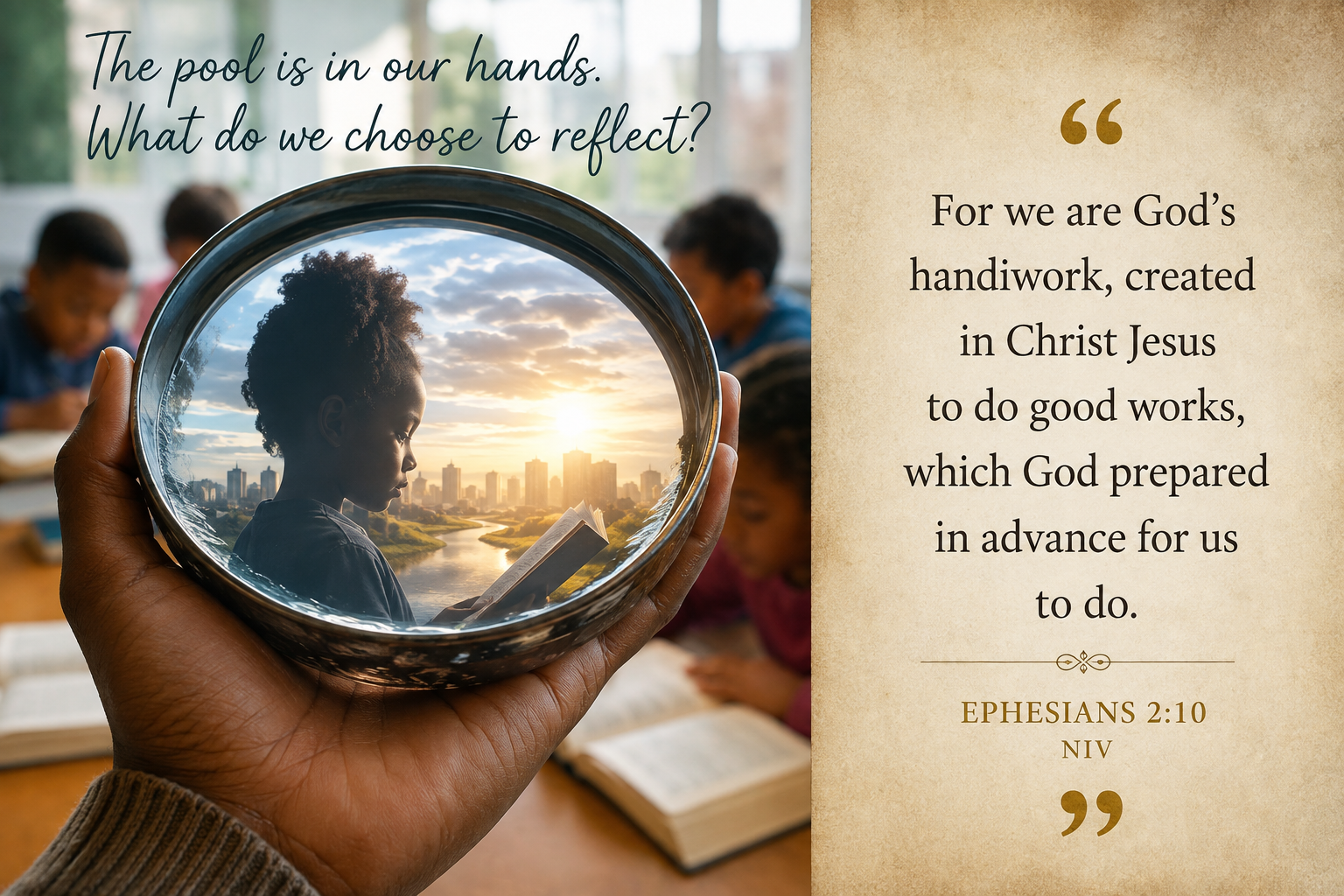
Narcissus’s problem was never that a reflection existed. His problem was that he could not pull himself away from it. And this time the pool is not in a forest. It is in our hands, on our desks, in our classrooms, and eventually inside nearly every decision we make.
The danger is not simply that artificial intelligence might one day become extraordinarily powerful. The danger may be that we become so mesmerized by what humanity has managed to create that we forget to ask where the intelligence, the imagination, the reason, and the ability to create came from in the first place.
Because perhaps the greatest danger of artificial intelligence is not that the machine eventually learns how to think like a human being.
Perhaps it is that human beings eventually decide they no longer have to think at all.
