
The Undercard
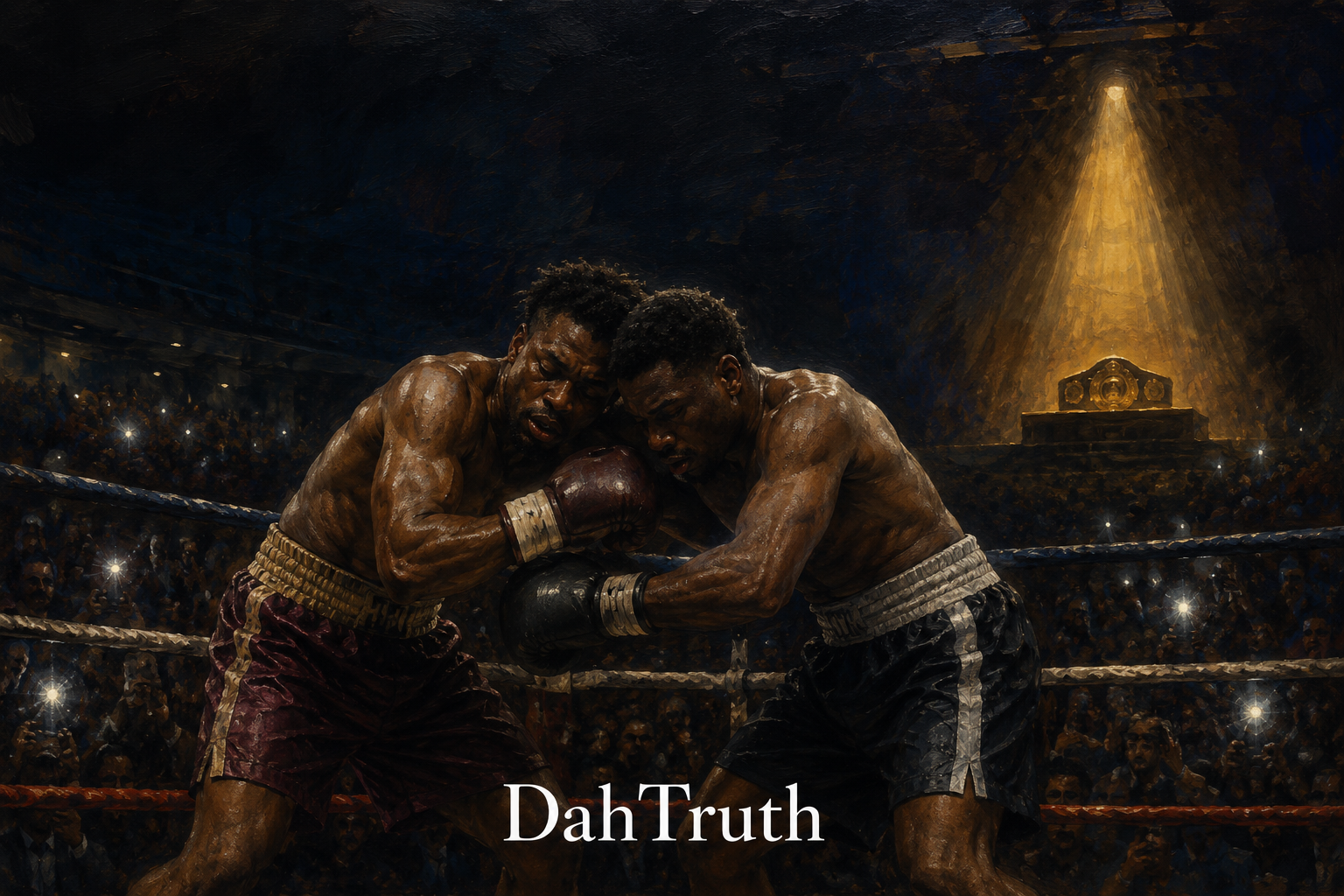
“It is better to hear the rebuke of the wise, than for a man to hear the song of fools.” — Ecclesiastes 7:5, KJV
On what fifteen thousand people paid to see, and what they walked past to get to it
Sometimes I worry severely about my community.
Not my neighborhood. Not my village. Not even my family. I worry about American descendants of slaves, and about the unfortunate habit we have of living up to a perception that was never ours to begin with. This past weekend gave me a great deal to worry about, because it was a weekend that showed me exactly how reality gets traded in for perception, and how cheaply we let it go.
Let me tell you about Saturday night.
*
I should tell you something before I go further, because I do not want to be dishonest about my own eyes. I do not like women's boxing. Something in me recoils at watching women take punches, and I am not going to dress that up as a considered position. It is not considered. It is a reaction, and I have had it my whole life.
Claressa Shields cut thirty-eight pounds in fourteen weeks and took back a championship on Saturday night, and my discomfort has nothing whatsoever to do with whether that is excellent. It is excellent. Those are two separate questions, and holding them apart is the exact thing I am about to ask you to do for the rest of this essay.
On Saturday the fifteenth of August, at State Farm Arena in Atlanta, about fifteen thousand people filled a building to watch a fight.
The main event was Claressa Shields.
If that name does not mean anything to you, sit still for a minute, because it should. Shields is from Flint, Michigan. Flint, where the water was poisoned and the country moved on. She won Olympic gold at seventeen in London and won it again in Rio, the first American boxer of any sex to take gold in consecutive Games. She has held world titles at four separate weights and at heavyweight besides. She calls herself the greatest woman of all time and has the ledger to make the claim an argument rather than a boast.
Saturday she came back down to middleweight to take on Kaye Scott, who held the WBA and WBC belts. Coming down meant cutting from one hundred ninety-eight pounds to one hundred sixty in fourteen weeks. Thirty-eight pounds. If you have ever tried to lose ten and keep your strength, you know what that sentence costs a body.
She stopped Scott at one minute thirty-eight seconds of the sixth round. Three left hooks in succession, a knockdown, a count, one more flurry, and towels coming into the ring from the other corner. Shields moved to nineteen wins and no losses. Scott had never been stopped before.
A Black woman from Flint reclaimed a championship in the fifth weight class of her career, in front of fifteen thousand people, on a Saturday night in Atlanta.
I saw this in my timeline, but not before I saw short after short of the prefight.
*
Here is what I saw first.
On the undercard, before the title fight, Ray J fought Orlando Brown. A promised three rounds. Ray J won by unanimous decision. Every outlet that covered it used some version of the same word: comedy. Neither man appeared to be trying to box. They grappled to the floor in the second round and threw punches that reporters described as arriving in slow motion. The clips were circulating online before the third round was over.
Floyd Mayweather was in that building. Terence Crawford was in that building. Two of the finest craftsmen the sport has produced in fifty years sat at ringside and watched that, and so did the rest of us, and the difference is they had also come to see the champion.
Now let's turn to the two clowns that were in the ring.
Ray J was in there three months after being knocked unconscious and hospitalized in a fight in May. He said afterward that the fight had been fixed. Three months later he is back under the lights, on a card built to go viral. Orlando Brown was a child actor on a Disney program that half our children grew up watching, and what has happened to him in the years since has been documented in public, over and over, by people who were entertained by it.
I am not going to inventory that man's suffering for you. I am not going to do to him on this page what a network did to him in that arena. What I will say is that both of those men were the product being sold, and I want you to sit with what the product actually was. Paid jesters who were willing to make a mockery of boxing for a payout.
People paid money to watch two hurting Black men fail to box each other, and it was funnier because they were bad at it, and it was funnier still because one of them we have watched come apart for years.
*
Now let me say the part that I think is fair, because I am not interested in standing over my own people with a switch.
We are tired of watching clowns.
There is a reason foolishness sells to us and it is not that we are frivolous. We have been carrying weight for four hundred years and laughter is one of the few things nobody has ever been able to tax or seize or legislate away from us. We made a whole tradition out of it. There is nothing wrong with wanting to laugh, and I am not going to pretend that I have never watched something ridiculous at the end of a long week.
So my argument is not that we should behave ourselves in front of company. I have no interest in respectability. I am not asking anybody to perform dignity for an audience that was never going to be satisfied.
My argument is about attention.
Attention is the one currency a people cannot borrow. You can raise money. You can organize labor. You can build an institution out of nothing, and we have, more than once. What you cannot do is get back the hours a community spent looking at the wrong thing. Attention is finite, and every hour of it is spent whether you decide where it goes or somebody else decides for you.
Here is the part I cannot talk myself out of. The promoter got it right. Salita Promotions put the championship in the main event and the spectacle on the undercard, exactly where each belonged. The building knew what it had come for. Fifteen thousand people sat there and watched a woman from Flint take a title back.
The inversion happened afterward, and it happened in our hands. The clips that traveled were the clown fight. The shares were ours. The group chats were ours. Nobody at that arena decided that excellence would become the undercard of the evening. We decided it, one thumb at a time, in the hours after the towels came in.
That is worse, and I want it to be worse, because it is the only version of this that we can do anything about.
*
Then there was Friday.
On Friday the fourteenth, Candace Owens sat down for three and a half hours opposite a man named Andrew Wilson, with Patrick Bet-David moderating, to debate whether a man named Tyler Robinson killed the conservative activist Charlie Kirk, or whether Tyler was the patsy set up to take the blame for it. Robinson is twenty-three, charged with aggravated murder and six other counts. He has entered no pleas. Prosecutors have said they intend to seek the death penalty. Nothing about that case has been tried.
I have no verdict to offer you and neither does anybody else yet. That is the entire point of a trial.
What I am able to tell you is what Owens said. She said that she believes France and Israel were involved in the assassination, and she said she was putting it out there with full confidence.
Full confidence.
There is no room for suspicion in that phrase. Not a question she wanted answered. Not a thing she was troubled by and wanted somebody to explain. Two nations named as accomplices to a political murder, offered to millions of people with full confidence.
Then Wilson asked her whether she had any positive evidence whatsoever that Israel killed Charlie Kirk.
She conceded that she could not say Israel was on the ground and shot him. She said she had been working to establish a motive.
Sit with the distance between those two moments, because the whole of what I am trying to tell you lives in it. The confident version went out to millions of people over the better part of a year. The concession came the first time somebody put money on the table and made her defend it out loud, and it took one direct question to get there. One.
The debate drew millions of views on the PBD Podcast channel within a day.
*
I wrote about Cambridge University this week and I did not expect the two pieces to shake hands, but they do.
At Cambridge, a room full of credentialed people looked directly at a document and could not see what was in it. Here we have the same faculty failing in the other direction. Owens looks at a case file and sees things she cannot show anybody, and states them with the certainty of a woman reading a thermometer, right up until the moment somebody asks her to produce them.
Those look like opposite errors. They are the same error wearing different clothes. Both are the failure to keep the distance between what you have evidence for and what you have decided. The professor who will not check because checking is inconvenient and the commentator who will not doubt because doubt does not sell are doing the identical thing. They have both stopped letting reality have a vote.
Do not miss what is similar between Ray J and Brown and Candace Owens. Money sits right in the middle of both of these stories. Greed is the culprit. Wilson went on Joe Rogan in early August and said he had offered Owens three hundred thousand dollars to defend her claims. She countered toward half a million with conditions attached. On the day of the debate, Wilson said from his chair that it had cost him three hundred thousand dollars to get her to sit down. Whatever else that was, it was a transaction. Certainty is a product now. It has a price, a distribution deal, and a view count, and the market rewards the person who never says the three words that ought to be the beginning of every serious argument.
I do not know.
The purse paid to Ray J and Brown has not been disclosed, and it has been speculated that both men are in serious need of resources. Whatever the figure was, it was evidently no small sum.
*
So here is the weekend, laid end to end.
On Friday, millions of us watched a woman name two foreign governments as accomplices to an American murder and then concede, when pressed, that she could not show it. On Saturday, an unknown number of us watched two damaged men stumble through three rounds while, in the same building, on the same night, one of the greatest fighters this country has ever produced took a championship back.
Now consider what did not get millions of views.
Nobody put up three hundred thousand dollars to debate why our children are leaving school unable to read the documents that govern their lives. There was no viral clip about the men in our neighborhoods burying each other before thirty. There was no pay-per-view about the pills and the powder that emptied a generation out of our households, though we did pay to watch what addiction has done to Black men and called it entertainment. Nobody cut a promo about the fathers who are not in the houses, or the grandmothers raising the third set of children they did not plan on raising.
Those things are real. They are not perception. They are the actual condition of the actual people I am worried about, and they went another weekend without our attention because our attention was already spoken for.
*
Scripture has a story about this and it is shorter than anything I have written here.
Esau came in from the field and he was hungry. His brother had a pot of stew. And Esau, who held the birthright, the inheritance, the thing that could not be earned and could only be received, looked at that pot and asked what profit the birthright would do him, seeing he was about to die. He was not about to die. He was hungry. He traded an inheritance for one meal because the meal was in front of him and the inheritance was not.
That is the whole mechanism. Nobody ever takes an inheritance from a people by force alone. They wait until the people are tired and hungry and the pot is warm and close, and then they let the trade happen, and everybody involved can say afterward that it was freely done.
We are the descendants of people who built this country's wealth and were not paid for it. Whatever else is owed to us, the one thing that has never been in dispute is that we are owed our own attention. It belongs to us. It is the last unmortgaged thing we have, and every week we hand it across the counter for a bowl of something warm.
Where your treasure is, there will your heart be also. Read that the other way around, which is how I think it was meant. If you want to know what a people actually treasure, do not ask them. Watch where their hearts went this weekend.
*
I am not asking anybody to stop laughing. I am asking a harder thing.
Claressa Shields cut thirty-eight pounds in fourteen weeks and won a championship on Saturday night, and most of us could not tell you her name this morning while we could quote the undercard. That is not her failure. She did the work. She has done the work for fifteen years and she keeps doing it whether or not we look.
It is ours. The excellence was in the building. We were watching the parking lot.
So here is my question. If a people can be reliably counted on to look at the clown and walk past the champion, what exactly is the value of the freedom to look wherever we want, and who benefits from the way we keep spending it?
This week, do one thing. Find the person in your own community who is doing the unglamorous excellent work. The teacher. The coach. The woman running the food pantry out of a church basement. The young man who got the certification nobody threw him a party for. Give them the attention you were going to give to the next clip. Say their name out loud to somebody else.
That is not sentiment. That is where our treasure goes, and our hearts are going to follow it either way. I would rather we chose the direction.
