
The Self-Proclaimed Savior at the Table
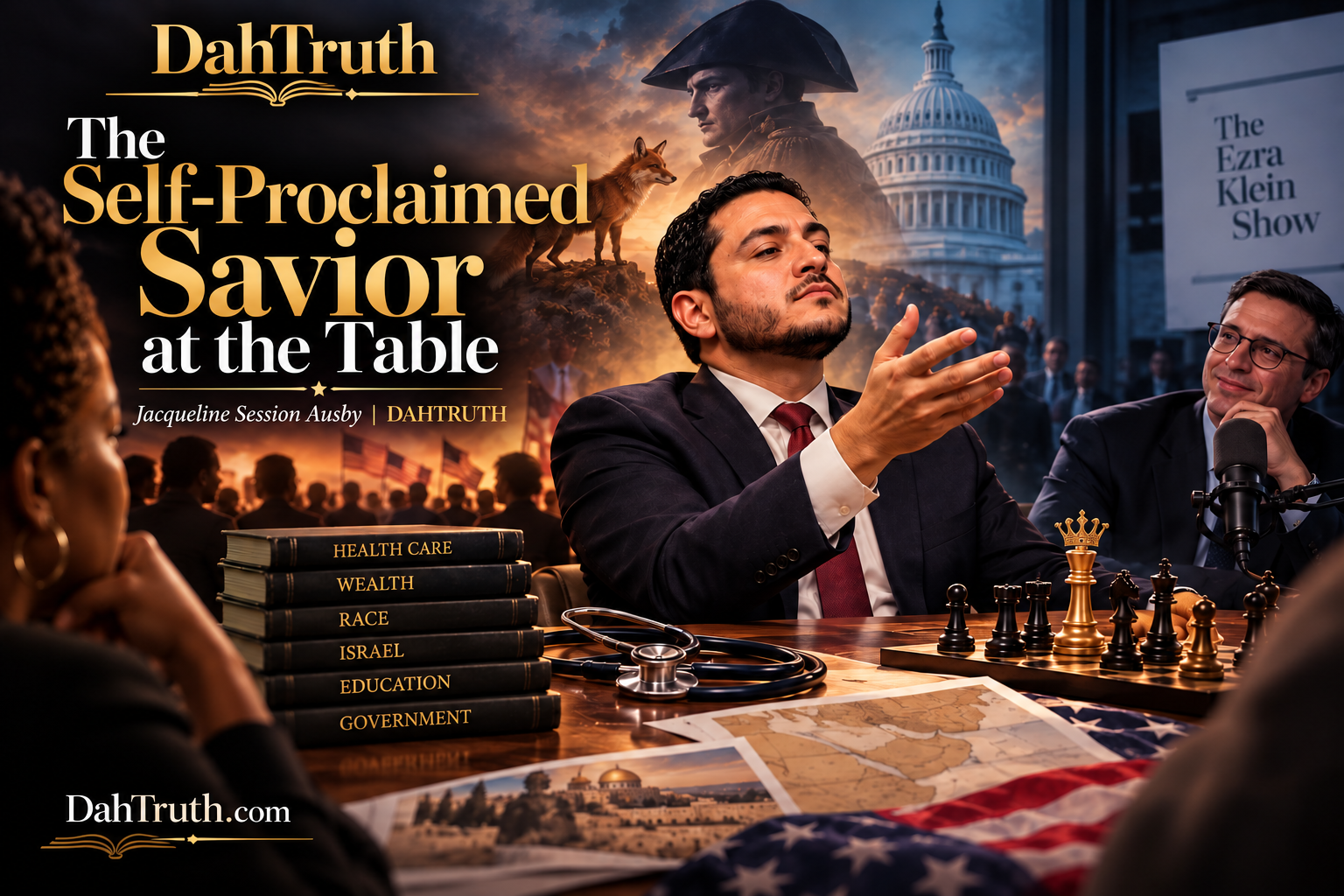
“Take us the foxes, the little foxes, that spoil the vines: for our vines have tender grapes.” — Song of Solomon 2:15 KJV
If Napoleon's spirit were roaming the earth today, I sometimes think it would recognize something familiar in Abdul El-Sayed, the Democratic nominee for the United States Senate in Michigan. I offer that as my impression of the man, and I will spend the rest of this essay showing you where it comes from. There is a confidence in the way he talks about remaking American systems that reminds me of a little man with very big plans. Listening to him on The Ezra Klein Show, I kept picturing a fox standing on a hill, looking out over the horizon, certain that if everyone below would only follow his plan, every problem in the valley could be solved. Health care, wealth, race, Israel, education, the role of government itself: El-Sayed has an answer for all of it.
Ezra Klein's episode, "What Does Abdul El-Sayed Believe?", was released on September 25 and runs more than an hour and a half. I watched all of it as Klein, a supposed journalist, sat and sucked in every word El-Sayed said like it was refreshing water. What bothered me most was how little of what El-Sayed said was ever forced to collide with the questions that should come after the promise. That is my larger complaint about the media, and this interview is simply the clearest example I have seen in a while. Journalists sit across from candidates they find sympathetic, let them tell their life stories, and never address the real issues underneath. I watched Ezra Klein sit there with a smile on his face while El-Sayed told his, and I found it sickening, because something kept surfacing beneath that story that remained unquestioned.
The Little Thing
It starts with little things. El-Sayed told the story of visiting his grandmother in Egypt, where she told him his cousins were smarter, nicer and more athletic than he was, but that he had the best thing of all: he got to go back to America. Klein let it pass as a sweet family story. I heard something else in it. His grandmother understood that the greatest advantage her grandson had was America itself. Yet that grandson has built a political career describing America as a place that fails its people, and he never seemed to notice the contradiction. Nobody asked him what his grandmother saw in this country that he spends so much of his time running down.
Then came the conversation about 9/11. El-Sayed spoke about how people in this country treated him afterward because of his name. I think that resorting to a name to illustrate some form of social injustice is simply a distraction. I doubt that it happened, but I continued to listen to his story of how he was affected personally after 9/11. And to be honest, El-Sayed told that story without ever addressing what actually happened that morning, when Muslim terrorists murdered nearly three thousand people on American soil. I wrote about that morning in "What the Passengers Knew," and I remember it too well to hear the story told with the attack itself left out. A good interviewer could have honored his experience and still asked him to speak about the terrorism that set it in motion. Klein did not.
The Doctor Question
El-Sayed continues to present himself as a doctor. He does hold a medical degree from Columbia and a doctorate in public health from Oxford. What he does not hold is a license. Politico reviewed medical licensing records in Michigan and New York this spring and found no sign he had ever been licensed to practice in either state, and he never completed a residency. Even so, he introduced himself as "a physician and epidemiologist" at an April debate before Detroit's Council of Baptist Pastors, and his campaign's answer to the reporting was that he has earned the right to be called doctor twice over.
This matters because the medical credential is the very thing he leans on when he talks about Medicare for All. He speaks about patients and treatment as though he spent years at a bedside, and he describes his training role in ways that make it sound like caregiving, when by his own account he turned away from practicing medicine while still in school. Klein could have asked him plainly: You call yourself a physician. Have you ever been licensed? Did you complete a residency? How much patient care have you actually provided? Those are simple questions, and voters deserve the answers before accepting a candidate's medical authority on health policy.
What Medicare for All Leaves Out
Then there is Medicare for All, the centerpiece of his campaign. On the show, El-Sayed described his plan as what Medicare is today. That description is very misleading. As a matter of fact, it is a straight lie. When Klein pressed, El-Sayed laid out something very different: he would first make existing Medicare more generous, bring premiums and deductibles to zero, add dental, vision, hearing and stronger drug coverage, and then lower the eligibility age step by step until the program covered everyone. Medicare as seniors know it today carries a monthly Part B premium, deductibles, and coinsurance that commonly runs twenty percent, and it does not ordinarily cover routine dental, vision or hearing care. The familiar word is doing a great deal of work to reassure people about a program far larger and far more expensive than the one they know.
He talked about our paychecks, about how we would no longer see money taken out for insurance. What he left out is the taxes we would pay in its place. No premium, no copay and no deductible still carries a cost, and that cost moves into the tax code, where the government also decides what benefits we receive. Today I can choose between Aetna, UnitedHealthcare, and Blue Cross Blue Shield. I may not love any of them, but I have options, and if one fails me I can go to another. Under a single government plan I would have one choice, and that choice would come from Washington. Insurance companies sit over our health care now, and El-Sayed's answer is to replace them with one payer that answers to politicians. To be fair, Klein did raise questions about wealth and systems, and he pushed on parts of the plan. He simply did not go far enough.
There is also the question of who gets covered. Medicare today was built for older Americans who spent their working lives paying into it. Extending a richer version of it to every person in the country is a different undertaking entirely, and El-Sayed has not always been precise about who "everyone" includes. In 2022 Senate testimony he spoke of covering every single resident from cradle to grave, and his 2018 plan for Michigan, MichCare, said the state would not consider federal immigration status and would cover undocumented residents who paid Michigan taxes. So does his current plan cover people who are here illegally? If it does, who qualifies, and who pays? Klein never asked.
Ten Minutes in the Restroom
I know a public toilet is a long way from health care, but I could not stop thinking about the bathrooms Mayor Zohran Mamdani just rolled out in New York City. The city is spending $4 million on a one-year pilot for 17 modular public restrooms across the five boroughs, free to use and open from seven in the morning until ten at night, run by a private company called Throne Labs. You get ten minutes. Warnings come at five minutes and again at eight. At ten, the lights flash, a voice announces that your time is up, and about thirty seconds later the door opens whether you are finished or not. To get in at all, you have to text a number, scan a QR code, use an app, or tap a card handed out by a community group.
Ten minutes in a restroom is not generous to a homeless person, at least I do not think so. Someone living on the street may need to wash up, change clothes, manage her period, or simply use the toilet without being rushed, and a person without a phone has to find a card just to open the door. The company says most people leave within a few minutes, and the city says the limit keeps a scarce resource moving. I understand the reasoning, and that is exactly my point. The government uses taxpayer resources to provide the benefit, and because the resource is limited, the government, or the contractor it hires, also decides how long you get to use it. If they control something as small as your time in a public bathroom, how much more control will they have over your health care?
A doctor's office is no public restroom, and I make no prediction about how long your visit would last. My question is simpler: what happens when a free benefit meets a limited supply? When health care is fully paid for by the government and coverage reaches everyone, more people will walk into doctors' offices, hospitals and laboratories, and they will walk in more often. With nothing to pay at the door, demand goes up, and so does the cost of running the whole system. That cost does not disappear. It lands on the taxpayer. And the people carrying the heaviest share will be the hardworking Americans who have paid into this system for years, now funding the same generous benefits for people who may have paid in far less, or nothing at all. I find it hard to call that fair. When prices climb and emergency rooms fill, the government will stop the clock, and rather than open the door, it will shut it tight. Then it will raise taxes and start to cut. Cut what it pays hospitals? Trim benefits? Let the waiting lists grow? Those are the only levers there are, and El-Sayed was never asked which ones he would pull.
Israel, AIPAC and the Money Nobody Asked About
Israel cannot be left out of this conversation, because for El-Sayed it is central. He calls what Israel has done in Gaza genocide, he wants to end American military aid to Israel, and he has made AIPAC a villain of his campaign. Klein and El-Sayed spent a long stretch on AIPAC, on Jews, on Israel, and on what El-Sayed calls a genocide. In that same interview, El-Sayed suggested that one of Israel's big war aims in the conflict with Iran was setting up the annexation of southern Lebanon. El-Sayed has condemned the October 7 massacre in other settings, but in this conversation I never heard a serious reckoning with Palestinian violence: the hostages, Hamas fighting from inside civilian neighborhoods, Hezbollah opening fire on Israel in support of Iran. I never heard him asked about Egypt, which controls Gaza's southern border and keeps it closed too. Israel alone was placed on trial.
His position on American weapons is more extreme than anything the Senate has actually voted on. El-Sayed supports a complete embargo on arms sales to Israel. Even Bernie Sanders, who has forced vote after vote to block specific sales of bombs, rifles and bulldozers, has aimed only at offensive weapons, and those measures have failed every time, most recently by 40 to 59 in April. A total embargo would reach the defensive systems too. That is why CNN's Van Jones, no conservative, called El-Sayed's position insane and dangerously extreme, pointing out that it would stop Israel from buying the interceptors that shoot down rockets fired by Hamas, Hezbollah and Iran, the same Iron Dome system Barack Obama championed. At a September 19 town hall in Saginaw, El-Sayed argued that the money spent on heavy bombs should go instead to Detroit's schools, health care and infrastructure, and he has called Israel an illegal apartheid regime that America should treat like any other country. Once again, Detroit becomes the backdrop for his argument.
AIPAC and its affiliated committees take part in American elections under federal campaign finance law, the same law every other group must follow. You may dislike its influence, but it is legal. So if pro-Israel money deserves a moral microscope, so does the money behind El-Sayed. A Fox News review of federal records found more than $115,000 given to his campaign by at least 41 people who work for, once worked for, or held leadership posts with the Council on American-Islamic Relations, known as CAIR. His father-in-law, Tayeb Jukaku, a former president of CAIR-Michigan, gave $300,000 in three separate checks to Fighting for Michigan PAC, a super PAC formed to back him. In July, the Unity & Justice Fund, a super PAC launched by CAIR's political arm, gave that same PAC $175,000.
CAIR has long faced allegations of ties to the Muslim Brotherhood and to Hamas-linked networks. In the Holy Land Foundation case, the largest terrorism-financing prosecution in American history, federal prosecutors named CAIR as an unindicted co-conspirator, and the foundation itself was convicted of funneling money to Hamas. CAIR was never charged, and it denies those ties. Money from a foreign national, a sanctioned group, or a straw donor would break federal law, and no one has shown that here. But it is fair to ask why Ezra Klein was so curious about AIPAC's money and so incurious about CAIR's. Who funds Abdul El-Sayed? Which organizations stand behind the people writing the checks? Klein never asked, and that silence is the double standard I am talking about.
The Black Women in His Stories
There is one more question Klein never asked, and it is the one that matters most to me. For all the time the two of them spent on Israel, AIPAC and Medicare for All, neither man stopped to consider the people El-Sayed keeps using to make his case at home. When he argues against weapons for Israel, he points to Detroit's schools. When he argues for Medicare for All, he points to Black mothers. When he needs a story about a broken system, he reaches for a Black woman. I watched that interview as an American Black woman, and that pattern is what stayed with me after it ended. It kept taking me back to a story a friend once told me.
I once had a friend tell me an unfortunate story about a promotion she received at work. There was a woman she had befriended at work, and that woman had told her, to her face, that she supported anything my friend wanted to do, and my friend believed her. Then some of the circumstances surrounding the promotion began to touch that woman personally, and her position changed almost overnight. My friend had been presented with two opportunities, and she chose the one this woman did not like. That choice was enough. The woman began speaking about her to other people behind her back and started presenting herself as the victim in the whole affair, even though she was the one who had placed herself in the line of fire.
What stayed with my friend was the feeling that she had overstepped an unspoken line. She found herself asking the questions American Black women know by heart. Should she have waited in the wings instead of asserting her capabilities? Should she have chosen the opportunity that fit someone else's thinking? Did making her own decision mean that, as a Black woman, she was being too bold? There was a time when she would have played it safe. She told me she no longer felt the need to. The threats that once overcame her had long been diminished and were no longer part of her psyche. She could speak clearly, articulate plainly, and make a decisive decision accordingly, and that is exactly what she did.
Every American Black woman I know has some version of that story. It is uncomfortable, and I have come to recognize it as part of our plight. We are perceived as weak and in need of saviors right up until the moment we assert our power, and then our power becomes the problem. That is where Abdul El-Sayed comes in. He speaks about American Black women as though we are the most oppressed people in this country: the ones most in need of healthcare for all, the ones who must be saved from neglect, from abuse, from violence, and from disease. Black women keep appearing in his stories. We appear when he talks about poverty, about maternal health, about Medicaid, about racism, and about HIV.
He tells of a woman he encountered while training in New York, an indigent patient who had fallen while intoxicated. By his account, the team was ready to send her out without a CT scan because she was treated as a "social" case, and she turned out to be gravely ill with AIDS. He has told that story many times as the reason he turned from clinical medicine to public health, and he has identified her as a Black woman. We have only his word for it, repeated over and over. And of course the woman in the story is poor, addicted and sick, and of course he is the one who saw what the system would not.
In an earlier blog, "A Warning From Detroit," I wrote about how he talks about going with his wife to her prenatal appointments, how he was by her side, how she could see a doctor who looked like her, and how so many Black women, in his telling, never get that same experience. He sets his own family's care beside ours so that ours can serve as the example of failure.
Every time, I have the same reaction. Why are Black women so often the vehicle through which Abdul El-Sayed explains what is wrong with America? We become the suffering woman, the poor woman, the woman whose doctor will not listen, the woman on Medicaid, the woman with HIV, the woman with the bad outcome. Then El-Sayed walks into the story as the one who sees the injustice everyone else missed. Some people hear compassion in that. I hear a man using the most painful and degrading examples he can find involving Black women to hold up his larger argument about America, and I resent it. I resent the idea that Black women have to be placed in the gutter before somebody can promise to lift us out of it. I do not accept the way he presents these conditions as though they define American Black women or our communities.
I have been reading Ibram X. Kendi's How to Be an Antiracist, and I agree with very little in it. However, one passage stayed with me. Kendi describes hearing a Black man speak with open contempt about other Black people, and it forced him to ask whether Black people can hold racist ideas about their own. What I took from it is that a racist idea does not become harmless because of who is speaking or because the speaker claims to be helping. A person does not have to insult Black women outright to diminish us. Sometimes the diminishment comes wrapped in concern.
So I am going to say it plainly: I believe there is something racist in the way Abdul El-Sayed talks about Black women. He has no need for a slur. The racism I hear lives in the way he repeatedly imagines us. You cannot continually present Black women as the sickest, poorest, most neglected people in America and then tell me the only thing moving you is concern for our well-being. At some point I have the right to look at the pattern and say, this is how you see us. I cannot see inside his mind. I can only tell you what I hear when I listen to the pattern, and I reject it.
That rhetoric takes agency away from Black women and hands it to him. In his stories we are the people something happens to: failed, ignored, mistreated, underserved. He gets to define the problem, explain our condition, decide what caused it, and then offer himself and his policies as the cure. He says he is elevating Black women. I hear him reducing us. It reminds me of the serpent in the garden, who studied Eve, found what he believed was her weakness, and offered her something that sounded like a gift. El-Sayed names the conditions he believes are the weaknesses in our communities and offers himself as the conveyor of our righteousness: free glasses for children, free health care for all, more for education, and always Detroit as the foundation of the story.
The truth is that American Black women have proven time and time again that we are the lead stompers. We are the ones in control, and we do not need to be controlled. We are the heartbeat of our community, the backers of our men, and the ones trusted morally when everyone else's word has run out. We vote, organize, work, raise families, build businesses, and lead churches, schools, hospitals and offices. Michigan's median household income is a little over $72,000, and Black women are among the workers, homeowners and taxpayers who make that state run. Our lives cannot be summed up by the worst statistic a campaign can find.
And here is the irony. Black women remain one of the most dependable voting blocs in the Democratic Party. Pew found that roughly nine in ten Black women voted for Kamala Harris in 2024. El-Sayed knows he cannot win Michigan without Black voters, especially in Detroit, and this summer he was struggling with them: a July poll had Haley Stevens leading him among Black voters by 46 points, and the Congressional Black Caucus and Jim Clyburn endorsed her. He speaks about us as though we have no power while seeking the very power our votes can give him. I believe he is using the American Black community because he knows it is his only way to win, and I find the pretense sickening, because the deceit is so easy to recognize.
A Seat Black Women Filled
The rescue language does not hold up to his record, either. This summer El-Sayed marked Black Women's Equal Pay Day by posting that Black women have to work an extra seven months to earn what white men earn in a year. Look at the job he held before he said it. In 2021 Wayne County chose Melita Jordan to lead its Department of Health, Human and Veterans Services. She was picked from more than 35 candidates after four panel interviews, meetings with every one of her direct reports, and a tour of the jail's medical operations, and the County Commission approved her unanimously. She is a Black woman, and she came to the job with the kind of experience El-Sayed only talks about. She began her career as an advanced practice nurse in midwifery, directed maternal and child health hospital units, and ran the nurse-midwifery program at Temple University's medical school. She led Pennsylvania's Bureau of Family Health, with 125 staff and a $400 million budget, and then spent eight years as a senior executive at the New Jersey Department of Health. She was hired at $180,000 in the middle of the pandemic, built the county's community outreach plan for COVID-19, and brought in $5 million in new grant money for testing and vaccination.
In December 2022 the county announced that El-Sayed would take her place. He started in March 2023 at $200,000 plus benefits and paid parking, according to county commission records, and his June 2025 Senate financial disclosure reported $278,939 in pay from Wayne County. When he left, the director's job went to Kennyle Johnson, another Black woman and his own chief of staff, at $180,000. So a Black woman who spent her career delivering babies and running maternal health programs was replaced by a man who never held a medical license, and that man now campaigns on Black maternal health. She actually managed patients, and she did not use the county's health department as a launching pad for a political campaign. He did both of the things she did not: he talked about patients he was never licensed to treat, and he left the job to run for office. A man who mourns the Black woman's paycheck while being paid more than the Black women on either side of him in the very same seat has shown us what his concern is worth.
More importantly, two educated Black women stand on either side of his time in that office. One led the department before him, and the other leads it now. Yet he goes around talking as though American Black women are hopelessly oppressed and downtrodden, and as though he alone has come to save us. The proof against his story was sitting in his own department.
His résumé tells its own story about what these seats mean to him. Mayor Mike Duggan appointed him in 2015 to rebuild the Detroit Health Department, which had been handed off to a nonprofit during the city's bankruptcy, and he left in early 2017 to run for governor. He lost that 2018 primary to Gretchen Whitmer. Wayne County Executive Warren Evans then appointed him to the county job in March 2023, and on April 1, 2025, he announced he was resigning to explore a run for the Senate. Two public health departments serving some of the most heavily Black communities in this state, and he stayed at each one for roughly two years before using it as the launching pad for the next office. The people of Detroit and Wayne County deserved a health director who meant to stay, and what they got was a candidate between campaigns.
The Table in Detroit
That brings me to Kamala Harris. On September 22, El-Sayed sat beside her at Birth Detroit for a roundtable on Black maternal health and healthcare costs. He did not bring out just any Democrat. He brought out the first Black woman to serve as vice president and put her beside him at an event built around Black women's bodies. Harris told the room that an attack on DEI is "an attack by definition on maternal care," and she said she knew El-Sayed would be a champion on the subject.
By definition? That is where I stop. Maternal care is prenatal appointments, competent doctors and nurses, a hospital close enough to reach, a provider who knows whether a woman has high blood pressure, diabetes or fibroids, someone who recognizes an emergency, and care in the months after the baby comes. You can argue that particular programs help in some of those areas. Declaring that opposition to DEI is automatically an attack on Black mothers is a political slogan dressed up as medicine. And once again, Black women become the reason the policy must exist, the suffering body placed in the middle of a political argument.
Consider who sat at the head of that table. The son of an Egyptian immigrant and the daughter of a Jamaican father and an Indian mother, neither of them descended from people enslaved on this soil, gathered to discuss how Black women must be protected through pregnancy, childbirth, and the months that follow. Our mothers and grandmothers carried and delivered this community through conditions far worse than anything discussed at that table, and they did it without a Senate candidate appointing himself their champion.
The irony runs deeper. In 2024, Harris stood with the Biden administration's basic position that Israel had a right to defend itself, even as she spoke about Palestinian suffering and called for a cease-fire and the release of the hostages. El-Sayed went much further. He backed Michigan's uncommitted movement, which grew out of anger at that very administration's support for Israel, and he now calls what Israel has done genocide. Those are no small differences. Yet when he needed help reaching Black voters, there sat Harris beside him, and suddenly Gaza was off the table. Black women were the subject instead. Two politicians who disagree on one of the biggest issues dividing their party found common ground on our health, our bodies and our experiences, and Black women have every right to notice when that happens.
So when I hear an individual like Abdul El-Sayed speak about American Black women in ways that diminish our capability and our character, it makes me angry. It makes me want to scream at the nonsense. It is what Harry G. Frankfurt would describe as bullshit, and I will use that word once, plainly, because this has earned it. What is even more disturbing is watching some American Black women align themselves with his malarkey and agree with his degradation of our plight. I must state that it is bewildering and disgusting. I understand the pull. The rescue story comes with a microphone, a seat at the roundtable, and the warm approval of people who like us best when we are hurting. But it asks us to trade the truth about who we are for the comfort of someone else's narrative, and that is a bad trade at any price.
Why America Should Be Careful
I believe Abdul El-Sayed is a dangerous choice for Michigan and for this country, and I want to be precise about why. What concerns me is the accumulation of what he is asking Americans to accept, and the confidence with which he presents government as the answer to everything. His platform calls for Medicare for All, abolishing ICE, ending American military aid to Israel, taxing billionaire wealth, and abolishing the filibuster. Taken together, those positions point toward a government with far more control over American life, and I want to know how much authority individual Americans would be surrendering to it.
His record adds to my concern. He has never stayed long in any office, and each appointment has become a platform for the next campaign. A senator serves six years and votes on military aid, on war, on treaties, and on the people a president appoints to run our government and our armed forces. When a man who calls Israel's war a genocide, who would cut off even the defensive weapons that protect Israeli civilians, who told Ezra Klein that Israel's war aims included annexing southern Lebanon, and who this week was criticized for declining to explicitly condemn Iran's Revolutionary Guard asks for that kind of power, Americans are right to ask what he would do with it.
I also believe he has learned to move carefully. The Democratic Socialists of America have called for abolishing the Senate itself, and I believe El-Sayed has put distance between himself and that movement because no one wins a Senate seat by promising to eliminate it. His platform calls for abolishing the filibuster instead. He gives voters crumbs of what he believes and keeps the rest for later, and too many of us are consumed with other things to notice.
Asking these questions is simply scrutiny of power, and Americans should apply it to every politician, Republican or Democrat, Christian, Jewish or Muslim, who asks us to place more authority in his hands. The trouble is that we are so busy with everything else that we stop paying attention, and the journalists who should be asking the hard questions sit back and smile. If we are not careful, we will hand power to someone like Abdul El-Sayed and have only ourselves to blame.
My friend was offered a bargain at work: keep someone's support as long as you choose what they want. She chose for herself. American Black women in Michigan will be offered the same bargain this November. We have never been waiting in the wings, and we do not need to be saved by a man who cannot see us standing. I hope they think before they vote blue no matter who.
