
Just Enough
“Money helped create the space, but what they are doing with their minds belongs to them.”
It is a rainy Saturday, and I am feeling a bit melancholy. My grandsons are out getting their haircuts, two of my granddaughters are in the kitchen burning toaster strudels, and I am sitting here listening to the rain as the cars drive past, reminding me what a wonderful day it is to stay inside and do absolutely nothing. So I have been strolling through old pictures of my family, looking at my life and how far we have come, how far I have come at least, from New Jersey Avenue to Pine Hill, New Jersey. And looking at those pictures, I realize I got out of life everything I probably wanted, or at least everything I thought about wanting when I was a young person.
I never wanted to be super wealthy. I just wanted to have enough, you know, just enough to make it. Enough to eat, enough to sleep, enough to drive, enough to not always be struggling, downtrodden, begging, or having to rely on the system. Growing up, I kind of knew it started with education, or at least I believed it did. Really, I think that belief was instilled in us more than it was something I figured out for myself. Because when I got out of high school, I realized I had to go to work first, and then, as I worked, build up my skill set by adding education to it.
So for me, education came second. What came first was hard work. What came first was resilience. Those things came first, and then came the recognition that without a degree, I was in a second position. I wasn't working jobs where I used my hands. I was working jobs where I used my brain, and I figured that if I was going to have to think my way through my work, I had better get the degree. So I went back to college at 28. I got my bachelor's degree at 31, and I got my master's degree in my late 40s. Those degrees have put me on a different plane. I am nowhere near rich, but I am no longer on the low end of the middle class either. I am probably in the higher echelon of it.
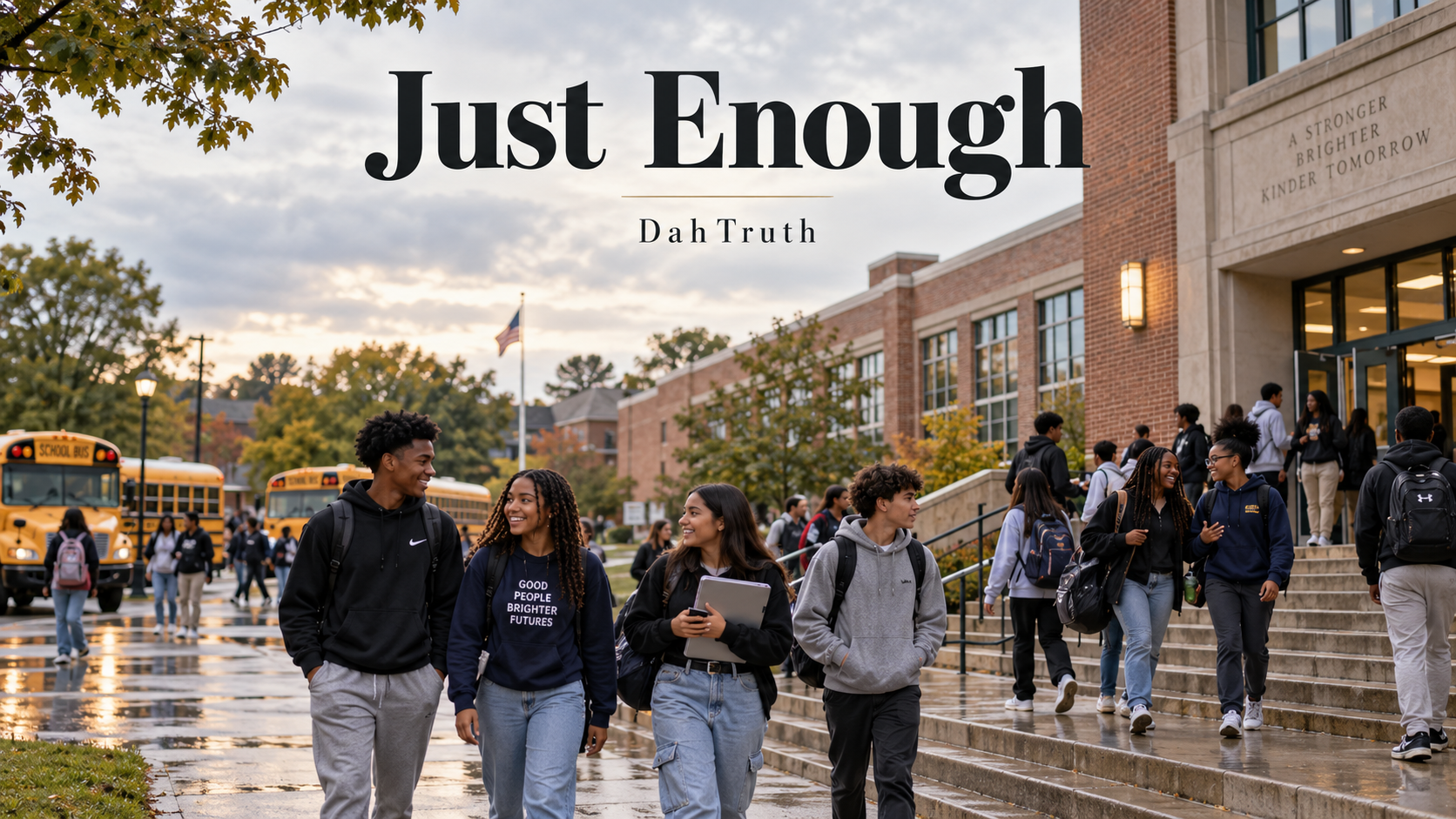
And that position has given me something bigger than money. It has given me the opportunity to create space for my grandkids to come and live with me, along with my son and his wife, and to watch them grow. They were in a school system in New Brunswick, New Jersey, that was at the bottom. When they came to live with me in Pine Hill, they entered a school system that sits more in the middle bracket, and I have watched them go from the lower end to excelling at the highest level. Right now my oldest grandson is in a program where, after four years, he will graduate from high school with an associate's degree.
I am writing about this to make a point, but before I get to that point, I want to talk about a book I just finished reading, Purple Hibiscus by Chimamanda Ngozi Adichie, a Nigerian writer. In that book there is a clear dynamic between being a wealthy African and being a poorer African. There does seem to be a middle class, but the middle class is still poor. They struggle with petrol. They struggle with food. They struggle with the conditions of the housing they live in. And below them there seems to be an even lower class, where the struggle for food and energy is greater still, where not having a generator means the power goes out and stays out.
The main character, Kambili, and her brother Jaja go to visit their Aunty Ifeoma, who has two sons and a daughter and who works at the university in Nsukka where she lives. Kambili and Jaja come from wealth and attend Catholic school. Their cousins live with far less. And yet, looking at those two households, what stood out to me is that when it came to education and intellectual knowledge, the children seemed to be on the same plane, even though they came out of two completely different schooling environments.
Both sets of children excel, but they excel in different ways. In the wealthier family, the focus seems to be on studies. In the poorer family, there are studies too, but there are also conversations. There is art. There is intellectual stimulation that comes from outside the constant striving to get A's without ever really internalizing what you are learning. That kind of thinking gets built through caring adults, and in a school, it depends on teachers who care enough to instill it in their students.
Which brings me to something I read this week in The New York Times Magazine, Nikole Hannah-Jones's new essay titled "In Fighting for Every Black Child, Did I Betray My Own?" Ten years ago she wrote about putting her daughter, Najya, in a high-poverty, predominantly Black public school in Brooklyn, and now, with Najya sixteen, she is looking back on that decision. I thought to myself how twisted her version of education is compared to a place like Nigeria, or even a place like where I come from. For me, it has never really been about the resources. It is about the work ethic and the work you put in. It is about training. Opportunity, in my life, came through hard work, diligence, and resilience, and wealth had very little to do with it.
I will say plainly that I think Nikole Hannah-Jones is overrated. So much of her work, to me, reeks of her own entitlement, her own privilege, and a way of looking down on other communities. I think the 1619 Project was off. It painted Americans, white Americans in particular, as if they are all still part of a racist regime, and as if every individual American owes a debt. I believe America owes a debt. The American government should pay that debt. But individual Americans living today do not personally owe it. Yes, there are still racists in our society, but we are not living in the 1950s, and her work carries forward a sense of continued oppression as if nothing has changed.
In all of her writing, her persona, and her attitude, I see someone who wants to be a kind of savior of American Black culture. She wants to be the critic of American systems and American history, and at the same time she wanted to be the savior of the New York school system, or at least she put herself in the position of trying. That was her mission in putting her daughter in that school, to bring her child and her family's resources into a struggling school and somehow lift the Black children who were already there. She kept her daughter in that system through elementary and middle school. Then her daughter asked her the question any of us could have asked for her: did you know my school was bad like this when you put me here? And in eighth grade, when Najya finally got to choose her own high school, she chose a screened, mostly white and Asian school, the very kind of school her mother spent a career arguing against. Now Hannah-Jones writes that she feels she failed both her values and her child.
I can remember growing up, if you lived in a certain neighborhood, people would sometimes use another person's address just to get their kid into a better school. Parents have always tried to send their children to what is best for them. That is what parents do. So there is a self-righteousness in the idea that you can save an entire school system by placing your child in it, without actually improving the system itself. She had the ability to create different circumstances for her daughter's outcome, and she chose to make her daughter part of her mission instead.
And here is the part of her story that makes my point for me. Her daughter came from a middle-class home, with educated parents and resources that many of the other children in that school did not have. And still, Najya was bringing home strong grades in algebra and then could not pass the state Regents exam. When she got to that more demanding high school, she needed serious help to catch up to classmates who came in better prepared. All that money and all that education in the house did not protect her from being taught to collect grades instead of learning the material. That is the same thing I saw in Purple Hibiscus. Resources do not dictate a child's fate, and they certainly do not determine a child's mind. What happens in the classroom, and in the home, and inside the child, is what counts.
There is no doubt that education is an issue in some American Black communities, and in some American communities, period. There are teachers who do not care about their students, and there are some who are just doing a job and collecting a paycheck. But the bigger problem, as I see it, is that the more we lean on testing, testing to get into better schools, testing to get into Ivy League schools, testing to ultimately get good jobs, the more that mentality ripples through every community in America. Instead of teaching for teaching's sake, teachers are programming students to pass tests and post high scores so they can get into the next school. That is the dysfunction in our school system that needs to change, and I think that is exactly the point Nikole Hannah-Jones missed. Worse than missing it, the way she tells her story reeks of the belief that she had, and still has, the solution to all of our problems.
So I come back to where I started, sitting in my house on this rainy Saturday with the smell of burnt toaster strudels coming from the kitchen, waiting for my grandsons to come home with their fresh haircuts. I did not get here because I was born with resources. I got here through work first, resilience first, and education after that, and now my grandchildren get to start a little further ahead than I did. They are excelling, and I believe that is because of what they are putting in, what is being poured into them, and the expectation that they will think for themselves. Money helped create the space, but what they are doing with their minds belongs to them.
