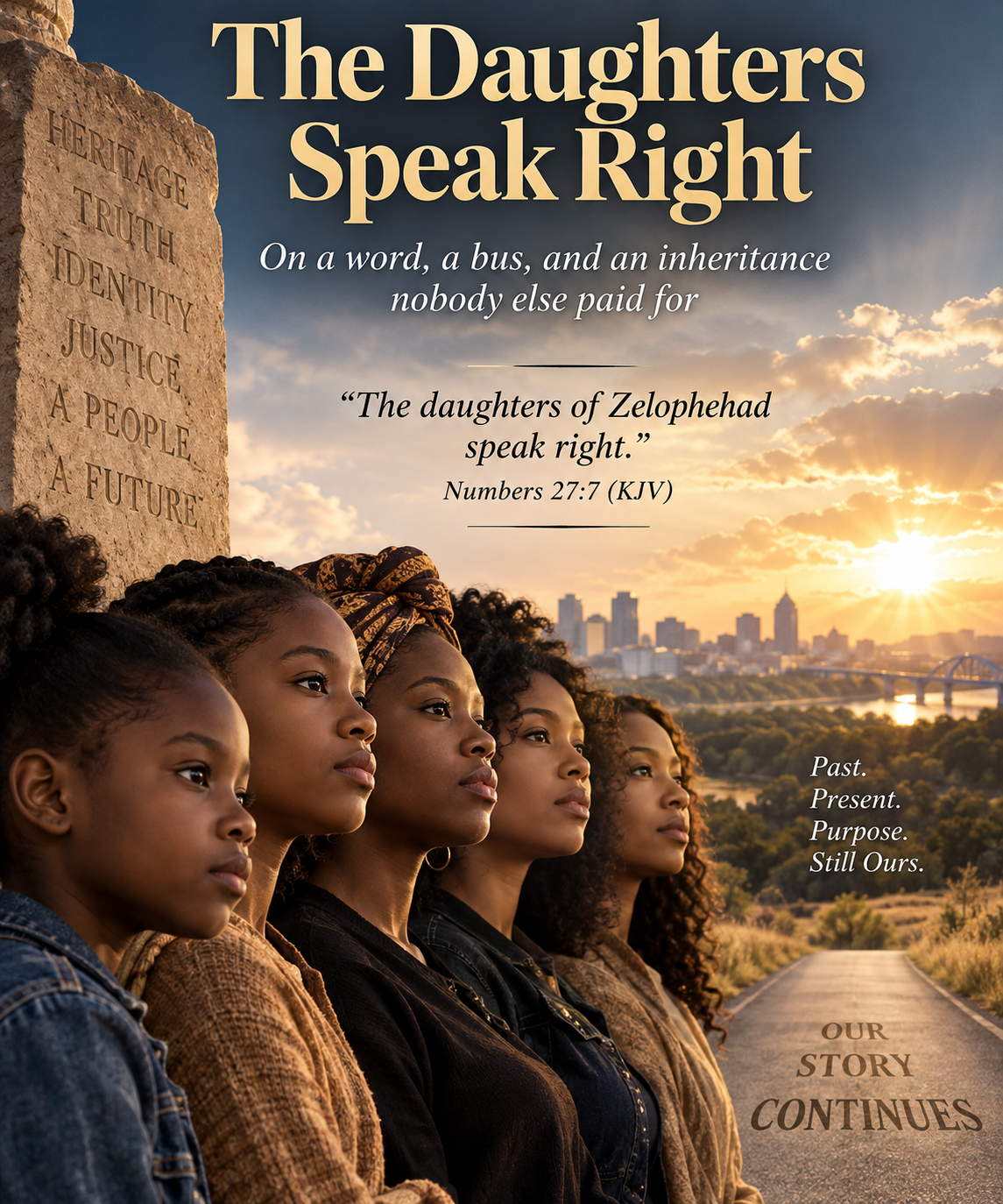
The Daughters Speak Right
Numbers 36:7, KJV “So shall not the inheritance of the children of Israel remove from tribe to tribe: for every one of the children of Israel shall keep himself to the inheritance of the tribe of his fathers.”
On a word, a bus, and an inheritance nobody else paid for
“The daughters of Zelophehad speak right.”
Numbers 27:7
I. The Word
Nigger. One word, and the oldest argument we have about it: who may say it, who may not, and who gets to decide.
I will confess first. The word does not carry much weight for me. I understand its history, and I also understand that it is a word. I have used it myself, and never carelessly. When it has crossed my lips or run across my mind, it has come in a vicious and ugly moment, and it told the truth about my condition in that moment more than it told anything about the person I aimed it at. Among friends it can do the opposite work. It can be a term of endearment that pulls another person up to the level of family. It is an odd word that way. It curses and it claims kin. In both uses it reveals the speaker, and that is the only rule about it I trust.
In early September the rapper Fat Joe, who is Puerto Rican and Cuban, sat on The Joe Budden Podcast and was asked whether he had ever reconsidered his use of the word. He answered by declaring himself Black. The Blackest, he said, that anyone had ever seen. His evidence was the Bronx. He grew up beside us, came of age inside hip-hop, and has been greeted with the word since he was a child. When the backlash came, quick, fast, and in a hurry, he added Afro-Cuban ancestry to the claim. He did not apologize. He said he comes from the block that invented hip-hop.
Marc Lamont Hill, a co-host of that podcast who was absent that day, gave the best short answer anyone gave: “There’s no honorary degrees in Blackness.” Living close to a people does not make you one of them.
I cannot tell Fat Joe what words to use. Nobody can, and I have no interest in policing his mouth. I am interested in what his mouth reveals. The word was made in American slavery, for American slaves, and their descendants carried it through Jim Crow and carry it still. Whatever ancestry Fat Joe holds through Cuba, that lineage is not his. When he reaches for the word, he reaches for an inheritance of suffering he did not pay for, because in America that inheritance comes with cultural credit. He wants the blessing without the birth.
Scripture has already heard a case like this one. When Israel stood at the edge of the promised land and the portions were being counted out by family, five sisters came before Moses and the whole congregation: Mahlah, Noah, Hoglah, Milcah, and Tirzah. Their father, Zelophehad, had died in the wilderness and left no son, and his portion was about to vanish. “Why should the name of our father be done away from among his family?” they asked. Moses carried their cause before the Lord, and the answer came back plain: “The daughters of Zelophehad speak right.”
It was a claim made by lineage, in a father’s name, by women nobody expected to hear from, and God ruled for them. Hold on to that. I will come back to it.
II. The Definition
This whole argument lives inside a definition, so let me give mine. Black, as the world uses the word, is global. It covers the Nigerian, the Jamaican, the Afro-Cuban, and the Congolese. American Black is narrower and older. It names one people: the descendants of slaves in the United States, the people who were called Negro and then called themselves Black, who built a culture under the lash and under Jim Crow. ADOS, American Descendants of Slavery, is the name for that lineage.
Dr. King wrote in Where Do We Go from Here: Chaos or Community? that “we are the descendants of slaves,” the offspring of men and women kidnapped from their homeland and carried away in chains. He did not stop there. “But we are also Americans,” he wrote, and he insisted that our destiny is bound to the destiny of America. Two years before that book, in 1965, the Hart-Celler Act opened the door to large-scale immigration from Africa and the Caribbean, and in the decades since, the word Black has been stretched to cover everyone who arrived. The stretching is my subject.
III. The Panel
On September 15, Joy Reid took up the Fat Joe affair on her show under the title “Uniting the Diaspora, Part 1: Who Is Actually Black?” Reid is a first-generation American, the daughter of a Congolese father and a Guyanese mother. Her guests were Hill, the writer Michael Harriot, Nana Gyamfi of the Black Alliance for Just Immigration, and a Nigerian-born commentator who goes by The Merc.
I wonder why Reid believes she should lead this discussion, since nobody in the American Black community asked her to. She opened the hour by asking whether the global Black community can unite in time to save our democracy, fifty days before the midterm elections, and she said there are not enough of us in this country to fight each other and the fascists at the same time. So the unity has a deadline, and the deadline is Election Day. Still, she asked questions she did not ask seven years ago at MSNBC: whether African Americans feel that Black immigrants show them solidarity, and whether those immigrants give them enough credit for laying the foundation of the civil rights they now enjoy.
She wanted the Caribbean given its credit first. African American history has a lot of blending in it, she said, and she named Stokely Carmichael, Malcolm X’s family, and the children of Jamaican immigrants who helped start hip-hop. Then she admitted the separation. Foreign-born Black people, she said, arrive with an image of African Americans “identical to the image that white foreign people have,” and they treat us accordingly. She called it a dichotomy.
She described the immigrant’s double mind plainly. There is admiration, she said, for a culture that everyone copies, a culture she called “sort of supreme throughout the world.” Alongside it, among the newcomers, runs a sense that they can get away with more.
Then she said the thing I did not expect to hear from her. On the continent, she observed, nobody is divided by black and white, because everyone is Black. The divisions are tribal. African Americans, she said, are in some sense a tribe of their own: the one group made of many tribes, mixed together at random by slave owners, who then formed a distinct culture that is imitated around the world, and who can claim a specific lineage. Harriot added that Black America is older than some of the peoples on the continent it is compared to.
I note for the record that this is some distance from 2019, when her MSNBC program gave a platform to the claim that people organizing under the ADOS banner were likely Russian botsYvette Carnell, who co-founded the ADOS movement, has said she woke one weekend morning to find herself described on that program as an agent of misinformation, and that nobody from the show had called her first. Carnell’s reply to the tribe remark was short: “Yes, we’re a tribe, Joy.” She added that she was sorry it took ten years. It seems Joy has been enlightened. A tribe is exactly what we are.
Scripture has a rule about tribes, and it comes from the same case. After the five sisters won their father’s portion, the elders worried that the land might drift away from the family over time. The ruling was completed: “Neither shall the inheritance remove from one tribe to another tribe.” Every tribe was to keep its own. Nobody in Israel called that division. It was how each tribe remained a tribe.
The Merc gave the panel its most honest moments. It was shocking to hear him say that growing up in Lagos he did not know Black Americans had whole, stable families until he watched The Cosby Show and A Different World. The image of us that reached Nigeria, he explained, was made by white people and exported. He spoke the truth about what follows. The immigrant arrives desperate to succeed, studies the power structure, and sees quickly that Black Americans sit at “the bottom of the ladder.” So he attaches himself to white institutions and keeps as far from us as he can. He called it a survival instinct.
He went further. American institutions, he said, actively put African immigrants ahead of Black Americans. To the eye he is just another Black man, and he has been arrested in this country for things he did not do. Once the police hear his accent and realize he is not American, he said, “the whole situation changes.” He also said he owes his American education to what Black Americans did before he came, and that a people who will not say “this is my group, this is what I deserve” leave themselves open to infiltration.
Malcolm X said the same thing on television sixty years ago. They are not lynching Puerto Ricans, he told a panel. A Negro who speaks Spanish, or ties his head up in a turban, can go anywhere in Mississippi he likes, and African students in the South were arrested only when they were mistaken for us. “The problem is the Negro problem,” he said. The foreigner gets a pass the native son never gets. Malcolm meant that the problem belonged to us and that we would have to solve it ourselves.
Nana Gyamfi made the argument from power. If one in five Black people in this country is an immigrant or the child of one, she asked, how do you get rid of twenty percent of your population by declaring that they are not part of you? Her number is sound. Pew Research put the figure at 21 percent in 2022, and its newer count is closer to a quarter. I concede the arithmetic and answer the argument.
First, naming ourselves removes no one. The Jamaican is still Jamaican American and the Nigerian is still Nigerian American, with a flag and a history of his own that he is rightly proud of. Second, run the arithmetic the other way. If a quarter are immigrants and their children, then three quarters of Black America is ADOS, and a majority needs no permission from a minority to say who it is. Third, a head count becomes power only when the whole bloc carries your claim. On this very panel The Merc said the newcomer steers away from us and is advanced ahead of us, and Hill said the murkiness of “we are all Black” is used to deny what we are owed. A larger number that waters down the one claim belonging to us alone has made us weaker.
Then there is Hill. Early in the show he said he is “not here to be the race police,” and that anyone with demonstrable African roots who moves through the world as Black is Black to him. But when Gyamfi asked how a people can declare a fifth of its population not part of it, Hill pushed back. He would not dismiss lineage. There are traditions and experiences, he said, that only the descendants of U.S. slavery can fully understand. His own great-grandparents were enslaved in this country, his people are Georgia and Virginia people, and even the way they did church was different. It is too easy to say we are all Black, he said, because that “ain’t exactly true either.”
Later he went all the way. The collective identity, he said, cannot come at the expense of the particular justice claim of Black Americans. We have a “lineage specific justice claim,” and it should not be denied by the argument that we are all Black. When the government wanted to send stimulus checks, he noted, it found everyone in the country without any trouble. I give him full credit. That is what ADOS has been saying for years.
Now watch the frame that was built around those concessions. Reid set it up: the trouble with this conversation, she said, is that Black Americans start saying they do not care about immigrants being deported and do not care about Palestinians, and can be weaponized against other Black people. Hill agreed. While we point at each other, he said, our open enemies take the resources, and that is how we “start to echo MAGA talking points.” He named our “obsession with Americanism,” the flags on our social media pages, and then said it outright: do not do the flag.
Here Hill and I part. Dr. King said we are also Americans, and I take him at his word. Carnell answered Hill on her own show better than I can: “We put the flag in our bio to claim what we built here.” She also noticed what I noticed. The immigrant keeps the flag of the country he left in his profile, whatever that country did to him, and nobody on the panel asks him to take it down. A descendant of American slaves who flies her own flag and declines to carry another people’s cause has echoed nobody. She has counted what her own house needs.
The Merc closed with a warning that Ann Coulter and Tucker Carlson have praised lineage-based movements in order to keep a reparations coalition from forming, and Reid added the name of John Tanton. Carnell has answered the Tanton charge in the open. He donated to an immigration group on whose board she once sat, she never met him, and he died in 2019. She asks why anyone assumes that a Black woman on a board must be somebody’s tool. In 2019 we were Russian bots. In 2026 we are the dupes of Ann Coulter. The charge has better manners now, and it does the same work.
Harriot got the last word and spent it on Palestine, which he offered as the parallel for how a diaspora is divided. Reid signed off by promising more episodes, including one on whether reparations should be global or limited to African Americans, and by hoping to see everybody “rowing together on this little ship” to save our democracy. I wondered, as she closed, what gives her the authority to answer that question. On her way out she mocked a candidate for governor of Florida whose people, she said, “weren’t even here during Jim Crow.” She did not name him, but the description fits Byron Donalds, the Brooklyn-born congressman who said in 2024 that during Jim Crow the Black family was together, and who says his words were twisted. If his people came here after Jim Crow, then he is the child of immigrants exactly as Joy Reid is. So the lineage test exists after all, and she knows how to use it. It is available when the target is a conservative. It was never applied to the two people in my next section. Reid opened this very hour by saying that of course Kamala Harris is Black, and she treated the people who asked the question as the problem.
That is the panel in full. They granted the tribe, the lineage, the justice claim, and the favor shown to the immigrant. The series is still called Uniting the Diaspora. They grant the argument and keep the conclusion.
IV. The Borrowers
None of this is new. We have watched it at the highest level of American politics, twice.
In March 2007, Barack Obama stood in a pulpit in Selma and told the congregation that the movement there had brought his parents together. He was born in 1961. The march across the Edmund Pettus Bridge was in 1965. He later explained that he meant the civil rights movement as a whole. Obama is the son of a Kenyan father and a white mother from Kansas. His African lineage is real and direct, and it does not pass through American slavery. He married into an ADOS family, and that marriage is part of how he earned our trust. Then he spent it. He opposed reparations, and he told us more than once that he could offer no agenda aimed at us because he was president of all America.
Kamala Harris was born in Oakland to a Jamaican father and an Indian mother, both immigrant graduate students. By the world’s definition she is Black through her father. She is not American Black. She rode a bus to an integrated elementary school in Berkeley, spent her high school years in Montreal, and then chose Howard University and pledged Alpha Kappa Alpha. I do not doubt the affinity. Affinity chosen at eighteen is still a choice, and ADOS is what you are when there was never a choice.
In June 2019, on a debate stage, she turned to Joe Biden, raised his old opposition to busing, and told the country about a little girl in California who was bused to school every day. “That little girl was me.” Within hours her campaign had posted a childhood photograph with that line, and a T-shirt carrying her picture as a girl was on sale on the campaign website that same day for about thirty dollars. She inflated her story to place it beside the busing the rest of us remember. The ride itself was real. The Berkeley school district confirmed that she rode in the second year of its program. What the story left out is that Berkeley’s plan was adopted by its own school board in 1968, in a liberal college town, with no court order and no mob. Biden said as much that night: hers was a local decision, and local decisions were never what he opposed.
She told the truth about the bus and borrowed the meaning of it. School desegregation was won by ADOS families, by the children of Brown and Little Rock and New Orleans. She was a beneficiary of that fight. On that stage she cast herself as its wounded party.
Their defenders will answer that both of them identified sincerely, that American racism never asked either one for a family tree, and that watching them rise had value for every Black child. I grant all of it. Then I ask for the ledger. What did ADOS, specifically, receive?
With Harris I can answer from the record, and I will say plainly that I did not support her run for the presidency. As district attorney of San Francisco she prosecuted parents over their children’s truancy, and as attorney general she championed the 2011 state law that made it a misdemeanor carrying up to a year in county jail. She has said she never jailed a parent herself. Under her law, prosecutors elsewhere did, and one of the mothers arrested was a Black woman named Cheree Peoples. Harris later called that an unintended consequence.
In 2010 a scandal at the San Francisco crime lab ended in the dismissal of drug cases by the hundreds, after a judge found that her office had failed to disclose what it knew. Early counts ran to five or six hundred. By the end, about a thousand cases had been dismissed or dropped, some of them after conviction.
As attorney general, lawyers in her office argued against extending enhanced early-release credits to minimum-custody prisoners, warning that it would deplete the state’s inmate labor force, including its fire camps. Harris later said she was shocked to learn her office had made that argument, and she disavowed it. And when she was asked in 2019 about a policy aimed specifically at Black Americans, she said she was not going to promise something “that’s only gonna benefit Black people. No.” Her argument was that whatever helps Black families helps the whole country. That is the ledger.
V. The Nickel
I know something about buses. In 1977 I was nine years old and in the third grade in New Brunswick, New Jersey. My school was Washington School, on French Street, where all my friends were. That year I was put on a bus and sent across town to a school in a white neighborhood. My mother always told us we were bused for integration. I never saw the paperwork, and nobody explains such things to a nine-year-old. To this day I cannot tell you whether it was for racial balance or for lack of desks. I can tell you what I found when I got there.
My teacher’s name was Mrs. Ford. Mrs. Ford was not a nice teacher. She had a way of singling out the Black children, or at least that is how it felt to one of them. She kept a tin of butter cookies, the kind my mother bought only at Christmas. The rest of the year we had the vanilla and chocolate creams. For a nickel a day, a quarter a week, a child could have a cookie. We were dirt poor. My mother could not give me a nickel a day. So on most days Mrs. Ford served cookies to the children who had paid, and the rest of us sat and watched them eat.
I got slick. Mrs. Ford kept no record of who had paid, so whenever we had a substitute I told the substitute I had paid. When Mrs. Ford came back I told her I had paid for the week. If she had been out three days, I counted a week and three days and said forty cents. I was nine, and I could run that arithmetic in my head for a butter cookie.
One day I told my mother what I had been doing, and she beat me. She had no nickel to give, and she would not have a daughter who lied for a cookie. I will tell you honestly that the beating was worth every cookie. I still want to know how a teacher creates a hardship for the children under her own watch.
The next year I went back to Washington School for the fourth grade and the fifth. Most of my friends had never left. There we were all poor.
The school across town was Woodrow Wilson Elementary, named for the president who segregated the federal workforce and screened The Birth of a Nation in the White House. I learned that later. In August 2025 the New Brunswick Board of Education took his name off the building, citing that legacy, and renamed it for a longtime local principal. It took forty-eight years.
Washington School did not last that long. It was torn down after I left it. The New Brunswick Free Public Library keeps a photograph of the building coming down. The side wall is peeled away so that the classrooms stand open to the street. The windows are still in their frames on the half that has not fallen, and the bricks are heaped at the corner of French and Louis. Somewhere in that open side was a fourth-grade room where everybody was poor and nobody watched anybody else eat.
Kamala Harris got a debate line and a T-shirt out of her bus ride. I could not get a nickel cookie out of mine. I am past competing over whose bus was harder. The cost of this history was paid in particular rooms by particular children. Those children have a name. Why should the name of our fathers be done away? It is not available for borrowing.
VI. The Vest and the Oil
The image I have been reaching for belongs to Yvette Carnell, and I will give it back to her. We tried globalism, she said in her response to Reid’s panel, and we tried Pan-Africanism. Look at every measure and ask whether it worked. “This globalism is not working,” she concluded, and you have to put the life vest on yourself first. If you cannot save your own child, your own neighbor, and your own community, you will save nobody in Kenya or Nigeria.
She answered the charge about Palestine as well. Nobody in ADOS says the Palestinians should perish, she said. It is not in us to say it. What has changed is the strategy. Solidarity is now a contract: tell me what you want, I will tell you what I want, and we will see whether both can be had. We showed up for everyone for sixty years out of the goodness of our hearts, and our own claim still waits at the back of the line.
Reid wants everybody rowing together on one little ship. We have rowed. Jesus told a story about this too. Ten virgins waited for the bridegroom, five with oil for their lamps and five without. At midnight the foolish said to the wise, “Give us of your oil.” The wise answered, “Not so; lest there be not enough for us and you.” They were not rebuked for it. The door opened to them. There is a kind of sharing that leaves everybody in the dark.
So let Fat Joe say what he wants. I will not police him, or Reid, or Hill, or anyone else. I will do what Mahlah, Noah, Hoglah, Milcah, and Tirzah did. I will stand up in my father’s name, in front of the whole congregation, and state the claim. It was heard once before, and the ruling still stands. The daughters speak right, and the inheritance does not move from tribe to tribe.
There we were all poor. We were also one people. That is where the repair is owed, and that is where it will have to begin.
