
Give Us A King
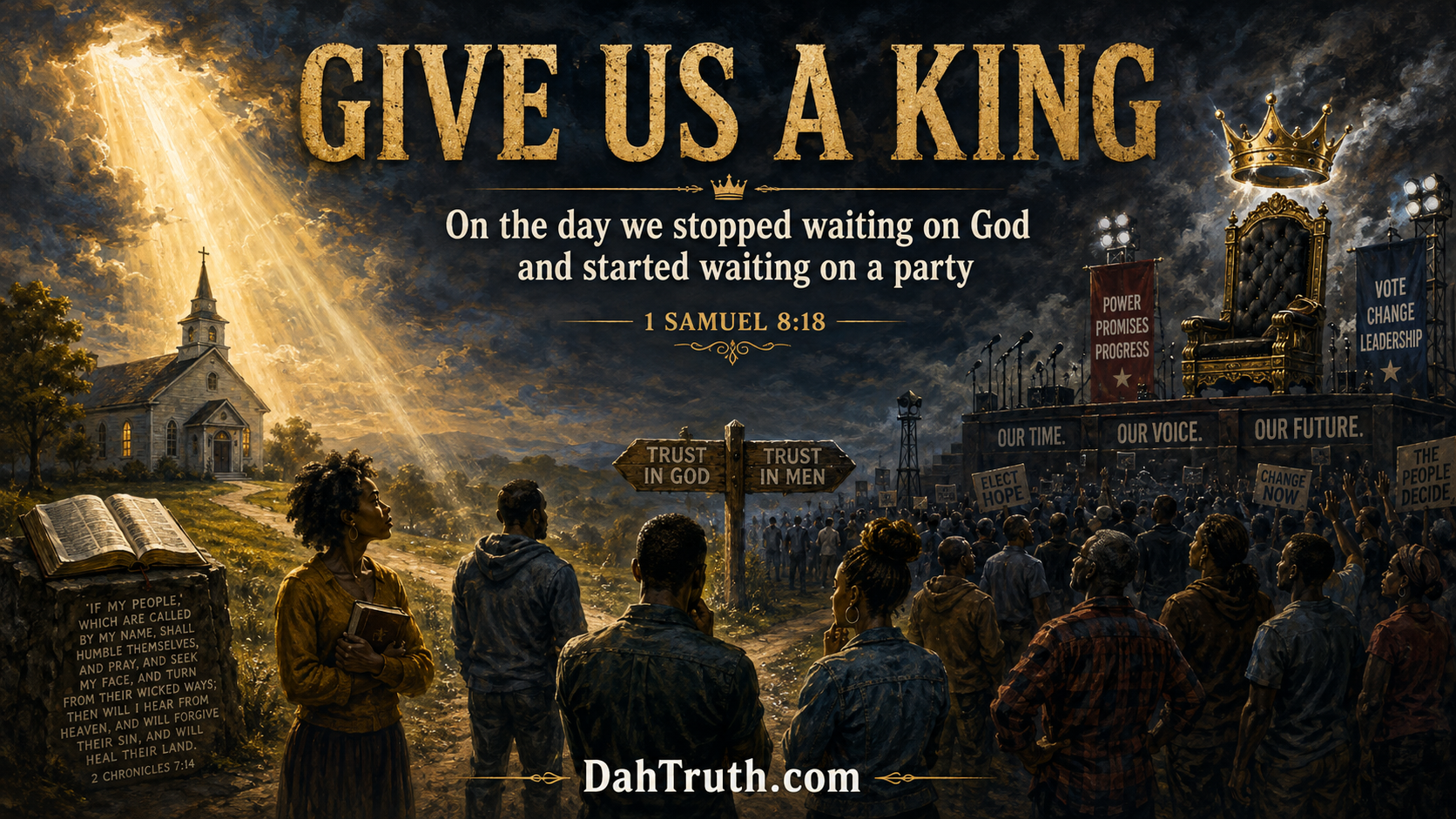
“And ye shall cry out in that day because of your king which ye shall have chosen you; and the LORD will not hear you in that day.” 1 Samuel 8:18
On the day we stopped waiting on God and started waiting on a party
I. The Waking
This Sunday I opened my eyes with a single thought, to get to the house of the Lord.
It was not a bright morning. The sky hung low and overcast, and rain waited somewhere behind it. I went anyway, because His promises are Yes and Amen, and what He asks of us is one thing. Trust. He has never failed me and He never will. That is a small thing, going out under a gray sky, and I would not have thought about it twice except for what I heard when I arrived at the small community of believers.
The sermon was about trust.
As believers in Jesus Christ we are called to trust God, not only with our salvation but with every area of our lives. God is Jehovah Jireh, our Provider. Our provision does not come finally from the government, the system, or humanity. It comes from God.
When the Israelites came out of Egypt, God provided for them every single day. He gave them manna from heaven, but only enough for that day. He did not permit them to store up tomorrow’s portion, because He was teaching them something greater than survival. He was teaching them dependence. Every sunrise required another act of faith. Every morning they had to trust that He would provide again.
I sat with that longer than I expected to, because the manna is not the end of the story. The manna stopped. Scripture says it ceased the day after they ate of the produce of the land, and from then on they ate the fruit of Canaan. God did not withdraw His provision. He changed its form. He moved them from bread they watched fall from the sky to bread that came up out of the ground, and that is a harder trust, because the hand becomes invisible. A people can eat every day of their lives and forget who is feeding them.
That is what happened to them. In the wilderness they had nothing and trusted God for everything. Generations later they had fields and cities and harvests, and they went to Samuel and asked him for a king, so they could be like the other nations. The demand for a king did not rise out of their hunger. It rose out of their abundance.
Somewhere along the way we made the same exchange. As an American Black community we had survived and thrived despite the obstacles of Jim Crow and racism, and despite leaving the South behind and forging north into an unknown world. We traded our trust in God for trust in systems, institutions, and government. Our desire for more government has drawn us away from the One who has always been faithful and toward the belief that security is found in what man and his systems have built rather than in what God provides.
That shift is not only political. It is spiritual. When a people stop trusting God to provide, they begin trusting government to become their provider, and once that happens, dependence becomes a useful thing to the people who administer it. Useful for control. Useful for votes. Before a nation changes politically, it changes spiritually.
We are not a people waiting on God to move. We are a people standing at Samuel’s door, asking for a king.
❦
II. Give Us a King
The elders of Israel came to Samuel at Ramah with a request that sounded reasonable. Samuel was old. His sons walked in their own ways, took bribes, and perverted judgment. Give us a king to judge us, they said, like all the nations.
Samuel was grieved, and he took it to the Lord. The answer he received did not concern him at all.
They have not rejected thee, God told him, but they have rejected me, that I should not reign over them.
That is the verse the whole account turns on. The elders had a governance complaint and God heard a spiritual transfer. They believed they were asking for better administration. He told Samuel they were asking to be ruled by something other than Him.
Then He instructed Samuel to warn them, and the warning is not vague. Read what a king does.
He will take your sons and appoint them for himself, for his chariots and to be his horsemen. He will take your daughters to be confectionaries and cooks and bakers. He will take your fields and your vineyards and your oliveyards, even the best of them, and give them to his servants. He will take a tenth of your seed and give it to his officers. He will take a tenth of your sheep. And ye shall be his servants. 1 Samuel 8:11-17
The word repeats until it becomes the whole meaning of the office. Take. A king was not described to them as a giver. He was described, in advance and in detail, as a taker, and the taking would begin with their children and end with the tenth part of everything they owned.
Then the last warning, which is the one nobody quotes.
And ye shall cry out in that day because of your king which ye shall have chosen you, and the LORD will not hear you in that day.
Not that He could not. That He would not. There is a kind of suffering that comes from an arrangement a people asked for, and God told them plainly that He would let them keep it.
They heard all of it. Scripture says they refused to obey the voice of Samuel, and they said, Nay, but we will have a king over us, that we also may be like all the nations, and that our king may judge us, and go out before us, and fight our battles.
Go out before us. Fight our battles. That is the exchange stated in their own mouths. They were willing to be taken from if someone else would do the fighting.
We know what the king took from Israel. The question worth asking is what he is taking now, and from whom, and whether the people paying have noticed the price.
❦
III. If You Want to Win
A reel came across my timeline this week, posted by Native Land Pod. In it, Tequila Johnson, co-founder and chief executive of The Equity Alliance in Tennessee, a woman who has registered our people by the tens of thousands and has more field experience than most of the men who go on television to explain us, was answering a question about why Democrats will not invest in the South, given that more than half of all Black voters live there.
Her answer was that the party is not afraid of the South. It is afraid of Black leadership. Afraid of funding our media, our strategists, our organizations, our operatives, our candidates at the rates they actually require. Afraid, she said, of Black power and what it would do to their agenda.
She said something else that I have not been able to put down. Being a Black organizer in the South, she said, is full-time work, and the point of it is to humanize us in this work, to make sure we are not just a number on a door sheet. She does not want to be funded as a conduit to knock on doors when elections come. She wants to be funded so that people get fed and their needs are met, so that when elections come around, they know us and trust us.
Then she closed: invest in Black leadership if you want to win.
This was a clip, and a clip is always somebody’s choice about what to show. I am responding to what was put in front of me, and to what Native Land Pod decided was the strongest part of what she said.
I want to give her every bit of her due, because she has earned it and because I think she is right about nearly everything she describes.
We are a number on a door sheet. Anyone who has worked a cycle knows it. The vans arrive in September and leave in November, the consultants who never set foot in the neighborhood collect on the contract, and the people who actually know which house has a grandmother who will talk to you are paid in pizza and a T-shirt. Her frustration is real, it is specific, and it is the frustration of somebody who has done the work.
Sit with that last sentence, though.
If you want to win.
Who is the you?
It is not us. The entire argument is addressed to the Democratic Party, and the return on investment she offers is the party’s victory. Fund our leaders, and we will feed the people, and the people will trust us, and we will deliver them to you.
Follow the circle, because every step in it is rational and not one step produces ownership.
The party funds our organizations. Our organizations meet needs in the community. The community, having been met, comes to know and trust the organizations. The organizations deliver the community at election time. The party wins the seat. Then the party funds our organizations again, at whatever rate seems warranted by last cycle’s yield.
Turn that circle for sixty years and the party has thirty terms in office and we have thirty rounds of programming. On the day we stop turning it, we have nothing, because nothing in it was ever transferred to us. We were never buying. We were being paid, and the payment was calculated against the value of the delivery.
She is not asking for the land. She is asking for a bigger share of the crop, and she is asking the man who owns the land, and she is making her case by promising him a better harvest.
I have called this policy sharecropping before and I will call it that again. The sharecropper who negotiates his share up from a third to a half has negotiated well. He has also agreed, in the act of negotiating, that the land belongs to somebody else.
Now the part that stopped me, and it is the reason this essay exists.
She said the purpose of the funding is to feed people and meet their needs, so that they know us and trust us when the election comes.
Read that as a believer and not as a strategist.
The feeding is instrumental. It is not the end, it is the mechanism, and the product it manufactures is trust. Trust to be harvested on a Tuesday. I do not say that as an accusation against her, because I do not think she is being cynical. I think she has been so long inside an arrangement that she has stopped being able to hear what she is proposing, which is a machine that converts our hunger into our loyalty and then converts our loyalty into somebody else’s seat.
That is manna administered by a king. It comes daily, it comes from a hand you can see, and it teaches dependence on the giver. That is exactly what it is designed to do.
The difference between that and what God did in the wilderness is not the bread. It is who you are looking at when you eat it.
There is one more thing in what she said, and I am going to say it gently. She noted that white people are going to be white people, that even the well-meaning ones hold themselves a class above when it comes to political strategy because they believe they built this system and understand it.
She may well be right about the men she has dealt with. Look at what that observation concedes, though. If the people who control the money cannot help themselves, then the strategy she is proposing is to keep bringing our harvest to a class of people she has just told us cannot be changed. That is not a plan for power. That is a description of a permanent arrangement, offered by someone who has correctly identified that it is permanent.
They are not asking for Black power. They are asking for a king.
Read the mechanism again and it is Samuel 8 in modern dress. Give us someone to go out before us and fight our battles. Give us someone whose business it is to see about us. We will bring what we have and he will send back what he decides we need, and we will be like the other nations, who also have someone to see about them.
Because the faces on the mailer are ours, and the organizers are ours, and the cadence is the one we grew up hearing on Sunday, we have been taught to call the arrangement Black power.
It is not Black power. It is Democratic power with our name on the invoice.
The elders of Israel got the king they asked for, and he was one of their own. From the tribe of Benjamin, a head taller than any man in the nation, an Israelite through and through. He took their sons and their daughters and the tenth part of their seed exactly as Samuel warned, because what made him a taker was never his ancestry. It was the office. A king from among your own people is still a king, and the first thing any king requires is that you keep bringing him something.
We want a king. We have agreed to pretend that he is ours.
❦
IV. The Best of Your Fields
He will take your fields and your vineyards and your oliveyards, even the best of them, and give them to his servants.
On Tuesday, Michigan Democrats choose a nominee for the United States Senate. The contest is between Congresswoman Haley Stevens and Dr. Abdul El-Sayed, and by the time the polls open, something close to sixty million dollars will have been spent to decide it.
Consider what that number means before you consider anything else about the race. Sixty million dollars, in a primary, in one state, for one seat.
Where it came from is a matter of public record. As of late July, the AIPAC-aligned United Democracy Project had spent roughly twenty million dollars supporting Stevens, and a group called A Stronger Michigan had spent almost seventeen million more on her behalf without disclosing a single one of its donors, being funded almost entirely by an organization that does not disclose either. On the other side, the largest outside group supporting El-Sayed had spent a little over two million, and its filings show money from the Institute for Middle East Understanding. Counting everything, outside groups committed something near fifty-one million dollars to boosting Stevens or attacking El-Sayed.
He has run against that money and made it the center of his campaign. He has also pledged to refuse super PAC support while a super PAC formed to counter pro-Israel PACs spends on his behalf anyway, and he released a tax return only under weeks of pressure, and not the full ones his opponent demanded. She released hers and demanded he release his, while quietly requesting extensions on her own financial disclosures every year she has served in Congress. Each of them is transparent about exactly the thing the other is hiding.
Set all of that aside for a moment and ask a different question.
What were they fighting about?
Sixty million dollars came into Michigan, and nearly every dollar of it was deployed in a quarrel over a war seven thousand miles from Seven Mile Road. One side’s money came from people whose central commitment is the state of Israel. The other side’s money came from people whose central commitment is opposition to it. That is a real disagreement, and men of conscience hold both positions.
It is not a Detroit position. Neither one of them is.
Not one of those sixty million dollars was fighting over whether a child on the east side can read. Not one was contending over the nine in ten of us who die of overdose without ever having been reached by treatment. Not one was spent arguing about who owns the buildings on the block, or what happens to the men coming home from Jackson, or why the neighborhood clinic closed. Two armies met in Michigan, spent a fortune, and the thing they were fighting over was not us.
Both of them want Detroit, and both have spent the final weeks trying to get it. She has been working the churches in Wayne County. He points to his years as the city’s health director and then the county’s, the free eyeglasses he put on children’s faces, the polluters he went after, the lead he took out of the pipes. Those things happened. Neither one of them is a stranger here and I am not going to pretend they are.
What I notice is the shape of it.
When Bernie Sanders and Alexandria Ocasio-Cortez came to Detroit to rally for him, the room was overwhelmingly white, in the largest majority-Black city in America. Congressman Clyburn said afterward that he saw a photograph of that rally and did not see a single person who looked like him, and that this told him all he needed to know. Meanwhile an AIPAC-funded super PAC has been running an advertisement featuring Barack Obama praising Haley Stevens, and Barack Obama has not endorsed Haley Stevens.
Our faces are in the commercial. We were not in the room.
He is down forty-six points with us. So today, two days out, he is walking our streets and sitting for our media.
Larry Nix is a sixty-three-year-old Army veteran. He pulled into a cookout hosted by the El-Sayed campaign, rolled down his window, and said he needed answers. Haley Stevens had come to his house during previous campaigns, spoken with him, and put a sign in his yard.
That is what showing up means to a man who has been here the whole time. Not a cookout in the last fortnight. A knock on the door in a year when nothing was at stake.
Tequila Johnson said she does not want to be funded as a conduit to knock on doors when elections come. She named the thing exactly, and here it is, forty-eight hours out, both campaigns on our blocks, sixty million dollars spent, and the block itself learning nothing about either of them that it did not already know.
Keith Williams, who chairs the Michigan Democratic Party Black Caucus, said the truest thing anybody has said about this race. He does not want to see people die in the Middle East, he said, but his people are dying every day in the hood, from gun violence and from not having the education they need to survive in this community.
He is right, and nobody spent sixty million dollars on what he just described.
That is the vineyard. The harvest of a place, gathered up and handed to the servants of a court, to settle disputes the people who grew it were never consulted about. Samuel told them the king would do this. He said the best of it, not the leavings. Then he told them the part we forget, which is that when it began to hurt, they would cry out and would not be heard, because the arrangement was one they had asked for.
I have no counsel to offer either side of that war. What I know is that our fields are being harvested for it, and that both armies will be in our churches by Sunday.
❦
V. The Silence
On July 2, Andrew Gillum was pulled over in Daphne, Alabama, for driving erratically. An officer saw a glass pipe on the center console. The search that followed turned up rolled marijuana cigarettes and three packages of a substance that tested positive for methamphetamine. He was booked into the Daphne City Jail, transferred to the Baldwin County Correctional Facility, and released the following day.
He is forty-six. He was mayor of Tallahassee, and in 2018 he came within roughly thirty-four thousand votes of becoming the first American Black governor of Florida. He co-hosts Native Land Pod with Angela Rye and Bakari Sellers. This was not the first time. In 2020 he was found in a Miami Beach hotel room in an incident involving suspected crystal meth, and no charges were filed.
His colleagues did not abandon him. The podcast told its audience he would be absent and asked for prayer. Angela Rye spoke about it on the air, plainly and with feeling, and said she had no intention of turning her back on him, that a person should not be reduced to his worst moment. She was right. I will not pretend otherwise, and anyone who watched that segment saw something real.
Then the show went back to work.
The episode that carried the audience’s messages of support for him also covered a security breach at a concert, a governor turning down summer food funds, and a rapper who paid for a presidential pardon that never came. Two days after the arrest he appeared at the Essence Festival in New Orleans, on a panel about the midterm elections, and said nothing about it. The stage went on.
I want to be careful here, because this is not about one man’s failure. It is about what his failure reveals.
Andrew Gillum has money, a national platform, and colleagues who love him publicly. He could not get free of the addiction that runs rampant through our communities. If a man with all of that cannot get free, what do we imagine is happening to the woman on the third floor of a building nobody has repaired since 1994, who has neither the access nor the resources?
Here is what is happening to her.
In the most detailed federal analysis of overdose deaths by race, among American Blacks who died, only 8.3 percent showed any evidence of having received substance use treatment beforehand. That is the lowest share of any group measured. More than nine out of ten died having never been reached by anyone. Nationally, in 2023, an estimated 54.2 million Americans needed treatment for a substance use disorder and 12.8 million received it.
Now hold that next to this. Overdose rates were higher in areas with more treatment program availability than in areas with less, and among American Blacks the gap was 34.3 against 16.6.
Read that again. The buildings existed. The grants were awarded. The ribbon was cut and somebody stood behind a podium and called it an investment in the community. The death rate in those places was double.
That is the whole argument in a single line of data. A program is not a person. An appropriation is not an outreach. A facility down the street that no one on your block has ever walked into is not help, it is architecture, and we have been taught to accept the architecture as the answer.
I will tell you the part that complicates my own case, because you deserve it and because someone will say it if I do not.
Things improved. The CDC reported in January of this year that overdose death rates fell for every group between 2023 and 2024, and that the largest decline of all was among American Blacks, down 30.9 percent, from 48.9 to 33.8 per hundred thousand. Provisional figures through January 2026 project another 13.2 percent national decline.
That is real and I thank God for it.
It is also not what it appears to be. A rate of 33.8 still sits far above the national rate of 23.1. We fell the furthest and we are still dying at the highest rate in the country. The decline came largely through changes in the drug supply and through the distribution of naloxone, which is to say we got better at reviving people after they stopped breathing. That is worth having. It is not restoration. The bleeding slowed. Nothing was rebuilt. No father came home. No man was discipled. No young woman was taken in by anybody’s church and taught who she is.
We were revived. We were not delivered.
Through all of it, count the hours of commentary you have heard on the recovery of American Black men from addiction, and set them beside the hours on the last election, the next election, and the man in the White House. Count the segments on prison reform, on family formation, on homeownership, on business formation, on why our children cannot read, and set them beside the segments on what some senator said on a Tuesday.
The elders told Samuel they wanted a king to go out before them and fight their battles. We have people who will go out before us and fight our battles on television every week. The battle they fight is not the one that is killing us.
❦
VI. The Name
On July 2, Native Land Pod published an episode. The description in the feed promised its listeners a case study of Clarence Thomas, perhaps the most powerful self-hating Black man.
That was not a slip of the tongue in the middle of a live conversation. It was written. It was edited. It was placed in the feed where subscribers would see it before pressing play.
I will tell you plainly that I admire Clarence Thomas, and I will tell you why, because it is not the reason people assume. It is not that I agree with every opinion he has written. It is that he reasons from somewhere. He argues from what a people are owed and what a people are capable of, and not from what a party will permit, and he has paid for thirty-four years in a currency most men will not spend.
Argue with the man. Take apart his reasoning, his method, his votes, his silences. All of that is legitimate and some of it is necessary. What is not an argument is the word they used.
Self-hating is not an argument. It is a diagnosis of a man’s interior life, delivered by people who have never sat with him, and it does a particular kind of work. It says that an American Black man who reasons his way to an unapproved conclusion is not mistaken but sick. It relocates the disagreement from what he said to what is wrong with him. Once a man’s dissent is a symptom, nobody has to read it.
It also belongs to a family. Coon. Uncle Tom. House negro. Sellout. That vocabulary was not built to help us. It was built to describe us, and we borrowed it, and we now aim it at each other with a fluency our enemies never achieved. I notice, too, that whoever reaches for Uncle Tom as an insult has not read the book, in which Tom is beaten to death for refusing to say where two women had gone.
Now consider what was actually in the record when that description was written.
Two days earlier, on June 30, the Supreme Court decided Trump v. Barbara, upholding birthright citizenship for children born on American soil to undocumented parents and temporary visa holders. The vote was six to three. Only five justices reached that conclusion on constitutional grounds.
Clarence Thomas dissented, at ninety-one pages, occupying nearly half the length of the Court’s entire opinion. His argument was that the Fourteenth Amendment was designed and understood to secure equal rights for the freed blacks and has since been repurposed for political projects the Reconstruction Congress did not support. He wrote that the majority’s reading devalues citizenship. He leaned heavily on Dred Scott, the decision that held our ancestors could not be citizens at all, and argued the Court had gotten it wrong because Blacks were entitled to citizenship as Americans.
Whatever else is true about the man, that is the particularist claim. It is the argument that the covenant made after the war was made with a specific people, for a specific injury, and that it belongs first to their descendants.
Ketanji Brown Jackson concurred with the majority, in twenty pages, and she came for him directly. She noted that despite his long endorsement of a colorblind Constitution, Thomas now surprisingly suggests the Citizenship Clause was a race-conscious remedial measure. She called his treatment of the history myopic. She wrote that the Reconstruction Amendments were an anticaste, antisubordination reset for the nation, not a mere spot treatment for the dark stain of slavery. She wrote that his account pitches Black Americans against immigrants when the advocates who promoted the Fourteenth Amendment did no such thing.
Her strongest blow is historical, and I will not pretend it is weak. She spent much of her opinion on the decades before ratification, when American Blacks organized local and national conventions and pressed a universalist vision of citizenship grounded in birth on the soil. Freed Blacks, she wrote, did not advocate for a unique set of rules that catered only to their situation.
That is a serious argument and it is aimed at people who think like me.
Here is my answer. Our ancestors argued universally because particularity was the instrument being used to destroy them. Dred Scott was a particularist ruling. It held that this specific people, uniquely, could not be citizens. A man fighting that decision could not win by requesting a carve-out, because the carve-out was the weapon. The only road to being covered was to make the rule cover everyone. That is a strategy adopted under duress, and reading it as a renunciation of what they were owed asks us to believe that a people arguing for their lives were also, in the same breath, waiving their claim.
The citizenship rule is not the same question as the debt, either. Whether every child born on this soil is a citizen, and whether this nation owes a particular people for two hundred fifty years of unpaid labor, are two separate questions. Jackson answered the first. She did not answer the second, and neither did the Court.
I will concede what should be conceded. Thomas’s reading served the position of an administration that wanted to end birthright citizenship, and that alignment is not nothing. A man can be right about the origin of a promise and still be wrong about what to do with it, and I would rather say that than pretend the alignment is not there.
His critics reach past this case for two others, so let me meet them. Shelby County did not end the Voting Rights Act. The Court struck a coverage formula Congress had not updated since 1975 and handed the pen back to Congress, which has declined to pick it up for thirteen years, and Section 2 stands untouched.
What preclearance actually produced is worth remembering. Under the rule against retrogression, the Justice Department spent the nineties pressing what were called max-Black plans, concentrating our voters into a handful of safe seats and bleaching everything around them. We got districts nobody had to compete for, held by people who never had to earn us, in states where every surrounding seat went the other way. That was the machinery, and the people mourning its loss were the ones it served. The fight over packing did not end there and has not ended now, and it is being waged over Section 2, which is still standing.
As for affirmative action, I will say plainly what many of us say quietly. A program whose beneficiaries extended far past us, and whose Black beneficiaries were disproportionately the children of immigrants and professionals, was never built for the descendants of slaves. It bought us a stigma and somebody else’s advancement.
The record is longer than a feed description, and I have read the ninety-one pages. They did not.
What I am asking you to notice is smaller and harder.
The man they call self-hating made the argument that the Fourteenth Amendment belongs particularly to the descendants of slaves. The woman they celebrate made the argument that it does not. Both of them are American Black. Both of them are serious. The vocabulary we have been handed predicted the opposite of what happened, which should tell us the vocabulary is not for thinking.
It is for sorting. It tells us who is inside and who is outside, and it saves everyone the trouble of reading ninety-one pages.
There is one more thing about that date.
The description went into the feed on July 2. That night, in Daphne, Alabama, one of the show’s hosts was pulled over for driving erratically, and an officer saw a glass pipe on the console. The word self-hating was published, in writing, on the same day, by a program that would ask its audience the following week to pray for a man in the grip of an actual affliction.
They located the sickness in the wrong man.
❦
VII. The Cry in That Day
Somebody reading this is preparing an objection, and it is the right one, so let me state it better than they would.
The Black church built the Civil Rights Movement, and the instrument of that movement was federal power. The Voting Rights Act was legislation, not revival. Men and women who prayed all night went to Washington in the morning and demanded that the government act, and it acted, and lives were saved. An essay that says a people should not look to government would have told them to stay home.
It would not, and here is the distinction.
Moses went to Pharaoh. He stood in the court of the most powerful man in the world and made a demand of the state, and the demand was righteous, and God sent him to make it. Read what he asked for, though. He did not ask Pharaoh for bread. He did not ask to be fed better inside the arrangement. He said let my people go, and every plague that followed was an argument about departure, not about terms.
A people can approach power out of covenant or out of forgetting, and the difference is not the approach. It is what they are carrying when they arrive. Moses came to Pharaoh’s court with God behind him and a demand in his mouth. The wilderness generation, a few chapters later, wept for Egypt and remembered the fish they ate freely there, and wanted to go back. Same people. Same God. Different thing being asked for.
We have been taught to ask for the fish.
We should be honest about how it happened, because nobody chose it in a single afternoon. The manna stopped when they entered the land. God did not withdraw. He changed the form of the provision, and ordinary provision is where trust gets hard, because the hand becomes invisible. Then generations pass, and the elders walk to Ramah and ask for a king so they can be like the other nations, and the request does not come out of hunger. It comes out of having enough to be embarrassed about what they look like to everybody else.
Samuel told them what a king costs. Their sons. Their daughters. The tenth part of their seed. The best of their fields, handed to his servants. He told them and they said, nay, but we will have a king over us, that we also may be like all the nations, and that our king may judge us, and go out before us, and fight our battles.
Go out before us and fight our battles.
We have men and women who will go out before us and fight our battles every week, on television, on podcasts, in the well of the Senate. They are good at it. Some of them love us. The battles they fight are not the ones that are killing us. Sixty million dollars moved through Michigan in ninety days over a war on another continent while nine out of ten of our dead went to the grave without anyone reaching them. A man was called self-hating in writing for saying the covenant was made with us, on the same day another man was pulled over with a pipe on the console.
And ye shall cry out in that day because of your king which ye shall have chosen you, and the LORD will not hear you in that day.
That is the hardest sentence in the chapter and I have carried it all week. Not that He could not hear. That He would not, because they asked for it, and He let them keep what they asked for.
I do not believe we are past hearing. I have too much history with Him to write that sentence and mean it. I believe we are somewhere in the taking, though, and I believe we have been trained not to recognize it, because the taking arrives with a press release and a ribbon and a man in a good suit saying he is fighting for us.
The question is not who we voted for. It never was.
The question is who we are waiting on.
❦
SOURCE NOTES
Scripture: 1 Samuel 8; Joshua 5:12; Numbers 11:5; 1 Samuel 9 and 10 (Saul of the tribe of Benjamin).
Tequila Johnson: Native Land Pod Instagram reel, viewed this week. Quotations transcribed by the author from the clip as posted.
Michigan spending figures: AdImpact and FEC filings as reported by Bridge Michigan, CBS News and CNN, as of late July 2026. United Democracy Project roughly $19.9 to $30 million; A Stronger Michigan $16.8 million, donors undisclosed, funded by Center Forward; Fighting for Michigan roughly $2.3 million, filings show Institute for Middle East Understanding.
Transparency: Michigan Advance and The Hill, July 2026. El-Sayed released his 2025 return in mid-July under pressure; Stevens pressed for full returns at the July 27 debate. House records show Stevens has requested disclosure extensions annually since 2019.
Detroit rally and Clyburn: Punchbowl News and WDET, July 2026. Larry Nix and the New Bethel Missionary Church appearance: CNN, July 27, 2026. Keith Williams: MS NOW, July 31, 2026. Forty-six-point deficit among Black voters: polling as reported July 2026.
Gillum arrest: Daphne Police Department release; NBC News, Detroit News, CNN, July 2026.
Overdose data: CDC SUDORS analysis, MMWR 71(29), covering 2019 to 2020 across 25 states and DC (8.3 percent prior treatment; 34.3 vs 16.6 by treatment availability). CDC NCHS Data Brief No. 549, January 2026 (30.9 percent decline; 48.9 to 33.8; national rate 23.1). CDC provisional data, June 2026.
Trump v. Barbara, decided June 30, 2026. Thomas, J., dissenting; Jackson, J., concurring. Quotations as reported by Bloomberg Law, The Hill, NPR and HuffPost.
Native Land Pod episode description, published July 2, 2026, Apple Podcasts feed.
