
“Power concedes nothing without a demand. It never did, and it never will.” —Frederick Douglass, West India Emancipation, August 4, 1857
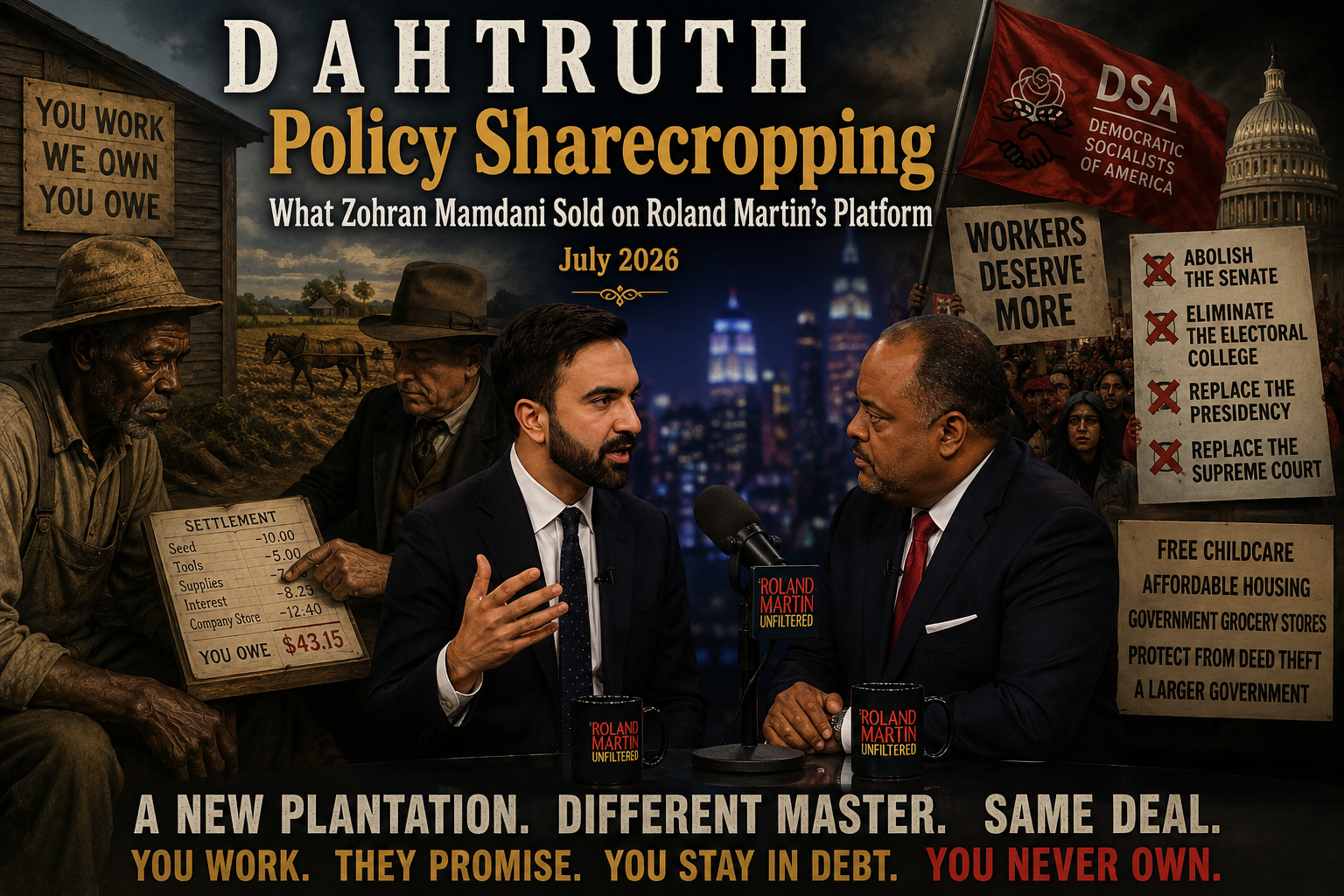
What Zohran Mamdani Sold on Roland Martin’s Platform
❦
After emancipation, the men and women who had been slaves were handed something that looked like freedom and operated like a lease.
The sharecropper worked land he did not own. He supplied the labor, the sweat, the hours before daylight and the hours after. He planted the crop, tended it and brought it in. At settlement the books were read to him by the man who owned the field. He could not audit those books, could not dispute them and could not walk away, because the debt always came out just above the harvest.
He was free. He was also never going to own anything.
That arrangement never fully ended in American Black life. It changed clothes.
❦
Over the last several weeks, we have watched a widening fracture inside the Democratic Party between its centrist establishment and the Democratic Socialists of America. I must admit that it has been a joy and a pain to watch. For years, centrist Democrats tolerated the socialist wing, borrowed its language, encouraged its activists and assumed they could control its growing influence. Now the faction they helped cultivate is attempting to take possession of the party itself, and the centrists have finally begun to fight back with a vengeance.
The next several months will be critical. A number of states will hold important primaries and elections in August and September as both parties move toward the November 2026 midterm elections. These contests will help determine whether the Democratic Party remains under the control of its traditional establishment or whether the DSA succeeds in moving the party further toward democratic socialism.
At the center of this struggle stands New York City Mayor Zohran Mamdani. He may not carry an official title as the national leader of the DSA, but he has become its most recognizable elected spokesman and one of its most valuable political organizers. In June his endorsements carried socialist and progressive candidates past established Democrats in three New York congressional primaries, and the movement is now attempting to reproduce that success in other states, including Michigan.
The DSA has recently faced damaging publicity, and its own documents have done more damage than its critics ever could. In July the organization released a program titled Workers Deserve More, drafted between April and June and approved by its National Political Committee. That program calls for a new democratic constitution. It would abolish the United States Senate. It would eliminate the Electoral College. It would replace the presidency and the Supreme Court with an executive and a judiciary chosen by Congress and answerable to it.
Asked whether any of that was extreme, DSA co-chair Ashik Siddique answered that they do not think so.
Even as one of the movement’s favored candidates seeks a seat in the United States Senate, the movement has now put in writing that the Senate should cease to exist.
That is not ordinary political reform. It is an attempt to reconstruct the American system.
Prominent Democrats have begun saying publicly what centrists long avoided. Van Jones, no one’s idea of a conservative, wrote this month that the youth movement he waited his whole life to see is being hijacked by people with insane, outlandish and nutty ideas.
The problem underneath is real. Mamdani won the 2025 primary without us. A New York Times analysis found that in precincts where at least seventy percent of residents were Black, Andrew Cuomo more than doubled him, fifty-nine percent to twenty-six. Black voters moved toward him in November, after months of outreach and a deliberate pivot to pocketbook language. That is a movement that had to run from its own brand to survive a primary.
That presents the DSA with a serious problem.
The Democratic Party cannot consistently win national elections without the American Black vote. Yet the socialist faction attempting to take control of that party is overwhelmingly white, advances very few American Black candidates and increasingly promotes immigrants, the children of immigrants and white progressive candidates as the new faces of the Democratic coalition. American Blacks remain the party’s most dependable voting bloc, but we are becoming less central to the leadership, ideology and candidate selection of the party our votes have sustained.
So what does Mamdani do?
He appears on Roland Martin Unfiltered, one of the most recognizable Black political platforms in the country, to sell democratic socialism directly to the American Black community.
The timing was strategic. Mamdani appeared after weeks of negative press for the DSA, and in the same week his own rhetoric collided with the limits of his office. He had said his administration was in active conversation with the city’s Law Department about arresting Israeli Prime Minister Benjamin Netanyahu when he comes to New York for the United Nations General Assembly in September. Days later he conceded the city has no authority to execute a warrant from the International Criminal Court, and asked the federal government to carry it out instead. The retreat was jurisdictional. The accusation never softened.
Now Mamdani is moving through the media circuit attempting to present the DSA as reasonable, practical and far less radical than its critics claim.
His sales presentation to Roland Martin’s audience was built around familiar promises: free childcare, affordable housing, protection from deed theft, government grocery stores and a larger government prepared to provide more services. The message was clear. Democratic socialism, he argued, is not something American Blacks should fear. It is simply government working on behalf of ordinary people.
That sales presentation rests upon an assumption that deserves to be confronted.
It assumes that American Black voters can be won by promises of free programs. It assumes that we are more interested in government dependence than homeownership, entrepreneurship, educational excellence, safe communities and generational wealth. It assumes that if politicians tell us often enough what they are prepared to give us, we will not examine what their policies prevent us from building for ourselves.
Most importantly, it assumes that we will not notice the political sharecropping taking place directly in front of us.
Mamdani and the DSA need the American Black vote to capture the Democratic Party. The policies they offer do not place American Blacks at the center of their agenda. We are expected to provide the turnout, defend the coalition and deliver the election, while other groups select the candidates, define the ideology and inherit the political power.
That is why Mamdani’s conversation with Roland Martin deserves closer examination. Not simply because of what Mamdani said, but because of what he avoided, what Roland failed to press and what the entire interview revealed about the DSA’s effort to gain control of the Democratic Party through a voting bloc it has done very little to represent.
❦
What He Reached For
Asked about the shortage of senior African American leadership in his administration, Mamdani named Deputy Mayor Renita Francois and Chancellor Kamar Samuels, then said he wanted a city government that looks like New Yorkers, a gorgeous mosaic. He credited the phrase to David Dinkins. He called Dinkins the first democratic socialist mayor of New York and our first Black mayor, and called him an inspiration. He left out that David Dinkins was an strong supporter of Israel.
Roland Martin asked one follow-up question and moved on.
He might have asked one more. Kamar Samuels was born in Jamaica. David Dinkins, the man whose standing was being borrowed, was an American Black New Yorker who served in a segregated Marine Corps and spent a lifetime inside the party. Between the two of them sits the whole argument this movement will not have.
Understand what happened in that moment. A movement with almost no American Black leadership reached back more than thirty years to borrow the standing of a Black man it did not elect, in order to sell itself to Black voters it needs but does not intend to promote.
That is the transaction. Everything after it is terms.
❦
The Sales Presentation
Mamdani did not come before Martin’s audience to defend the hardest edges of his movement. He brought the softened version, packaged for us.
Childcare. Affordable housing. Deed theft. Groceries. Potholes.
Everything framed as something the government could give.
Childcare
He opened by saying his administration had put the city on a path to universal childcare, saving parents more than twenty thousand dollars a year for every two-year-old enrolled.
The word carrying that sentence is path.
By his own administration’s announcement, the first phase provides two thousand free seats this fall in four communities: Washington Heights and Inwood, Fordham and Kingsbridge, East Brooklyn including Canarsie, Brownsville and Ocean Hill, and Ozone Park and the Rockaways.
Look at that map. Washington Heights and Inwood, the largest Dominican community in the United States, is 8.7 percent Black. Fordham and Kingsbridge run roughly seventy percent Hispanic. Ozone Park is heavily Indo-Caribbean and South Asian, and the Rockaway peninsula is 35.1 percent white against 33.8 percent Black. One of the four, East Brooklyn, is predominantly Black, and Brownsville and Ocean Hill earned every seat they received. Brownsville’s poverty rate is 29.3 percent.
One of four. Three of the first four communities are immigrant-heavy neighborhoods, in a program his administration advertises as available regardless of income or immigration status, paid for with tax dollars including ours.
The program is expected to reach roughly twelve thousand children by the fall of 2027 and full universality by the end of his term, serving an estimated fifty-five thousand two-year-olds.
Two thousand today. Fifty-five thousand at completion. Available regardless of income or immigration status.
Martin did not ask how the two thousand families would be selected, how many qualified families would be turned away this fall, or what share of the first seats would go to American Black children. He accepted the twenty thousand dollar figure and moved on.
A promise can be universal while the benefit in hand stays very small.
Housing
Martin raised the departure of Black residents from the city, and he was right to. Mamdani acknowledged that more than two hundred thousand Black New Yorkers have left over recent decades, that the population of Black children and teenagers fell nineteen percent between 2010 and 2019, and he called it a reverse Great Migration.
His answer was to build two hundred thousand affordable homes and preserve two hundred thousand more over ten years.
Ask what affordable means in that sentence.
Affordable housing is not ownership. It is most often another regulated rental, another income-restricted apartment, another household living inside a system where a public authority, a nonprofit developer or a private landlord holds the deed and the government sets the eligibility. That housing keeps families from being displaced. It prevents homelessness. It provides stability, and stability is worth something. Stability does not appreciate, and stability cannot be left to a grandchild. It is stability administered by the government, renewable at the government’s discretion. Socialism at its finest.
New York City already holds roughly one million rent-stabilized apartments housing about 2.4 million people. In June the Rent Guidelines Board voted seven to one to freeze rents on one-year and two-year renewal leases, the first two-year freeze in the city’s history. That freeze is real relief for tenants already inside the system, and Black tenants are among them. It produces no additional apartment for the family still searching, and it converts no monthly payment into equity.
Meanwhile, according to the Furman Center’s most recent figures, homeownership in New York City in 2024 ran to 45.2 percent for Asian households and 41.7 percent for white households, against 25.9 percent for Black households and 17.2 percent for Hispanic households. Black borrowers were the only group whose refinancing activity fell further that year, down 7.3 percent.
Those numbers should have driven the entire interview.
Where was the plan to raise Black homeownership? Down-payment assistance aimed at long-established working families. Affordable mortgage products. Protection of inherited property. Black-owned housing development. A pathway out of public housing and into a deed.
Martin asked the ownership question and Mamdani answered a different one.
He mentioned homeownership, then moved to what he had built to protect it. The city’s first Office of Deed Theft Prevention. A pause on the Giuliani-era tax lien sale, which he correctly noted had been applied in Black neighborhoods at six times the rate of white ones.
Both are worth having. Neither is what he was asked.
Here is the scale of what he offered. The Independent Budget Office reports that at least 1,008 lien-sale properties completed foreclosure and went to auction over the past decade. Two hundred fourteen of them were one-to-three family homes. About twenty-one small houses a year. Nearly six hundred more sit in active foreclosure now. Deed theft draws roughly three hundred complaints a year across the five boroughs, and the Queens District Attorney has recovered twenty-three homes since 2020.
Every one of those families deserves protection and every case deserves prosecution.
Now set that beside the question. Black homeownership in New York City is 25.9 percent. White homeownership is 41.7 percent. Closing that distance means tens of thousands of families holding a deed who do not hold one now.
Protecting the house a family already owns is not the same as helping a family buy one. The first defends the few who made it inside. The second is how a community builds something it can hand down. He was asked about the second and answered with the first.
He did not mention the partition suits either. Roughly 350 are filed in this city every year against families whose parent died without a will. The homes average $1.1 million and they cluster in Central Brooklyn and Southeast Queens. A speculator buys one heir’s fractional share for a fraction of its worth, then uses the courts to force the sale of the whole house. The Center for NYC Neighborhoods has identified $400 million of equity sitting in those disputes and estimates the true figure closer to $4 billion. It is asking for ten million dollars to lend heirs the capital to clear title before an investor arrives, and calculates that every dollar lent preserves thirteen to fifteen dollars in family wealth.
Ten million dollars, to keep families in houses worth a million each. He has committed seventy million to five grocery stores.
Taxes
Martin asked the right question. What happens to homeowners, especially seniors on fixed incomes, when you raise the revenue to pay for all of this? Which is to say, what happens when you draw on the middle class and the elderly to expand services offered without regard to citizenship?
Mamdani answered that the burden would fall on non-resident owners of second homes worth more than five million dollars. Very few and far between, he said.
The flip repeated itself. He had two proposals of his own aimed squarely at ordinary homeowners, and he named neither.
In March his office circulated a memo to state lawmakers proposing to cut New York’s estate tax exemption from $7,350,000 to $750,000 and raise the top rate from sixteen percent to fifty percent. It would have given New York the lowest estate tax threshold in the country. The figure is not new to him. As a state legislator he co-sponsored a bill built on the same $750,000 exemption.
The median New York City home price reached a record $800,000 in the third quarter of 2025. The median home in this city already clears the line he proposed. A family in St. Albans or Cambria Heights that bought in 1975 and held on through everything the city did to them would cross that threshold on the house alone, before a single retirement account is counted.
Council Member Phil Wong of Queens said the change would hit closer to home than people realize, and that families could be forced to sell the very homes they hoped to pass on to their children. Bloomberg Tax, writing in favor of taxing inherited wealth, called the design a policy that would land on asset-rich, cash-poor households whose primary asset is housing.
Asset-rich and cash-poor. That is the identical phrase housing researchers use for the families losing homes to partition suits in Southeast Queens. Same families. Same houses. Two mechanisms reaching for the same equity.
It did not pass. Neither the legislature nor the governor included it. He asked for it anyway, and then sat in Roland Martin’s studio and answered a question about the burden on Black homeowners by talking about five-million-dollar second homes.
Deed theft is the story he tells about Black homeowners. The estate tax memo is the one he does not.
What he did not volunteer, and what Martin did not raise, is that in February he had proposed a 9.5 percent citywide property tax increase in his preliminary budget as a fallback if Albany refused to raise taxes on high earners and corporations. It would have touched more than three million residential units. The Citizens Budget Commission estimated roughly seven hundred additional dollars a year for a typical homeowner.
Mamdani knew exactly who it would land on. He said so at the announcement. He acknowledged the increase would fall hardest on homeowners in mostly Black neighborhoods, a constituency he had struggled to win, and framed it as asking those working-class New Yorkers to fork up.
He was not the only one who noticed. Council Deputy Speaker Nantasha Williams of St. Albans said that advancing a tax increase without first addressing the underlying inequity feels deeply tone-deaf to Black, Brown, and working-class homeowners like the families she represents in Southeast Queens, who are already shouldering a disproportionate share of the property tax burden.
That is a Black Democratic official describing a Black Democratic constituency being asked to finance a program built for someone else.
Speaker Julie Menin said significant property tax increases should not be on the table whatsoever. Mamdani dropped the proposal from his executive budget in May, after Governor Hochul delivered enough state aid to close the gap.
He backed off because Albany paid, not because the constituency he named held leverage he was obliged to respect.
Martin had every element of that history available to him. He asked about the burden on Black homeowners and let the answer about five-million-dollar second homes stand.
Groceries
Five city-owned stores, one per borough, seventy million dollars in capital funding. The first is scheduled to open in the Bronx at the end of 2027. The East Harlem location is not expected until the end of 2029. The city will own or subsidize the space while a private operator runs the store.
That does nothing for the grocery bill a family is paying this week. It is a promise whose distance is concealed inside the phrase city-run grocery stores.
None of it is free. The childcare worker is paid. The bus is fueled and repaired. The store buys inventory, employs staff, runs refrigeration and carries its property costs. Government can move a cost, bury it in another account or collect it from a different taxpayer. Government cannot make a cost disappear.
❦
A Chancellor Without an Accounting
Martin raised the schools and asked the right question again. If a parent has a child in the ninth grade, that child cannot wait four or five years for a turnaround.
Mamdani answered by praising Chancellor Kamar Samuels, who is doing a very good job, and emphasized his commitment to rigor and to an integrated school system.
A very good job is not a measurement.
Samuels has a real record and it deserves examination rather than a wave of the hand. He began as a Bronx classroom teacher, became principal of the Bronx Writing Academy, served as superintendent of Brooklyn’s District 13 and Manhattan’s District 3, oversaw the NYC Reads literacy rollout that his own department credits with a five percent increase in literacy outcomes, secured more than ten million dollars for integration work across two districts and launched seventeen International Baccalaureate programs.
Five percent of what, and for whom?
There is the question Martin never asked. What happens to Black children in the districts this man has led, and in the system he now runs?
The answer is public. It has been sitting on the New York State Education Department website the entire time.
Take Brooklyn’s District 13, which Samuels ran from 2019 until 2022 and which is the district most associated with his integration work. The most recent state report card is not his tenure, and I will not pretend it is. It is worth reading anyway, because of what it says about what integration accomplished and what it did not.
In District 13, Black students were proficient in English at just under fifty percent. White students, in the same district, in many of the same buildings, sitting the same tests: eighty-seven percent. In mathematics, Black students came in at forty percent. White students, eighty-four.
A thirty-seven point gap in reading. A forty-four point gap in mathematics. Inside one district.
Now understand what makes that number land. District 13 is not a failing district. All students, grades three through eight, came in at sixty-two percent in English, above the city and above the state. The four-year graduation rate is ninety-one percent. On the aggregate it reads as a success story, and that is precisely how it gets told.
The aggregate is the disguise. A district can post excellent overall numbers while the Black children inside it are educated in a different system entirely, and nobody is ever required to say so, because press releases do not disaggregate.
Citywide the same pattern holds in the system Samuels now runs. Forty-seven percent of Black students read at grade level, against seventy-four percent of white students. Black scores rose eight points last year, the largest gain of any group, and the gap is still twenty-seven points wide.
That is the emergency. Neither man in that studio named it.
Longevity inside a struggling system can demonstrate expertise. It can also demonstrate participation. Samuels was appointed, not elected, and the case made for the appointment was assembled out of adjectives. Rigor. Integration. A very good job. When a man is handed nine hundred thousand children and the strongest public argument for him is a five percent literacy improvement in a single district, the parents asked to applaud are entitled to ask what he produced for Black children specifically, and to be handed a number rather than a word.
Then Mamdani redirected. Asked about a ninth grader who cannot wait, he returned to the investment in two-year-olds.
Early education matters, and it does not answer the question. The Black ninth grader who cannot read at grade level today will be a grown man before the first universal cohort reaches the third grade.
❦
The Interviewer Becomes Part of the Presentation
Roland Martin has built a career on one explanation of American Black life. He published White Fear in 2022, and the argument is that white anxiety over demographic change drives our politics, that the Republican Party has made itself the leader of that fear, and that what happens to us traces back to that source.
The explanation has one convenient quality. It can never be tested, and it never has to account for sixty-two years of results.
American Blacks have voted for Democratic representation in overwhelming numbers since 1964. We have delivered the presidency, the Senate, the House, governorships and city halls. In New York City the last Republican to win the mayoralty did so in 2005. Democrats hold the City Council, the state legislature, the governor’s mansion and both United States Senate seats.
Black homeownership in that city stands below twenty-six percent. Black children in the nation’s largest school system are not reading at grade level. More than two hundred thousand Black New Yorkers have left. No Republican legislature drew those numbers.
There is also a question about the platform itself.
Martin built Black Star Network with three hundred fifty thousand dollars of his own money and the backing of one sponsor, the American Federation of State, County and Municipal Employees, the union of public employees. He has since leaned on viewer donations while publicly demanding that brands and agencies spend more with Black-owned media.
Set that beside the product Mamdani carried into the studio. City-owned grocery stores. Universal childcare requiring a workforce the city funds. An expanded municipal government presented as the answer to housing, food, transportation and early education. Every item in that catalog enlarges the public payroll.
A platform launched on the sponsorship of the public employees’ union is not a neutral room in which to question a mayor whose entire program grows public employment. I am not saying anyone was paid for this interview. I am saying the incentives were never aimed at a hard question, and the transcript shows it.
Martin raised homeownership and accepted deed theft prevention as the answer.
He raised taxes on fixed-income seniors and never mentioned the 9.5 percent increase Mamdani had put forward in February, the one Mamdani himself conceded would land hardest on homeowners in mostly Black neighborhoods.
He raised failing schools and asked nothing about what Kamar Samuels had actually produced.
He raised the exodus of Black New Yorkers and never asked which Black families would receive the first childcare seats.
He raised democratic socialism and then helped Mamdani peel the label off the ideology, suggesting Democrats lead with policy instead of terminology.
Then he called the campaign a model for 2026 and asked the mayor to teach other Democrats how to reach African American voters.
Somewhere in the middle, the interview stopped being journalism and became distribution.
❦
The Harvest
On the plantation the overseer did not own the land. He protected the arrangement. He kept the laborers moving, watched the field, enforced the pace and made certain the crop reached the owner before nightfall.
In this new field, Roland Martin warns American Blacks about the danger of leaving the Democratic plantation and never asks who now owns its machinery, who selects its candidates or who will collect the political harvest.
Keep voting. Keep organizing. Keep defending the party. Keep plowing as nightfall comes on.
This season the crop is being claimed by a movement that is overwhelmingly white, that draws its strength from young professionals in gentrifying districts, and that advances almost no American Black candidates while reaching back three decades to borrow David Dinkins.
I am not telling anyone how to vote. I am telling you to read the settlement before you sign it.
Ask what we own when the harvest is in. Ask whose name is on the deed. Ask whose children are reading, whose businesses opened this year, and whose grandchildren will inherit something more than a lease.
Sixty-two years is long enough to know the answer.
❦
DAHTRUTH
