
A Warning From Detroit
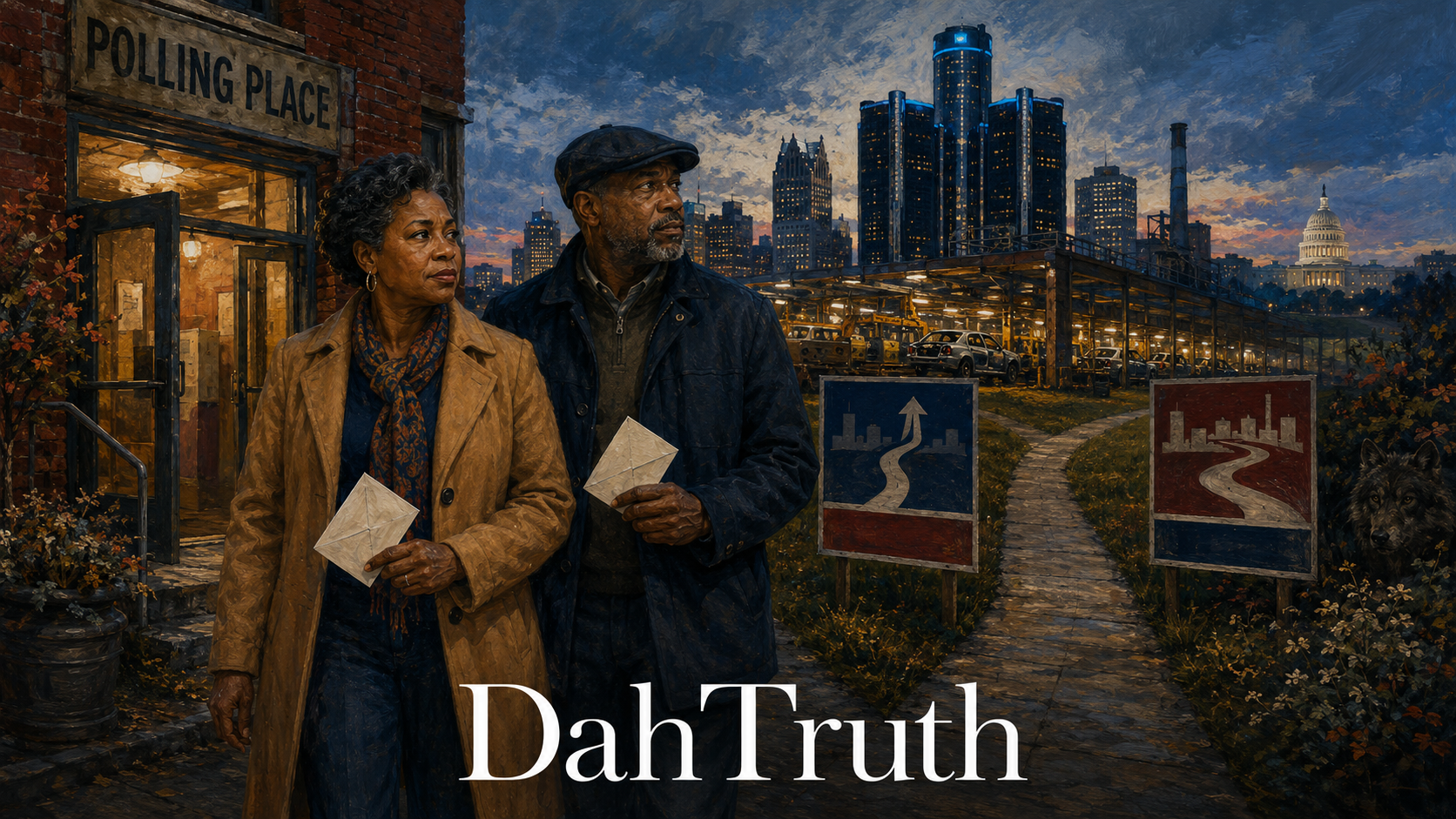
“Discussion of public issues and debate on the qualifications of candidates are integral to the operation of the system of government established by our Constitution.” — Buckley v. Valeo, 424 U.S. 1, 14 (1976)
What Michigan's Primary Revealed About American Black Voters, the Progressive Movement, and the Difference Between a Promise and a Record
❦
Last week, the Michigan Democratic Senate primary revealed something uniquely important about the political direction of the American Black community. For months, Americans have watched one primary election after another with caution, trying to understand not only whom voters are choosing, but what those choices say about the changing identity of the Democratic Party. Michigan gave us an answer that deserves considerably more attention than it has received.
American Black voters are not nearly as progressive as political strategists, activists and media commentators often assume. That may be because more of us are beginning to distinguish between promises made, promises repeated and promises actually kept. We have heard the language of transformation for decades, yet many of our neighborhoods remain burdened by struggling schools, disappearing businesses, unsafe streets and political leaders who appear only when they need our votes.
The Michigan results reflected that growing skepticism. Abdul El-Sayed, the progressive candidate embraced by Bernie Sanders, Alexandria Ocasio-Cortez and other leaders of the DSA-aligned movement, won the Democratic nomination by less than one percentage point. Yet he lost Wayne, Oakland and Macomb counties, the center of metropolitan Detroit, and substantially underperformed in traditional American Black strongholds. Haley Stevens received more than 60 percent of the vote in Detroit, America's largest Black-majority city. El-Sayed became the first Democrat to win a statewide race in Michigan without carrying any of those three counties since Bernie Sanders in the 2016 presidential primary. He built his victory elsewhere, particularly in university communities and progressive strongholds such as Ann Arbor and Grand Rapids.
The presence of Mallory McMorrow's name on the ballot also mattered. Although McMorrow suspended her campaign before the election, she still received approximately 4 percent of the statewide vote, while El-Sayed defeated Stevens by only about one percentage point. We cannot declare with certainty that every McMorrow voter would have supported Stevens. McMorrow herself endorsed El-Sayed the morning after the primary, which should caution anyone tempted to assume her supporters belonged to the moderate lane by default. We can say, however, that a divided field may have helped El-Sayed capture a nomination that nearly half of Democratic primary voters rejected.
This election therefore should not be presented as an overwhelming progressive mandate. It was a narrow victory produced by enormous margins in selected progressive and university communities, combined with a potentially consequential division among voters seeking a less ideological candidate. Meanwhile, Detroit's American Black electorate moved decisively in a different direction.
That divide is significant because it suggests that American Blacks may have more in common with centrist Democrats and moderate Republicans than either political party wants to acknowledge. This does not mean American Black voters are suddenly becoming Republicans, nor does it mean they have abandoned every progressive policy. It means their political judgment cannot be reduced to ideological labels. American Black voters often evaluate candidates through experience, relationships and evidence of tangible service. Our loyalty is not always ideological. It is frequently reciprocal. We remember who appeared when our communities were in danger, who protected our livelihoods and who treated our concerns as something more than campaign-season material.
That brings us to Haley Stevens.
❦
Stevens was born in Rochester Hills and raised in Oakland County. She earned bachelor's and master's degrees from American University and worked in Democratic politics before joining the Obama administration's response to the collapse of the American automobile industry. During the Great Recession, General Motors and Chrysler were approaching disaster. Their collapse would not have stopped at corporate boardrooms. It would have spread through assembly plants, parts suppliers, dealerships and working-class communities across Michigan. Detroit's American Black families were among those with the most to lose.
Stevens worked on the federal Auto Task Force and was described by its leadership as its chief of staff. She also helped establish the Office of Recovery for Automotive Communities and Workers, which was created to address the consequences of the industry's restructuring. Her campaign has claimed that this work helped save approximately 200,000 Michigan jobs. That number should not be credited to Stevens alone. The rescue was a massive federal undertaking involving two presidential administrations, Congress, Treasury officials, automakers, unions and many other participants. Nevertheless, Stevens was part of the team doing the work, and the economic outcome was real.
Economic studies estimated that allowing General Motors and Chrysler to collapse through uncontrolled liquidation could have cost Michigan more than 200,000 jobs. The precise counterfactual can never be proved, but the catastrophic job losses predicted by analysts did not occur. Stevens cannot personally claim salvation of the automobile industry, but neither should her participation be dismissed as an empty campaign slogan.
That distinction may help explain her strength in Detroit. For many American Black voters, the automobile industry is not an abstract economic sector. It represents generations of work, union wages, homeownership, family stability and entry into the middle class. When the industry was threatened, the livelihood of Detroit was threatened with it. Stevens could point to her presence during that crisis, while El-Sayed offered a much newer collection of promises about what an expanded federal government might accomplish in the future.
American Black voters understand the difference between a promise and a record. Our communities may recognize even a limited contribution when it is attached to work that helped preserve families and livelihoods. Loyalty does not require exaggerating Stevens's role. It requires acknowledging that she participated in an effort whose consequences were felt in Detroit homes.
This is what the progressive movement repeatedly misunderstands about American Black voters. It assumes that the language of revolution, universal programs and expanded government automatically speaks for us. Michigan demonstrated otherwise. When given a choice, Detroit's Democratic voters favored the candidate connected to an imperfect but tangible record over the candidate offering a sweeping ideological vision.
El-Sayed may have won the nomination, but Haley Stevens won the argument in Detroit.
“The right of citizens to inquire, to hear, to speak, and to use information to reach consensus is a precondition to enlightened self-government and a necessary means to protect it.
”
THE SAME BALLOT, TWO DIFFERENT ANSWERS
There is a second result from that Tuesday that deserves as much attention as the Senate primary, and it complicates any simple reading of what Detroit did.
In Michigan's Thirteenth Congressional District, which covers much of Detroit, voters removed Representative Shri Thanedar and nominated Donavan McKinney, a state legislator, former union organizer and self-described democratic socialist endorsed by Bernie Sanders, Rashida Tlaib, Ilhan Omar and Ayanna Pressley. McKinney campaigned on a Green New Deal, removing corporate money from politics and ending military aid and arms transfers to Israel. Unofficial Wayne County results show he defeated Thanedar by approximately 4,200 votes out of 112,000 cast, a margin near four percentage points.
McKinney and El-Sayed were not rivals. They campaigned together. McKinney appeared at an El-Sayed rally in Detroit on July 18, roughly three weeks before the election, and the two walked the streets of Detroit together on the Sunday before the vote. They shared endorsements, a movement and a platform.
Detroit sent one of them to Congress and gave the other's opponent a decisive victory on the same ballot.
The ticket splitting becomes stranger the closer it is examined. Thanedar was supported by AIPAC-aligned spending and endorsed by House Democratic leader Hakeem Jeffries. Stevens was supported by AIPAC-aligned spending as well. Detroit voters rejected the AIPAC-backed candidate in the House race and selected the AIPAC-backed candidate in the Senate race, in the same election, on the same day.
Whatever that is, it is not an electorate following instructions. It is also not the behavior of people who can be purchased with advertising, since the advertising pointed in opposite directions and Detroit went its own way in both contests.
❦
Thanedar's presence in that seat requires explanation, and the explanation is arithmetic.
In 2022, when the district was newly drawn, nine candidates competed in the Democratic primary. Eight of them were Black. Thanedar, an Indian immigrant and millionaire businessman, was not. He committed more than five million dollars of his own money to the race and won the nomination with 28 percent of the vote, against Adam Hollier at 24 percent, Portia Roberson at 17 percent, John Conyers III at roughly 9 percent and Sherry Gay-Dagnogo at roughly 8 percent. Seven Black candidates divided nearly seventy percent of the vote among themselves.
Within the City of Detroit itself, Thanedar defeated Hollier by 78 votes, 10,248 to 10,170. Seventy-eight votes. That is how a district represented by an American Black member of Congress continuously since the 1950s lost that representation. Not through persuasion, and not through a shift in the community's judgment, but through a divided field and a self-funded advertising budget.
Two years later the pattern held for a different reason. Hollier attempted to challenge Thanedar again in 2024 and was disqualified from the ballot for failing to file enough valid petition signatures. Thanedar faced Detroit City Council member Mary Waters instead and retained the seat.
Thanedar therefore served four years in Congress without once facing a single credible American Black Detroiter in a head-to-head contest. The first time he did, in 2026, he lost.
That history matters because it removes the lazy explanation. Detroit did not suddenly discover racial solidarity in 2026. Detroit finally received a clean choice.
The McKinney result also disposes of a reading that would otherwise be tempting, that Detroit's rejection of El-Sayed amounted to a rejection of progressive politics. It did not. On the same ballot, in the same city, Detroit nominated a democratic socialist who wants to end American arms transfers to Israel. What Detroit declined to accept was not a program. It was a stranger.
THE MOVEMENT BEHIND THE CANDIDATE
The Michigan primary also directs our attention toward something much larger than a single election. A political movement is rising within the Democratic Party that Americans should examine with care. Candidates such as Abdul El-Sayed may deny belonging to the Democratic Socialists of America, but they increasingly travel within the same political orbit, embrace many of the same policies and accept the support of figures whose hostility toward American institutions and America's alliance with Israel is unmistakable.
El-Sayed is not formally a member of the DSA. He describes himself as a capitalist, and I have found no evidence that he has personally endorsed the organization's proposal to abolish the Senate or replace the independently elected presidency and present Supreme Court with institutions subordinate to Congress. We should not attribute another organization's entire platform to him without evidence. Nevertheless, Americans have every right to examine the movement surrounding his candidacy and demand that he state plainly which portions of its agenda he accepts and which he rejects.
What the DSA is proposing is not simply a larger collection of government programs. Its latest national platform reaches into the fundamental structure of American government. It calls for abolishing the Senate, replacing the existing presidency and Supreme Court with an executive and judiciary chosen by and subordinate to Congress, abolishing ICE and ultimately dismantling the police and prison systems. These are not ordinary proposals for reform. They would reconstruct the constitutional division of power that prevents any temporary political majority from controlling the entire federal government, while dismantling the institutions through which the nation enforces its laws, administers immigration and maintains public order. The DSA seeks to dissolve the constitutional structure that has held America together since 1789. El-Sayed may say that he is not a socialist, but he has benefited from the energy, endorsements and organizing power of a movement seeking changes he has not adequately confronted.
His relationship with Hasan Piker raises similar concerns. Piker is not a candidate, nor should every statement he has ever made automatically be assigned to El-Sayed. Yet El-Sayed has repeatedly chosen to campaign alongside him. Piker previously declared that America deserved the September 11 attacks, although he later described the remark as inappropriate and attempted to explain it as criticism of American foreign policy. He has also been condemned for statements concerning Israel, Hamas and the reported sexual violence committed during the October 7 attack. El-Sayed has rejected some of Piker's statements, but he has refused to sever the political relationship. In fact, he appeared with Piker again immediately before the Michigan primary.
A recently circulated video provides a disturbing glimpse into the attitude surrounding this movement. In the clip, an unidentified El-Sayed supporter speaks directly to El-Sayed and Hasan Piker and says, “The encouraging thing is that people are stupid.” El-Sayed did not make the statement, but he was present, heard it and did not disagree. He did not correct the speaker, defend the intelligence of the voters whose support he was seeking or reject the suggestion that political success could be built upon their ignorance.
A candidate cannot accept the energy of a political movement while avoiding responsibility for what is said openly in his presence. El-Sayed has demonstrated that he is perfectly capable of objecting when his opponents criticize him, when AIPAC spends money against him or when American policy supports Israel. Yet when one of his own supporters described voters as stupid, no comparable objection followed. His silence permitted the insult to remain within the conversation as though it were an acceptable political calculation.
The exchange then moved into the movement's familiar slogans: take money out of politics, put money into people's pockets and pass Medicare for All. That sequence matters because it reveals how complex policies are reduced to promises that sound free, immediate and effortless. The message does not explain the taxes required, the authority transferred to the federal government, the disruption of private insurance or the consequences for patients and medical providers. It offers the benefit while concealing the bill.
El-Sayed may argue that he did not personally call Americans stupid, and technically he did not. Leadership, however, is also demonstrated by what a candidate is willing to correct when the words are spoken directly in front of him. In that moment, El-Sayed was given an opportunity to reject contempt for the electorate. He chose not to use it.
El-Sayed promises health coverage from cradle to grave without premiums, copayments, deductibles or out-of-pocket costs. That does not make medical care free. Doctors, nurses, hospitals, pharmaceutical manufacturers, equipment suppliers and administrative workers must still be paid. Medicare for All changes the collection mechanism and transfers enormous authority to the federal government. It does not eliminate the cost of health care. Calling the program free conceals the very question voters deserve to have answered: who pays, how much do they pay and what happens to the present system during the transition?
The same instrument was used on his own biography. El-Sayed has campaigned as a physician, and the word has been central to his political identity. He holds a Doctor of Medicine degree, which is real. What public records do not show is a license. Politico reviewed state licensing records in Michigan and New York and found no record that El-Sayed has ever held a license to practice medicine in either state. His primary rival Mallory McMorrow's campaign went further, stating that he never completed a residency, never passed his boards and never practiced medicine independently.
By his own account, his direct patient care consisted of a four-week sub-internship at a Manhattan hospital near the end of medical school. On a 2022 podcast he described that experience as cosplaying a doctor and called himself the worst doctor on the team. Those are his words, offered before he had a Senate campaign to defend. When the journalist Mehdi Hasan, hardly a hostile interviewer, asked him directly whether he had told voters the truth, El-Sayed did not answer the question.
A medical degree certifies that a person completed medical school. A license is a state's active grant of authority to treat patients, issued after residency and board examination, and revocable by a board that can hold the holder accountable. Voters who hear physician do not hear graduate of a medical school. They hear someone who has sat with the sick. That is the whole reason the word carries weight in a debate about health care, and it is the reason its use deserves precision.
This is where language becomes a political instrument. Medicare for All sounds familiar because Americans already know Medicare. Yet the proposal El-Sayed describes is not simply the current Medicare program extended to everyone. Traditional Medicare contains premiums, deductibles and cost sharing. El-Sayed is proposing a different and substantially broader federal guarantee while borrowing the trusted Medicare name to make that transformation sound smaller and safer than it is.
THE DIFFERENCE BETWEEN CAMPAIGN MONEY AND OUTSIDE ADVERTISING
Abdul El-Sayed repeatedly tells voters that AIPAC spent tens of millions of dollars to purchase the Michigan election for Haley Stevens. That description obscures an essential distinction. Most of the money attributed to AIPAC was not donated to Stevens, placed in her campaign account or controlled by her campaign. It was spent independently by outside organizations, principally on advertisements and political communications supporting Stevens or attacking El-Sayed. In other words, American citizens contributed to a political committee that independently spent its funds on political messaging protected by the First Amendment.
That does not make the spending insignificant, and the scale of it should be stated plainly rather than minimized. The best-supported figure is approximately $30.6 million spent by AIPAC's affiliated Super PAC, United Democracy Project, on independent communications supporting Stevens and opposing El-Sayed. When expenditures by other outside organizations are included, roughly $54 million in outside spending benefited Stevens or opposed El-Sayed, while approximately $5 million benefited El-Sayed. That produced an outside-spending advantage of nearly eleven to one.
The imbalance was enormous, and the existence of that spending also tells us something El-Sayed's narrative leaves out. It demonstrates that a well-financed constituency of Americans considered his candidacy, his opposition to Israel and his proposed changes in American foreign policy important enough to organize, contribute and purchase political messaging. United Democracy Project is an American political committee operating within the American campaign-finance system. Its lawful expenditures represent political participation and constitutionally protected political speech, not money secretly deposited into Stevens's campaign account.
The amount spent does not prove that most Americans agreed with AIPAC or opposed El-Sayed. Dollars are not voters, and a comparatively small number of wealthy contributors can finance an enormous advertising campaign. Nevertheless, El-Sayed cannot fairly dismiss every American who financed that messaging as part of a corrupt foreign-interest operation. Many Americans support Israel, value the American-Israeli alliance and considered El-Sayed's call to end military assistance dangerous. They were entitled to organize around those convictions just as El-Sayed's supporters were entitled to organize around Medicare for All, opposition to Israel and his progressive agenda.
El-Sayed has sometimes described the broader opposition as a $70 million campaign against him, but that figure should not be attributed to AIPAC alone. AIPAC's affiliated Super PAC spent approximately $30.6 million. The larger figures combine the activities of multiple outside organizations and, depending upon the source, may also include campaign spending or advertising reservations. The accurate criticism is that Stevens benefited from a historically large outside-marketing advantage. The inaccurate implication is that AIPAC placed $60 million or $70 million into her campaign account and purchased control over her candidacy.
Tens of millions of dollars in advertising can dominate television screens, mailboxes and digital platforms. It can influence which subjects voters discuss and determine how frequently they encounter a candidate's name. Americans have every right to debate whether Super PACs possess too much power. Nevertheless, money spent talking about a candidate is legally and financially different from money given directly to that candidate.
Federal law permits an independent-expenditure-only committee to raise and spend large amounts advocating for or against candidates, but it prohibits the organization from coordinating those expenditures with the candidate's campaign. Stevens therefore benefited from AIPAC-affiliated marketing, but she was not legally entitled to direct it, spend it on campaign staff, move it into field operations or decide what advertisements the organization produced.
The direct fundraising comparison tells a different story. According to Federal Election Commission reports covering the period through June 30, 2026, and as reported by the Detroit Free Press, Stevens had raised just under $11 million for her Senate campaign, approximately $8.3 million of it from individual contributions. The remainder came from political action committees and other sources, including a joint fundraising committee she shares with the state Democratic Party. El-Sayed had raised approximately $12.2 million over the same period, nearly all of it from individual donations. El-Sayed therefore raised roughly $3.9 million more from individual contributors than Stevens did.
That difference matters because El-Sayed's campaign controlled the money it raised. It could decide how much to spend on employees, travel, organizing, voter outreach, data, events and advertising. Stevens could not exercise that authority over the millions spent independently on her behalf. Campaign-controlled money and independent marketing expenditures may both influence an election, but they are neither financially nor legally interchangeable.
El-Sayed's claim that he defeated $60 million can be rhetorically effective while remaining incomplete. He defeated a candidate who benefited from an extraordinary amount of outside advertising, but whose campaign raised substantially less than his campaign raised from individual contributors. The race was not simply one wealthy campaign against one penniless grassroots movement. It was a well-financed El-Sayed campaign facing a less directly funded Stevens campaign that benefited from a much larger independent advertising operation.
The source of El-Sayed's financial support deserves the same examination he demands of his opponents. His individual contributions arrived through a combination of itemized donations and smaller unitemized receipts. Those totals do not reveal that most of his donors were Arab American, nor do they tell us how long those donors' families have lived in the United States. The Federal Election Commission does not classify contributors by ethnicity or immigration generation. They do, however, demonstrate that El-Sayed entered the election with a powerful and successful fundraising network of his own.
The voting results show where one especially important part of his political strength was concentrated. According to census estimates reported in 2023, approximately 54.5 percent of Dearborn residents identify as having Middle Eastern or North African ancestry. The city has since questioned those estimates following a reported loss of more than 6,700 residents, but the general composition of the population is not in dispute. El-Sayed received 77.59 percent of the Democratic Senate primary vote cast in Dearborn.
The turnout figures are what make that share consequential. Dearborn cast nearly 25,000 ballots on August 4, the most in any primary in the city's recorded history, and 17,253 of them were Democratic, more than five times the 3,129 Republican ballots and the widest partisan gap there in a decade. El-Sayed's margin over Stevens within the city approached ten thousand votes. His entire statewide margin was fewer than 15,000. One city therefore supplied close to two thirds of the margin that carried him across the finish line.
That is not an objection to who those voters are. It is an observation about how little of Michigan was required to settle the question. Dearborn organized and produced record participation while the rest of the state performed ordinarily, and a compact, highly motivated bloc determined a nomination the entire state will live with in November. Michigan compounds this by holding an open primary with no party registration, which means a Democratic nomination here is not decided by Democrats in any formal sense. It is decided by whoever chooses that ballot.
There is a further irony in the arithmetic. Medicare for All has been the signature demand of the progressive movement for more than a decade, and it has never come close to passage, because the insurance industry it would eliminate remains among the most effective lobbying forces in Washington. A single Senate seat does not change that. Voters who cast ballots for that promise are unlikely to receive the program. What they receive instead is position, visibility and a voice in the party's direction, which are real goods but are not the good that was advertised. The distance between the two is the space in which political disappointment is manufactured, election after election.
This does not mean every El-Sayed voter in Dearborn was Arab or Muslim. It does mean that a city with a Middle Eastern and North African majority provided a concentrated political margin that was almost decisive, while Black-majority Detroit rejected him and gave Stevens more than 60 percent of its vote. His victory was not simply a broad uprising of ordinary Michigan voters against money in politics. It was produced by a coalition that combined extraordinary support in Dearborn with younger progressive voters and large margins in university communities.
El-Sayed can fairly say that AIPAC-affiliated organizations tried to defeat him. He is not entitled to imply that only his opponents were supported by organized political interests. He had his own donors, influential endorsers, outside organizations, online media personalities and geographically concentrated constituencies. The amount of money was unequal, but the system is designed so that individuals may exercise political freedom, and every American has a constitutional right to support the candidate of their choosing. That right guarantees that money will sometimes be distributed unevenly. Both sides used the American political system to influence an American election. The difference is that El-Sayed asks voters to treat one side's participation as corruption and the other's as democracy.
❦
El-Sayed did accept approximately $71,845 in contributions from other political committees, although he says he rejects corporate PAC money specifically. He also benefited from independent spending by Fighting for Michigan, a Super PAC substantially financed by his father-in-law, who contributed approximately $300,000. That outside spending was far smaller than the advertising operation supporting Stevens, but it was Super PAC spending nonetheless. There is something disingenuous about arguing that PAC money should be removed from politics while accepting contributions from political committees and benefiting from a Super PAC funded by a relative.
El-Sayed's claim that he has never accepted a corporate PAC check appears to be technically accurate. It is also considerably narrower than the political message he sells to voters. None of those transactions appears illegal, and individual contributions to a Super PAC are not corporate PAC contributions. Nevertheless, they complicate his declaration that he represents money out of politics. His objection is evidently not to every PAC, every Super PAC or every six-figure contribution. His objection is primarily to money spent by interests that oppose him. He has separated himself from the DSA by name while accepting the support of its movement, and he has declined to say which portions of its platform he rejects. That silence is a choice, and voters are entitled to read it as one.
ISRAEL, GAZA AND THE DIFFERENCE BETWEEN AN ALLEGATION AND A JUDGMENT
El-Sayed's campaign also collapses the legal and moral debate over Gaza into the declaration that Israel is committing genocide. That remains an allegation, not a final judicial judgment. South Africa brought a genocide case against Israel before the International Court of Justice, the principal judicial organ of the United Nations. The court issued provisional measures but did not rule that Israel had committed genocide. The case remains pending, and Israel filed its response in March 2026.
That distinction is critical. The humanitarian devastation in Gaza may be acknowledged without announcing that the most serious allegation in international law has already been proved. Civilian deaths, disrupted humanitarian assistance and the destruction caused by war require serious examination. They do not relieve those using the word genocide of the responsibility to prove genocidal intent.
The International Criminal Court is a separate institution. Its arrest warrant for Israeli Prime Minister Benjamin Netanyahu does not establish that Israel committed genocide. The United States and Israel are not parties to the Rome Statute, and the United States is not obligated to execute the warrant. Nevertheless, calling the warrant void goes too far. ICC member states face their own legal obligations if Netanyahu enters their territory, although questions involving jurisdiction and head-of-state immunity remain contested.
El-Sayed also presents American assistance to Israel as though it were simply money taken from Michigan classrooms and hospitals. That is misleading. Much of the assistance is congressionally authorized for defense and is used to purchase equipment from American defense manufacturers. Congress can debate whether that assistance should continue, be reduced or carry additional conditions. It cannot honestly be described as a pile of interchangeable money that a senator could immediately redirect into Detroit schools.
Israel is a longstanding American ally, and the relationship is not exclusively charitable. Israel provides intelligence cooperation, technological development, missile-defense research and strategic capacity in a volatile region. That relationship does not place every Israeli government decision beyond criticism. It does mean that ending military assistance, including defensive support, would represent a significant strategic change requiring more explanation than accusations against AIPAC and repeated invocations of genocide.
The strongest criticism of El-Sayed is not that his Muslim faith secretly controls him. It is that his documented political choices deserve scrutiny. He has made opposition to American support for Israel central to his campaign. He has repeatedly appeared with Hasan Piker despite Piker's history of inflammatory statements about America, Israel and October 7. He attacks the influence of his opponents' donors while accepting direct contributions and outside support from a politically organized network of his own. Those are matters of public conduct and political judgment. They are also more than sufficient grounds upon which Americans can evaluate him.
A WARNING FROM DETROIT
I had no personal stake in Michigan's Democratic primary, but I believe Haley Stevens would have been the more difficult candidate for Mike Rogers to defeat. Whether progressives like it or not, Stevens demonstrated considerable strength across metropolitan Detroit and within Michigan's traditional Democratic coalition. She carried Wayne, Oakland and Macomb counties, and she received more than 60 percent of the vote in Black-majority Detroit. Those results suggest that many working-class and American Black Democratic voters regarded her as a credible candidate with a record they recognized.
I liked Stevens, and I wanted her to win even though her nomination might have made it more difficult for Republicans to capture the seat. That is because elections should not be reduced to wishing for the weakest possible opponent. The country benefits when both parties offer candidates with experience, credibility and an identifiable relationship with the communities they hope to represent. Stevens's involvement in the federal auto rescue gave her a connection to Michigan workers that could not be manufactured during the final weeks of a campaign. Liking her does not require pretending she stood above the system. Her House campaign committee accepted corporate PAC contributions from DTE Energy and Consumers Energy in March 2025, and that money moved into her Senate account when she launched the following month. PolitiFact examined her debate statement that she had not taken utility money for her Senate campaign and found the transfer. It was legal. It was also narrower than what voters heard. Neither candidate in this race ran clean of the system, and Detroit was entitled to examine both.
El-Sayed defeated her, but his victory should not be mistaken for a statewide progressive transformation. He won by less than one percentage point after losing all three counties in metropolitan Detroit. He was carried across the finish line by enormous margins in Dearborn, university communities and progressive strongholds, while Mallory McMorrow's name remained on the ballot and drew more votes than El-Sayed's margin of victory. That is a victory, but it is not an ideological mandate.
Mike Rogers now enters the general election as a strong and experienced Republican candidate. He is not easily reduced to the most theatrical version of far-right politics, and he came within approximately 19,000 votes of winning Michigan's 2024 Senate election. Donald Trump carried the state that same year, while Rogers received nearly 123,000 fewer votes than Trump. If Rogers can recover even a portion of those Republican-leaning voters, compete for independents and persuade moderate Democrats who supported Stevens, he has a credible path to defeating El-Sayed.
Rogers should not assume, however, that opposition to El-Sayed will be enough. He must offer Michigan voters an affirmative economic program and speak directly to Detroit's American Black community about employment, education, public safety, homeownership, health care and the preservation of the automobile industry. American Black voters should not be expected to move from one party to another merely because Republicans identify the weaknesses in a progressive candidate. Their votes must be earned through policies, presence and reciprocal loyalty.
That may be the most important lesson of the Michigan primary. American Blacks are not a political monolith, but neither are we politically asleep. Detroit voters examined the candidates and moved differently from Dearborn, Ann Arbor and the progressive movement that delivered El-Sayed's nomination. They favored the candidate whose record was connected, however imperfectly, to the preservation of an industry that sustained generations of Black working families.
There was a wolf lingering at the edge of the garden, wrapped in the language of free government programs, political revolution and moral certainty. Detroit recognized that something did not belong.
❦
Perhaps the most important response to the supporter who described voters as stupid came not from El-Sayed or Hasan Piker, but from the ballots cast in Detroit. American Black voters did not accept El-Sayed's promises merely because they were wrapped in the language of free health care, money in their pockets and government working for everyone. They examined the candidates and overwhelmingly selected someone else.
That does not mean American Blacks think alike or will always reject progressive candidates. Detroit answered that question on the same ballot by nominating Donavan McKinney. New York's recent primaries make a similar point.
Michigan presented a different test. El-Sayed sought a statewide nomination in a politically divided state, and Black-majority Detroit gave more than 60 percent of its vote to Haley Stevens. Detroit voters were not seduced by the assumption that adding the word all to a government program makes it free. They did not confuse expansive promises with demonstrated results, and they did not accept the proposition that questioning a progressive program means voting against their own interests.
The two Detroit results are not a contradiction. They reflect an electorate that understands what each office does. A member of the House of Representatives is sent to speak for one district and to answer for its schools, its water, its housing and its jobs. McKinney was raised in that district, legislated for it and organized within it, and Detroit judged him on that ground. A United States senator represents an entire state and votes on treaties, arms sales, confirmations and the use of American force. That office invites a broader and more demanding examination, and El-Sayed had built his candidacy on precisely the questions a senator would decide.
Applying a district standard to a district office and a national standard to a national office is not inconsistency. It is discernment. It is what voters do when they are paying attention, and it is the opposite of what the man in that video believed about them.
American Black voters know better than most that every government benefit carries a cost, every political promise deserves examination and every candidate must eventually account for what has actually been delivered. We have lived through generations of politicians arriving with programs, slogans and assurances that government expansion would finally rescue our communities. We are entitled to compare those promises with the condition in which those same communities remain.
At the end of the day, this election is not merely about politics. It is about policy and whether a candidate's ideas align with the material needs of the communities that candidate wants to represent. American Black voters are not obligated to support a candidate because he calls himself progressive, promises universal programs or invokes our history to strengthen his movement. We are entitled to examine whether his policies will produce safer neighborhoods, stronger schools, greater homeownership, stable employment, affordable health care and opportunities for our children.
That is what El-Sayed will have to sell to a skeptical group of voters who did not follow him during the primary. He will have to explain what his policies will deliver beyond slogans, who will pay for his promises and why Detroit should trust a candidate it overwhelmingly rejected when given another choice. Mike Rogers will face the same standard. Opposition to El-Sayed will not be sufficient. Rogers must demonstrate that his policies can materially improve the lives of the working-class and American Black voters whose support could determine the election.
The people surrounding El-Sayed may find it encouraging to believe that voters are stupid. Detroit's American Black voters answered that contempt with discernment. They examined the promises, considered the records and cast their votes accordingly, twice, in two different races, by two different standards, on the same day.
Michigan's American Black voters did not prevent El-Sayed from winning the Democratic nomination, but they exposed the weakness concealed beneath his victory. They demonstrated that the progressive movement surrounding him does not speak automatically for us. Now both candidates must move beyond political branding and prove that their policies deserve our vote. If the rest of Michigan is listening, the warning from Detroit could determine what happens next.
