"Because sentence against an evil work is not executed speedily, therefore the heart of the sons of men is fully set in them to do evil." Ecclesiastes 8:11 (KJV)
On Tuesday, November 3, I took my seat at the polls in the community where I live, and before the day was over I had discovered something ironic about my own neighbors. For months the national conversation has been consumed with immigration, with borders and deportations and who belongs here, and yet hardly anyone who walked through the doors that day was someone I would have classified as an immigrant. A slew of mostly white and Black voters came in to cast their ballots, with a scattering of Asian and Hispanic neighbors among them. These were the people who pay the property taxes, raise the children, and drive the roads in this part of South Jersey, and they came out in force. My post was the station that handled every ballot cast in our district. Each voter came to me at the end of the process, and I received the receipt confirming that their ballot had been cast. I saw every one of them, and most of them were friendly indeed.
One woman was the exception. She came in expecting to vote on the machine like everyone else and became horrified when she heard the words "provisional ballot." In New Jersey, a voter who is on the rolls to receive a mail-in ballot cannot simply walk in and vote on the machine. She casts a provisional ballot, and the county verifies it after the polls close so that no one's vote is counted twice. This woman declared that she had never received a mail-in ballot and that someone had made a mistake. Once the provisional ballot was placed in her hands, her complaint shifted. She turned on the poll worker who was helping her, berated him, demanded his name, and pulled out her cell phone and began recording him. She insisted on his name because the provisional ballot asks whether anyone assisted the voter in completing it. The honest answer to that question was no. She was filling out the ballot herself, with no one's help, but she never stopped long enough to understand what the form was asking her.
Then the form asked for her driver's license number, and she found a new grievance. We live in a state, she complained, where identification is not required to vote, and here was the form asking for her identification. That number is how the county confirms that the person casting a provisional ballot is the registered voter she says she is, the same number New Jersey asks of every person who registers. None of that mattered to her in the moment. When she did not receive the response she had anticipated, she signed her ballot, dropped it into the provisional container, and walked out. Other than a woman who fell off one of the tables and hit the floor with a loud bang, the rest of the day went along as anticipated. Turnout was heavy. The number of people who voted in our district tripled the number who came out for the primary.
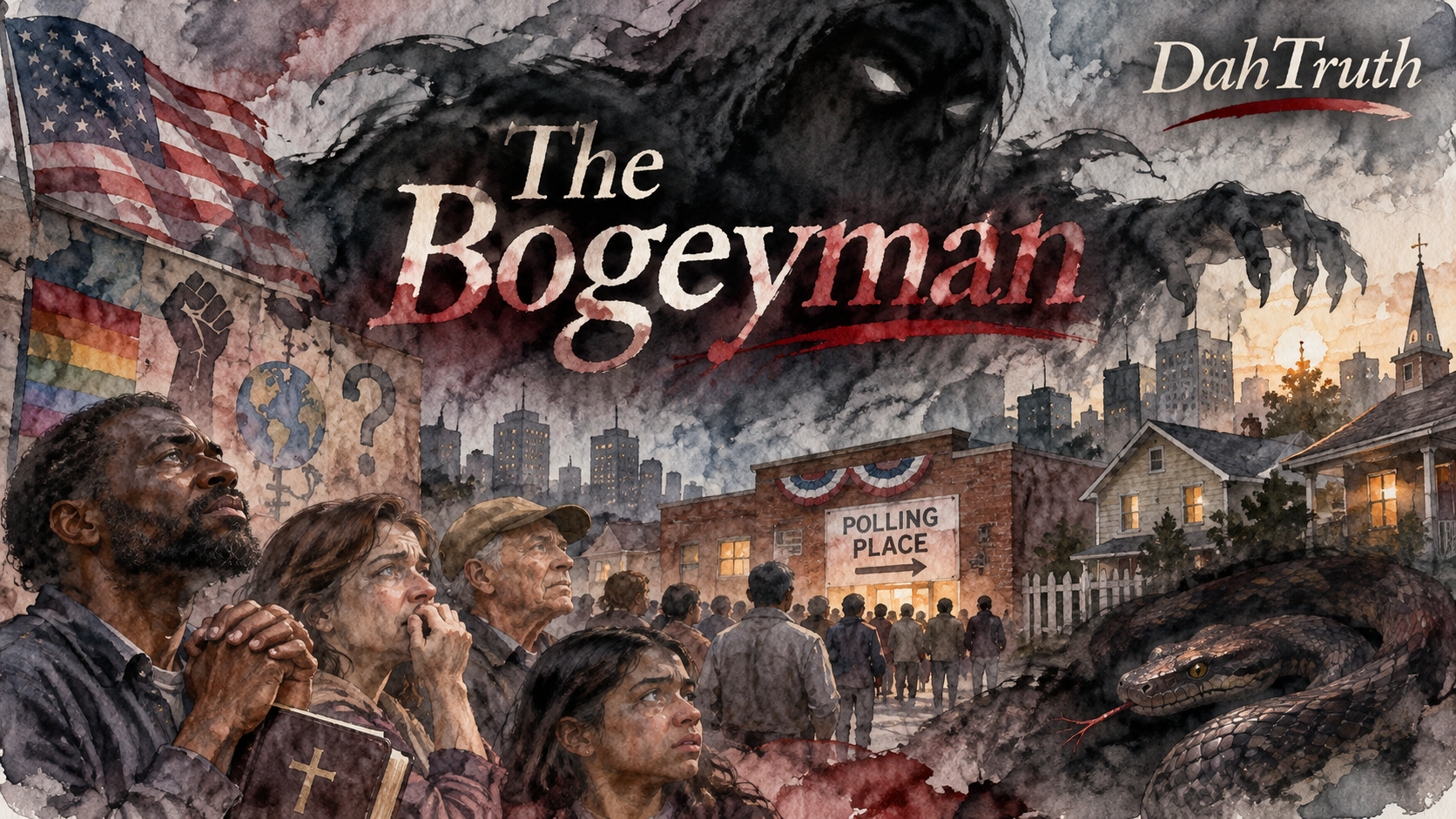
I have thought about that woman all week, because in a few short minutes she acted out the very thing I want to write about. She walked in afraid of being cheated, and when the process did not go the way she expected, she went looking for a villain. She found one in a poll worker who had done nothing but hand her the ballot the law required. She never read the question in front of her because she was too busy preparing her accusation. She needed someone to blame, and so she made one. That is the bogeyman, and that night I watched the entire country do the same thing on a much larger scale.
When the polls closed, we shut down the machines and began printing the tally reports. A quick glance at our numbers showed Cory Booker only about thirty votes ahead of his Republican challenger, Justin Murphy, and I thought it would be a good fight. When I got home, I was surprised to learn that Booker had already been declared the winner, and statewide it was never close. I turned on the television and, like most Americans, watched the Democratic Party sweep across the map. Democrats took back the House. They took the Senate, flipping seats in Texas, South Carolina, North Carolina, and Maine that few would have predicted a year ago. I was astounded, and as disappointment set in, I began to recognize something ironic.
Democrats were celebrating all over social media, but what they had gained was mostly numbers. Their majorities are enough to stall legislation, chair the committees, and launch the investigations Hakeem Jeffries has already promised. They are nowhere near the two-thirds needed to override a presidential veto, and they were never going to stop Donald Trump from carrying out his agenda, because so much of it has been accomplished around Congress through executive orders. When his policies have gone to court, by my count he has won most of those fights. The tariffs were the great exception. In February the Supreme Court struck down the tariffs he imposed under emergency powers, and a federal trade court has since ruled that importers are entitled to refunds on more than $130 billion that had been collected. Democrats applauded. I watched money that had been flowing into our own treasury, after years of trade arrangements that left American workers on the losing end, start flowing back out to the companies that brought in foreign goods. The status quo that cost American communities so dearly was restored, and the party that claims to speak for working people cheered.
It was probably then that I recognized something else. Policy was never the real issue in this election. Since Trump first took office, and even more so in his second term, the Democratic Party has kept its own policy agenda out of view and directed its voters to look at a man instead. They built a bogeyman, an image everyone could hate and get mad about, and that anger was enough to win a vote. It did not matter whether the complaint was gas prices or the war in Iran. Gas did climb above four dollars a gallon this fall, and families felt it, but I did not hear a plan for bringing it down from the people who won. I heard a name. As for the war, every American life lost is a grief carried by a family, and the Pentagon counted twenty-one service members killed through early October, with hundreds more wounded. Yet when I measure that against the more than 2,400 Americans killed in Afghanistan, the more than 4,400 killed in Iraq, the nearly three thousand who died on September 11, or the slaughter of October 7 and everything that followed it, I cannot see how anyone looked at this war and found in it the reason to hand Congress to the Democrats. The vote was cast against a man.
That man has a long list of stand-ins. The bogeyman can be Donald Trump. He can be the white man. He can be Christian nationalism, or traditional Christianity itself, or anyone whose way of thinking stands opposed to the progressive one. Opposing a politician or a policy is fair game in a free country. But when the enemy becomes the whole message, everything else gets pushed to the back burner: freedom, love for the stranger, the hard questions of sex and gender, the condition of our schools and neighborhoods. What rises in their place is fear, and fear is easy to organize and almost impossible to satisfy.
Hate is on a severe rise. This weekend, right across the river in Philadelphia, a cycling club called Philly Bike On Your Left, joined by the Boycott CookNSolo campaign and other groups, planned a "Boycott Ride" around Rittenhouse Square targeting six restaurants and food businesses with Jewish owners or ties to Israel. Their flyer declares that these "Zionist establishments must go." They scheduled it for Sunday, November 8, the day before the anniversary of Kristallnacht, when Nazi mobs smashed the windows of Jewish shops across Germany and Austria in 1938. Governor Josh Shapiro's office called the ride blatant antisemitism. The irony is thick. Many on the left spend their days calling their political opponents Nazis, while some among them ride through a city with a list of Jewish businesses that must go. People have every right to criticize the government of Israel, but riding past a family's restaurant to tell them they do not belong in the city is something history has already named.
Hate rises to tremendous levels because it is supported, and our algorithms are the proof. Anything negative, hateful, disrespectful, ungodly, or unrighteous rises to the top of our feeds, because outrage keeps us scrolling and scrolling keeps the platforms paid. Love, righteousness, and self-respect fall to the wayside. We sit back and watch, and we begin to tell ourselves that the wicked are winning and the godly are losing. Visibility has never been a measure of righteousness, though. A hateful post can collect a million views without becoming true, and a word spoken in love can reach ten people without losing any of its worth.
Then I recognized something even bigger. The Bible tells us plainly that this world is not going to get better. It will grow continuously and viciously more evil. Paul warned Timothy that in the last days perilous times would come, when men would be "lovers of their own selves," proud, blasphemers, unholy, and "without natural affection" (2 Timothy 3:1-3). Jesus said that "because iniquity shall abound, the love of many shall wax cold" (Matthew 24:12). Isaiah pronounced woe on those "that call evil good, and good evil" (Isaiah 5:20). Look at what the world is reaching for: anarchy, confusion, and chaos; no police; borders open to anyone who wants to cross them; the termination of pregnancies by the millions, which I can only call a genocide of the unborn; and the embrace of groups that hate the one small nation of Israel. Jerusalem sits at the center of that hostility, and Scripture tells us it is the place to which the Lord will return, when His feet stand upon the Mount of Olives (Zechariah 14:4). Some seem to believe that if that place can be destroyed, His promise can be destroyed with it. It should surprise no believer that the nations rage over it.
I was listening recently to Pastor Philip Anthony Mitchell, and he told a story that made me think about everything happening around us. He once kept a python in a cage, and to feed it he would put a bunch of rats inside. The rats would run around the cage, scrambling and playing, having a good time and feeling safe in the very place where death was waiting for them. The python would lie still in the darkness and do nothing. The rats grew so comfortable that they would run right over the top of the python's head. Their false sense of security lasted until the python moved. It would seize one of them, wrap it in its coils, and strangle the life out of it.
That is what I see in our culture today. The darkness sits back and waits, and it squeezes the life out of anything that is true and anything that is real. It is trying to squeeze the life out of Christianity. Abortion squeezes the life out of babies before they ever draw a breath. The transgender movement squeezes the life out of what it means to be made male and female in the image of God. The movement against the police squeezes the life out of order and lets chaos rule our streets. And under the banner of freedom of religion, the nation turns away from God while other faiths, Islam among them, rise in His place. I believe in religious freedom, but as a Christian, I cannot pretend that every faith leads to the same God, and I cannot pretend not to notice a country forgetting the God it was raised on. Meanwhile the wickedness of this world runs around the cage enjoying its false sense of security, convinced it is free, while the darkness waits in the corner.
I have been thinking about how a believer resists that squeeze, and my mind keeps returning to King Solomon. Scripture says that "Solomon loved the LORD, walking in the statutes of David his father" (1 Kings 3:3). God gave him wisdom beyond any king before or after him. Yet Solomon was provoked by the culture around him. He loved many foreign women from the very nations God had warned Israel against, and "when Solomon was old, his wives turned away his heart after other gods" (1 Kings 11:4). He built high places for Chemosh and Molech on the hill before Jerusalem so his wives could burn incense to their gods (1 Kings 11:7-8). Solomon did not wake up one morning and renounce the Lord. He grew complacent. He accommodated, and he kept accommodating, until shrines to false gods stood within sight of the temple he had built for the true one.
I believe that complacency is what eventually caused Solomon to question everything. In Ecclesiastes he looked at all the work of his hands, the wealth and the building and the pleasure and the wisdom itself, and declared, "Vanity of vanities; all is vanity" (Ecclesiastes 1:2). All of the devastation going on around him and all of his accomplishments came to the same conclusion: none of it ultimately mattered. At the end of that long search he arrived where he should have stayed all along: "Fear God, and keep his commandments: for this is the whole duty of man" (Ecclesiastes 12:13). The only thing that matters in the end is belief in the true God, Yahweh, and the salvation He provides.
That is why, when I vote against certain ideologies, against Democratic policies that I see destroying people and communities, provoking chaos and insecurity, and accommodating what Scripture identifies as false gods, I am contending for the faith. But I am also standing for the truth as I understand it from the evidence of the world around me. The destruction of a community is not merely a theological argument when the consequences can be measured in broken families, failing schools, violence, poverty, and the loss of human life. These are realities that demand examination and accountability. I cannot recognize those consequences and then become complacent because the culture has decided to embrace the policies I believe contribute to them.
Solomon knew the commandments of God, yet he accommodated what God had forbidden until his own heart was turned away. I do not want that complacency to become my own. Jude urged believers to "earnestly contend for the faith which was once delivered unto the saints" (Jude 1:3). I understand that instruction as a responsibility to stand for what is true, even when doing so places me in opposition to the majority. I will not surrender my convictions simply because they have become unpopular, nor will I pretend that the consequences of our decisions disappear because we have given them the language of freedom, progress, or acceptance.
I will be honest. I do not want to be one of the ones who is beheaded. I wish to die a peaceful death, one where God takes my hand and leads me to the Promised Land. But I worry that things will eventually become so far out of hand that we will no longer recognize the America we have lived through. The freedom we have known, and the place Christian belief once held in this country, could fade, and what remains could be persecution for simply believing. Even now, in some places, if you mention the Bible people scorn you. They become hostile, and all of a sudden you are the enemy because you stand against the beliefs of the community. I think of John the Baptist in the wilderness crying, "Repent ye: for the kingdom of heaven is at hand" (Matthew 3:2), calling people to turn from their sins because the Messiah was coming. People looked at him with scorn, laughed at him, and refused to believe. John ended in Herod's prison, and he lost his head for the truth he would not stop speaking (Matthew 14:10). The book of Revelation speaks of "the souls of them that were beheaded for the witness of Jesus, and for the word of God" (Revelation 20:4).
Jesus also told us, "fear not them which kill the body, but are not able to kill the soul" (Matthew 10:28). The Bible says that in the last days these things will indeed happen, and so we should not lose our faith or fall into disappointment when we see an election like the one we just had. That election was won on neither policy nor ideology. It was won through the enormous creation of a bogeyman, and because so many people were running after something to hate, consistently, in the form of a person.
I believe the next two years will be filled with that same animosity toward an individual, or toward the individuals who, in the minds of so many voters, represent hate. That is what disappoints me most. Instead of progress for our communities, we are going to see a rise in hatred and disrespect that will prove costly, because none of it addresses the crises inside our own neighborhoods. The new majorities will hold hearings, hoping for punch lines that go viral. They will issue subpoenas and make headlines, and meanwhile the families in the American Black communities I come from, and in towns like the one where I sat at that poll table, will still be waiting for someone to talk to them about schools, safety, work, and the price of keeping a household together. Defeating the man you fear does not repair a single block.
I keep thinking about that woman at the poll table, recording a poll worker on her phone while the answer to her complaint had sat in her mailbox and another answer sat right there on the form in front of her. She was so certain she had found her enemy that she never read what was being asked of her. I am afraid much of this country walked into the voting booth the same way. The bogeyman will change his face with every election, and the darkness will keep waiting in the corner of the cage while the rats run over its head. I would rather be found reading the question, knowing what I believe and why I believe it, and contending for the faith once delivered to the saints, whatever the vote count says the next morning.
