“The soul that sinneth, it shall die. The son shall not bear the iniquity of the father, neither shall the father bear the iniquity of the son.” Ezekiel 18:20 (KJV)
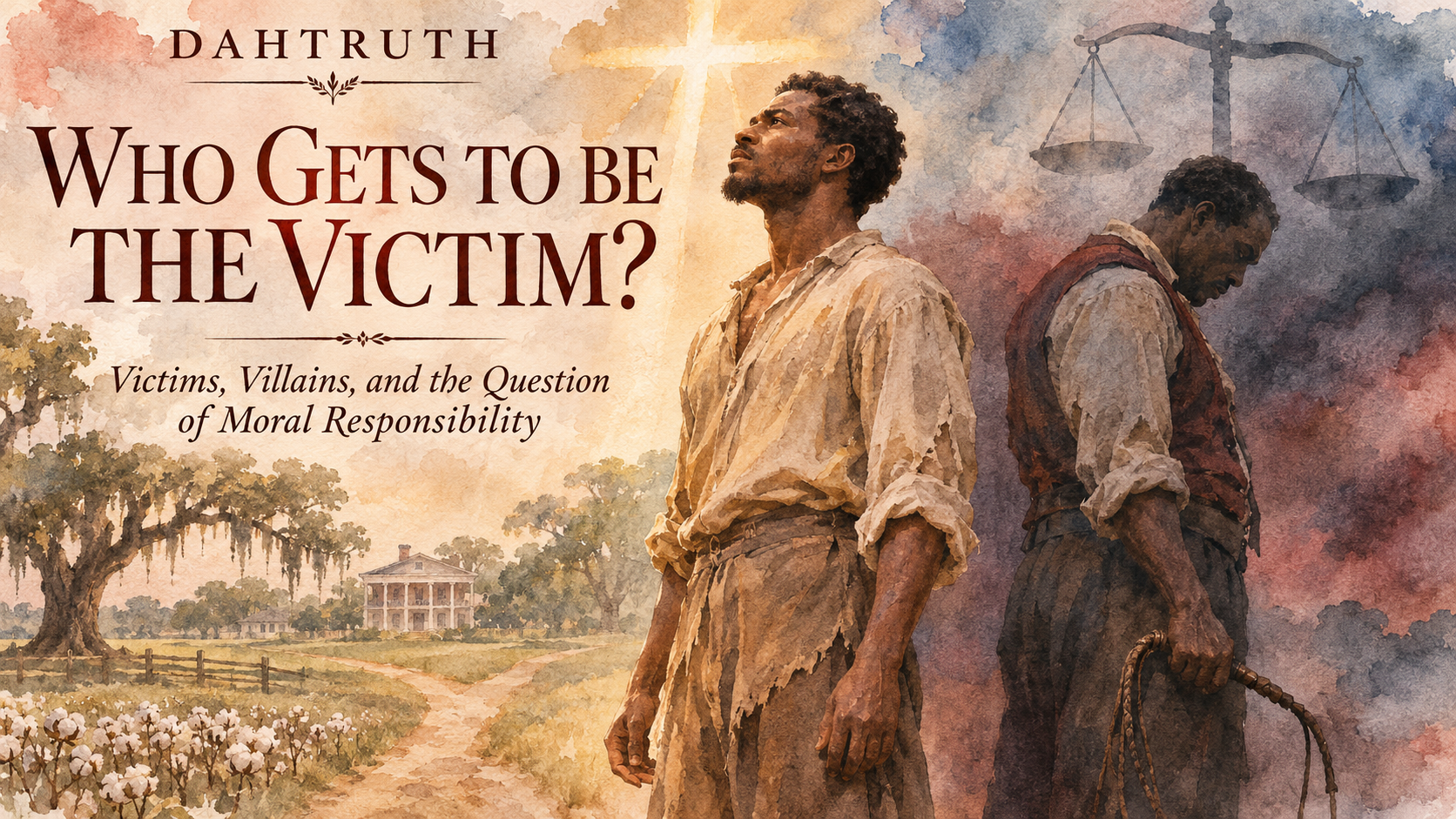
There is a scene in Uncle Tom's Cabin that I have never been able to shake. Simon Legree, the most vicious master in the book, does not always do his own whipping. He hands the whip to Sambo and Quimbo, two enslaved men who live under the same lash as everyone else on his plantation, and they do it for him. I have written about Tom and Sambo before, and I keep coming back to them because they lived inside the same evil institution, on the same land, under the same master, and they made opposite choices. Tom refused to let the culture, or even the man who claimed to own him, decide for him what was right and what was wrong. He moved with the ebbs and flows of whatever life brought him, but he would not surrender his conscience, and when Legree ordered him to whip another enslaved woman, he refused. We do not know all of Sambo's backstory, but we know what he became. He conformed to the viciousness of that culture until he was the hand that held the whip. Both men were victims of slavery. Only one of them became its instrument.
Those two men came back to me this week while I was reading "The Dangers of the Villain-Victim Dichotomy," an article in The New Yorker by the psychologist Paul Bloom about how we divide people into victims and villains. His point, put simply, is that once we label someone a victim we tend to treat that person as virtuous and stop asking what they have done, and once we label someone a villain we stop seeing that person as human at all. Isn't that what we did with George Floyd? Once we saw the knee on his neck, Floyd instantly became a victim, virtuous, a saint, despite the life he had lived before he stepped into that story with an allegedly counterfeit $20 bill. His past did not make his death deserved, and his death did not make his past holy.
When I started reading the article, I assumed I knew where it was headed. I thought it would lead straight to the Democratic and Republican divide in America, with Donald Trump cast as the villain and everyone who stands against him cast as the victims of his ideas and his policies. The article turned out to be about something larger than any one election, but it put words to something I have been wrestling with for a long time.
I believe the focus in America has been shifted away from examining the impact of certain Democratic policies on our own communities and toward simply naming the villain and consoling the victim. When one man is made the villain of every story, everyone standing against him is granted the status of victim, and that status comes with an unspoken pardon. Nobody has to answer for what their own policies have done to the neighborhoods they claim to defend. The questions that should matter most, what was promised, what was delivered, who benefited and who paid, get drowned out by the noise of condemning the villain. In the American Black communities I come from, we have been told for generations who our villain is, and we have been rewarded with the comfort of being called victims. But comfort is a poor substitute for examination. A community that is always assigned the role of victim is rarely invited to ask hard questions about the people who keep assigning it.
Bloom calls victimhood a kind of moral currency, and I think that is exactly right. In our politics, the side that controls the story of who has been wronged also controls who gets excused. If you are the victim, your failures are forgiven before anyone examines them. If you are the villain, nothing you do can be weighed fairly, because you have already been convicted. Sambo would have understood that system perfectly. As long as Legree was the villain of the plantation, no one had to ask what Sambo was doing with the whip in his hand.
There was one passage in the article I cannot let pass. Bloom mentions the historian Tom Holland, who argues that Christianity changed the world by worshiping a crucified man, and he notes that Friedrich Nietzsche blamed Christianity for our modern exaltation of victims, which Nietzsche called a "slave morality." Bloom does not say Nietzsche was right, but the idea is left hanging there that the West's devotion to the victim began with the cross. That is history twisted to make the faith the villain.
The suffering of the innocent did not begin at Calvary. It begins in the garden. When Adam and Eve disobeyed God, suffering entered human life: pain in childbearing, strife in the home, and ground cursed so that bread would come only by sweat (Genesis 3:16-19). In the very same chapter, God gave the first promise of a Redeemer who would suffer. Speaking to the serpent, He said of the woman's seed, "it shall bruise thy head, and thou shalt bruise his heel" (Genesis 3:15). The suffering Christ was announced before there was a single Christian. From there the thread runs through all of the Hebrew Scriptures. Abel is murdered by his brother. Joseph is sold by his brothers, falsely accused, and thrown in prison. Job, a righteous man, loses everything and still refuses to curse God. And centuries before the cross, Isaiah described a servant who was "despised and rejected of men; a man of sorrows, and acquainted with grief," who "was wounded for our transgressions" (Isaiah 53:3, 5).
And Scripture never taught what Nietzsche accused it of teaching. The Bible teaches that the innocent can suffer at the hands of the guilty. It never teaches that everyone who suffers is innocent, or that everyone who holds power is guilty. "The soul that sinneth, it shall die," says Ezekiel. "The son shall not bear the iniquity of the father, neither shall the father bear the iniquity of the son" (Ezekiel 18:20). Every person answers for his own conduct, whatever was done to him. God does not excuse wrongdoing because the one who committed it has also suffered. That balance is exactly what our culture has lost, and the Bible held it from the very beginning.
Bloom suggests that fiction can help us see people in their full complexity again, and on that point we agree completely. I just finished The Pillars of the Earth, and Ken Follett gives us William Hamleigh. From the moment we meet him, William is vicious. Follett never has to announce it. He simply shows us William's behavior as the story unfolds. Over time we come to understand how William became what he was, largely through his mother, Regan, who fed his ambition and his rage, and we begin to see the frightened, insecure boy, afraid of descending into hell, hiding beneath the bully. We can understand some of the circumstances that shaped him. But we cannot turn away from what he chose to do with them. William rapes. He murders. He steals and burns. In the end he helps kill an archbishop in his own cathedral and is hanged for the crime. Follett lets us understand William's humanity without ever asking us to pretend he was innocent, and that is exactly the skill our politics has forgotten.
The same question hangs over the Jewish men Bloom builds his article on, the ones the Nazis placed on the councils that chose who would be sent to the concentration camps. I can feel some empathy for people trapped inside a system designed to destroy them, working within it in the hope of saving themselves or their families. The terror was real, and a man with a gun at his back does not have the choices of a free man. But even inside that system there was a contention for truth, and too often it was dismissed by complacency. There is a difference between surviving an institution and helping it carry out its cruelty, and a difference between a man forced at gunpoint and a man who grows comfortable with the authority his oppressors have handed him. Paul told the church at Rome, "be not conformed to this world: but be ye transformed by the renewing of your mind" (Romans 12:2). Tom lived that verse in chains. Sambo shows us what happens when a person lets the world do the renewing instead. And in The Pillars of the Earth, the archbishop struck down by villains in his own cathedral shows us what it means to be killed for the faith.
So I keep returning to one question: how do we extend compassion to the suffering without surrendering our responsibility to judge actions, examine consequences, and hold people accountable? I believe the answer is that we refuse to let one take the place of the other. We can acknowledge what happened to people without surrendering our ability to examine what they did, what they permitted, what they participated in, and what they became. Compassion for the victim should never require us to stop asking hard questions, and the condemnation of a villain should never be allowed to excuse everyone standing on the other side of him.
That brings me back to American politics. Who gets to define the victim: the person who has actually been harmed, or the political party that claims to speak for that person? Does being called a victim relieve anyone of responsibility for their own decisions and for the policies they supported? And who benefits when we spend all of our energy identifying villains and almost none of it examining outcomes? Anyone who still wants the truth more than they want to win the argument should be asking those questions, whatever party they vote for.
Earlier this week I wrote about the bogeyman, the villain manufactured to keep us from examining policy. This is the other half of that trick. A manufactured villain hides what his opponents have done, and a manufactured saint hides what the victim has done. In both cases the label stands in for the truth. There are real victims in this world and real villains, and Scripture never pretends otherwise. But neither label can stand in for the truth, and the truth is the only thing we will be judged by.
There is one more scene in Uncle Tom's Cabin that I cannot leave out. As Tom lay dying from the beating, he forgave the men who had done it, and he told them about Jesus. Sambo and Quimbo wept over him and asked to know that same Jesus. Their repentance did not erase the whip in their hands, and Stowe never pretends that it did. They were victims of the same system that destroyed Tom, and they were also the men who had beaten him. Their redemption began only when they stopped hiding behind the first truth and faced the second. No one is beyond the reach of grace, but no one reaches grace by insisting he is only a victim. If we keep sorting the world into innocent victims and inhuman villains, we will never learn to tell suffering from innocence, circumstance from choice, or explanation from excuse, and we will lose the very thing that makes redemption possible. Read Bloom's piece in The New Yorker, and then decide for yourself how we should deal with a victim whose past has already defined them.
