The death of a Ghanaian child is a tragedy deserving justice. It is not permission to put American Black ancestry on trial. Dahtruth
A boy is dead, the shooters are unknown, and the verdict is already in
In October of 1977, Maude aired an episode called "Victoria's Boyfriend." Victoria Butterfield, Maude's West Indian housekeeper, had fallen for an American man, and when her father came to visit, he refused to accept his daughter being with a man who was not from the West Indies. I watched that kind of television growing up, and I remember the lesson in it even if the laugh track tried to soften it. A Black man from the islands looked at an American man and decided he was beneath his daughter. That was almost fifty years ago, on a network sitcom, in front of millions of American households. So when people tell me the tension between American Blacks, the descendants of those enslaved in this country, and the African and Caribbean immigrants who have come here since the 1960s is something new, something social media invented, I know better. It was on prime time before some of the people arguing about it now were born.
Over the last several months that old attitude has been manifesting itself again, louder than I have ever heard it. There has always been an implication, sometimes whispered and sometimes said outright, that African and Caribbean immigrants hold themselves to a higher standard than American Blacks. And over the last several years, American Blacks have begun answering back. We have been drawing a line around our own lineage, our own history, and our own identity as Americans, and we have refused to be folded into a general category of Black that erases what our ancestors built here. Some people have taken great offense at that. And now a child is dead, and the offense has found a target.
A Boy on His Way to School
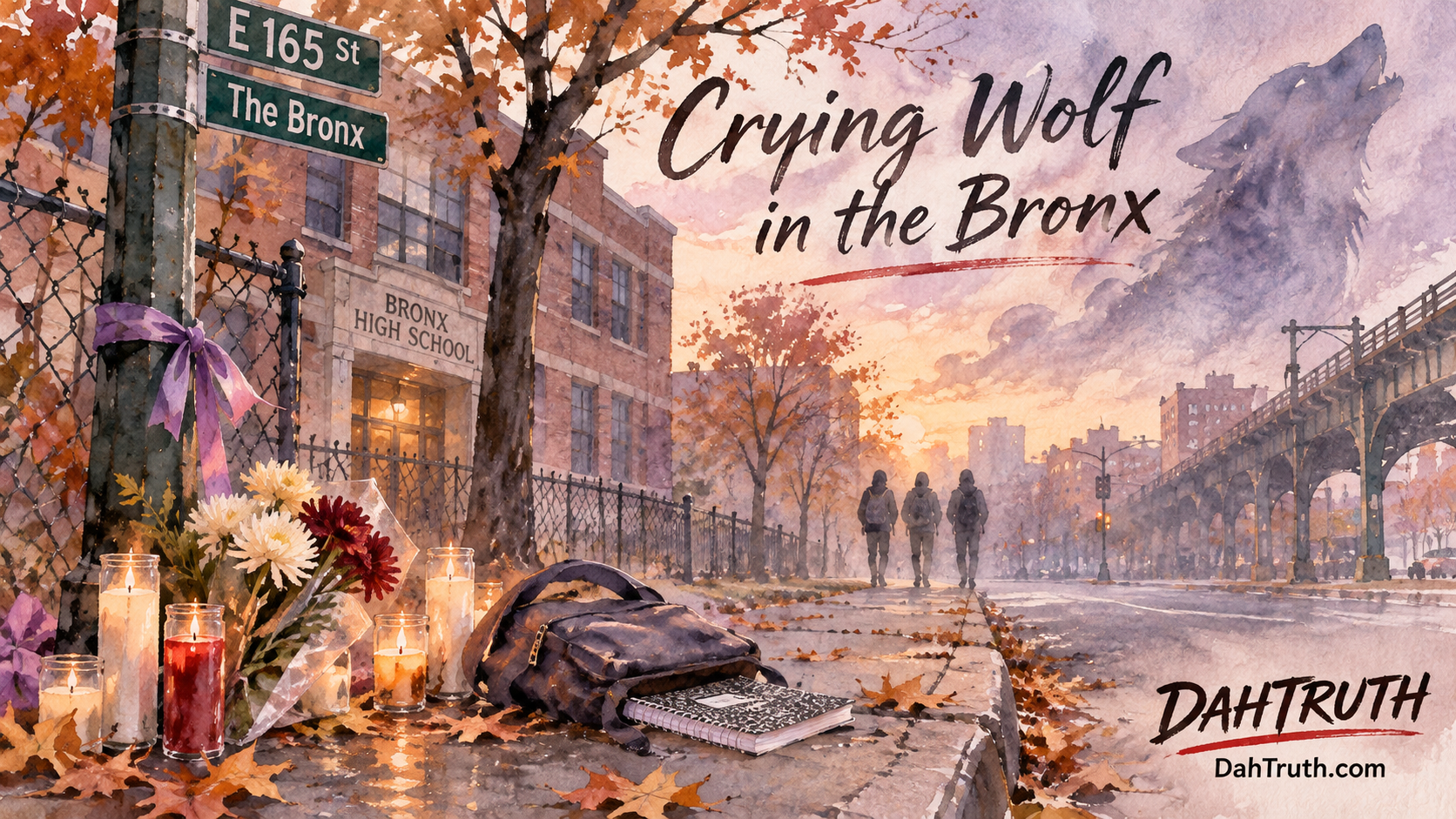
Javits Frimpong was fifteen years old. He came from Ghana about a year ago to live with his father, Thomas, a New York City cab driver, in the Claremont section of the Bronx. On the morning of Thursday, October 29, he was walking to school, Dreamyard Preparatory, just around the corner from the apartment he shared with his father, when he was shot in the abdomen near East 171st Street and Crotona Place. He died at the hospital. His father says he dreamed of becoming a doctor. Before anything else in this essay, let me say plainly that this was a child, that his life was stolen on a sidewalk on his way to class, and that whoever pulled that trigger should be found, arrested, and prosecuted to the full extent of the law. His mother in Ghana and his father in the Bronx deserve that much, and so does every child who walks to school in this city.
His father has told reporters that a few days before the shooting, Javits had gotten into a fight with two boys at school and that both were suspended, and that his son later said another boy had been bullying him at lunch. That deserves a full investigation. But here is what the police have actually said. They are looking for three teenage boys, between sixteen and eighteen years old, last seen in all-black clothing and blue surgical masks. As of this writing, there have been no arrests. Police have not identified the suspects. They have not said whether the suspects are the boys from the school. They have not named a motive, and they have not said one word about anyone's race, ethnicity, or nationality.
The Verdict Before the Evidence
And yet the verdict is already in. Across social media, voices from the Ghanaian and broader African and Caribbean communities have decided who killed this boy. According to them, it was American Black boys, and it was American Blacks as a people who shot him in the back. No suspect has been named, no arrest has been made, no motive has been established, and still the judgment has been handed down against an entire community whose only crime, as far as I can tell, is being the most convenient people to blame.
Think about how reckless that is. Claremont and the neighborhoods around Crotona Park are majority Hispanic, roughly two out of every three residents by the census count, and the Black residents there include a great many West African immigrants. The Bronx is home to one of the largest Ghanaian communities in this country. Three masked teenagers in black clothing could be anybody. They could be Dominican. They could be Puerto Rican. They could be the sons of African immigrants themselves. I do not know who they are, and neither does anyone posting accusations online. That is precisely my point. When you do not know, you wait for the evidence. You do not hang the crime around the neck of American Black boys because it fits a story you already wanted to tell.
Even Cardi B, a daughter of the Bronx with Dominican and Trinidadian roots, pushed back on it. Responding to the online claim that Black Americans are the bullies, she said that everybody bullies the new kids, even their own kind. She is right. Anyone who has walked the halls of a New York public school knows that the new kid with the accent, the new kid with the different clothes, the new kid who does not know the rules yet, catches it from every direction. That is cruelty, and it is ugly, and it is universal. It does not belong to one people.
Bullying Doesn't Pull a Trigger
Most of us were bullied at some point in school. Most of us were teased about how we looked, how we talked, where we lived, what we wore, or who our parents were. Children say hurtful things. Words wound, and I will never pretend that a child being tormented at lunch is nothing. But words are words, and they do not translate into murder. A bully calls you names. A killer waits for you on a corner with a gun. Those are two entirely different human beings, and a society that cannot tell the difference between them will never find the person who actually killed Javits Frimpong.
What troubles me is how quickly the two were fused together. A father's grief over bullying, which he has every right to feel and to voice, became a referendum on American Black people as a whole. And then came the stories. Suddenly the algorithms are full of them: Africans and Caribbeans recounting how, when they came to this country, they were bullied by American Blacks because of the way they looked, the way they spoke, and how different they were. Public figures have joined in with stories of their own. And the message underneath all of it is that we, American Blacks, were jealous of them, that we have always been jealous of them, and that this boy's death is the natural end of that jealousy.
When American Blacks hear that, we are shocked, because most of us never gave the African community that kind of thought. When an African family moved into our neighborhood, we accepted them. We did not study their conditions or measure ourselves against them, because we were too busy struggling with conditions of our own. And still we kept moving and shaking, living and loving, growing and spreading out. Now we are told that while we were surviving, we were bullying, and that while we were building, we were envious. I do not recognize that community. I grew up in it, and it was not looking over its shoulder at anybody.
The Performance
What I am watching now is a performance. People have gathered together, online and in person, as a supposed community, and they are performing grief and grievance in a way that strikes up a narrative the evidence has not supported. Every testimony of being teased in a school hallway twenty years ago gets stacked on top of the next one until the pile looks like proof. Every repost adds weight. And the more the story is performed, the less anyone asks the only question that matters for Javits: who actually shot him?
Grief is real. I will not mock a single tear shed for that boy. But a performance has an audience and an agenda, and this one has both. The audience is anyone willing to believe the worst about American Black people. The agenda is to recast us as the villains in the immigrant story, the bullies and the jealous neighbors, so that our demand to be recognized as a distinct people with a distinct history can be dismissed as just more evidence of our hostility. It is the same thing I wrote about in my other essay this week. Build a monster, point at it, and stop looking for the truth.
Begging for Our Loyalty
Here is what makes this so bitter. For years now, American Blacks have been delineating ourselves from African immigrants in this country. We have said that our lineage runs through the slave ships, the plantations, emancipation, Reconstruction, Jim Crow, and the civil rights movement, and that it belongs to us. We have said that the resources, the remedies, and the representation owed to the descendants of American slavery should go to the descendants of American slavery. And for saying so, we have been criticized for not aligning with Africans. We have been called divisive. We have been told we were abandoning our brothers and sisters. We have been begged for our loyalty.
Now a Ghanaian boy is dead, and the same voices that begged for our loyalty have turned and attacked us without a shred of evidence. You cannot ask a people to stand with you on Monday and accuse them of murder on Thursday. You cannot call us family when you need our votes, our platforms, and our history, and then call us killers when you need somebody to blame. That is the clearest demonstration I have ever seen of why the line we have been drawing needs to be drawn.
And spare me the lecture that American Blacks do not know our history. Ghana has existed as a nation only since 1957, when it gave up the colonial name Gold Coast. Nigeria has existed only since 1960, and it still carries the name a British colonial writer gave it. Our history in this country is documented back through the 1800s, and for many of us through the 1700s and earlier. We can look back through census records, plantation ledgers, church rolls, and Freedmen's Bureau files and see exactly who we are. We are Americans. We did not have to borrow that identity from anyone, and we will not hand it over to anyone who thinks they can define it better than we can.
Justice for Javits, and the Truth for Us
I want justice for Javits Frimpong. I want the three young men police are looking for found and held accountable, whoever they are and wherever their parents came from. I want the school's handling of the bullying complaints examined in full. And I want every voice that rushed to convict American Black boys without evidence to sit with what they have done, because a false narrative does not only slander a people. It also sends investigators, journalists, and the public looking in the wrong direction, and the person who actually killed that child benefits from every minute of it.
That Maude episode aired in 1977. I was nine years old. Almost fifty years later, the father's attitude has found a new stage and a much larger audience. So I will ask the question that has been hanging over this whole conversation. When did being an American descendant of enslaved people become something other Black people feel entitled to criticize, redefine, and now blame for a murder no one has solved? Somebody is crying wolf in the Bronx. And this time, we are not going to sit quietly and listen to the fake moans.
