
The Pill, the Panel, and the Lottery
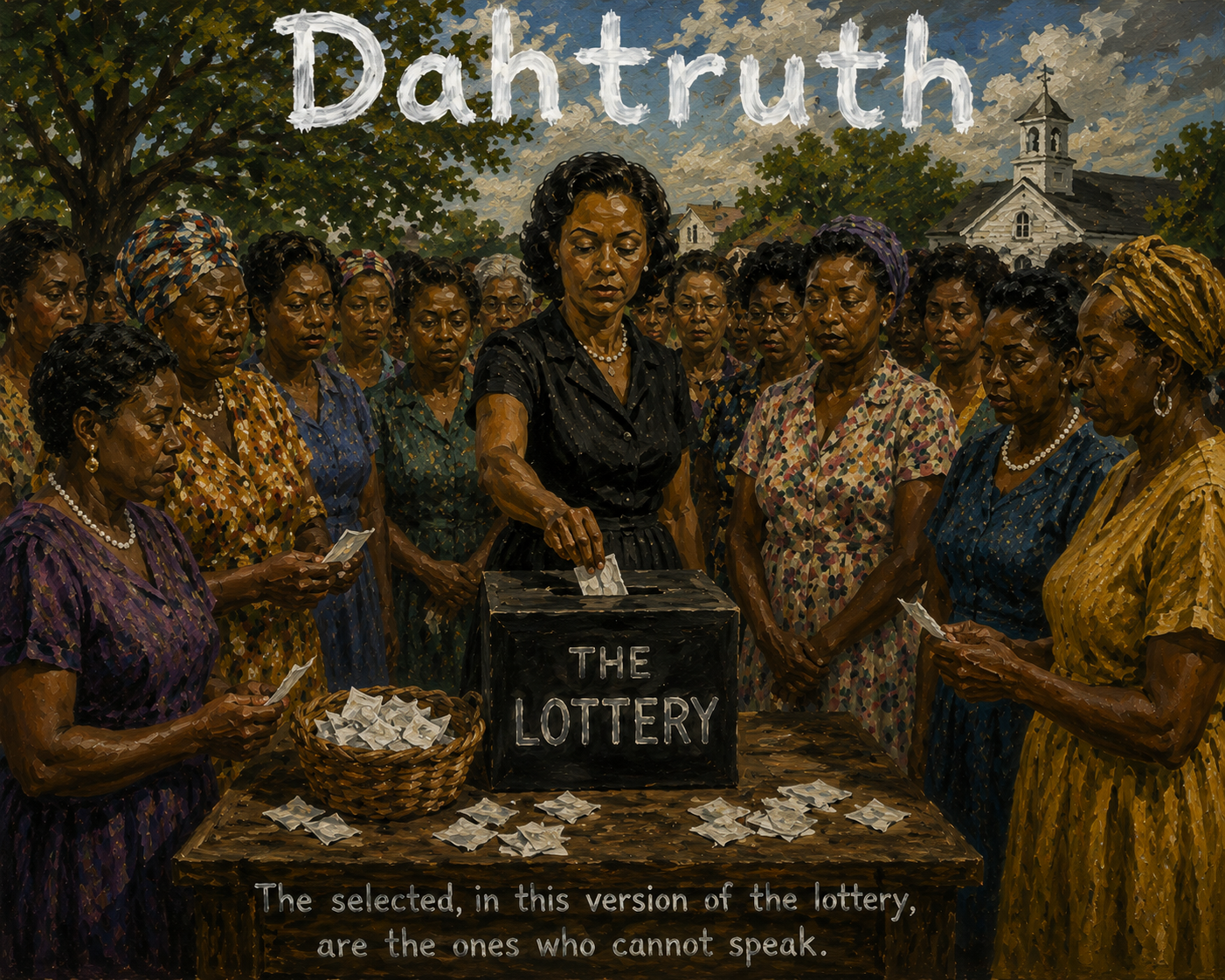
“Although the villagers had forgotten the ritual and lost the original black box, they still remembered to use stones.” - The Lottery, Shirley Jackson
This Mother’s Day finds the country in an uncomfortable position. On the same Sunday that we set aside to honor the women who carried us, fed us, walked the floor with us through fevers and disappointments, and offered up parts of themselves they will never get back, the Supreme Court is preparing to decide by tomorrow afternoon whether the chemical ending of pregnancy may continue to be ordered through the mail. The two events sit beside each other on the calendar without apology. We light candles for our mothers in the morning and read the legal briefs in the evening. We post tributes online to the women who chose us and scroll past headlines about the drug that ends the choosing. The strangeness of it ought to stop us in the doorway, and yet for most of the country it will not.
I am writing this on Mother’s Day for that reason. The juxtaposition is not an accident of the news cycle. It is a window into what we have become, and what we are still becoming, as a people who once knew how to call motherhood sacred without irony.
On May 1, 2026, a three-judge panel of the Fifth Circuit Court of Appeals issued a ruling in Louisiana v. FDA that required mifepristone, the drug used in roughly six out of every ten abortions in this country, to be dispensed only in person at a clinic or pharmacy. Two days later the manufacturers, Danco Laboratories and GenBioPro, raced to the Supreme Court asking for emergency relief, and on Monday, May 4, Justice Samuel Alito issued an administrative stay that paused the Fifth Circuit’s ruling until tomorrow, May 11, at five o’clock in the afternoon. By the time most readers see this piece, the country will already know whether the high court intends to keep the pill flowing through the mail or whether it will allow the appellate ruling to stand. Either way, the argument I want to make today does not depend on which way the justices rule. It depends on what we have already become as a society long before the ruling arrived, and on what we will choose to remember about motherhood once the news has moved on.
“Unto the woman he said, I will greatly multiply thy sorrow and thy conception; in sorrow thou shalt bring forth children...— ”
Reading the briefs filed by the drug companies, you would think the matter at hand is purely technical. Telehealth, dispensing protocols, regulatory chaos, the orderly function of the Food and Drug Administration. I do not dismiss the procedural questions as merely cosmetic. There are real arguments to be made about how a federal agency should regulate a drug, about the limits of agency discretion, and about the chaos that follows when courts and regulators contradict one another. Reasonable people, including some who share my convictions about the unborn, will disagree about whether the Fifth Circuit panel reached the right legal conclusion. What I am after today is something the briefs themselves cannot say out loud. The language is corporate and procedural, as it always is when the subject is one we no longer wish to confront in plain terms. The state of Louisiana, for its part, says in equally measured language that the telemedicine pathway undermines its laws protecting unborn human life and forces it to spend Medicaid funds caring for women injured by the drug. Every word in the case is carefully chosen to keep the reader at a distance from what is actually happening, which is the chemical termination of a developing human being inside a woman’s body, sometimes alone in a bathroom, sometimes after a fifteen-minute video call with a clinician hundreds of miles away, sometimes ordered through the mail like a prescription for blood pressure medication.
The legal complexity is real. The federal questions in this case are real, the Trump administration’s own FDA review of the 2023 dispensing policy is real, and the conflict between Louisiana’s near-total abortion ban and the federal regulatory framework is real. None of that, however, is the question I sit with on this particular Sunday as a believer and as an American Black woman watching this country argue about the unborn the way it once argued about us. There is a deeper question underneath the legal one, and it is older than the Fifth Circuit, older than the Comstock Act, older than mifepristone itself. It is the question first whispered in Eden, and it has not changed in form even though the speakers and the institutions have multiplied beyond counting.
Hath God said. That is the original challenge. The voice in the garden did not deny that the tree existed or that the fruit was real. It only suggested that what God had clearly said about the tree could be redefined, softened, reframed into something more reasonable, more sophisticated, more compatible with what the human creature wanted to do anyway. Surely you shall not die, the voice said. Surely God did not mean what you think He meant. The pattern has not changed. When I read the legal arguments and the public commentary surrounding the abortion pill, I hear the same refrain dressed in newer clothing. Surely that is not a life. Surely this pill represents healthcare. Surely this is simply part of the reproductive process. I am aware that thoughtful people, including some who would call themselves pro-life in their own way, hold a gradualist view, arguing that early development represents a different moral category than later development and that the chemical ending of pregnancy in the first weeks should not be weighed the same as the ending of a born life. I respect the seriousness of that position more than I respect the slogans, and I still cannot accept it, because the line drawn at week six or week ten or week twelve is a line drawn by the convenience of the one drawing it, not by anything inherent in the developing life itself. The institutions change and the intellectual frameworks become more elaborate, but underneath the layered language is the same redefinition of reality so that we may live at peace with what we have decided to do.
We are told, in the most credentialed voices we possess, not to trust what is plainly unfolding inside the womb. Not to trust the moral intuition that has belonged to mothers and grandmothers across every culture and century. Not to trust the continuity of human development that any honest embryology textbook will describe in the first chapter. Instead we are encouraged to trust the language of the pharmaceutical companies that profit from the continuation of this market, the legal theorists who construct the scaffolding around it, and the commentators who appear on our screens to assure us that the ritual is humane and the women are heroic and the question of what is being ended is, somehow, beside the point. That is what troubles me most. Once a society becomes comfortable redefining life itself in order to justify what it has chosen to do with that life, truth becomes increasingly difficult to recognize anywhere else. The same culture that cannot say what is in the womb will eventually struggle to say what is in the prison cell or the nursing home. These are the places where life is most easily questioned, because the people inside them cannot stand up and answer back. We have already watched this happen in our own lifetimes, as the man in solitary confinement became a case number, as the grandmother in the nursing home became a billing code, and each redefinition was defended by people who believed themselves to be reasonable. The redefinition does not stay in one place. It never has.
I have thought often, in the years since the public conversation around abortion shifted from the language of tragedy to the language of celebration, of Shirley Jackson’s short story The Lottery. Most American readers encountered it in high school. A small village gathers on a clear summer morning. The children are gathering stones. The adults are chatting about the weather and the planting. Old Man Warner reminds everyone that there has always been a lottery, that to abandon the ritual would be to abandon civilization itself. The proceedings are calm, orderly, even cordial. Names are drawn. A slip of paper is unfolded. With the same neighbors who had been laughing a few minutes earlier, the stoning begins. What Jackson understood, and what made the story unbearable to the readers of The New Yorker in 1948 who cancelled their subscriptions in protest, is that violence does not require monsters. It only requires a community willing to ritualize what it cannot bear to face directly, and a vocabulary respectable enough to keep the face from showing.
When I listen to the most credentialed voices in our culture defend the abortion pill as a matter of healthcare access, when I watched, during the last presidential cycle, the public celebrations of women who had ended pregnancies and been brought forward to tell their stories as acts of empowerment, when I hear the language of liberation applied to the chemical ending of a developing human life, what I am hearing is the calm and orderly procedure of a village that has decided the ritual is necessary. The participants are not cruel. Many of them are kind, educated, and sincerely persuaded that they are on the side of progress. The vocabulary is sophisticated. The framework is humane. The procedures are regulated by federal agencies and reviewed by appellate courts and defended by manufacturers in well-written briefs. Everything is in order. At the center of the ritual, no matter how many layers of language we wrap around it, a developing human life is being ended, and we have decided collectively that we will not look at that fact directly. The selected, in this version of the lottery, are the ones who cannot speak.
I want to be careful here, because I know that women who have walked through this decision often carry it for the rest of their lives, and many of them carry it with grief that the public celebrations do not acknowledge or allow. My argument is not against those women. My argument is against the cultural machine that requires their stories to be sorted into the approved categories of empowerment and liberation, that cannot make room for the fuller and harder truth, and that recruits the language of medicine and law and progress to keep us from facing what is actually being done. I have known women who were broken by what was sold to them as freedom, and I have known women who believed it was the right decision and still wept when no one was looking. The cultural ritual cannot account for either of them honestly, because the ritual depends on the redefinition holding firm.
The Fifth Circuit’s ruling, whatever its legal fate by the end of the day tomorrow, did one useful thing. It interrupted the smoothness of the procedure. It made the country argue, briefly and uncomfortably, about how a drug that ends a pregnancy should be obtained, and in arguing about the how, the country was forced for a moment to remember the what. That is why the manufacturers’ briefs sound so urgent. Not only because of the logistical disruption, real as that is, but because the public attention itself is dangerous to the ritual. Rituals work best when no one looks too closely. The whole point of the mail order pathway, beyond convenience, is that it removes the act from the clinical setting, removes it from the in-person encounter, removes it from the place where another human being might ask a question or pause a moment, and relocates it to the privacy of a bathroom where the woman is alone with the pill and the consequence and the silence. Whatever one thinks about the legal questions, that relocation is not a neutral act. It is the further refinement of a ritual that has always preferred not to be witnessed.
I do not know how the Supreme Court will rule. I do not know whether Justice Alito’s stay will be extended, dissolved, or replaced by a more substantive order. I do know that the deeper question, the one that has hovered over this republic since long before mifepristone was approved in the year 2000, will not be resolved by any panel of judges or any FDA review or any executive order. The court will decide tomorrow what the pharmacy may do. The older question is what the people will do, and that question is not on any docket. It is whether a people who once held that all human beings are endowed by their Creator with the right to life can keep that conviction alive while simultaneously building a sophisticated infrastructure for the chemical ending of human life in its earliest and most defenseless form. I do not believe a people can hold both. I believe that one will eventually overtake the other, and that we are watching, in real time and at considerable speed, which one is winning.
The voice in the garden has never stopped speaking. It has only learned to use better lawyers, better doctors, better marketers, and better legal briefs. The question for those of us who claim to follow the One who answered that voice with the cross is whether we will keep saying what God has said about the human person made in His image, even when the saying of it costs us our place at the cultural table.
So as we celebrate the sacrifice mothers make today, the women who carried us when carrying was hard, the foremothers who labored under conditions this country has still not fully reckoned with, the women in our own families who chose us when choosing was not the easy or the celebrated path, the daughters now becoming mothers themselves and learning what their own bodies can give and forgive, let us also remember what motherhood actually is. It is the willingness to receive a life that is not yours and to spend yourself for it. It is the original sacrament of the human story, written into the body itself before any law was ever written about it. The women I am thinking of this morning, including the one who carried me, did not ask whether the life inside them was convenient. They asked what was required of them, and they paid it. That is the older lottery, the one in which the mother accepts that her own ease will be drawn against the life of another, and offers herself instead. We used to know how to honor that. We are forgetting, and the forgetting is showing in our laws, our pharmacies, our headlines, and our hearts.
The pill, the panel, and the procedure may all hold for now. The truth still stands. The mothers still stand. So do I.
