Much Ado About Nothing
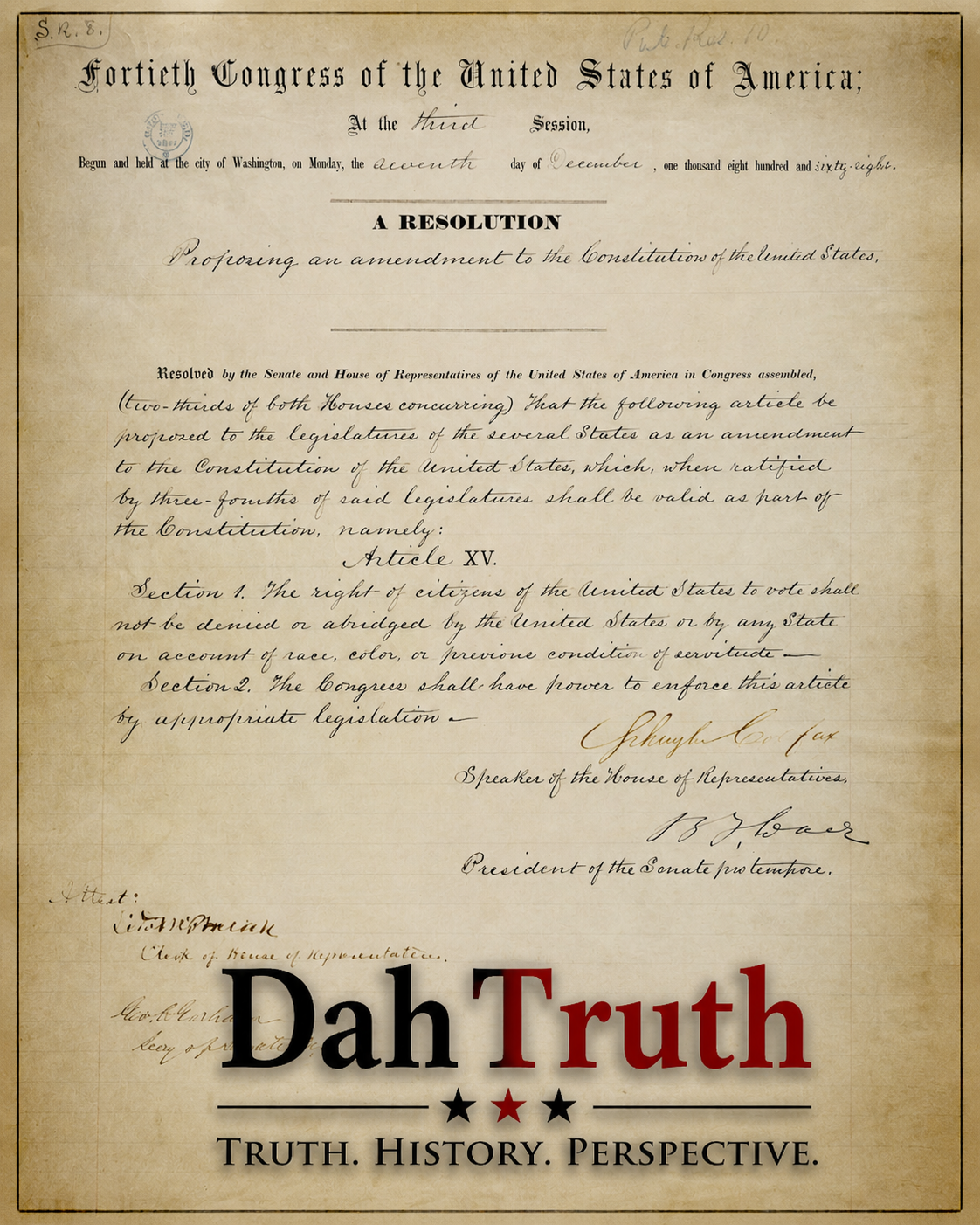
Article XV.
Section 1. The right of citizens of the United States to vote shall not be denied or abridged by the United States or by any State on account of race, color, or previous condition of servitude—
Section 2. The Congress shall have power to enforce this article by appropriate legislation.
Louisiana v. Callais and the Manufactured Crisis
May did not arrive with the sweet scent of spring flowers but with the stench of bad ideology and heat of rhetoric. It arrived with a chorus of outrage so loud, so coordinated, and so emotionally charged that you would think the country had been hurled back into the 1950s, complete with fire hoses, police dogs, and the open defiance of basic civil rights. The alarm has been sounded as if Jim Crow itself were making a full return, as if American Black people are on the brink of losing the fundamental voting protections secured in the 1960s. That framing demands scrutiny. We are being asked to accept, without question, that this moment represents the collapse of civil rights in America. That claim does not just raise concern. It raises the temperature of the conversation to a level that does not match the legal reality of what the Supreme Court actually decided in Louisiana v. Callais.
The Chorus of Alarm
Within hours of the decision, the rhetoric was deployed in nearly identical form across multiple platforms and from multiple voices. Derrick Johnson, President and CEO of the NAACP, called the ruling “a devastating blow to what remains of the Voting Rights Act” and accused the Supreme Court of betraying American Black voters, betraying America, and betraying democracy itself. He compared what the Court did to the dismantling of “the most significant piece of policy legislation of the civil rights movement.” The NAACP convened an emergency Zoom town hall the following day. The President of the NAACP joined that call from a booth in an airport, framing the moment as so urgent that he could not wait until he reached his destination. During that call, the decision was compared to Dred Scott v. Sandford.
Congressman Bobby Scott of Virginia, Co-Chair of the Congressional Voting Rights Caucus, declared that the decision “sets voting rights back decades” and accused the Court of creating “a nearly impossible standard to challenge racial gerrymandering.” Kristen Clarke, speaking through the NAACP, called Callais “one of the most consequential and devastating rulings issued by the Supreme Court in the 21st Century.” Ellie Mystal, appearing on the Dean Obeidallah show, went further. He argued that without the Voting Rights Act of 1965, only four American Black members would have served in Congress in the 1960s, and that the very ability of women, particularly American Black and Hispanic women, to be politically represented flowed almost entirely from that legislation. He framed the entire decision as the culmination of John Roberts’ lifelong crusade against the Voting Rights Act, traceable to his work in the Reagan administration. He declared that racism in America has now been made “unprovable” under federal law.
On the Native Land podcast, the ruling was described as a step back toward Jim Crow, framed as weakening and even dismantling Section 2 of the Voting Rights Act. Much of that argument leaned heavily on the dissent written by Justice Elena Kagan, with portions of her dissent presented as if they directly resolved the majority’s reasoning. As if a dissent, is more than an opinion. They treated her words as a one-sided understanding of what the Court actually decided and why.
What the Court Actually Decided
To understand whether this rhetoric matches reality, you have to understand what actually happened in Louisiana. After the 2020 census, Louisiana redrew its congressional districts, as every state is required to do. Plaintiffs argued that the state needed to create a second majority-Black district under Section 2 of the Voting Rights Act. A federal court agreed and signaled that the state would likely be found in violation of Section 2 if it did not comply. In response, Louisiana redrew its map. The new configuration created a second majority-Black district by connecting geographically distant American Black populations, stretching roughly 200 miles across the state, winding through Shreveport, Alexandria, Lafayette, and Baton Rouge.
That map was challenged. The challengers argued that the district was drawn predominantly on the basis of race, that race had become the dominant organizing principle of the map, and that this constituted an unconstitutional racial gerrymander under the Fourteenth and Fifteenth Amendments. The case made its way to the Supreme Court, and the question became this: when does compliance with the Voting Rights Act cross the line into unconstitutional race-based redistricting?
The Court applied the framework established in Thornburg v. Gingles, the long-standing three-part test that governs Section 2 claims. The first prong asks whether a minority group is large and geographically compact enough to form a majority in a reasonably drawn district. The Court found that the plaintiffs failed this prong because their illustrative maps did not satisfy the state’s legitimate non-racial districting goals, including political objectives. The second and third prongs ask whether minority voters are politically cohesive and whether majority voters consistently vote as a bloc to defeat their preferred candidates. The Court found that the plaintiffs offered evidence that American Black and white voters supported different candidates, but their analysis did not separate race from party. In a state where race and party often track closely together, that distinction matters. Finally, on the totality of the circumstances, the Court found that the plaintiffs relied on historical evidence and broad claims about societal discrimination rather than evidence of present-day intentional racial discrimination in Louisiana’s voting system.
“Because the Voting Rights Act did not require Louisiana to create an additional majority-minority district, the State had no compelling interest to justify the use of race as the predominant factor in drawing its congressional map.”
The Court did not strike down Section 2. The Court did not eliminate the Voting Rights Act. The Court raised the evidentiary bar and clarified that race cannot be used as the dominant organizing principle of a congressional map without satisfying every prong of the legal test. That is a meaningful shift, but it is not the end of voting rights. It is a redefinition of what plaintiffs must prove in a political landscape where race and party are deeply intertwined.
The Asymmetry No One Wants to Talk About
Here is where the rhetoric begins to collapse under its own weight. The loudest voices framing this decision as catastrophic are concentrated in states where the Democratic Party already holds significant power. Within hours of the ruling, Politico reported that some Democratic strategists were already discussing the possibility of diluting their own majority-minority districts in blue states in order to spread American Black voters across more districts and pick up additional Democratic seats. Read that again. The same political coalition that is publicly mourning the loss of Section 2 protections was, in private, already discussing the strategic dismantling of majority-Black districts when it served their partisan interests.
That is the asymmetry. In red states, the political map was already going to be redrawn after the next census, with or without this ruling. Republican legislatures in Texas, Missouri, North Carolina, and elsewhere have been redistricting aggressively for years, and they will continue to do so. The Callais decision does not fundamentally change that trajectory. What it does change is the strategic landscape in blue states, where Section 2 has often been used as a shield to preserve majority-minority districts that, in some cases, also serve as reliable Democratic strongholds. Strip away the legal protection, and those districts can be redrawn, repackaged, or repurposed by either party, depending on who holds the pen.
That is why the rhetoric feels so disproportionate. If the concern were truly about American Black political representation, the response would be the same regardless of which party benefits from the maps. Instead, the response is sharpest where the partisan stakes are highest. The defense of Section 2, in much of the public commentary, has begun to look less like a defense of American Black voters and more like a defense of a political coalition that has assumed American Black voters will always vote one way.
The Monolith Assumption
That assumption is the heart of the problem. Justice Kagan’s dissent, while legally serious, rests on a framework that treats racial voting patterns as stable and predictable enough to function as a legal proxy for political behavior. Ellie Mystal’s commentary goes further. He treats the political alignment of American Black voters as essentially fixed, framing any disruption to that alignment as either suppression or manipulation. He argues that without majority-minority districts, American Black political power evaporates, because the assumption built into the entire framework is that American Black voters will vote together, vote Democrat, and vote in a way that produces a single political outcome.
““Section 2 of the Voting Rights Act was designed to root out voting practices that deny minority voters an equal opportunity to participate in the political process and to elect representatives of their choice.””
That assumption is increasingly hard to sustain. The 2024 election demonstrated measurable movement among American Black voters, particularly among American Black men, toward Republican candidates. Donald Trump received the highest share of the American Black vote of any Republican presidential candidate in modern history. That shift did not happen because of voter suppression. It happened because American Black voters, like every other group of voters in this country, are not a monolith. We have political diversity within our community. We have theological diversity. We have economic diversity. We have generational diversity. To build a legal framework that assumes otherwise is to flatten the very people the framework claims to protect.
There is also a piece of history that is rarely mentioned in these conversations. American Black Republicans existed in the South long before the Voting Rights Act. They were oppressed, disenfranchised, and silenced, often by the very Democratic political machines that controlled Southern states. To now turn around and argue that American Black voters must be packed into specific districts because they will reliably vote Democrat is to repeat, in different language, a version of the same assumption that silenced American Black Republicans for generations. It treats American Black political identity as fixed by race rather than shaped by conviction.
The Comparisons That Do Not Hold
Comparing Callais to Dred Scott is not just inaccurate. It is irresponsible. Dred Scott v. Sandford declared that American Black people could be treated as property and denied citizenship. The Fourteenth Amendment was passed specifically to overturn that ruling. Nothing in the Callais decision approaches that territory. Nothing in the decision touches citizenship, personhood, or the legal status of American Black people. To suggest otherwise is to use one of the most morally serious rulings in American history as a rhetorical prop, and that cheapens the memory of what Dred Scott actually was.
The Jim Crow comparison is similarly overstated. Jim Crow was a regime of poll taxes, literacy tests, white-only primaries, lynch mob enforcement, and explicit legal segregation. The Callais decision does none of that. It does not reinstate poll taxes. It does not reinstate literacy tests. It does not strip American Black people of the right to vote. It addresses how districts are drawn and how race may be used as a factor in drawing them. Reasonable people can disagree about that legal question, but to call it Jim Crow 2.0 is to suggest that the protections won in the 1960s have been erased, and they have not.
The Question We Should Actually Be Asking
The question worth asking is not whether racism still exists. It does. The question is what kind of nation we are now, and whether the legal frameworks built to address the racism of the 1940s, 50s, and 60s still describe the country we actually live in. We have 67 American Black members in Congress. A man allegedly considered American black but not ADOS has served as President of the United States. We have even had a women serve as VP and although she pretended to be ADOS and will go down as one of the worse vice presidents in American history, it is worth nothing she did serve Vice President of the United States. Harris attempted to pass as ADOS to win an election, and she came very close to winning. Clearly, we have measurable shifts in political alignment within our own community. We have economic, geographic, and theological diversity that simply did not exist in the political imagination of 1965.
None of that means racism has been eradicated. None of that means the work of justice is finished. What it does mean is that treating the political landscape of 2026 as if it were the political landscape of 1965, is not honesty. It is rhetoric. And when rhetoric replaces analysis, the people who suffer most are the very people the rhetoric claims to protect, because they are denied the dignity of being seen as full political agents capable of making their own choices.
“The Constitution does not tolerate the use of race as a proxy for political belief.”
Much Ado About Nothing
That is why, when I look at Louisiana v. Callais, I do not see a constitutional rupture. I do not see Jim Crow returning. I do not see the death of the Voting Rights Act. I see a legal dispute about how race interacts with redistricting, how far Section 2 of the Voting Rights Act can be extended before it collides with the Equal Protection Clause of the Fourteenth Amendment. There may be legitimate debates about fairness and representation, but those debates should be grounded in what the Court actually decided, not in assumptions imported wholesale from a different era.
What must be restated is the reality that we are not living in the 1940s, 1950s, or 1960s. The political landscape has changed, including within American Black communities themselves, where political affiliation is not as uniform as it is often portrayed. Reducing that complexity to fixed assumptions about how we vote, or how we must vote, flattens reality in ways that ultimately weaken the very argument being made. The hard-won protections of the Civil Rights Movement have not vanished. The question is how those protections are being interpreted, applied, and contested in a modern political environment where race and partisanship are deeply intertwined.
For all the urgency in the public response, the legal outcome in Louisiana looks less like a constitutional rupture and more like a disagreement over how race should function in modern districting. In that sense, much of the reaction surrounding it begins to feel, at least in legal terms, much more like rhetoric than reality. Much ado about nothing.
