“And when he was come near, he beheld the city, and wept over it, Saying, If thou hadst known, even thou, at least in this thy day, the things which belong unto thy peace! but now they are hid from thine eyes.” Luke 19: 41-42
It is deep November. Thanksgiving is approaching, and outside our windows the leaves are falling from the trees, and backyards look more like leaf rugs than green lawns. This should be a joyful time of year as we begin to gear up for the holiday season of Thanksgiving and Christmas. Yet I have been feeling a bit stressed over the last few weeks, as much as I do not like to admit it. It has been disappointing, and not because things are different for me personally, because they are not. The concern I carry runs as deep as a well, and lately it bubbles at the very top as I watch our society change and people change, and not much of it for the better. I watch our community move under the fallacy that all will be well. I recognize the rugged box we have put ourselves in, and I see what awaits us inside it.
What brought it to the surface was a clip of Hasan Piker going around on X. Piker, the streamer who has become one of the loudest voices on the left, was explaining to his audience how the Democratic Party holds on to older Black voters. In his telling, older Black voters are the most reliable Black vote the party has, a bloc that votes in unison, “like a monolithic voting bloc.” Democrats cannot win the presidency without them, and the party knows it. Then came the word that stopped me. He called us malleable. Go into the churches, activate the community leaders, pump positive messages, and you can turn our minds on anything or get us to ignore certain things. He said they did it with Hillary Clinton, and with Bill Clinton and Joe Biden, and that we vote for the safe bet because the media told us to.
Malleable is a metalworker’s word. A malleable metal can be hammered into any shape without breaking. Said of a people, it means you can tell us anything and we are not wise enough to recognize the lie. His defenders will say he was only describing what the Democratic establishment does to us. Maybe so. But a man who believes a people can be hammered into any shape will eventually pick up the hammer himself, and Piker already has. Just last month, he said the way for the Democratic Socialists of America to win older Black voters who are skeptical of socialism was to copy the Black Panthers’ free breakfast program for schoolchildren, or a European labor party’s free medical assistance. Same hammer, new hand.
What is also distressing is the way a certain group of left-leaning people see their opportunity to prey on the most vulnerable by using something that carries emotional weight for all Americans: our health care. Free healthcare for all is the growing sentiment on the far left, the thing they say they are going to give the American people. Listen to the pronoun. Leaders no longer speak about us or them. They speak about I. I will do this. I will do that. I will take it right to Donald Trump, and let him veto universal healthcare. They talk big and bad, as if it is ever actually going to come down to that.
I wonder why American Blacks keep voting for candidates who do not have our interest at heart. They never speak about the economic conditions in Black communities, about Black businesses, about education, or about the way immigration into blue cities displaces Black workers from Black jobs. Instead they talk Israel and Gaza. They pretend Gaza’s leadership deserves equal standing with Israel, when Hamas, which ruled Gaza, wrote a call to kill Jews into its founding charter. None of that matters to them. It is the words they spew and the hate they slant in the name of their own self-righteousness, and the big fat cover-up of the goal underneath it: to stop funding Israel and, in the end, to see the only Jewish state in the world destroyed.
Worst of all is the way they use the American political system and the way we vote when we lack knowledge. And then there are the Black officials who clearly lack wisdom and understanding, who align with a party instead of a people, and who continually make American Blacks look like fools for following them. I am talking about the Letitia James’ of the democrat party. James just won a third term as New York’s attorney general, and she won it on the party line alone. In their debate, her Republican challenger, Saritha Komatireddy, a former federal prosecutor and an Indian American woman, ran circles around her. James came unprepared, had no answers, and could not defend her own record. Komatireddy lost anyway, because she was a Republican. So we are left with officials who answer to a party line and not to their constituents.
Look, too, at who the left lifts up when it wants our votes. I went through about half of the candidates the Democratic Socialists of America endorsed or claimed this year, eighty-five names, looking for the American descendants of slavery among them. I found two whose family histories trace documented lines to slavery and the Great Migration, and six more who are American-born Black with no immigrant ties on the record. I also found Black candidates who are immigrants or the children of immigrants, and they hold some of the biggest prizes: Melat Kiros, born in Ethiopia, headed to Congress from Denver, and Darializa Avila Chevalier, the daughter of Dominican immigrants, headed to Congress from Harlem. Black is global. American Black is ours. When the left says it is lifting up Black representation, ask whose lineage it is lifting.
Then ask what it does with our own. Hakeem Jeffries, an American Black man, is in line to become the first Black Speaker of the House, and none of the incoming DSA-endorsed members would commit to supporting him. Piker, meanwhile, was coaching his followers on how to talk to Black voters about Jeffries. And when DSA does run one of our own, it is often to unseat another of our own. In Bedford-Stuyvesant, its candidate took out Assemblywoman Stefani Zinerman in what Brooklyn’s political press called a proxy war against Jeffries. They want our votes, and they want our seats, and they want them on their terms.
What is happening in New York City right now shows the practice plainly. On November 20, Mayor Zohran Mamdani unveiled his plan to close Rikers Island and replace it with four smaller jails in the boroughs, and he reached back for the story of an American Black boy, Kalief Browder, as his anthem. Browder’s brother Akeem stood with him at the announcement.
What the mayor does not understand is what the Browder case meant to our community. Kalief was sixteen when he was arrested in the Bronx in 2010, accused of stealing a backpack. He spent three years on Rikers without a trial, much of it in solitary confinement, and in the end the charges were dismissed. Mothers like me saw our own sons in the eyes of Kalief Browder. We shouted for joy when he was finally released, and we cried when he took his own life in 2015, at twenty-two years old. The system was responsible for his death, for sure. But the system had already been made to change. In December 2014 the city ended solitary confinement for sixteen- and seventeen-year-olds on Rikers, and in January 2015 the Board of Correction voted to end it for everyone twenty-one and younger. In 2017 Governor Andrew Cuomo signed Raise the Age, and the city’s teenagers were moved off Rikers Island altogether. No longer could Rikers hold a child behind those walls.
Mamdani said none of that. Closing Rikers was never his idea, either. The City Council voted to close it in 2019, under Bill de Blasio, and Mamdani opposed the council’s plan at the time. The law required Rikers to close by August 2027, and his plan now pushes that date to 2032. So the mayor took credit for a closure he is delaying, and he used this story to feign support for our community. Akeem Browder has fought for years to shut Rikers down, and he deserved better than to be a backdrop. Mamdani dug up something painful for our community so he could look like a superhero. It is a practice that is done over and over again.
So let me talk about the hope that is missing. My hope is that one day American Blacks will wake up and open our eyes. Greed has been a common denominator in who we elect. We like it when people offer us things instead of solutions or representation: free housing, free healthcare, the freedom to be who we want to be, freedom of choice. We take the offer, and we end up victims. We embraced Planned Parenthood as it set out to solve what others called a problem in our community, too many Black children, through birth control and abortion. What Margaret Sanger wanted for our births is a story for another week, but I will say this much now: we should have asked whose answer it was.
There is another divide inside the party, and it runs along race. Watch where the Democratic Party’s money and favor go. In Texas, Jasmine Crockett ran for the Senate and lost the primary to James Talarico, and the party’s blessing followed him. Even Kamala Harris, who had backed Crockett, endorsed Talarico once he won. In Florida, Angie Nixon, a Black woman from Jacksonville, won her primary on a shoestring and lost in November with little meaningful support from national Democrats. This is a real issue within the Democratic Party. Nevertheless, there are Black people who wholly support the party for some obscure reason and insist that American Blacks vote in line with it, as if we really are the monolith Piker is speaking about.
That is how we can be used. But I disagree with even that much of his picture, because I am a boomer. I am part of the Hip Hop generation, and I have seen the impact policy has had on our communities. I have seen the displacement of our neighborhoods. I have seen the heavy, demonic lean on our community to abort our children and to feminize our sons. I have seen drugs infiltrate our streets, and I watched rap music flip into trap music and enslave so many of our children in prison or in addiction. Many of us escaped. Many more were left behind. And I believe that if we are not careful, we will be pulled back into that same environment by policies that will trap us even further.
There is a saving grace, of course. There is freedom beyond the grave, and so we can wade in the water, as our ancestors sang. But we can also refuse to follow these policies. We can vote for candidates who have the best interest of our communities at heart. We can open our eyes and see the way they parade through our churches every election season, making countless promises they never intend to keep. We can say no more, and demand representation that looks, thinks and acts like our own.
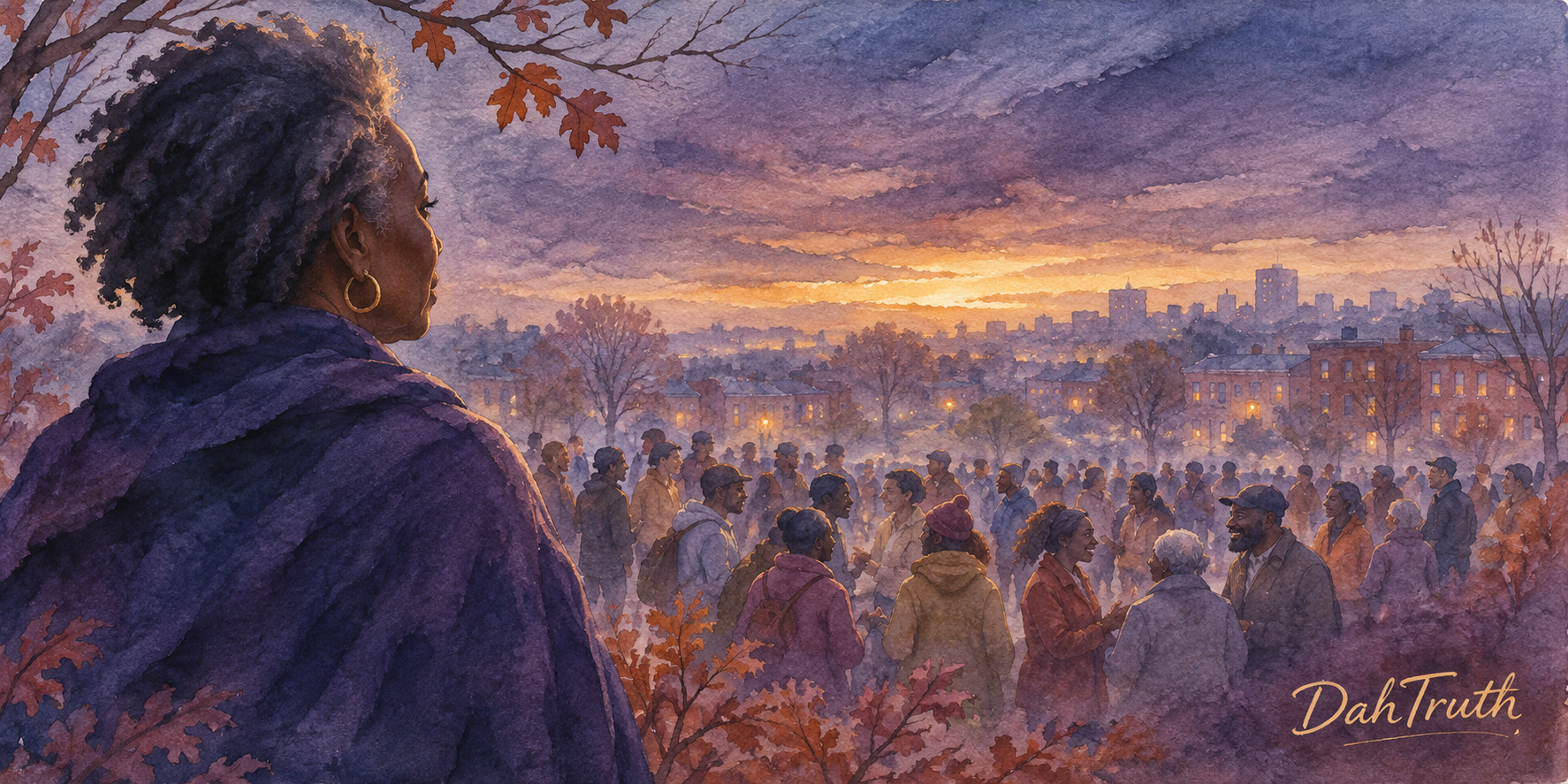
Some days I fear it will never happen. I fear I will never be able to walk with the masses, and that I will always be on the outside looking in while a people is destroyed by its own ballots, putting people into power who do not care and have no answers or solutions for us. A few will rise to the top. Many will escape the train. Most will be like the crowd that Jesus watched from afar.
I understand now how Jesus felt when He looked at the masses who were lost. When He came near Jerusalem, He beheld the city and wept over it, saying, “If thou hadst known, even thou, at least in this thy day, the things which belong unto thy peace! but now they are hid from thine eyes” (Luke 19:42, KJV). Earlier, when He saw the multitudes, “he was moved with compassion on them, because they fainted, and were scattered abroad, as sheep having no shepherd” (Matthew 9:36). He grieved, and He kept preaching. He told His disciples that the harvest truly was plenteous and the laborers few, and to pray for more.
That is the hope I am holding on to. The things that belong to our peace are hid from our eyes for now. They do not have to stay hidden. So I will keep writing, and I will keep speaking to the crowd, because I am not finished with my people, and I do not believe God is either.
