Imitation of Life, Revisited
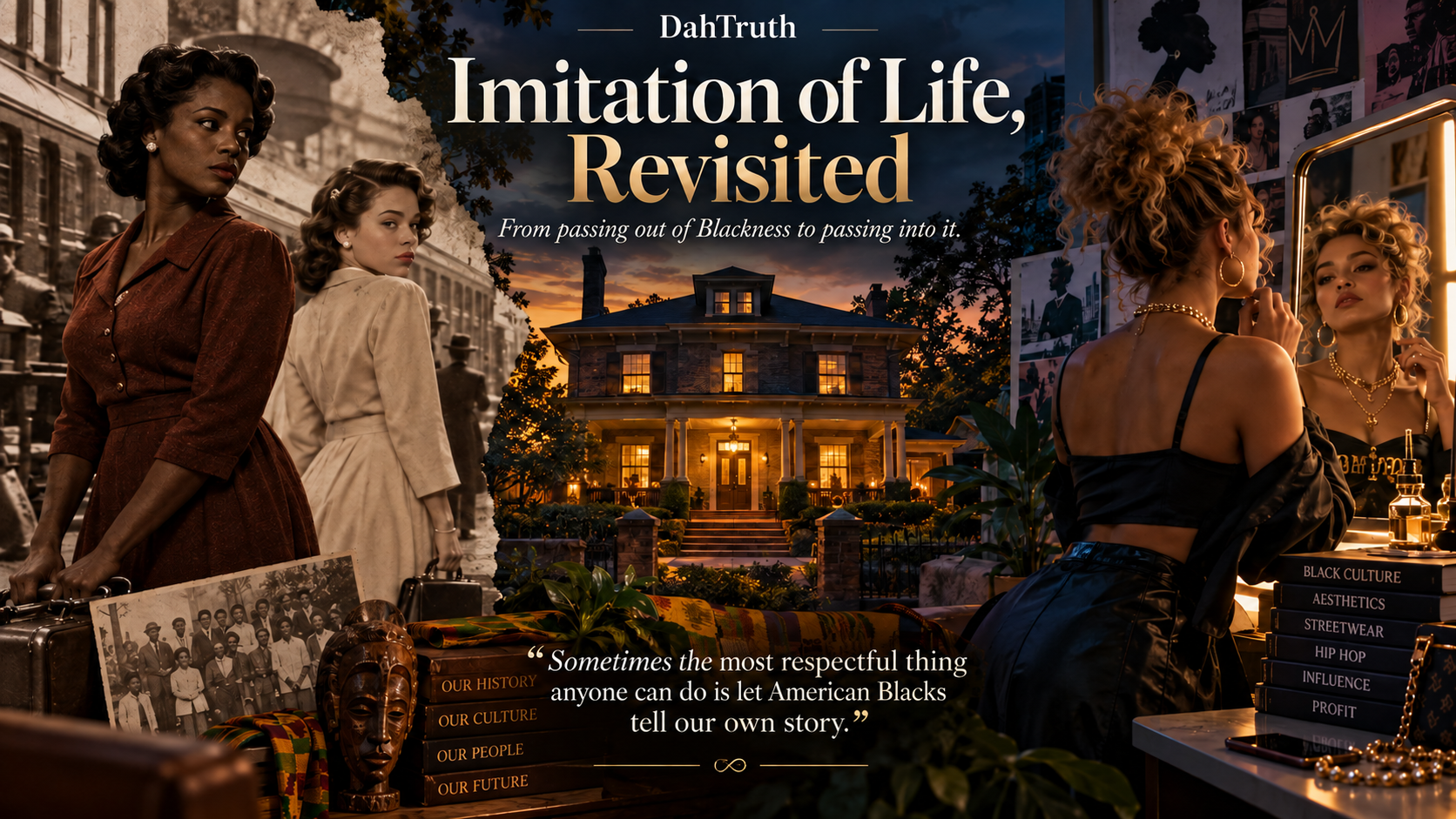
From passing out of Blackness to passing into it, and what American Blacks lose along the way
Sometimes I don't know whether these stories are small, whether they only seem small because of who is telling them, or whether they are distractions from something much larger that continues to permeate our communities. But this past week, two stories landed almost side by side. On October 1, John McWhorter published a column in The New York Times about Hannah Gann, the thirty-four-year-old white Jewish teacher and activist in Philadelphia who spent years presenting herself as a woman of Black Tunisian and Palestinian descent. The next day, Cam Newton released an episode of Funky Friday with the actor Da'Vinchi, a Brooklyn-born son of Haitian immigrants, in which a conversation about Hollywood casting drifted into American work ethic, competence, and whether Blacks from the Caribbean, Africa, and Britain look down on Black Americans. At first glance the two stories have nothing to do with each other. I believe they have everything to do with each other.
We are living through a strange moment in the history of American Black identity. On one side are people who want proximity to Blackness so badly that they will manufacture an ancestry, change their appearance, adopt our speech, and construct an entirely different racial history for themselves. On the other side are people who already live and work inside American Black culture, who portray us on screen, build careers inside institutions we fought to open, and profit from audiences we helped create, and who still speak of American Blacks as though we were culturally deficient. One group wants in. The other wants the benefits of being near us while keeping enough distance to tell us what is wrong with us. So I have to ask what it is about American Blackness that would make someone lie to become it, and why someone whose success is tied so closely to our culture feels free to look down on the very people whose lives he is paid to portray. Those questions grow sharper when we remember how dramatically the meaning of Blackness in America has changed. There was a time when Blackness was something people tried to escape. Now there are people trying to acquire it.
* * *
I wrote about Imitation of Life a long time ago, and I keep coming back to it. In the 1959 film, Sarah Jane is a light-skinned Black girl who can pass for white, and she does, because she has seen what Blackness costs in America. Her mother, Annie Johnson, is dark-skinned, devoted, and dignified, and all she wants is for her daughter to stand up and be a proud Black woman. To pass, Sarah Jane has to separate herself from her mother. She denies her, hides from her, and runs from her, and Annie dies with a broken heart. Only at the funeral, when Sarah Jane throws herself across her mother's casket, does she seem to understand what she has caused and who she really is. The film never says it in so many words, yet its message is plain: we should never be ashamed of being Black or of carrying American blood. In Sarah Jane's world, and in the America that stretched from the 1930s through the 1950s and even into my own childhood in the 1970s and 1980s, Blackness was associated with the underclass. It could cost you a job, a home, an education, your dignity, your safety, and sometimes your life. Passing was a way out, and the price of the exit was your own mother.
What amazes me is that American Blacks were producing extraordinary culture even while Blackness itself was treated as a mark of shame. Paul Robeson, the son of a man who escaped slavery, graduated from Rutgers in New Brunswick, the city where I grew up, as an All-American football player and a scholar. He went on to earn a law degree, then became one of the most internationally recognized actors and singers of the twentieth century, carrying "Ol' Man River" around the world and playing Othello on Broadway, all while segregation was still the law of much of the land. By the time I was a girl, American Black life had made it into the living room every week. I watched What's Happening!!. I watched The Jeffersons, where George Jefferson had built a dry-cleaning business big enough to move his family into a deluxe apartment on the East Side. I watched The Cosby Show, with a doctor and a lawyer raising their children in a Brooklyn brownstone. I watched A Different World, which carried the tradition of the historically Black college into American homes, and Amen, which set its stories inside a Philadelphia church at a time when the Black church had already spent generations educating us, organizing us, burying our dead, and holding our communities together. Those programs were only reflections of what already existed in real life: American Blacks working, raising families, attending college, building businesses, and arguing among ourselves about what success was supposed to look like. Somewhere along that timeline the meaning of Blackness shifted. It moved from something to be escaped, to something accepted, to something admired. Today it is imitated, borrowed, performed, profited from, and sometimes fabricated.
* * *
Rachel Dolezal was the famous case in 2015. The historian Jessica Krug followed in 2020. Now we have Hannah Gann. According to the reporting, Gann grew up in a white, Jewish, comfortable family, yet for years she told people she had a Palestinian-born grandfather, a grandfather who was in fact born in Baltimore. She claimed Black Tunisian heritage. Those who knew her described darker makeup, African-print clothing, and speech patterns borrowed from American Black communities, what linguists now call African American Vernacular English and what my generation simply called Ebonics. She reportedly told different people different stories depending on who was listening. And she did not wake up one morning and confess. Fellow activists investigated her claims, confronted her with the evidence, questioned her, and only then did she admit that she had lied. Notice something about the costume she chose. The ancestry she borrowed was African, but the voice she put on was American Black. Whatever she understood about where the real currency lay, she went looking for it in our speech.
McWhorter has argued for years, most directly in his book Woke Racism, that today's antiracism has turned into something like a religion, with white privilege cast as original sin and Black identity carrying a kind of moral authority. In his column on Gann he suggests that for some white people, claiming another identity offers a way to escape that original sin of privilege, and he writes that Dolezal was "an almost inevitable sign of our times." I think he is onto something. If American culture keeps teaching white people that whiteness means privilege, oppression, and inherited guilt, while teaching that Blackness means suffering, resistance, and moral authority, why should anyone be surprised that a few of them try to move from one identity to the other? If I can show that I am not like those white people, maybe I can set down the burden attached to being white. I don't know that this explains every person who has crossed that line, and Gann herself has offered only a vague confession. But the question deserves to be asked. The activists she worked beside made clear she never needed to be Black or Palestinian to support their causes. So if she truly believed in the work, why did she need to become the people she claimed to be fighting for?
Here is where our culture's logic turns against itself. We now live in a country where a person born male can say, "I identify as a woman," and much of the culture insists the rest of us accept it. Hannah Gann could make the very same argument: I was born into a white family, but I identify as Black, and because I identify that way, I am. Racially it might even be an easier claim to make, since plenty of white Americans have an African ancestor somewhere down the line. Yet when Gann is exposed, everyone from her fellow activists to the newspaper columnists calls it a lie, and the country agrees. In both cases a person claims an identity that their body and their lineage do not support. Our culture has decided one claim is ridiculous and the other is courageous. I believe both rest on the same error, the notion that who we are is whatever we declare ourselves to be. You cannot call one a fraud and the other a truth without explaining why the same argument produces opposite answers.
That same looseness explains how the words "African American" came to cover almost anyone with African ancestry. Kamala Harris, the daughter of a Jamaican father and an Indian mother, calls herself African American, and the country accepts it without a second thought. If the term means anything, it should belong to the American descendants of slavery, the people whose history it was coined to describe. That is precisely why so many of us now insist on naming ourselves more carefully. The same blurring happens inside the wider Black world. People throughout Africa, the Caribbean, and the diaspora hold Nigerian, Ghanaian, Jamaican, Haitian, and a dozen other identities that are entirely legitimate. Yet more and more I see people reaching toward the identity of the American Black and treating it as though it belongs to everyone with African ancestry, or else correcting us, suggesting that we survived slavery because we are African rather than because of who our ancestors became here.
I say this without claiming that American Blacks are better than anyone else. I say it because our history is ours. Africa is part of our ancestry, and our history was written on this soil. Our ancestors survived the Middle Passage. They survived slavery and the selling of their children. They survived the dismantling of Reconstruction, the rope of the lynch mob, and the long night of Jim Crow. They survived being shut out of homes, schools, businesses, jobs, and political power. Then they had children, and those children had children, and those children had me. Millions of us are here because of a capacity to endure that was forged in this country, under conditions designed to destroy us. That strength is the American Black story, and sometimes I think we are so busy talking about Black suffering that we forget to talk about Black strength.
* * *
Which brings me back to Da'Vinchi. On Funky Friday he suggested that producers may prefer overseas Black actors because they seem "more focused" on the work, and he said Americans have been incompetent "for a really long time," offering the example of grown adults who cannot do their own laundry. When Newton raised the idea that some people elsewhere in the diaspora consider themselves better than Black Americans, Da'Vinchi agreed that it was true, though he said he did not think it was right. Listening to him, you would think American Blacks had wandered into the twenty-first century without having built anything. What makes the scene almost comical is where he was sitting. He was having this conversation across the table from Cam Newton, an American Black man who reached the very top of professional football, survived that career, moved into business and media, and built the platform on which Da'Vinchi was speaking. And Da'Vinchi's own best-known role is Terry "Southwest T" Flenory in BMF, a Detroit story about real American Black men, created by a Black American writer from Detroit and executive-produced by Curtis "50 Cent" Jackson. Professionally, he has been paid again and again to inhabit American Black lives while culturally distinguishing himself from the people whose lives he portrays.
He has every right to criticize anyone, including us. His parents chose to build their family in this country, and he chose to build his career here. But his success happened here, inside American institutions, playing American Black men for audiences full of American Blacks, and that ought to complicate any suggestion that a superior culture somewhere else explains it. He did not arrive at the beginning of Black achievement in American entertainment. Long before he walked into his first audition, Robeson and generations of American Black actors, musicians, writers, and directors had been carving out space in a country that once allowed us onstage only as caricatures. He did not build that road. He was given the opportunity to travel it. Some American Blacks have answered with a boycott; Freedmen Nation has already added his name to its list. My answer is simpler. Cultural superiority is hard to maintain when the people supposedly beneath you are hiring you, producing you, interviewing you, and supplying the stories you make your living from. Perhaps the problem is that some people have grown so comfortable consuming Black American achievement that they no longer recognize it as achievement.
Set Gann and Da'Vinchi side by side and you see that American Black identity has become both desirable and deniable. Gann shows the desirable side, a woman who wanted the credibility of a marginalized Black identity so badly that she built one from scratch. Da'Vinchi shows the deniable side, a man who lives and works deep inside American Black culture while keeping the freedom to say, in effect, that is them, not me. And the diaspora voices who fold our history into a larger African story show a third side, the claim that our achievements belong to everyone with African blood. All three converge on the same result. Everyone wants some relationship to American Blackness, yet American Blacks themselves can disappear in the process.
I also wonder what this new admiration costs us, especially American Black women. If Blackness has come to stand for honesty, integrity, strength, and moral conscience, then we are quietly assigned the job of being the conscience of the whole society. We are expected to absolve everyone's guilt, march for everyone's cause, and never falter. What happens when we are simply human, when we are tired, or wrong, or unwilling? Admiration can become another kind of cage, and an image that has to be lived up to can weigh as much as a stereotype that has to be lived down.
Sarah Jane wanted out of Blackness, and it cost her her mother. Hannah Gann wanted in, and it cost her the trust of the very people she claimed as her own. Da'Vinchi stands inside a house our ancestors built and wonders aloud why the people who built it are not more focused. Annie Johnson asked only one thing of her daughter: never be ashamed of who you are. I would ask something of everyone else. You don't have to become Black to stand against racism. You don't have to borrow our ancestry to care about our people. You don't have to rewrite our history to prove you understand it. And you certainly don't get to live in our house and look down on the people who built it. Sometimes the most respectful thing anyone can do is let American Blacks tell our own story.
