The Ghost With the Wand
“A man's gift maketh room for him, and bringeth him before great men.” Proverbs 18:16
Jay-Z, Marc Lamont Hill, and the Myth of a Government That Distributes Everything Equally
In the April 2026 GQ cover story, Jay-Z sat down with Frazier Tharpe and did something he rarely does. He answered his critics. Asked about being labeled a capitalist, especially as a Black man and an artist, he said he makes art first, and then he makes sure he is compensated for his art. He added that he did not get where he is by taking advantage of people. To my ears that was a plain description of how work and reward are supposed to meet in a free country. A man has a gift, he develops it, he puts it before the public, and he insists on being paid what it is worth.
“Socialism: An economic system in which major productive resources are owned or controlled socially, through the state, workers, cooperatives, or the community, with the aim of meeting collective needs and reducing economic inequality.”
The backlash came quickly. Critics reminded him, as though he had ever hidden it, that Shawn Carter sold drugs in the Marcy Projects long before he sold a single record. Then Marc Lamont Hill took the argument further from his seat on The Joe Budden Podcast. Jay-Z sold drugs, he said, and the system that produced him is a system built to manufacture billionaires and widen the gap between the wealthy and the poor. Nobody reaches billionaire status, in Hill's telling, without extracting from somebody beneath them. Hill has explained Cedric Robinson's theory on that same show, the idea that all capitalism is racial capitalism, and his conclusion is that socialism offers a more equitable way to live.
I want to take that argument seriously, because a lot of our people are listening to it, and because the times we are entering make it more tempting than it has been in my lifetime.
The Corner and the Catalog
Let me be honest about the drug dealing first. The crack era cost our communities more than any of us can count. It cost mothers their sons, children their parents, and whole blocks their peace. I will not wave that away, and I do not think Jay-Z would ask me to. Accountability means we name it.
But notice what Hill does with it. The drug trade is the clearest picture we have of a market with no law in it. There is no contract to enforce, no court to settle a dispute, no deed to protect what you own, and so every disagreement gets settled with a gun. Holding up the corner as proof against capitalism confuses the shadow with the house. The corner is what economic life looks like when the protections of a lawful market are absent. The money that made Jay-Z a billionaire came from the other side of that line: the records, the independent label he built when the industry would not pay him what his work was worth, the brands, the businesses, the art. The hustle he left behind would have ended with him in a cell or a grave. The art he chose is what carried him out.
Why Socialism Sounds Like Mercy Right Now
I believe in capitalism. I also have eyes. I have spent more than twenty years in executive support, and I can see which desks artificial intelligence is coming for first. The scheduling, the correspondence, the research, the drafting, the work that put food on a lot of tables in our communities is exactly the work these systems are being built to absorb. When the jobs start disappearing in large numbers, the promise of guaranteed housing, guaranteed healthcare, and guaranteed food will sound like mercy. I understand why people will reach for it. I have even caught myself thinking that, given where this economy is headed, maybe socialism will be the way we have to go.
Then I remember who would be holding the keys.
The Ghost With the Wand
“Capitalism: An economic system in which individuals and private businesses own most property and productive resources. Production, prices, and investment are guided largely by markets, competition, and the pursuit of profit.”
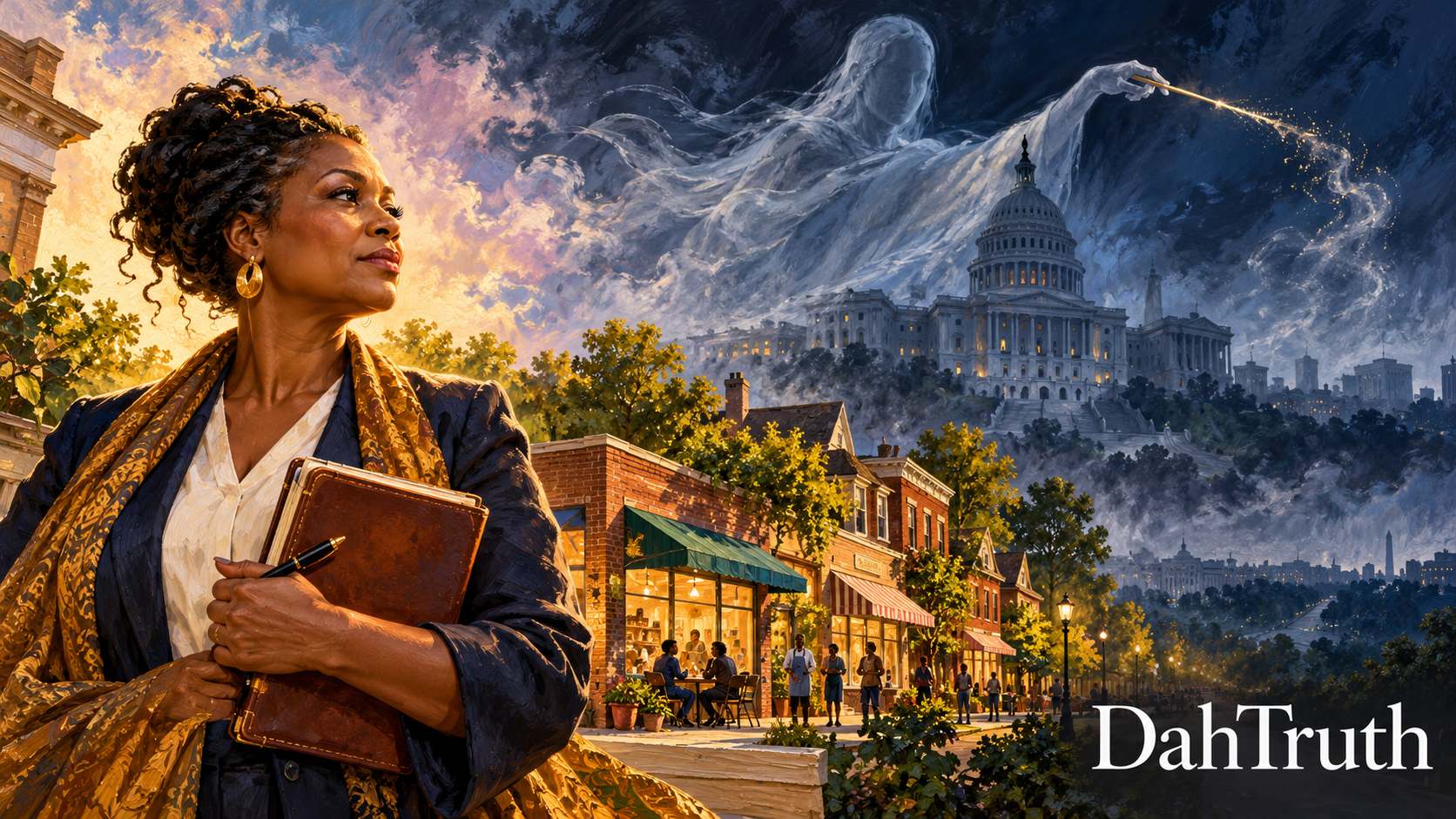
What amazes me about Marc Lamont Hill's position is that he speaks about government as though it floats somewhere in the atmosphere, a great ghost in the sky that twirls a wand and distributes everything equally to everyone below. Government has a name and an address. People write the rules. People decide who qualifies. People set the waiting list, approve the vendor, sign the contract, and hire the cousin. When the state becomes the only provider of housing, healthcare, and food, the people who run the state become the new wealthy class. You will still have rich and poor. The rich will be the ones who work for the government, and the poor will be everyone else.
And there will be no balance on that power. Under capitalism, if a company cheats you, you can take your money somewhere else, take the company to court, or open a business across the street and compete with it. When the government is your only landlord, your only doctor, and your only grocer, where do you go? Who do you complain to? The system itself becomes the oppressor, and it becomes a more severe oppressor than any billionaire, because no check remains on it. A billionaire cannot put you in a cell. A government can.
Scripture warned us about this a long time ago. When Israel demanded a king so they could be like the other nations, the prophet Samuel told them exactly what that king would cost them.
"He will take your fields, and your vineyards, and your oliveyards, even the best of them, and give them to his servants. He will take the tenth of your seed... and ye shall cry out in that day because of your king which ye shall have chosen you." 1 Samuel 8:14-15, 18
I wrote about that passage in "Give Us a King," and the warning has not expired. Every generation that hands its provision over to a ruler in exchange for security learns the price afterward.
Our History Testifies
If anybody should understand that government is made of people, and that those people can become oppressors, it is the American descendants of slavery. The law enforced our bondage. Slave codes were statutes. The Black Codes that followed emancipation were statutes. Jim Crow was written into law, and federal housing policy drew red lines around our neighborhoods so that we could not borrow against the homes we bought. Urban renewal sent bulldozers through Black business districts across this country. Congress chartered the Freedman's Savings Bank in 1865 to hold the earnings of the newly freed, and when it collapsed in 1874 our ancestors lost the savings they had trusted to it. In 1921, Greenwood in Tulsa, built by Black enterprise and Black hands, was burned to the ground by a white mob that included men deputized by city officials. The government did not protect what we built. In too many cases, the government was the hand that tore it down.
And yet we advanced. Madam C.J. Walker, the daughter of formerly enslaved parents, built a fortune selling hair care products to Black women. A.G. Gaston built an empire in Birmingham under segregation. Our ancestors founded banks, insurance companies, newspapers, churches, and mutual aid societies when every door was shut to them. Each generation moved further than the one before it, through setbacks, through violence, through laws designed to stop us. That is what the freedom to change your trajectory looks like in practice.
I am a small piece of that same testimony. I grew up on New Jersey Avenue in New Brunswick. I went back to college at twenty-eight, earned my bachelor's degree at thirty-one, and finished my master's in my late forties. I built DAHTRUTH with my own gifts and my own hours. Nobody distributed that to me. America was built so that a person with talent, discipline, and hard work could dig herself out of whatever condition she was born into, even while facing obstacles of race, of education, and of the state of her community. Our very history argues against everything Marc Lamont Hill believes.
Healthcare, Homelessness, and the Machine
The instinct now is to hand government the answer to every problem that touches our lives: healthcare, homelessness, and increasingly the control of artificial intelligence and the internet itself. Before we do that, we should remember that the Tuskegee syphilis study was run by the United States Public Health Service. We should ask whether the same institutions that have failed our communities for generations deserve control over the medicine we receive, the roof over our heads, and the information we are allowed to see. Concentrating that much power in one place has never ended well for the people at the bottom, and our people have usually been the people at the bottom.
None of this means government has no role. A free market needs a referee. It needs courts that enforce contracts, laws that protect property, and protections against fraud and abuse. Government at its best keeps the field fair. The danger comes when the referee decides to own every ball on the field and hand them out according to its own preferences.
What We Do With What Is Coming
So what do we do when the machines come for the jobs? We do what our ancestors did when every system was rigged against them. We learn the new tools before they learn us. We teach our children skills and ownership instead of dependency. We buy land, start businesses, and rebuild the mutual aid institutions our churches and lodges once ran. We pool what we have and protect it. Dependency on any master, whether it wears a corporate logo or a government seal, has never set our people free.
Jay-Z said he makes his art first and then makes sure he is compensated for it. Every one of us has an art of some kind, a gift that God placed in our hands for a reason. The ghost in the sky with the wand will never come. The people who claim to speak for it will always take their share first. Our future lies with the gift in our hands, the work we put into it, and the God who gave it.
"Seest thou a man diligent in his business? he shall stand before kings; he shall not stand before mean men."
Proverbs 22:29
