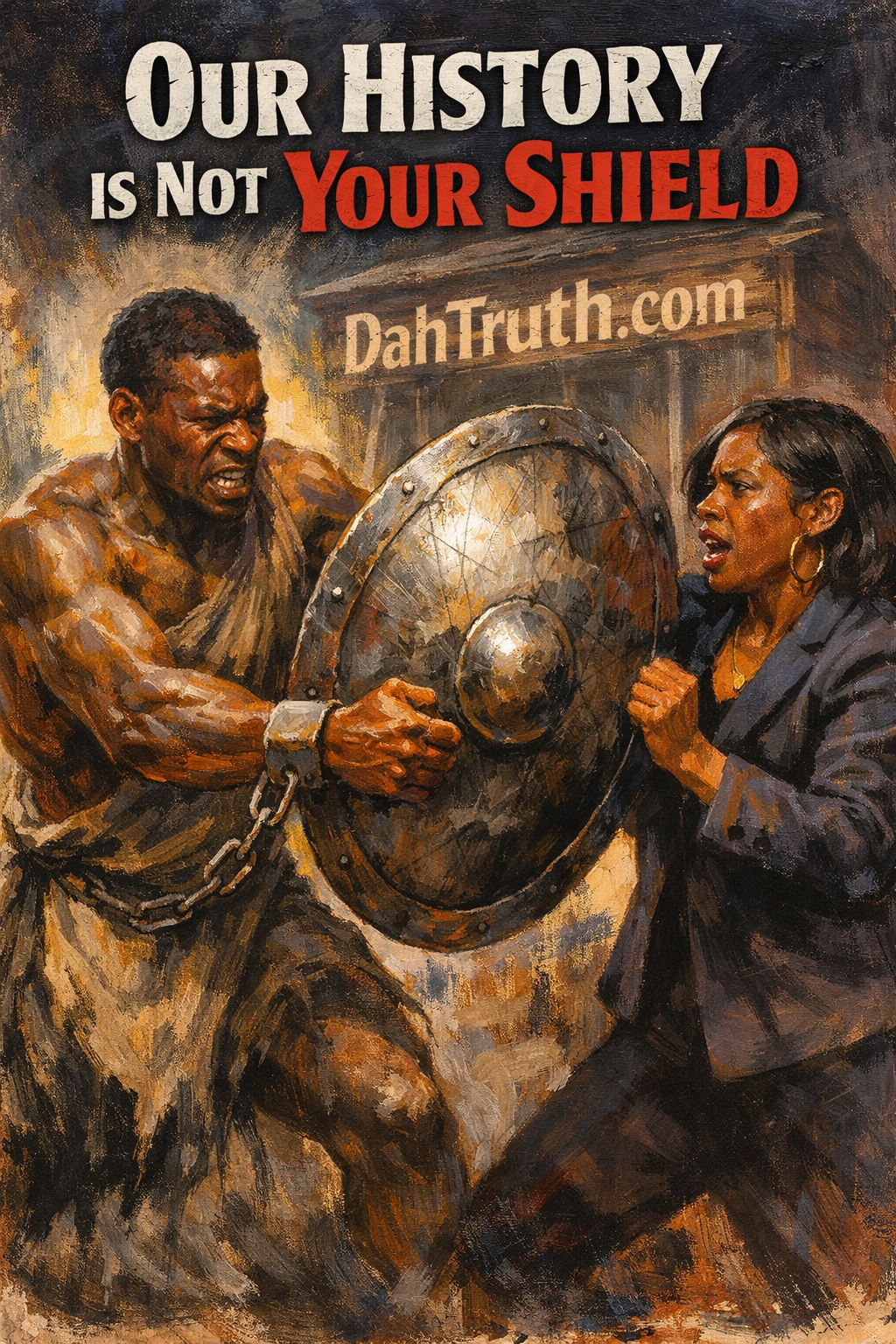
Our History is NOT Your Shield
“If you’re not careful, the newspapers will have you hating the people who are being oppressed, and loving the people who are doing the oppressing.” Malcolm X
“Power concedes nothing without a demand. It never did and it never will.”
When I was growing up, one of the things I distinctly remember is the bond we had as a family. Our extended family included my grandmother, my aunts, uncles, and cousins. My grandmother and grandfather owned a large house, and most of our family migrated there almost daily.
Growing up in the 1970s and 1980s in America, I saw clearly how strong family bonds in our communities were slowly torn apart by an influx of alcohol and, more specifically, drugs. Crime went from being nearly nonexistent to ever-present in our neighborhoods. Black America was strong, but over time those bonds weakened. The fracture was not abstract. It was personal. It formed between those who used drugs and those who did not, between those who sold drugs and those who refused to participate. Families were divided. Fathers were incarcerated. Mothers were left alone. Children went astray. Trust eroded.
We were programmed in many ways to believe that certain white Americans were our enemies and that they were responsible for the drugs flooding our communities and for the imprisonment of Black men. While there is truth in recognizing external forces and government complicity, we were also taught a very specific political lesson: that Republicans were the villains and Democrats were the saving grace of the Black community.
Yet even as this belief took hold, major crime legislation, beginning in the early 1980s when Joe Biden became chairman of the Senate Judiciary Committee and culminating in the 1994 crime bill, was sponsored, written, and led by Democrats. These policies reshaped our communities, accelerated mass incarceration, and permanently altered Black family and labor structures. The damage may not have been the result of one party alone, but the narrative we were given never allowed that truth to be fully examined or honestly explored.
What is often left out of this conversation is a historical reality that has long been buried beneath social safety nets. Covered by public housing, Section 8, food stamps, and Medicaid is a deeper truth: long before President Lyndon B. Johnson famously remarked that Black Americans would be voting Democratic for the next seventy-five years, it was not Democrats who first fought for the recognition and citizenship of American Descendants of Slavery. It was white Republicans.
Men like Thaddeus Stevens brought the Fourteenth Amendment before Congress so that Black people displaced by the Civil War could be recognized for what we were, Americans. It was Republicans who openly proclaimed the injustice of slavery. It was Democrats, including figures like Andrew Jackson, who sought to preserve slavery as a system of free labor.
For more than sixty years, social safety nets have replaced justice, wages, and true economic restoration for American Black communities. Today, Democrats control the narrative by holding social safety nets over our communities. While these programs were often necessary for survival, they have also kept us tethered in dependency. Now that many of us are beginning to question this arrangement, there is anger. There is resistance. There is a pull to realign with where we truly belong.
What makes this legacy harder to confront is that it is no longer discussed primarily through policy, but through media narratives. The story of American Black life has increasingly been filtered, summarized, and reinterpreted by commentators who speak with authority but without lineage. In that shift, history is no longer examined for accountability. It is repurposed for messaging.
Liberal commentators like Joy Reid make statements such as “diversity is what has made America great,” language that increasingly functions as code for immigration. She is a first-generation immigrant herself, yet she speaks as though people like her are the reason this country has succeeded, while people like me are reduced to statistics. I am acknowledged only as a data point in discussions of oppression.
American Black people have always been oppressed in this country. That truth does not need embellishment. But she presents herself as though she is doing us a favor by continually holding up images of our past, displaying the scars of slavery and Jim Crow, while asserting that America is now great because of immigrants. In this framing, it is neither White Americans nor Black Americans who built this nation. Our labor, our endurance, and our survival are pushed aside.
Recently, she posted a short video on Facebook in which she appeared to glorify the U.S. military. After repeating the familiar refrain that diversity makes America great, she said that when we come together as a multicultural society, that becomes our strength. She then declared that the United States has the most powerful military in the world.
In that same commentary, she referenced statements made by JD Vance, who said diversity is not our strength, dismissing his view outright. When Pete Hegseth stated that diversity was our strength, she brushed him off as a “mediocre guy from Fox News.” What she failed to acknowledge is that both men served in the United States military.
That matters to me personally. In my family, several of my uncles served in the military. Several of my cousins served as well. And if members of her family have served, I am certain they do not outnumber the families of those of us who lived in this country long before 1960. That includes Black families like mine and white families too. Families whose roots stretch back generations.
Our military is not powerful because of slogans or commentary. It is powerful because of the accumulated sacrifice of families who have fought, bled, and died for this country over centuries. That history does not belong to pundits. It belongs to the families who carried this nation through every war and every reckoning.
Today, with many immigrants using the American Black narrative as if it were their own, more of us are beginning to recognize the negative impact Democrats have had on our communities all along. We are watching our history be repurposed and deployed as a political shield for causes that are not rooted in the American Black experience.
This becomes especially clear when we look at what has happened in Minnesota, where Somali-led organizations were investigated and charged in one of the largest pandemic-related fraud cases in the country. Once the fraud was uncovered, racism was immediately raised as the catalyst for the inquiry. References to slavery and historic oppression were used to frame accountability as persecution. Our history was invoked as the foundation for their grievance.
But the truth is, they were given an opportunity my ancestors were never afforded. The opportunity to arrive in this nation free. To live without chains. To build communities without first surviving slavery, Jim Crow, or generational exclusion. They were not forced into neighborhoods destabilized by drugs, crime, and systemic misrepresentation over centuries. They did not inherit a caste position at birth.
And yet, figures like Ilhan Omar speak as though they have endured the full weight of the American Black woman’s experience. She talks openly about how white Americans have always viewed Black women, as if her journey mirrors mine. But she came to this country by invitation, fleeing a nation torn apart by people like herself. I was born here.
She has had access to opportunities I could never have imagined, yet she positions herself as uniquely scorned by racism. She does not know what it is to step into a job market where your very presence marks you as less than. She does not understand the discipline required to walk a straight line in a society waiting for you to stumble. She does not know the cost of survival in a country that never meant to include you. And yet, she gets to speak this rhetoric as if those were her circumstances. She will never understand the sting of a system that insists whites are always more privileged than me, no matter how hard I worked or how carefully I lived.
Instead, individuals like Omar take advantage of opportunity and then throw stories in the faces of what they call the white man. Trump is labeled a racist. MAGA is labeled racist. Anyone who questions fraud, accountability, or misuse of public funds is labeled racist. All of it is justified under the emotional weight of slavery, even when slavery is not their history.
What is never confronted is the truth that American Black history is being abused for personal and political gain. And it is allowed. It is accepted. It is encouraged. Because the narrative serves Democrats well. It keeps the focus on shaming white America for slavery, while ignoring how that same narrative is weaponized against the descendants of those who actually lived it.
Before moving on, it is necessary to address the disparity illegal immigration has created in Black communities. During a 2019 debate involving Kamala Harris and Donald Trump, Trump made remarks about illegal immigration and “Black jobs.” Democrats immediately condemned the comments as racist and out of bounds. Derrick Johnson, president and CEO of the NAACP, rejected the phrase outright, arguing that there is no such thing as a Black job and that the comment ignored the breadth of Black talent. Michelle Obama also weighed in, suggesting that the comment reflected a narrow view of the world and pointing out that the office Trump was seeking might itself be considered one of those so-called Black jobs. Even former Atlanta Mayor Keisha Lance Bottoms joined in, saying, “I’m still wondering, what is a ‘Black job’? I have a law degree. Does that get me a Black job?”
Outrage indeed. But what Trump was pointing to, however poorly phrased, was something specific and familiar to many in the Black community. While prominent Democrats and institutions framed the comment as racist and dismissive, they largely avoided engaging with the underlying issue he was raising.
He was calling attention to the influx of illegal immigrants into low-skilled labor markets and the displacement that followed. These were jobs historically filled by Black men reentering society after incarceration or by those with limited formal education. Construction, warehousing, sanitation, trucking, and other forms of manual labor provided a path back into stability.
This displacement is especially visible in places like California, particularly in trucking and commercial driving. For decades, CDL jobs were a pathway for Black men after incarceration or instead of college. Policies such as California Assembly Bill 60 expanded access to licenses regardless of immigration status and fundamentally altered that labor market.
In California, Sikh drivers are now widely recognized as a dominant presence in the trucking industry, even though nationally Black Americans far outnumber Sikh drivers. This suggests that when policy opens a limited labor pathway to everyone, groups with tighter migration pipelines and fewer reentry barriers will naturally outpace Black labor. This is not about work ethic. It is about policy design.
There is no such thing as Black jobs in a racial sense, but there are low-wage, low-skill jobs once disproportionately held by American Blacks that are now being replaced by immigrant labor willing or forced to work for less. That replacement does not help American Black, or ADOS, communities. It erases them.
I raise all of this because, as we close out the year and move into 2026, another election cycle is approaching. The midterms are coming. While we may not agree with everything put forward by the Republican Party, we should be willing to engage honestly with policies that acknowledge the real harm done to the American Black community.
We should be clear about what that harm looks like. It is the tearing apart of families. The erosion of stable labor pathways. The quiet replacement of our skills with a workforce that can be paid less. It is the continued misappropriation of our capabilities.
We should also be honest about why the Democratic Party resists this conversation. Cheap labor serves their interests. Black Americans’ demands for fair wages and dignity do not. Instead of addressing those demands, we are ignored and replaced, asked to fight for those taking our places.
Recognizing this does not require blind loyalty to any party. It requires clarity. It requires us to acknowledge what has been done to our communities, what continues to be done, and why so many are uncomfortable when we begin to name it. As we approach 2026, that clarity matters more than ever. We have to be reprogrammed to give up Democratic policies, or I fear we are going to be lost to a party that never wanted us to be free in America.
