Inside the Burning Building
“In 1960, before the great expansion of the welfare state, the Black poverty rate had already fallen dramatically, Black marriage rates were higher, and Black labor force participation was rising. These trends reversed after the expansion of social programs.”
— Thomas Sowell
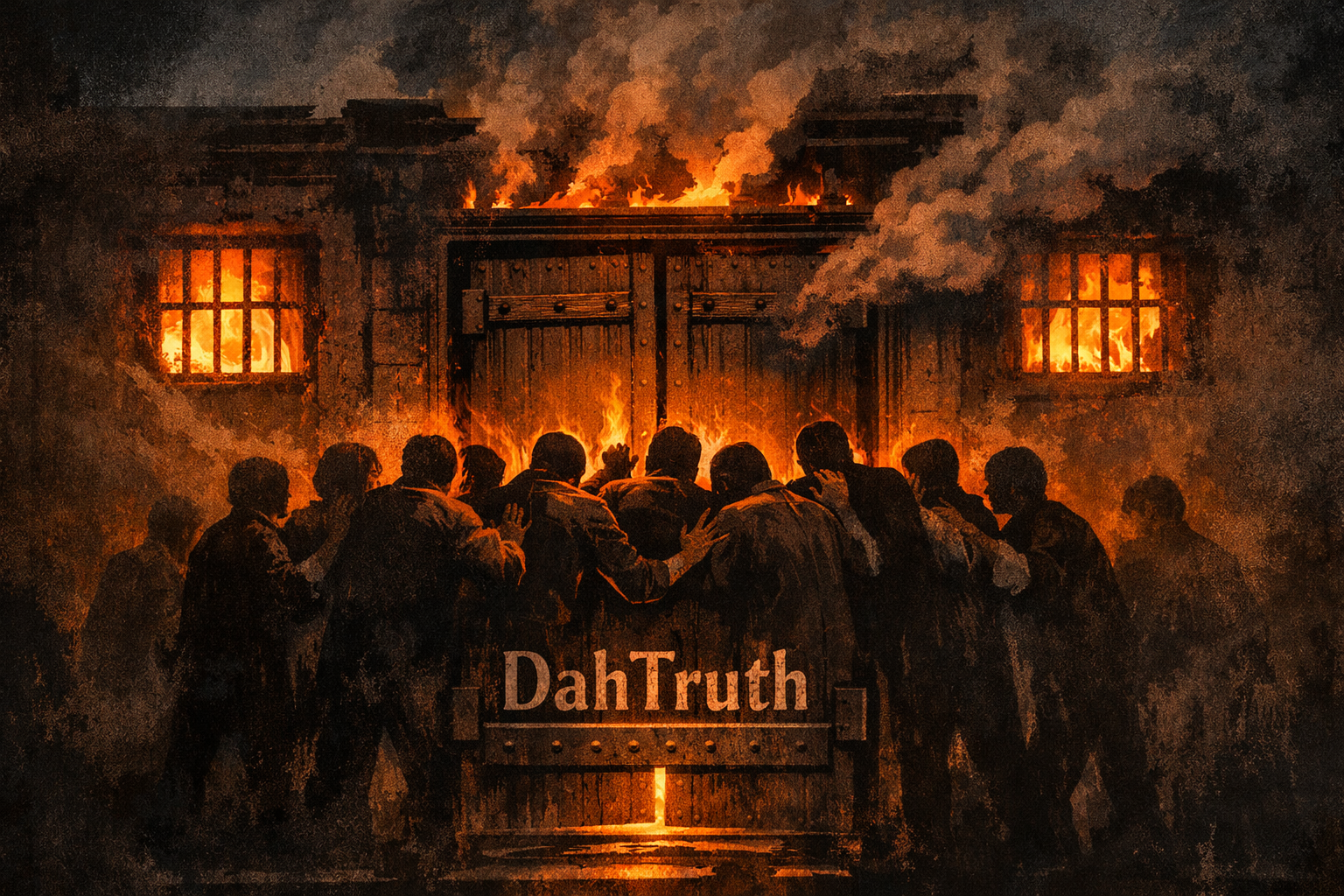
Sometimes I tell myself that racism in America no longer exists. Then I see something that reminds me that this is not exactly true. It can be something small and simple, like seeing a photo of employees in an office, or realizing at a professional gathering or party that I am the only Black person in the room. In moments like those, I understand why, in Martin Luther King Jr.’s final days, he wondered whether he was leading ADOS into a burning building. ADOS often find ourselves trapped inside that burning building, proud of our endurance, even as we quietly succumb to the system that confines us.
We have become a generation that learned how to survive, and in many cases thrive, within America’s social systems. We have been successful at it, although many were lost along the way. Today, Black Americans make up a significant portion of the middle class, even though after slavery ended we had nothing to call our own.
But now we are beginning to understand something more sobering.
We are starting to recognize what social systems in America have actually done to us. There is no doubt that these systems kept our communities locked in cycles of poverty, dependency, oppression, and degradation. As this realization spreads, some of us are no longer aligning ourselves with Democratic policies. Some are looking instead toward Republican ideas, not because we reject compassion, but because we recognize ourselves as a people who have always fought, survived, and built despite every obstacle placed before us.
“They know not, neither will they understand; they walk on in darkness: all the foundations of the earth are out of course.”
We have always been resilient.
We survived capture.
We survived slavery.
We survived the journey across the Atlantic.
We survived being sold on blocks.
We survived beatings, whippings, and lynchings carried out by white Americans.
We made it through all of it.
Now we find ourselves at a crossroads. We see ourselves as fully American. We believe in American systems because, in certain ways, they did work for our lives. But as we begin rejecting social dependency, another reality confronts us, and it is deeply unsettling.
Drugs and the Fracturing of Our Communities
From the late 1970s until today, drugs have been one of the most destructive forces in Black American communities. When crack cocaine entered our neighborhoods, families were torn apart. Men who sold drugs were imprisoned for decades. Communities were destabilized, and generations were lost.
We relied on social systems such as Section 8 housing, food stamps, and welfare because survival demanded it. But when parts of our generation began rejecting those systems and pursuing college degrees, upward mobility, and independence, something else appeared to intensify. Drugs flooded our neighborhoods even more aggressively. Every time we tried to let go, it felt as though we were pulled back.
At the same time, political messaging shifted. Ronald Reagan’s “Just Say No” campaign emerged, and people like me believed it. We believed discipline and personal responsibility were the path forward. But the unintended consequence was moral separation. Those who escaped addiction moved forward, while those still trapped were labeled fiends.
As we pursued the American Dream, we left behind our aunts, our uncles, our cousins, and our friends. Survival required distance, but that distance came at a cost.
Economic Exclusion and Corporate Erasure
Beyond drugs, there was another form of destruction that was quieter but just as devastating. It was the systematic removal of Black Americans from positions of influence across major industries.
In arts, entertainment, and sports, our bodies and creativity built empires we did not own. In corporate America, our intelligence and skills were consistently sidelined. Most Black professionals can say they were few and far between in these spaces. When opportunities opened, they often went to everyone except us.
Corporations took our ideas, exploited our labor, and profited from our ingenuity. When we sought advancement, doors quietly closed. First, whites were hired over us. Increasingly now, other groups are hired over us. People insist racism no longer exists, but this pattern is real and ongoing.
I have worked in corporate environments where Black presence was almost nonexistent. Years later, returning to those same spaces, the absence of Black Americans is even more pronounced. This is not accidental. It reflects a broader economic displacement that few are willing to name.
This exclusion did not remain confined to professional or white collar spaces. It spread into every level of labor.
Immigration and Replacement
For many years, ADOS Black Americans have been warning that they were being replaced in warehouses and on farms by illegal immigrants. These workers demanded very little. Low wages. No benefits. No health care. No protections. And Black labor was quietly replaced.
For a long time, these warnings were dismissed. Today, displacement in employment has become more visible, because it is no longer happening only to Black workers. White labor is being replaced as well.
Corporations are not concerned with people. They are concerned with profit. When cheap labor is not available locally, jobs are sent overseas to India, Mexico, and China. What Black Americans experienced first, white Americans are now beginning to experience too. There is now an awareness that can no longer be ignored.
This mirrors what happened with drugs. For years, Black communities warned about crack cocaine and the devastation it caused. Those warnings were ignored. Today, white communities are sounding the alarm about fentanyl. Only now is the crisis considered urgent.
Illegal immigrants now outpace Black Americans for jobs, often for lower wages. Corporations benefit from this arrangement because they do not want to pay Black Americans what we are worth. Democratic policies increasingly support this reality, while on the Republican side Black Americans are often ignored altogether.
White Americans now argue loudly for self sufficiency because they see immigrants outpacing them economically and demographically. They know they are slowly becoming a minority. When they say this country was built by Americans, Black Americans are almost always left out of the statement.
We are erased from both sides of the argument.
“It is certain, in any case, that ignorance, allied with power, is the most ferocious enemy justice can have.”
Political Representation and Manufactured Leadership
ADOS have been arguing for voting rights for centuries. We have always wanted equal representation and leaders who genuinely support our communities. Yet since the Voting Rights Act of 1965, we have watched our communities descend into a cycle of Democratic policy that has produced little real upbuilding.
We continue to lack adequate housing. Our schools remain among the worst in the country. We are still last when it comes to Black owned businesses. Yet we continue to put into office the same individuals who serve Democratic causes rather than Black American interests. In many ways, we fight to remain at the bottom by repeatedly selecting candidates who keep us there.
This realization takes me from New Jersey all the way to Texas, where my family comes from. Texas is a place where I know, with certainty, that three Black men walked away from slavery with nothing and built a town that still exists today. They were the sons of an African man who was brought to this country on a slave ship and held in bondage until the 1800s. Only his legacy remains to tell the story. They accomplished this long before America told us we needed social systems to sustain ourselves.
That history matters.
On the political left, figures like Jasmine Crockett rely on racial grievance as their primary currency. Race is used to emotionally tether Black Americans to the same political loyalties, even when those loyalties no longer serve our long term interests.
On the Republican side, figures like Wesley Hunt are quietly dismissed. Hunt is a Black man married to a white woman, which unfairly places him outside the boundaries of acceptable Blackness for many. Yet he offers policy positions that align with Black American interests and does not diminish Black American history.
Despite this, he is consistently excluded from serious media coverage. Recently on CNN, discussions about the Texas Senate race focused on Jasmine Crockett and her prospects. Republican candidates were discussed, but Wesley Hunt was not mentioned. Instead, attention was given to John Cornyn and Ken Paxton. Both men fit the expected image of Republican leadership. Both are white.
Hunt represents something that must be controlled, so he is drowned out.
Voices like Roland Martin amplify figures like Jasmine Crockett. They highlight her announcement video for Senate, a video in which she offers no substantive vision, no policy direction, and no record of achievement. Instead, the video relies almost entirely on clips of Donald Trump criticizing her, calling her a low IQ Democrat.
Crockett is a lawyer, but her professional record reflects representation of car accident plaintiffs and Black Lives Matter activists. This does not demonstrate exceptional legal leadership or policy expertise. She supports standard Democratic positions such as a woman’s right to choose, yet she is now in her forties with no family or children. That does not disqualify her from office, but it raises legitimate questions about how her political priorities are formed and whose futures she is invested in protecting.
With all her education, she failed to recognize that centering her campaign launch around Trump’s voice allowed him to define who she is and what she represents. In the absence of a meaningful record, that choice became her message. She had little else to run on. No significant legislative achievements. No policies that clearly support Black American advancement. No proof of capability as a Senate candidate.
History shows what happens when Black men rise outside approved boundaries. When they get out of line, they are removed. Sometimes through violence. Sometimes through circumstances that are never fully explained.
People point to Barack Obama as proof that this pattern no longer exists. But Obama was not ADOS. He did not share our lineage, our historical experience, or our communal struggle. He had Black skin, but not Black American roots. Society insists we should be grateful anyway, as if we are incapable of understanding the distinction ourselves.
The same attempt was made with Kamala Harris. This time, many in our community recognized the pattern and resisted.
Conclusion
It pains me to admit that ADOS increasingly feel as though we have no real political options. The suggestion that another party might emerge often sounds like a fantasy, as if such a reality could never exist in America. And yet the absence of that option is itself the problem.
ADOS are the people whose labor built this nation. Not symbolically. Not rhetorically. Literally. Roads, railways, agriculture, industry, infrastructure, culture. And still, there is no political party that aligns itself unapologetically with our specific lineage, our historical reality, and our present day needs. Instead, we are asked to choose between dependency and dismissal. Between grievance and erasure.
We are told to remain loyal to systems that do not build us, or to tolerate ideologies that do not include us. When we question this arrangement, we are accused of betrayal. When we comply, we are quietly replaced. That is not representation. That is management.
If there is to be any future worth inheriting, ADOS must begin telling the truth about where we stand. We must stop mistaking symbolism for substance and proximity for power. And we must be willing to imagine something America has never fully offered us before. A political alignment that recognizes our labor, protects our families, invests in our communities, and respects our independence.
Until then, we remain inside the burning building. Not because we lack strength, but because far too many are outside barricading the door.
